Novelhalla
Leviathan
Read Leviathan by Thomas Hobbes for free on Novelhalla, and try out our easy-to-read modern edition of this classic book. You can also download the EPUB and read it on any device if you prefer!
The Plot
The Problem With People
Imagine there are no laws. No police, no courts, no government. Just people. What happens?
Thomas Hobbes has an answer, and it's not pretty. Stripped of civilization, human beings are restless, competitive creatures driven by desire and fear. Everyone wants power, comfort, and survival. And since no one is so strong that they can't be killed by another, everyone is a threat to everyone else. This isn't a hypothetical thought experiment. Hobbes is writing during the English Civil War, watching his country tear itself apart, and he's trying to figure out why.
His conclusion is devastating. In the natural state, without any authority to keep them in check, humans exist in a war of all against all. Life in this condition is, in his famous phrase, solitary, poor, nasty, brutish, and short.
The Deal
But Hobbes doesn't stop at the diagnosis. He builds, piece by piece, a radical argument for how humanity escapes this nightmare.
It starts with reason. Even in the chaos of nature, people can recognize certain "laws of nature," basic rational principles that point toward peace. The first and most fundamental: seek peace when you can. The second: be willing to give up some of your freedom, but only if others do the same. This is the seed of the social contract, the idea that people can agree to surrender their unlimited natural liberty to a common authority in exchange for order and protection.
Here's where it gets provocative. That authority, the Leviathan, must be absolute. Not because Hobbes loves tyranny, but because he believes any division of power invites the very conflict the whole arrangement is supposed to prevent. Split sovereignty between a king and a parliament? You've just created two factions with a reason to fight. The sovereign must be undivided, unchallengeable, and supreme.
The Monster on the Cover
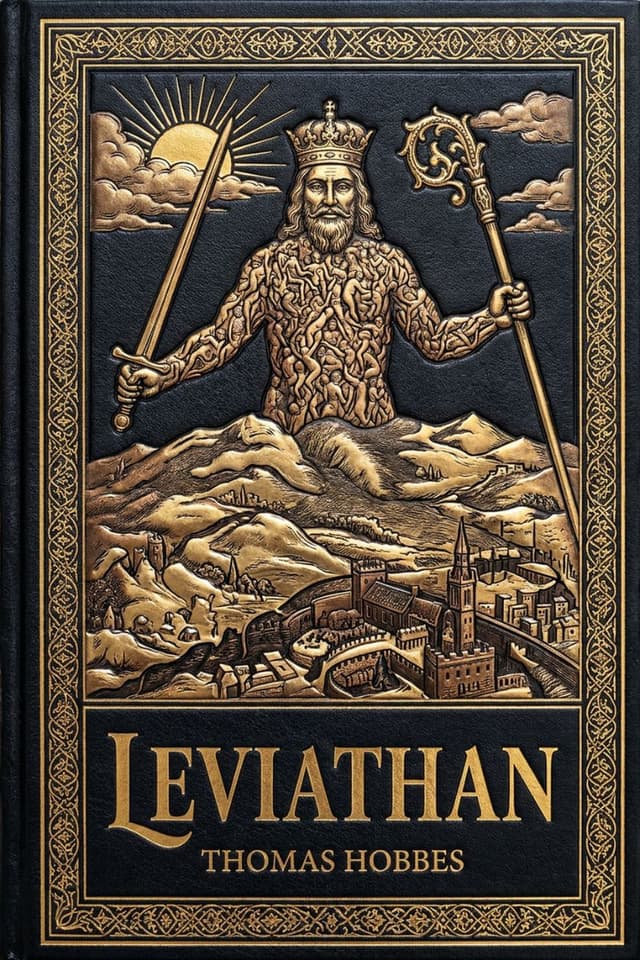
The book opens with one of the most famous images in the history of ideas. A colossal crowned figure rises over a peaceful landscape, holding a sword in one hand and a bishop's staff in the other. Look closer, and the giant's body is made up of hundreds of tiny people, all facing inward, all composing the sovereign's form. This is the Leviathan: a biblical sea monster repurposed as a metaphor for the state itself, an artificial person assembled from the bodies and wills of its citizens.
It's brilliant and unsettling in equal measure. The message is clear. The state is us. We made it. And it must be more powerful than any of us.
The Church Problem
Hobbes doesn't stop at politics. Fully half the book takes on religion, and this is where he really made enemies. He argues that the sovereign must hold authority over religious matters too, because competing claims to spiritual power are one of the fastest routes to civil war. Priests, bishops, popes, none of them should hold independent authority that could challenge the state.
He dives deep into Scripture, reinterpreting biblical passages, questioning the nature of miracles, arguing that God himself is a material being, and dismantling what he sees as centuries of religious manipulation designed to keep people obedient to the wrong masters. His final section, "Of the Kingdom of Darkness," is a full-scale assault on the Catholic Church and on the philosophical traditions he blames for propping it up.
The Stakes
What makes the book electric, even now, is the tension at its core. Hobbes starts from premises most people would accept: that we are free, that we are equal, that we have a right to protect ourselves. And then, through relentless logic, he arrives at a conclusion that feels like a trap. The only rational response to human nature is to hand nearly all your power to a single authority and never take it back.
Is he right? Is he terrifying? Is there a flaw in the logic, or is this really what peace costs? Hobbes lays it all out with the precision of a geometric proof and dares you to find the error.
About the Author: Thomas Hobbes
Born Into Chaos
Thomas Hobbes arrived in the world on April 5, 1588, in Westport, Wiltshire. His mother, hearing that the Spanish Armada was sailing to attack England, went into premature labor from fright. Hobbes would later write that "fear and I were born twins together," a line that reads like a joke but turns out to be the thesis of his life's work.
His father was the local vicar, a man Hobbes's biographer John Aubrey described as ignorant and hot-tempered. After getting into a physical fight with another clergyman at the church door, Hobbes senior fled town and abandoned his family. Young Thomas was raised by his uncle Francis, a successful glove maker who recognized the boy's talents and paid for his education.
The Scholar and the Nobleman
Hobbes excelled at languages from an early age. Before even arriving at Oxford, he had translated Euripides' Medea from Greek into Latin verse. He entered Magdalen Hall at fourteen but found the university curriculum stale and uninspiring, spending more time in bookshops than in lectures.
After graduating in 1608, he became tutor to the son of William Cavendish, Earl of Devonshire, beginning a lifelong association with one of England's wealthiest and most politically connected families. The position gave him access to libraries, to intellectual circles, and to the grand tour of Europe, where his mind truly caught fire.
The Continental Awakening
On his travels, Hobbes encountered the ideas that would transform him from a classicist into a philosopher. He met Galileo in Florence while the scientist was under house arrest. He joined the intellectual circle around Marin Mersenne in Paris, debating with some of the sharpest minds in Europe. And in a gentleman's library in Geneva, he stumbled upon a copy of Euclid's Elements lying open and was struck by the beauty of geometric proof, the way an impossible-seeming conclusion becomes self-evident if you accept the premises and follow each step.
This became his method. He would build his philosophy the way Euclid built geometry: from definitions to axioms to irrefutable conclusions.
Exile and the Masterwork
When the English Civil War erupted, Hobbes, a known Royalist, fled to Paris in 1640. He would remain there for eleven years, watching from across the Channel as England descended into the very chaos he feared most. Parliament beheaded King Charles I in 1649. The monarchy was abolished.
It was during this exile that Hobbes wrote his masterpiece. Published in 1651, the book managed the remarkable feat of offending absolutely everyone. Royalists were furious that he grounded the sovereign's authority in a social contract rather than divine right. Parliamentarians rejected his insistence on absolute monarchy. The Church despised his materialist philosophy and his attacks on clerical power. Even his fellow Royalists at the court of the exiled Charles II turned on him, and he was banned from the royal presence.
The Controversial Elder
Hobbes returned to England in 1651 and spent the rest of his long life under a cloud of controversy and a steady stream of accusations of atheism. In 1666, the House of Commons investigated him for blasphemy, and his books were burned at Oxford, his own alma mater. He was banned from publishing further works on sensitive topics in England.
None of this slowed him down. He continued writing, arguing, and picking intellectual fights well into his eighties. He translated Homer's Iliad and Odyssey into English verse and wrote an autobiography in Latin. He was a keen tennis player and an enthusiastic (if terrible) singer who believed singing was good for the lungs.
Last Words
Hobbes died on December 4, 1679, at the age of 91, at Hardwick Hall, still in the care of the Cavendish family he had served for most of his life. His reported last words capture the man perfectly: "A great leap in the dark."
Fun Facts About the Book
The Most Famous Frontispiece in Philosophy
The book's cover illustration, designed by French artist Abraham Bosse in close collaboration with Hobbes himself, is one of the most iconic images in intellectual history. The giant sovereign figure, made up of over three hundred tiny citizens, looming over a peaceful landscape with sword and bishop's staff, has been analyzed, parodied, and reinterpreted for nearly four centuries. It captures the book's entire argument in a single image.
Born Twins With Fear
Hobbes claimed his mother went into premature labor upon hearing the Spanish Armada was approaching, making fear his literal birthmate. Whether or not the story is precisely true, Hobbes leaned into it. Fear drives his entire philosophical system: fear of violent death is what motivates people to form societies, and fear of the sovereign is what keeps those societies intact.
It Angered Every Side
Most controversial books upset one faction. This one managed to infuriate all of them simultaneously. Royalists rejected the social contract basis for sovereignty. Parliamentarians rejected the case for absolute monarchy. The Church hated the materialist philosophy and the attacks on clerical authority. Even Hobbes's own Royalist allies in exile disowned him. It's hard to think of another book in history that was so comprehensively offensive to its entire readership.
Written in Exile During a Civil War
Hobbes composed the book in Paris while England was ripping itself apart. Parliament had beheaded the king. Armies were clashing across the countryside. The old order had collapsed. The book is not an abstract exercise. It's a philosopher watching the worst-case scenario unfold in real time and trying to explain, with terrifying clarity, how it happened and what would prevent it from happening again.
Hobbes the Athlete
In an era when average life expectancy was around forty, Hobbes lived to ninety-one. His biographer John Aubrey attributed this partly to Hobbes's devotion to exercise. He was an avid tennis player and would sing loudly (badly, by all accounts) because he believed it was good for his lungs and would extend his life. He even worked tennis into his political philosophy, comparing statecraft to games of skill.
The Latin Remix
Hobbes wasn't done after the English edition. In 1668, he produced a revised Latin version of the book, making significant changes and additions. Scholars still debate the differences between the two versions and which better represents his mature thinking.
That Phrase
"Solitary, poor, nasty, brutish, and short." It's one of the most quoted lines in the English language, used by people who have never read a word of the book it comes from. Hobbes wrote it to describe life in the state of nature, before civilization, but it has taken on a life of its own as a shorthand for any kind of miserable existence.
Themes
Fear as the Foundation of Society
Most political philosophers start with justice, or rights, or the common good. Hobbes starts with terror. His entire system rests on the claim that fear of violent death is the most powerful human motivation, and that this fear, properly channeled, is what holds civilization together. It's a bleak starting point, but Hobbes makes a disturbingly persuasive case.
The Social Contract
The idea that government derives its authority from the consent of the governed didn't begin with Hobbes, but he gave it its most rigorous and unflinching formulation. People agree to surrender their natural freedom to a sovereign because the alternative is unbearable. It's not a joyful bargain. It's a desperate one.
Power and Human Nature
Hobbes sees human beings as creatures of endless appetite. We don't desire something and then rest content. We desire something, get it, and immediately want the next thing. This "perpetual and restless desire of power after power" isn't wickedness exactly. It's just what we are. And any political system that ignores this reality is doomed.
The Danger of Divided Authority
One of Hobbes's most forceful arguments is that splitting sovereign power is an invitation to war. When a king and a parliament both claim authority, or when church and state compete for allegiance, the result is the kind of catastrophe Hobbes watched unfold in England. Undivided sovereignty isn't ideal. It's just the only thing that works.
Religion as a Political Problem
Hobbes takes religion seriously, but he sees it primarily as a political force. Competing religious authorities, claims to divine revelation that override civil law, priestly classes with independent power: these are engines of conflict. His solution is radical: the sovereign must control religious doctrine. Whether you find this reasonable or horrifying probably depends on which century you're reading from.
Reason Versus Tradition
Hobbes has no patience for appeals to authority, ancient wisdom, or established custom. He wants to build political philosophy from scratch using pure reason, the way a mathematician builds a proof. If tradition can't survive logical scrutiny, tradition goes. This made him enemies among conservatives and radicals alike, since both relied on different traditions to justify their positions.
Historical Context
A Country at War With Itself
Hobbes wrote during the English Civil War (1642 to 1651), one of the most violent and destabilizing periods in English history. Parliament and the Crown were locked in a struggle that led to pitched battles across the country, the trial and execution of King Charles I, and the abolition of the monarchy. For a thinker obsessed with order and the horrors of anarchy, this wasn't background noise. It was the entire point.
The Execution That Changed Everything
In January 1649, Parliament put King Charles I on trial for treason and had him publicly beheaded. This was an almost unthinkable act, the killing of a divinely anointed king by his own subjects. It shattered assumptions about political authority that had held for centuries and forced every political thinker in Europe to reckon with a basic question: where does the right to rule actually come from? Hobbes's answer was the most radical of all: not from God, not from tradition, but from the rational self-interest of the governed.
The Book's Legacy
The book was called the greatest single work of political thought in English by the philosopher John Rawls. That's a big claim, but it's hard to argue against. Every major political philosopher who followed, from John Locke to Jean-Jacques Rousseau to Immanuel Kant, was responding to the arguments Hobbes laid down here, either building on them or trying to tear them apart.
The social contract tradition that dominates modern political thought is essentially a centuries-long conversation with this book. Locke's more optimistic version of the social contract, Rousseau's romantic vision of natural freedom, the American founders' ideas about government by consent: all of these are, in some sense, replies to Hobbes.
The word "Hobbesian" has entered the language as a descriptor for any situation characterized by ruthless competition, mutual distrust, and the absence of civilizing restraints. International relations theorists still use a Hobbesian framework to describe the anarchic system of competing nation-states.
But the book's real legacy might be the question it forces every reader to confront. How much freedom would you give up for safety? Where is the line between order and oppression? And if you think Hobbes went too far, you have to explain exactly where his logic breaks down, because he's daring you to try.