Novelhalla
The Problems of Philosophy
Read The Problems of Philosophy by Bertrand Russell for free on Novelhalla, and try out our easy-to-read modern edition of this classic book. You can also download the EPUB and read it on any device if you prefer!
The Plot
The Table
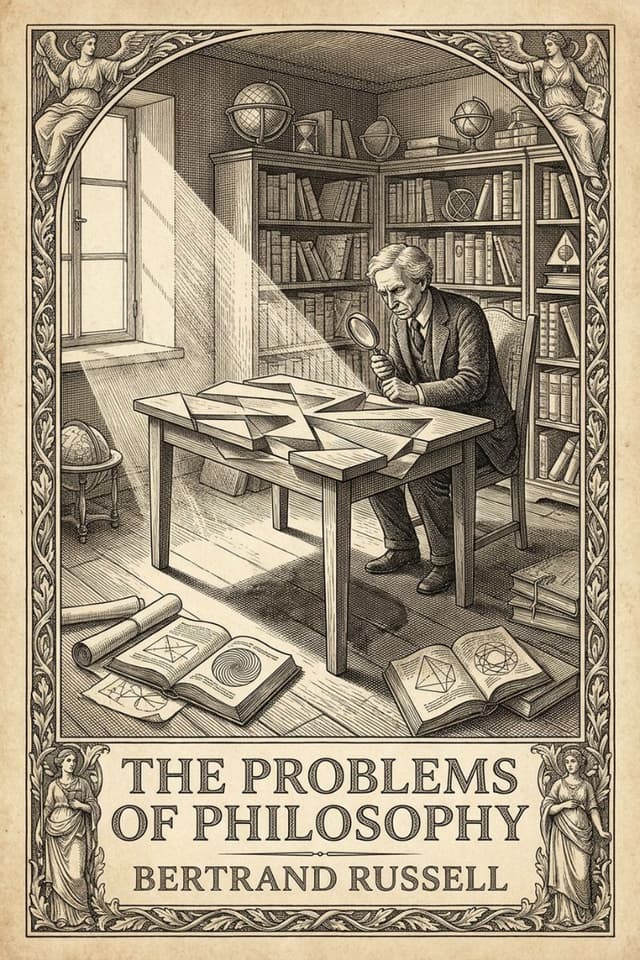
Look at the table in front of you. What color is it? What shape? What does it feel like under your fingers? You know the answers instantly. You've never doubted a table in your life.
Now Bertrand Russell is going to ruin tables for you forever.
He starts with something so simple it feels almost insulting. A table. Brown, rectangular, solid. But watch what happens when you actually pay attention. The color changes depending on the light. The texture feels different depending on which part you touch. The shape shifts based on where you're standing. So what color is the table, really? What shape is it, actually? Is the table you see the same table everyone else sees?
And just like that, the floor drops out from under you.
Down the Rabbit Hole
Russell doesn't stop at tables. He keeps pulling threads. If we can't even be sure about the color of a piece of furniture, what can we be sure about? Do physical objects exist when no one is looking at them? Is the world outside your head real, or is everything just a kind of elaborate dream your mind is constructing?
These aren't stoner questions. These are the questions that have consumed the greatest minds in human history, from Plato to Descartes to Kant. And Russell walks you through them like he's sitting across from you in a pub, casually dismantling everything you thought you knew about reality.
He introduces you to Bishop Berkeley, who argued that matter doesn't exist at all. To Descartes, who imagined an evil demon might be faking the entire universe. To Hume, who pointed out that we have no logical reason to believe the sun will rise tomorrow just because it always has before. Each thinker takes a swing at common sense, and common sense keeps stumbling.
The Big Questions
But Russell isn't just tearing things down. He's building something. He wants to know: what can we actually know? What does knowledge even mean? He draws a line between two kinds of knowing, between things you've experienced directly and things you can only describe from a distance, and this distinction turns out to matter far more than you'd expect.
He tackles cause and effect, the reliability of our senses, the existence of other minds, the nature of truth. Each chapter opens a new trapdoor. You think you've found solid ground, and then Russell shows you it's floating.
The real hook, though, is where he ends up. Because after spending an entire book showing you how little we can prove, after pulling apart certainty piece by piece, Russell arrives at a conclusion about the value of philosophy itself that is surprising, beautiful, and not at all what you'd expect from a mathematician who spent years trying to reduce all of reality to logic.
Whether that conclusion satisfies you or haunts you depends entirely on what kind of person you are.
About the Author: Bertrand Russell
An Unusual Childhood
Bertrand Arthur William Russell was born in 1872 into one of Britain's most prominent political families. His grandfather had been Prime Minister twice. His parents were radicals who championed birth control and women's suffrage in Victorian England, which was about as socially acceptable as you'd imagine.
By the time Russell was four, both his parents and his sister were dead. He and his brother were raised by their grandmother in a grand, lonely house in Richmond Park. He was educated entirely at home by tutors and governesses. He later described his childhood as isolated and deeply unhappy, and said that mathematics was the thing that kept him from taking his own life as a teenager.
Cambridge and the Revolution
Russell entered Trinity College, Cambridge in 1890 and found his people. He studied mathematics and philosophy, excelling brilliantly at both. He fell in with the philosopher G.E. Moore, and together they launched what became known as the revolt against idealism, a movement that would reshape philosophy in the English-speaking world.
His collaboration with Alfred North Whitehead produced Principia Mathematica, a monumental (and monumentally difficult) attempt to prove that all of mathematics could be derived from pure logic. It took them a decade to write. It runs to three enormous volumes. Almost no one has read it cover to cover. It remains one of the most important works in the history of logic.
The Public Intellectual
Russell was never content to stay in the ivory tower. He opposed World War I publicly and loudly, which got him fired from Cambridge and thrown in prison. He ran for Parliament. He started a school. He wrote popular books on everything from marriage to happiness to why he wasn't a Christian.
He married four times. He traveled the world. He was banned from teaching in New York City because of his views on sex and morality. He won the Nobel Prize in Literature in 1950. In his eighties and nineties, he protested nuclear weapons and the Vietnam War, getting arrested again at the age of eighty-nine.
The Long Goodbye
Russell died in 1970 at the age of ninety-seven, still writing, still protesting, still causing trouble. Two days before his death, he issued a statement condemning Israeli aggression in the Middle East. He never stopped.
He once wrote that three passions governed his life: the longing for love, the search for knowledge, and unbearable pity for the suffering of mankind. Anyone who reads his work can feel all three.
Fun Facts About the Book
The Shilling Shocker
Russell himself called The Problems of Philosophy his "shilling shocker." It was published in 1912 as part of the Home University Library of Modern Knowledge, a series of cheap, accessible books for general readers. Priced at one shilling, it was designed to be the kind of thing anyone could pick up. It became his most widely read book and has never gone out of print.
Written at the Peak
Russell wrote this book in the early months of 1912, right when he was at the height of his academic powers. The second volume of Principia Mathematica had just been published. He was a fellow and lecturer at Trinity College, Cambridge. It struck many people as surprising that someone working at the absolute frontier of mathematical logic would pause to write a little introductory book for ordinary readers. But Russell believed philosophy belonged to everyone, not just specialists.
The Table That Launched a Thousand Doubts
The book's opening, in which Russell stares at a table and begins questioning everything about it, has become one of the most famous passages in introductory philosophy. Countless students over the past century have had their first encounter with philosophical thinking through Russell's table. It's the kind of move that sounds absurd until you actually follow the argument, and then you can never look at furniture the same way again.
A 1943 Correction
When the book was reprinted in 1943, Russell added a note explaining that certain references in the text reflected the world of 1912. China was still an empire when he wrote it, and the name of the late British Prime Minister really did begin with the letter B. More than thirty years of history had made some of his casual examples obsolete, but the philosophical questions hadn't aged a day.
The Quiet Influence of Friends
Russell acknowledged in his preface that he drew on unpublished writings by G.E. Moore (on the relationship between sense-data and physical objects) and John Maynard Keynes (on probability and induction). Yes, that Keynes, the economist. Before he revolutionized economic theory, Keynes was doing serious work in probability theory, and Russell found it useful enough to credit.
Still Assigned, Still Argued About
Over a century after publication, The Problems of Philosophy remains one of the most commonly assigned texts in introductory philosophy courses at universities worldwide. It has outlived most of Russell's more technical work in the public imagination and continues to be the first book many people read when they decide to take philosophy seriously.
Themes
Appearance vs. Reality
The book's central engine is the gap between how things seem and how things are. Russell uses this tension to drive every chapter forward. We think we know the world through our senses, but our senses give us only appearances. What lies behind those appearances, if anything, is the question that won't let go.
The Limits of Certainty
Russell keeps showing you how little you can actually prove. You can't prove the external world exists. You can't prove that other minds are real. You can't even prove the sun will come up tomorrow. But rather than leaving you in despair, Russell uses these limits as a starting point. The interesting question isn't whether we can achieve perfect certainty. It's what we can reasonably believe and why.
Knowledge and Its Boundaries
The distinction between knowledge by acquaintance (things you experience directly) and knowledge by description (things you know about secondhand) is one of Russell's most lasting contributions. It sounds technical, but it cuts to something deeply personal: how much of what you think you know is actually something you've experienced, and how much is just something you've been told?
The Value of Questions Over Answers
Russell argues that philosophy's value doesn't lie in providing definitive answers. It lies in the questions themselves. The act of questioning enlarges the mind, breaks the tyranny of habit and assumption, and reveals possibilities you never considered. A person who has never been touched by philosophical doubt lives in a smaller world than they realize.
The Tension Between Science and Philosophy
Russell draws a careful line between what science can tell us and what it can't. Science describes how the physical world works with remarkable precision. But it can't tell you whether that physical world is ultimately real, or what "real" even means. Philosophy picks up where science leaves off, not to contradict it, but to ask the questions science doesn't have the tools to answer.
The Book's Legacy
The Problems of Philosophy is arguably the most successful introductory philosophy book ever written. It has been in continuous print for over a century and has sold more copies than any of Russell's other works. For generations of readers, it has been the gateway into philosophical thinking.
What makes it last is Russell's voice. He writes with a clarity that most philosophers can only envy. He makes difficult ideas feel approachable without dumbing them down. He respects his reader enough to walk them through real arguments rather than offering watered-down summaries. And he does it all in about 160 pages.
The book also helped establish a tradition of public philosophy, the idea that serious thinkers should engage with general audiences, not just talk to each other. Russell modeled what it looked like for a first-rate mind to care about being understood by ordinary people, and that example still matters.
Its influence extends beyond philosophy departments. Writers, scientists, and thinkers across disciplines have cited Russell's little book as the thing that first made them question their assumptions about the world. In a culture that increasingly values quick answers and confident assertions, a book that celebrates the beauty of uncertainty feels more relevant than ever.