Novelhalla
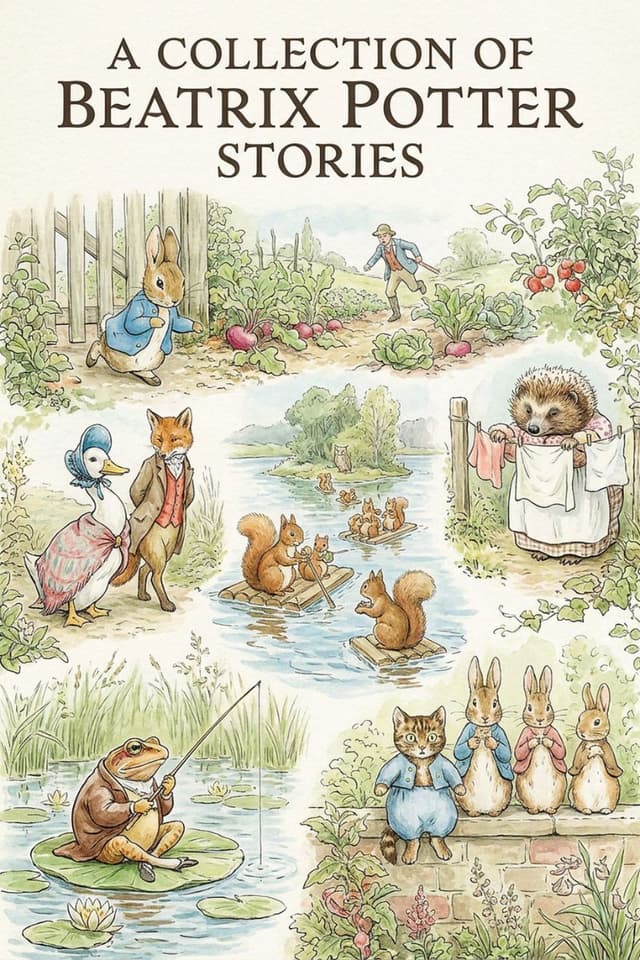
A Collection of Beatrix Potter Stories
Read A Collection of Beatrix Potter Stories by Beatrix Potter for free on Novelhalla, and try out our easy-to-read modern edition of this classic book. You can also download the EPUB and read it on any device if you prefer!
The Stories
A World Behind the Garden Gate
Picture a world where rabbits wear little blue jackets and lose their shoes in vegetable gardens. Where mice set up shop and extend credit to customers who never pay. Where a hedgehog does laundry for the neighborhood and a frog goes fishing only to nearly become someone else's lunch. Where a fox and a badger wage a private war so vicious it would make a crime thriller blush, and a kitten gets rolled up in pastry dough by rats who are planning to bake him into a pudding.
This is the world of Beatrix Potter. And it is much stranger, funnier, and darker than you probably remember.
Not Just for Children
Potter's stories are tiny. Most of them are only a few thousand words long, with illustrations on nearly every page. They were designed to fit in a child's hands. But there's something going on underneath the sweetness that rewards adult readers too. Her animals behave like animals. They eat each other. They steal. They scheme. A mother rabbit warns her children to stay out of Mr. McGregor's garden because their father went in there and was put in a pie. That's the first page. That's how we start.
Potter never talks down to her readers, no matter how young they are. She uses words like "soporific" and "exert" and trusts her audience to either know them or figure them out. She writes with a dry, precise wit that belongs more to Jane Austen than to the nursery. And her plots, for all their tiny scale, have real tension. Real consequences. Real teeth.
What You'll Find in This Collection
The Gutenberg collection brings together many of Potter's best-known tales. You get Peter Rabbit, of course, and his cousin Benjamin Bunny. You get the fastidious Mrs. Tittlemouse, who can't stand messy visitors in her house. You get Jemima Puddle-Duck, who is so trusting that she nearly walks into the worst dinner invitation of her life. You get Tom Kitten and his sisters, whose attempts to look respectable last about thirty seconds. You get the magnificent Mr. Tod, which Potter herself described as lacking in interest but which is actually one of her most gripping stories, a tale of predator versus predator with no hero in sight.
Each story is its own complete world. You can read one in five minutes. You'll want to read them all in an afternoon.
About the Author: Beatrix Potter
A Lonely Childhood
Helen Beatrix Potter was born in 1866 in Kensington, London, to a wealthy family that gave her everything except freedom. She never went to school. She was educated by governesses, kept largely apart from other children, and raised in a top-floor nursery where she spent most of her time alone. Her parents were distant and formal. Her brother Bertram, six years younger, was her closest companion.
What she did have was animals. The Potter nursery was a menagerie: rabbits, mice, a hedgehog, a frog, bats, lizards, a snake named Sally. Beatrix and Bertram studied them obsessively, sketching them, observing their habits, and occasionally smuggling them past the household staff. These childhood pets would later populate some of the most beloved stories in the English language.
The Secret Scientist
Before she ever wrote a children's book, Potter was a serious naturalist. During family holidays in Scotland and the Lake District, she developed a fascination with fungi, eventually producing over 350 scientifically precise watercolors of mushrooms and lichens. She taught herself microscopy, developed theories about how fungal spores germinated, and in 1897 submitted a research paper to the Linnean Society of London.
She was not allowed to attend the meeting where her paper was presented. She was a woman.
The scientific establishment dismissed her work. A century later, the Linnean Society issued a formal apology. Her mushroom illustrations are still used by mycologists today for their extraordinary accuracy.
The Accidental Author
In 1893, Potter wrote a picture letter to a former governess's sick child, a boy named Noel Moore. The letter told the story of four little rabbits named Flopsy, Mopsy, Cotton-tail, and Peter. Years later, Potter borrowed the letter back and expanded it into a manuscript.
Six publishers rejected it. Potter self-published 250 copies with her own money in 1901. The next year, Frederick Warne & Co reconsidered, agreed to publish the book with color illustrations, and by Christmas had sold 20,000 copies. Beatrix Potter was 36 years old.
Over the next decade, she produced two or three books a year, 23 in total, working closely with her editor Norman Warne. She wrote, illustrated, and helped design the layouts. She also proved to be an exceptionally sharp businesswoman, patenting a Peter Rabbit stuffed toy in 1903, making it the first licensed fictional character in history.
Love and Loss
While working together on the books, Potter and Norman Warne fell in love. In 1905, he proposed by letter. She accepted the same day. Her parents were furious. Warne was "in trade," a publisher, not a gentleman. They insisted the engagement be kept secret.
A month later, Norman Warne was dead of pernicious anaemia at 37. Potter, devastated, did the most Beatrix Potter thing imaginable: she used her book earnings and a small inheritance to buy a farm.
The Farmer
Hill Top Farm in the Lake District's Near Sawrey village became the center of Potter's new life. She threw herself into farming, bred prize-winning Herdwick sheep, and bought more land whenever she could afford it. In 1913, at age 47, she married William Heelis, a local solicitor. Her parents objected again. She married him anyway.
Potter continued writing for a few more years, but her interests shifted increasingly to farming, conservation, and land preservation. She became one of the most important early supporters of the National Trust, and over her lifetime she acquired over 4,000 acres of Lake District countryside.
She died on December 22, 1943, at age 77, and left nearly all of it to the National Trust. Much of what is now the Lake District National Park exists because Beatrix Potter bought it and refused to let anyone develop it.
Fun Facts About the Books
Peter Rabbit Was a Real Rabbit
Potter's pet rabbit, also named Peter, was her constant companion during her lonely London years. She walked him on a lead and sketched him endlessly. Peter Rabbit's blue jacket was inspired by one she actually made for the real Peter. The rabbit lived to be nine years old.
The First Licensed Character in History
In 1903, Potter designed and patented a Peter Rabbit doll, making Peter the world's first commercially licensed fictional character. She sewed the prototype herself, writing to her publisher that she was working on getting the expression right and considered putting lead bullets in his feet to help him stand up. The doll was followed by board games, wallpaper, figurines, tea sets, and china. Today, Peter Rabbit merchandise is estimated to be worth around $500 million.
She Self-Published First
After six publishers rejected The Tale of Peter Rabbit, Potter paid for 250 copies to be printed privately in December 1901. She gave them to family and friends. The little books generated enough buzz that Frederick Warne & Co took another look, and the rest is publishing history. She later self-published The Tailor of Gloucester too, because she loved it too much to wait.
The Diary in Code
As a teenager, Potter began keeping a journal written entirely in a cipher she invented. The code wasn't cracked until 1958, fifteen years after her death. The decoded diary revealed her private thoughts on art, science, politics, her unhappy relationship with her parents, and her observations of the natural world. It runs to over 200,000 words.
The Cemetery Connection
Potter is believed to have found several of her character names by walking through Brompton Cemetery near her London home. Graves there bear the names Peter Rabbett, Jeremiah Fisher, Mr. McGregor, and Mr. Nutkins. Whether this was deliberate research or happy coincidence, nobody knows.
Mr. Tod Is Dark
The Tale of Mr. Tod, in which a fox and a badger try to outwit each other, is startlingly violent for a children's book. Potter wrote to her publisher about it: "I am sure that it is badly written. I feel certain it will not be a success. It is full of disagreeable people." It is also arguably her best story, a tightly plotted miniature thriller with no sympathetic characters and real menace on every page.
She Gave Up Writing for Sheep
After her marriage in 1913, Potter gradually stopped writing children's books and devoted herself to Herdwick sheep farming. She became one of the most respected breeders in the Lake District and was eventually elected president of the Herdwick Sheepbreeders' Association, the first woman to hold the position.
250 Million Copies and Counting
Potter's books have sold over 250 million copies worldwide and have been translated into more than 35 languages. The Tale of Peter Rabbit alone has sold over 45 million copies, making it one of the best-selling children's books in history.
Themes
The Natural World, Honestly
Potter's animals live in a world with real predators and real consequences. Fathers get baked into pies. Ducks nearly get eaten by foxes. Kittens get kidnapped by rats. She never sanitized nature for children, and her stories are better for it. The world she creates is beautiful and dangerous in equal measure, which is exactly how children experience the real one.
Independence and Disobedience
Her most memorable characters are the ones who break rules. Peter ignores his mother. Tom Kitten sheds his clothes. Jemima wanders off alone. Potter doesn't always punish disobedience, and she doesn't always reward obedience either. Her moral universe is more complicated than that. Sometimes the naughty ones get away with it. Sometimes they don't. Just like life.
Small Worlds, Big Lives
Every Potter story takes place in a tiny, perfectly realized world. A mouse's house. A kitchen garden. A hedgerow. A shop. Within these miniature settings, her characters experience the full range of drama: fear, ambition, vanity, love, survival. She understood that the size of the stage has nothing to do with the size of the story.
The Comfort of Home
For all the danger in her stories, Potter always brings her characters back to something warm and safe. Peter gets chamomile tea. Tom Kitten gets cleaned up. The good mice retreat to their nest. Home, in Potter's world, is the reward for surviving the adventure. And it's always worth coming back to.
The Books' Legacy
Beatrix Potter essentially invented the modern picture book. Before Peter Rabbit, children's books were either crude chapbooks or elaborate, oversized productions. Potter created something new: a small, beautifully produced book with illustrations and text working together on every page, designed to be held and owned by a child.
Her influence on children's literature is almost impossible to overstate. Every picture book author who has followed owes something to the format she pioneered. Her insistence on artistic control, fair contracts, and character licensing laid the groundwork for how authors' rights work in publishing today.
The stories themselves have been adapted into ballet, television, film, and animation. The Royal Ballet performed The Tales of Beatrix Potter in 1971. A biographical film, Miss Potter, starring Renee Zellweger, was released in 2006. Peter Rabbit has starred in animated feature films. Her characters appear on merchandise in virtually every country in the world.
But the most lasting part of Potter's legacy may not be literary at all. The 4,000 acres she left to the National Trust helped preserve the Lake District as one of England's most beautiful and protected landscapes. The woman who drew rabbits in blue jackets also saved an entire countryside. Not bad for someone who started by writing a letter to a sick child.