Novelhalla
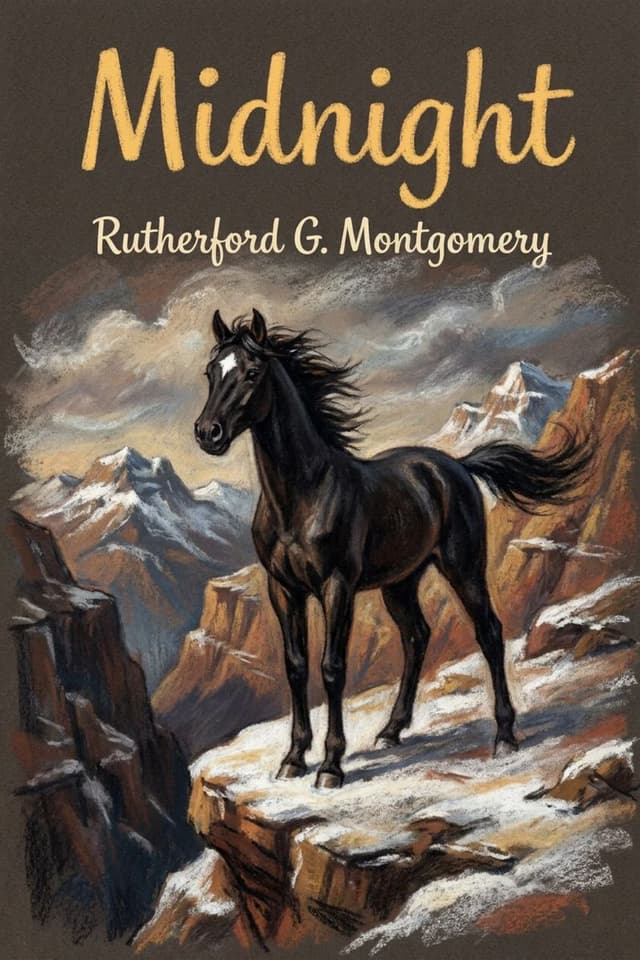
Midnight
Read Midnight by Rutherford G. Montgomery for free on Novelhalla, and try out our easy-to-read modern edition of this classic book. You can also download the EPUB and read it on any device if you prefer!
The Plot
An Old Man and His Favorite Mare
High on a mountain mesa above Shadow Canyon, an old prospector named Sam spends his days tipped back in a homemade chair, watching the marmots, chipmunks, and prairie dogs he's coaxed into becoming his neighbors. His favorite visitor is Lady Ebony, a sleek black mare who gallops up every morning looking for the lump of sugar she knows he keeps in his pocket. She isn't his, though. She carries the brand of Major Howard, a hot-tempered Easterner who owns the ranch in the valley below and doesn't think much of the easygoing ways of mountain folk.
When Sam asks to buy the mare, the major names a price he's sure the old man can never pay and rides off chuckling about it. What the major doesn't know is that Sam has a secret gold pocket tucked up under the rim of the mountains, and he's willing to dig out every flake it takes to make that mare his pal for good.
A Theft With No Thief
While Sam is off panning gold, a wild chestnut stallion leads his band of mares across the mesa, and Lady Ebony, restless and full of spirit, runs off to join them. By the time Sam returns with his pouch of dust, the mare is gone, and Major Howard is standing at his cabin door with the sheriff, demanding to know what Sam has done with her.
Sam has an alibi sitting right there in his pocket, but explaining it would mean giving away the location of his claim and bringing a flood of gold seekers to his beloved mountains. He's a stubborn old frontiersman who believes no man has the right to ask where he's been, and in that tense moment on his doorstep, he makes a choice that changes everything. Before long he's sitting in a cell behind gray prison walls, staring at a single cottonwood branch through a barred window and insisting he'll see his mountains again.
Born Wild
Meanwhile, Lady Ebony is learning a whole new way of life. The chestnut stallion drags his band south into a vast, sun-baked desert of red canyons and ancient cliff dwellings, where every water hole might be an ambush and every winter night might bring wolves out of the junipers. When Navajo horse hunters start running the band in relays, determined to wear them down and claim the fleet black mare, she slips away on her own and heads north toward the mountains she remembers.
In a hidden garden of red rocks, she gives birth to a jet-black colt with a white star on his forehead. He's got his mother's fine head and his father's heavy bones and fighting heart, and he has absolutely no idea how dangerous his world is. Eagles circle overhead, a cougar watches from the cliffs, and a curious little horse who wants to make friends with everything is about to find out what it takes to survive in the high country.
The One Witness Who Can't Talk
Here's the cruel irony at the heart of the story. Out there in the wilderness, a black colt is growing into a powerful young horse, and his very existence is living proof of what really happened to Lady Ebony. Sam is wasting away in prison for a crime that never took place, and the only evidence that could free him is running wild through the Crazy Kill Range, fighting off wolves and bears and rival stallions, and wanting nothing to do with mankind. Somebody is going to have to catch him first, and Midnight isn't the kind of horse who makes that easy.
About the Author: Rutherford G. Montgomery
A Prairie Boy
Rutherford George Montgomery was born in 1894 in Straubville, North Dakota, a tiny town that has since faded into a true ghost town. He grew up on a family farm and started writing stories about the wild animals living around it while he was still in school. As a boy he loved listening to the tales hunters told, but he grew up to describe himself as a watcher rather than a hunter, someone whose favorite pastime was sitting quietly on a log in the woods and observing whatever came by.
Teacher, Flier, Judge
Montgomery studied at Colorado Agricultural College, Western State College of Colorado, and the University of Nebraska. He taught elementary school in Wyoming, served in the United States Air Corps from 1917 to 1919 during World War I, and spent the 1920s working as a teacher and principal in Montrose County, Colorado. He married Eunice Opal Kirks in 1930, and they had three children.
Then his career took an unexpected turn. He served as a county judge in Gunnison County, Colorado, from 1931 to 1936 and as a county commissioner through 1938. After that, he left public office behind and became a full-time freelance writer.
A Writing Machine
Once he committed to writing, Montgomery never really stopped. He turned out more than a hundred books over his career, publishing under his own name as well as several pen names, including Everitt Proctor, Al Avery, Art Elder, and E.P. Marshall. Most of his books were animal and wilderness stories set in the Colorado Rockies he knew so well, but he also wrote aviation adventures, space stories, and boys' action series. From 1941 to 1946 he even worked as a writer on the Dick Tracy comic strip, and he later did scriptwriting work connected to Walt Disney Studios.
Recognition and Later Years
His biggest critical success came with Kildee House, which earned a Newbery Honor in 1950. He also won a juvenile silver medal from the Commonwealth Club of California in 1952. Montgomery eventually settled in Los Gatos, California, and he died in 1985 at the age of ninety-one.
Fun Facts About the Book
Published Before the Big Horse Classics
Midnight came out in 1940, a year before both The Black Stallion and My Friend Flicka were published in 1941. It arrived right at the start of the golden age of American horse stories.
A Story Told From the Animals' Side
Montgomery spends most of the book inside the heads of the horses and the wild creatures around them rather than the humans. Readers who've picked up more than one of his wild horse books often point out that this is his signature style.
A School Book Fair Favorite
The paperback edition from Scholastic Book Services was a fixture in classrooms for decades. It was still on its eighth printing in 1969, which means a whole generation of kids met Midnight through school book orders.
Illustrated Later
The original text was published by Holt in 1940, but the illustrations most readers remember were created for a 1949 Pocket Books edition. The frontispiece shows Midnight in a tight spot on a narrow cliff ledge, and it's a great tease for what's coming.
Dedicated to the Lonesome Places
Montgomery dedicated the book to a man named Earl Hammock, whom he described as someone who understood the value of lonely, wild places. It's a fitting dedication for a book that spends so much of its time far from any town.
A Whole Mountain Ecosystem
Beyond the horses, the book is packed with careful observations of wildlife, from the sentinel marmot who whistles warnings for the whole meadow to the chipmunks whose songs Sam times with his pocket watch. It reads like the work of someone who really did spend hours sitting quietly and watching.
Free to Listen
The book has been recorded as a free public domain audiobook through LibriVox, so it's easy to enjoy on a long drive or a quiet evening.
Themes
Freedom and Its Price
The wild horses in this book are free in a way the ranch horses never are, but that freedom comes at a steep cost. Every water hole could be a trap, every winter could be the last, and every colt is a target. Montgomery doesn't romanticize the wild, and he doesn't pretend captivity is all bad either, which makes the question of where Midnight truly belongs genuinely interesting.
Stubborn Pride
Sam could clear his name in a heartbeat if he'd just tell the truth about where he's been. He won't, because to him a man's business is his own and his mountain is worth protecting. It's a frustrating, admirable, completely human kind of stubbornness, and it drives the whole human side of the story.
The Law of the Wild
Over and over, the young colt learns that the strong survive and the careless don't last long. Montgomery shows nature as beautiful and brutal at the same time, with predators and prey all simply doing what they must to get through another season.
Friendship Across Species
The bond between Sam and Lady Ebony sets everything in motion, and the book keeps returning to unlikely alliances, like a mare, a colt, and a lone mule deer buck who team up to dig for grass through a terrible winter.
Injustice and Patience
While Midnight grows up in the wild, an innocent man sits in a cell watching the seasons change through one small window. The two storylines run side by side, and the slow ticking of Sam's sentence gives the whole adventure a sense of urgency.
The Book's Legacy
Midnight belongs to a beloved tradition of American wild horse stories, and it helped kick off the boom in horse books that exploded in the 1940s. For decades it was a staple of school libraries and Scholastic book orders, and plenty of adults still remember reading it as kids and rooting for the black colt through every close call.
Montgomery's lasting fame rests mostly on Kildee House, but Midnight remains one of his most fondly remembered animal adventures. Readers today still praise his vivid, unfussy descriptions and his honest portrayal of a time when ranchers and wildlife were constantly at odds.
If you grew up loving stories about horses running free across the mountains, this is one of the books that helped invent that feeling. It's part survival story, part frontier mystery, and part love letter to the high country, and it holds up as a terrific read for anyone who's ever wanted to watch a wild thing grow up.