Novelhalla
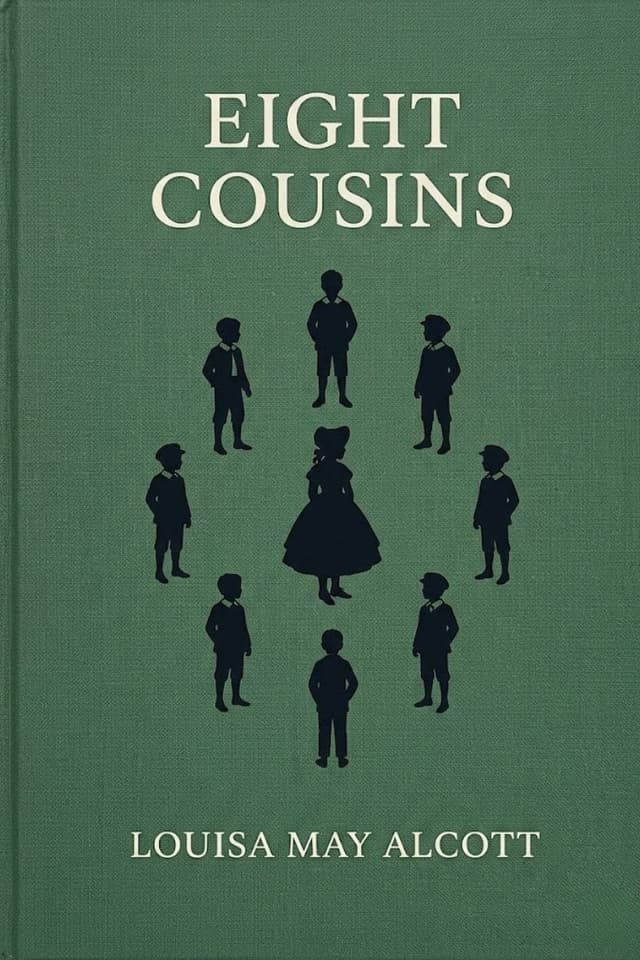
Eight Cousins
Read Eight Cousins by Louisa May Alcott for free on Novelhalla, and try out our easy-to-read modern edition of this classic book. You can also download the EPUB and read it on any device if you prefer!
The Plot
Rose Campbell is a pale, sickly thirteen-year-old orphan who arrives at the home of her aunts after the death of her father. She finds herself surrounded by relatives eager to manage her upbringing, each aunt with her own ideas about what a proper young lady needs. She also discovers she has seven boisterous boy cousins who intimidate her at first with their roughhousing and teasing.
Everything changes when her Uncle Alec returns from sea to become her guardian. A doctor with unconventional ideas about child-rearing, he immediately upends the household's assumptions about what Rose needs. He throws out her medicines, burns her back-straightening board, cuts her restrictive clothing, and insists she spend time outdoors exercising rather than sitting indoors studying French and practicing piano.
The aunts are scandalized. Aunt Myra obsesses over illnesses, Aunt Clara spoils her own son and focuses on fashion, Aunt Jane runs her household with military precision, and Aunt Plenty fusses over everyone. Uncle Alec must navigate their objections while gradually transforming Rose from a wan invalid into a healthy, confident girl.
Rose slowly gets to know each of her seven cousins, finding unexpected friendships and learning that the boys she feared are actually loyal and good-hearted beneath their rough exteriors. She discovers her own strength, develops her own opinions, and begins to figure out what kind of person she wants to become.
About the Author: Louisa May Alcott
Early Life
Louisa May Alcott was born in 1832 in Germantown, Pennsylvania, the second of four daughters. Her father, Bronson Alcott, was a transcendentalist philosopher and educational reformer whose idealism rarely translated into income. The family moved frequently, often one step ahead of poverty, and Louisa worked from a young age to help support them.
Transcendentalist Circle
The Alcotts lived at the center of the American transcendentalist movement. Ralph Waldo Emerson was a neighbor and benefactor, Henry David Thoreau a family friend and Louisa's sometime teacher. This intellectual environment shaped Alcott's thinking even as financial instability shaped her practical determination to earn money through writing.
Early Writing
Alcott wrote prolifically from her teens, producing sensational stories, gothic thrillers, and potboilers under pseudonyms to pay the bills. She was not ashamed of this work but kept it separate from the more respectable writing she published under her own name.
Civil War Service
During the Civil War, Alcott served as a nurse in a Union hospital in Washington, D.C. The experience damaged her health permanently when she contracted typhoid fever and was treated with mercury, which caused lasting effects. Her letters home became the basis for "Hospital Sketches," which brought her first real literary recognition.
Little Women and Fame
Her publisher asked her to write a book for girls, and in 1868 she produced "Little Women," drawing heavily on her own family. Its success was immediate and enormous, making her famous and finally financially secure. She followed it with sequels and other novels for young readers, including "Eight Cousins" in 1875.
Later Years
Alcott never married, instead supporting her extended family with her earnings. She was active in the women's suffrage movement and became the first woman to register to vote in Concord, Massachusetts, in a school committee election. She died in 1888, two days after her father, at age 55.
Fun Facts About the Book
Sequel
"Eight Cousins" was followed by "Rose in Bloom" the next year, which continues Rose's story into young adulthood and resolves the question of which cousin, if any, she might marry.
Health Reform
Uncle Alec's ideas about child-rearing reflected real reform movements of the time. Dress reform advocates campaigned against corsets and restrictive clothing for women and girls. Health reformers promoted fresh air and exercise over the confined indoor lives considered proper for young ladies.
The Title
Despite being called "Eight Cousins," Rose actually has seven boy cousins. The eighth cousin is Rose herself, completing the set.
Autobiographical Elements
Like Rose, Alcott grew up surrounded by strong-minded relatives with definite opinions. Uncle Alec's progressive views echo Bronson Alcott's educational philosophy, though Bronson lacked his fictional counterpart's practical medical knowledge and steady income.
Serialization
The novel was first serialized in the children's magazine "Good Times" before being published as a book. This was standard practice for Alcott, who serialized most of her novels before book publication.
Subtitle
The book's full title is "Eight Cousins; or, The Aunt-Hill," a pun on anthill that captures the busy, crowded household full of maiden aunts and their competing ideas about how to raise a girl.
Class Dynamics
Rose's friendship with Phebe, the servant girl, was progressive for its time. Alcott consistently included themes of social equality in her work, showing sympathy for working-class characters and questioning rigid class distinctions.
Themes
Health and Natural Living
Uncle Alec's reforms attack Victorian notions that kept girls pale, weak, and confined. The novel advocates for fresh air, exercise, practical clothing, and trusting children's bodies to thrive without constant medical intervention. Health comes not from medicines and restrictions but from freedom and movement.
Education of Girls
The novel questions what girls should learn and why. Rose's aunts want her to study accomplishments suitable for a young lady. Uncle Alec wants her to develop her mind, body, and character. The debate reflects real arguments about women's education in the 1870s.
Family and Belonging
Rose moves from feeling like an outsider overwhelmed by her large family to finding her place within it. Each aunt and cousin becomes a distinct individual rather than a blur of intimidating relatives. The novel celebrates extended family as a source of support, even when family members disagree.
Independence and Character
Rose must learn to think for herself rather than simply accepting what her aunts tell her. Uncle Alec does not want her merely to follow his ideas instead of theirs, but to develop her own judgment. The goal is a girl who can evaluate advice and make her own decisions.
Class and Friendship
Rose's friendship with Phebe challenges the assumption that social class should determine relationships. Rose sees Phebe as a person worthy of friendship and education, not merely as a servant to be kept at a distance.
Simplicity vs. Fashion
Aunt Clara's focus on fashionable clothes and social appearances contrasts with Uncle Alec's emphasis on practical, healthy choices. The novel consistently sides with substance over show, suggesting that fashion often harms those who pursue it.
The Book's Legacy
"Eight Cousins" remains one of Alcott's most beloved works after "Little Women." Its portrait of a young girl finding health and confidence through unconventional upbringing resonated with readers tired of the sickly, passive heroines common in Victorian children's literature.
The novel's advocacy for girls' physical activity and practical education anticipated changes that would gradually transform expectations for young women. Uncle Alec's ideas, radical in 1875, became mainstream common sense over the following century.
Alcott's warmth, humor, and genuine affection for her characters keep the book readable even when its specific debates about corsets and back boards have become historical curiosities.