Novelhalla
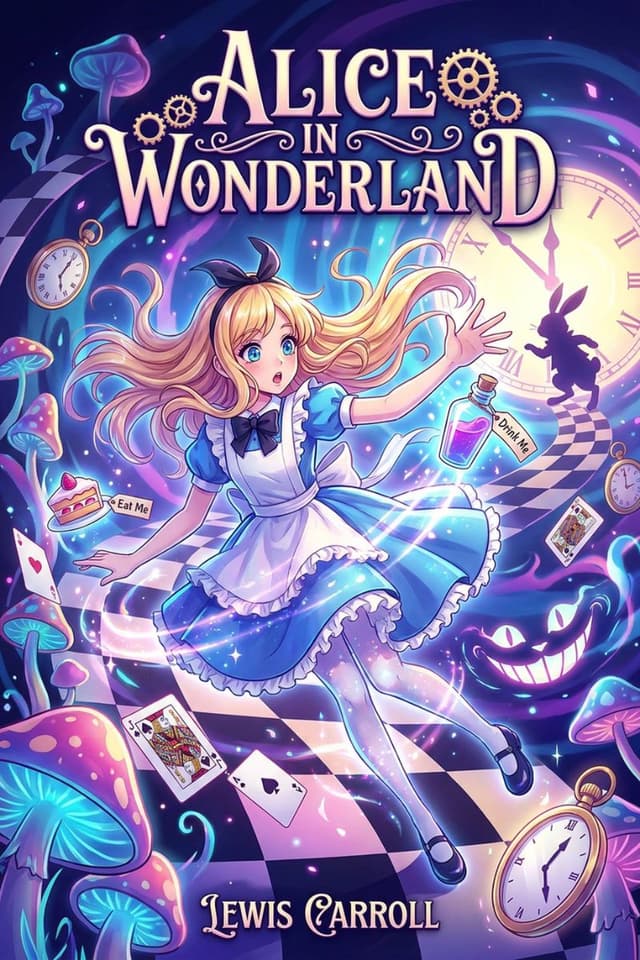
Alice in Wonderland
Read Alice in Wonderland by Lewis Carroll for free on Novelhalla, and try out our easy-to-read modern edition of this classic book. You can also download the EPUB and read it on any device if you prefer!
The Plot
The novel follows a young girl who tumbles down a rabbit hole into a fantastical underground world where nothing makes sense and the rules keep changing.
Down the Rabbit Hole
Alice is sitting on a riverbank with her sister, bored and drowsy, when she spots a White Rabbit in a waistcoat hurrying past and muttering about being late. Curious, she follows him down a rabbit hole and finds herself falling for what seems like an impossibly long time.
She lands in a strange hallway lined with doors. A tiny door leads to a beautiful garden, but she's too big to fit through. She finds a bottle labeled "DRINK ME" and a cake labeled "EAT ME," and her experiments with them cause her to shrink and grow wildly, leading to her first taste of the chaos to come.
A World Without Rules
Alice's journey takes her through a series of bizarre encounters. She swims through a pool of her own tears alongside a Mouse and various birds. She visits the home of the White Rabbit and grows so large she fills the entire house. She meets a hookah-smoking Caterpillar sitting on a mushroom, who speaks in riddles and challenges her sense of identity.
Throughout it all, Alice struggles to apply the logic and manners she learned above ground to a world that operates on dream logic. Poems come out wrong when she tries to recite them. Animals are offended by perfectly reasonable comments. Size, time, and meaning itself refuse to stay fixed.
The Duchess, the Cat, and the Tea Party
Alice encounters the Duchess, a violent cook who throws dishes, and a baby who turns into a pig. She meets the Cheshire Cat, whose grin can remain after the rest of him has vanished, and who offers cryptic guidance about the mad inhabitants of Wonderland.
The Cat directs her to the March Hare's house, where she finds herself at a tea party frozen perpetually at six o'clock. The March Hare, the Hatter, and the Dormouse speak in nonsense, ask unanswerable riddles, and treat rudeness as normal conversation. Alice leaves in frustration, calling it the stupidest tea party she's ever attended.
The Queen's Garden
Alice finally reaches the garden she glimpsed at the beginning. There she finds playing card servants painting white roses red to avoid the Queen of Hearts' wrath. The Queen herself arrives with her entourage and her constant demands for executions.
Alice joins a croquet game played with flamingos as mallets and hedgehogs as balls, where the rules change constantly and the Queen orders beheadings for the slightest offense. She meets the Gryphon and the Mock Turtle, who tell her about their strange school and sing melancholy songs about soup.
The Trial
The novel climaxes with a trial. The Knave of Hearts is accused of stealing the Queen's tarts. The proceedings are absurd: evidence is meaningless, witnesses are bullied, and the verdict is demanded before the jury can deliberate.
Alice, who has been gradually growing larger throughout the trial, finally loses patience with the whole affair. She's had enough of Wonderland's arbitrary rules and senseless cruelty.
About the Author: Lewis Carroll
The Man Behind the Name
Lewis Carroll was the pen name of Charles Lutwidge Dodgson, born in 1832 in Cheshire, England. He was the eldest son in a family of eleven children, and he entertained his siblings with games, puzzles, and stories from an early age.
Oxford Don
Dodgson spent most of his adult life at Christ Church, Oxford, where he was a lecturer in mathematics. He was shy, stammered in adult company, and never married. His mathematical work was respectable but not groundbreaking. He published treatises on logic and geometry under his real name.
Friendship with the Liddells
The Alice books originated in Dodgson's friendship with the children of Henry Liddell, the dean of Christ Church. On July 4, 1862, during a boat trip on the Thames, Dodgson entertained the three Liddell sisters with an improvised story about a girl named Alice who fell down a rabbit hole. Ten-year-old Alice Liddell asked him to write it down.
Photography
Dodgson was a pioneering amateur photographer, particularly skilled at portraits. He photographed many famous Victorians, including Tennyson and Rossetti. His photographs of children, including the Liddell girls, have been the subject of much modern speculation, though their interpretation remains contested among scholars.
Later Life
The relationship between Dodgson and the Liddell family cooled for reasons that remain unclear, as pages were cut from his diaries covering the relevant period. He continued teaching and writing until his death from pneumonia in 1898 at age 65. He never publicly acknowledged being Lewis Carroll during his lifetime, though it was widely known.
Fun Facts About the Book
The Original Manuscript
Before publication, Carroll created a handwritten, illustrated manuscript called Alice's Adventures Under Ground as a gift for Alice Liddell. It was about half the length of the published version. The original manuscript is now in the British Library.
Tenniel's Illustrations
The published book was illustrated by John Tenniel, a famous political cartoonist for Punch magazine. Carroll was extremely demanding about the illustrations, and the two clashed frequently. Tenniel refused to illustrate the sequel until Carroll promised to interfere less.
The First Print Run Disaster
Carroll rejected the entire first printing of 2,000 copies because Tenniel was unhappy with the print quality of his illustrations. The sheets were sold to an American publisher, making those "rejected" copies now extremely valuable.
Real People as Characters
Several characters may have been inspired by real people in Carroll's Oxford circle. The Dodo may represent Carroll himself (his stammer made him introduce himself as "Do-Do-Dodgson"). The Duck, Lory, and Eaglet in the pool of tears correspond to others on the famous boat trip.
Parodies of Victorian Poems
Many of the poems in the book are parodies of earnest Victorian verses that children were forced to memorize. "How Doth the Little Crocodile" mocks a moralistic poem called "How Doth the Little Busy Bee." Most modern readers miss the jokes because the originals have been forgotten.
The Mad Hatter's Real Inspiration
The phrase "mad as a hatter" predated the book and referred to the mercury poisoning that affected hat makers, causing tremors and mental confusion. Carroll didn't invent the association, but he certainly immortalized it.
Banned in China
The novel was banned in the Hunan province of China in 1931 on the grounds that animals should not be portrayed using human language, as it put animals and humans on the same level.
Translations and Adaptations
Alice has been translated into at least 174 languages, making it one of the most translated books ever. The wordplay and puns make it notoriously difficult to translate, and translators must often invent entirely new jokes.
Wonderland Syndrome
"Alice in Wonderland Syndrome" is an actual neurological condition where patients perceive objects or their own body parts as significantly larger or smaller than they are. It was named after Alice's experiences with size changes in the book.
No Wonderland in the Title
The word "Wonderland" doesn't appear anywhere in the text of the book. The underground realm is never given a name. "Wonderland" only appears in the title.
Themes
Identity and Self
Alice repeatedly questions who she is throughout the story. Characters demand that she identify herself, and she struggles to answer. The Caterpillar's question "Who are you?" becomes a genuine philosophical puzzle as Alice finds her memories unreliable and her sense of self unstable.
The Absurdity of Adult Rules
Wonderland operates on rules that are just as arbitrary as the social conventions Alice has learned, but more obviously so. The book gently mocks Victorian manners, education, and the moralistic lessons forced on children. Adult authority is shown as illogical and often cruel.
Language and Meaning
Words constantly fail in Wonderland. Puns derail conversations. Names don't match things. Poetry comes out wrong. The book plays endlessly with the gap between words and what they're supposed to represent, suggesting that language is stranger and less reliable than we assume.
Dreams and Logic
The story follows dream logic rather than waking logic. Events don't follow cause and effect. Characters appear and vanish. Scale and time shift without explanation. Yet Carroll, as a logician, also fills the book with puzzles and paradoxes that reward close reading.
Growing Up
Alice's constant size changes can be read as representing the confusing physical and emotional changes of childhood. She's too big, then too small, never quite the right size for her situation. The story captures the feeling of being a child in an adult world that doesn't quite make sense.
Authority and Power
The Queen of Hearts represents arbitrary power at its most absurd. Her constant death sentences are terrifying but also ridiculous, since they're never carried out. The book questions what makes authority legitimate and suggests that much of it is bluster and performance.
The Book's Legacy
Alice in Wonderland is one of the most influential works of children's literature ever written. It broke from the moralistic tradition of Victorian children's books to offer pure imaginative entertainment.
The book essentially invented literary nonsense as a genre. While nonsense verse existed before, Carroll created an entire coherent world built on illogic, influencing everything from surrealism to absurdist theater.
Its imagery has become embedded in popular culture worldwide. The Cheshire Cat's grin, the Mad Tea Party, the Queen shouting "Off with their heads," and Alice falling down the rabbit hole are references that transcend the book itself.
The novel has inspired countless adaptations: films, television shows, ballets, operas, video games, and theme park attractions. Disney's 1951 animated version shaped how generations visualize the characters, though it combined elements from both Alice books.
Writers from James Joyce to Jorge Luis Borges have cited Carroll's influence. The book anticipated psychedelic culture by a century, became a touchstone for mathematicians and philosophers, and remains genuinely strange and funny more than 150 years after publication.