Novelhalla
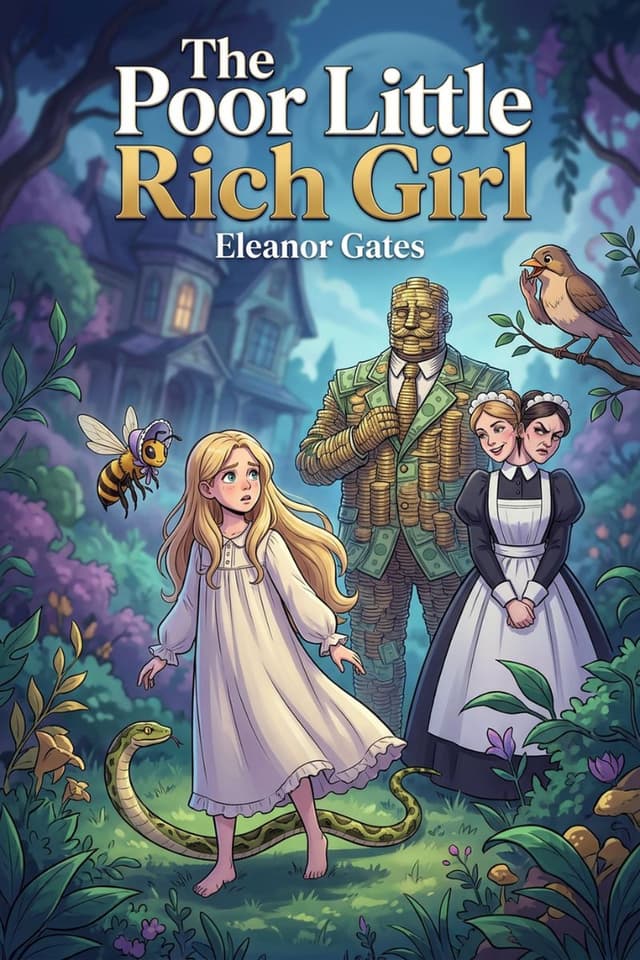
The Poor Little Rich Girl
Read The Poor Little Rich Girl by Eleanor Gates for free on Novelhalla, and try out our easy-to-read modern edition of this classic book. You can also download the EPUB and read it on any device if you prefer!
The Plot
Seven Years Old and Not a Bit Taller
The night before her seventh birthday, Gwendolyn drew a tiny ink line across the bevel of the tall mirror in her nursery, exactly at the top of her head. She has been counting down to this birthday for months, crossing days off the calendar on her gold-and-white writing desk, because seven is when you're grown up and everything changes.
She measures herself the next morning. She hasn't moved the line by so much as a hair.
She's so frightened by this that she scrubs the mark off the glass with her own handkerchief before anyone can see it, because if the grown-ups find out there's something wrong with her, no telling what they'll do. Then she sits down on the window seat with her back very straight and tries to work out what to do about it.
That's the first two pages. If you're not already fond of her, you may as well close the book.
The People Who Are Paid to Watch Her
Gwendolyn lives at the top of an enormous stone house overlooking the river, in a nursery with silk-shaded lamps, a case of dolls from six countries, a canary in a gilded cage that spends all day beating its wings against the bars, and a bronze elevator that carries her up and down like something in a bank vault. She has a pony, a limousine, a French teacher, a German teacher, a music teacher and a dancing master. Her mother is beautiful and busy. Her father is downstairs at his desk with his head in his hands.
She sees them at dinner sometimes. She curtsies her way down the whole length of the table, and the guests pat her head and call her cunning, and then she goes back up in the elevator.
The rest of her life belongs to three people who can't stand each other. Miss Royle, the governess, whose neuralgia flares up reliably on bargain days. Jane, the red-haired nurse, who is only interested in an afternoon off and a certain policeman. And Thomas, the footman, who takes the dogs out and eats most of Gwendolyn's birthday cake. All three of them keep her indoors, keep her quiet, and keep her from complaining downstairs, and their method is terror. She's told that if she walks on the street she'll be snatched by kidnappers with long curved knives. She's told there are bears in her father's street. She's told a doctor might come.
What she actually wants, and asks for, and never gets, is a dress with a pocket in it. Permission to go barefoot. A walk, on her own feet, on ground she can scuff. And a week back at Johnnie Blake's cottage in the country, where there was a stream with fish in it and her father rolled up his sleeves.
What the Grown-Ups Say
Because Gwendolyn is seven, she takes every word she hears exactly as it lands. And the adults in this house talk constantly, over her head, in the strangest language imaginable.
Her father, she is told, is made of money. He's in harness. He burns his candles at both ends, and he's on the edge of a crash, and a little bird told them so. Her mother has a bee in her bonnet, a society bee. Miss Royle is a snake in the grass. Jane laughs in her sleeve and has to dance attendance all day, though Gwendolyn has watched carefully and Jane never dances. Thomas has an itching palm. A man at the dinner table hands her a box of candy for her sweet tooth, and she'd very much like to know which one of her teeth that is, but everybody laughs, and when they laugh the question never gets answered.
She goes to the dictionary. The dictionary says a bee is a social honey-gathering insect and has nothing at all to say about bonnets.
So she starts investigating. She tries the telephone, and finds it dead. She creeps down the stairs at night in her dressing gown to see her father alone and ask him, straight out, whether the bears have ever frightened him. And the answer she gets, and the look on his face when he gives it, is the moment this book stops being funny.
The Night It All Goes Wrong
Miss Royle wants her afternoon. Jane wants her evening. Both of them want Gwendolyn quiet and asleep and out of the way, and there's medicine in the nursery for exactly that purpose, and a nurse with somewhere better to be isn't necessarily careful about the dose.
What happens after that is one of the strangest things in American children's writing. The nursery walls give way, and Gwendolyn tumbles out into a country where all of it is real: the bird that tells things, the bee in the bonnet, the two-faced governess, the snake in the grass, the man made of money, and figures with names like the Piper and the Man-Who-Makes-Faces. Everything the grown-ups ever said in front of her is out there walking around, and now she can finally get some answers.
She wanted to know what was happening to her father. She wanted a friend. She wanted to be allowed outside. She's about to get all of it at once, in the worst possible way, while three floors below her a doctor is coming up the stairs.
About the Author: Eleanor Gates
A Prairie Childhood
Eleanor Gates was born in Shakopee, Minnesota, in 1875, and was still a baby when her family moved out to a cattle ranch in the Jim River valley of what was then Dakota Territory. She grew up herding cattle, riding anything on four legs, walking miles to a country school and helping stretch hides through the winter. Her father taught her to notice things: the plants, the birds, the antelope, the way the sky over the plains kept changing.
When she was about ten the family moved to California. She went to Stanford and to Berkeley, and started out as a newspaper journalist in San Francisco and Oakland.
The Prairie Books
Her first book, published in 1902, was a lightly fictionalised account of that Dakota childhood, and she was careful to tell people it wasn't strictly autobiography, just experiences of her own dressed up to suit her fancy. More frontier fiction followed, including a novel about a plow-woman and a cheerfully slangy set of ranch stories narrated by a cowboy called Cupid.
It's worth sitting with that for a moment. The woman who wrote this book, with its Fifth Avenue nursery, its liveried footman, its French governess and its bronze elevator, learned to write while living on a cattle ranch in the middle of the plains. The child in this novel is starving for exactly the childhood the author actually had.
Broadway and Hollywood
In 1901 she married the playwright Richard Walton Tully. In 1913 he produced her stage version of this book at the Hudson Theatre in New York, and it ran into the summer. Four years later it became a Mary Pickford picture, and by then Gates was one of the more successful women writing for the American stage, with seven plays produced on Broadway.
Her marriage to Tully ended in divorce in 1914. A second marriage turned out not to have been legally valid at all, which is the kind of plot development she might have written herself.
Later Years
She kept writing books, plays, magazine work and screen material. She tried to follow this book's success in 1921 with a story that flipped the premise around, about a rich little poor boy, which never caught on the same way. Nothing else she wrote came close to the reach of the one about Gwendolyn.
Eleanor Gates died in Los Angeles in March 1951, at seventy-five, after being struck by a car.
Fun Facts About the Book
The Title Turned Into a Phrase
This is one of the rare books whose title escaped the covers and entered ordinary English. When somebody says the words now they almost never mean the book, and most of them have no idea there was one. It's up there with Catch-22 and Pollyanna for a phrase that outgrew its source.
The Broadway Version Aged Her Up
For the stage in 1913, Gwendolyn was raised from seven to eleven, and then played by Viola Dana, who was fifteen at the time and went on to become a substantial silent film star. Gates's own husband produced it.
The Film That Turned Mary Pickford Into a Child
The 1917 adaptation was scripted by Frances Marion, directed by Maurice Tourneur and shot in Fort Lee, New Jersey, back when that was where American movies got made. Pickford was twenty-four and played the whole feature as a little girl, which she had never done before. It worked so well that it effectively locked her into child roles for years, and she had real trouble climbing back out of them later. The Library of Congress added the film to the National Film Registry in 1991, and it's freely available to watch now.
The Shirley Temple One Isn't This
Temple made a picture with the same title in 1936, and people still assume it's a remake. It isn't. Fox used the title and built a completely different story around it, about a soap heiress who becomes a radio singing star. If you go looking for the dream forest and the two-faced governess, you'll be waiting a long time.
It's Enormous
Early editions run to around 450 pages, and a very large share of that is the dream. Some readers find that stretch the most inventive thing in American children's fiction from the period. Others, including more than one critic, have found it charming for fifty pages and exhausting for the next hundred and fifty. Both camps have a point, and knowing which one you're in is part of the fun.
The Movie Tie-In Edition
Grosset and Dunlap reprinted the novel with six black-and-white stills from the Pickford film. Movie tie-in paperbacks feel like a modern invention. They were already doing it in 1917.
The Nursery Is Full of Real Detail
The dictionary on the school-room table with "Use Your Dictionary" chalked across the top of the blackboard. The seven candles. The rabbit in the cabbage with the light-up eyes. The maids hanging washing on the roofs across the street, whose lives Gwendolyn envies. Gates had an unusually sharp eye for the specific objects of a wealthy Edwardian childhood, and the book works as a small documentary record of one.
Themes
Children Take You Literally
The whole engine of the book is that grown-ups speak in metaphor all day and nobody explains any of it. Gwendolyn isn't stupid. She's rigorous. She hears a claim, she checks the dictionary, she asks a follow-up question, and she gets laughed at for it. Gates understood that a child's world is built almost entirely out of half-heard adult sentences, and that adults have no idea what they're building.
Neglect by Delegation
Nobody in this book intends to hurt Gwendolyn. Her mother loves her in an absent-minded way. Her father loves her and is drowning. They've simply handed her over to three employees whose interests run directly against hers, and they've never once checked. The book is much angrier about this than its sweet reputation suggests.
Fear as a Management Tool
Kidnappers, bears, doctors, policemen, being stolen and sold. Jane and Miss Royle keep a small child permanently frightened because a frightened child is a quiet child. Watching Gwendolyn scan the sidewalk for men with knives on the way to her own limousine is genuinely upsetting, and Gates means it to be.
Money as a Cage
Everything Gwendolyn wants is free. A walk. A pocket. Bare feet. A friend. Everything she's given costs a fortune and means nothing to her. The bars on the basement windows exist because the family is rich, and to her they're just bars.
The Freedom of Ordinary Life
The people Gwendolyn envies are the laundry maids on the roofs, the plumber with his wrench, the nurse in the house across the way, and a poor boy called Johnnie Blake who owned a willow fishing pole and a shoestring for his hat. Her idea of paradise is a dirt road she's allowed to scuff. It's a genuinely radical piece of class writing hiding inside a children's book.
Fathers Under Pressure
The father here is one of the sadder figures in children's fiction of the era: a boyish, laughing young man in an old photograph, now grey and haggard at a desk, working himself to pieces to fund a life nobody in the house is enjoying. Gwendolyn's attempts to protect him, with the only tools a seven-year-old has, are the emotional center of the book.
Historical Context
This is New York in 1912, at the tail of an era when a certain kind of household could employ a butler, a footman, a nurse, a governess, a cook, a maid, a chauffeur and a stable of visiting tutors, and when a child of that household might genuinely spend most of a week without a private conversation with either parent. The arrangement was normal enough that Gates didn't have to explain it to her readers. What she was doing, gently and then not gently at all, was asking them to look at what it did to the child in the middle of it.
The Book's Legacy
The phrase is the legacy. It stuck to heiresses and starlets and eventually to anyone with money and misery, and it's still doing service more than a century later, which is a strange kind of immortality for a book about a small girl in a nursery.
The story itself has been remade, borrowed from and diluted so many times that its shape now feels like common property: the lonely child of rich, distracted parents; the servants who rule the top floor; the fantasy world that fixes what the real one broke. It's in the Pickford film, in a hundred children's books after it, in every story where a kid with everything turns out to have nothing.
What's kept it readable is the voice. Gwendolyn's puzzling over adult language is funny in a way that hasn't dated at all, and the book is one of the few from its period that treats a child's misunderstandings as logic rather than cuteness. Modern parents tend to read it and get quietly uncomfortable, because the specifics have changed while the arrangement hasn't. Swap the governess for a schedule and the limousine for a screen and Gwendolyn's afternoon looks a lot like some children's afternoons now.
It's also, for a book about neglect, remarkably kind. Nobody in it is a monster. The servants are petty and self-interested rather than evil, and the parents are just people who let the wrong thing become urgent. Gates was writing to be heard, not to condemn, and the result is a book that has been quietly nagging at people who have too much and see their children too little for a hundred and ten years.