Novelhalla
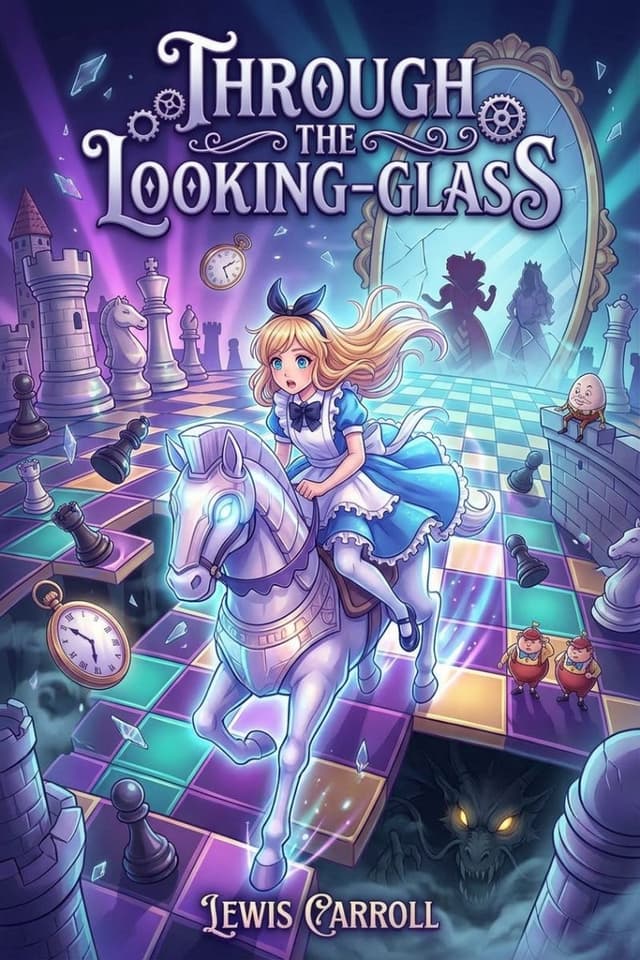
Through the Looking-Glass
Read Through the Looking-Glass by Lewis Carroll for free on Novelhalla, and try out our easy-to-read modern edition of this classic book. You can also download the EPUB and read it on any device if you prefer!
The Plot
A Snowy Afternoon and a Very Bad Kitten
It's a wintry November day about six months after Alice's first trip underground. She's seven and a half now, curled up in a big armchair by the fire while the snow comes down outside, half talking to herself and half scolding a black kitten called Kitty, who has spent the entire afternoon unwinding a ball of worsted that Alice had rolled up very carefully.
Alice does what bored, imaginative children do. She starts inventing a punishment. She holds the kitten up to the mirror over the mantelpiece and threatens to put her through into Looking-Glass House, where everything is the same as this room, only the other way round, and the fire probably isn't a real fire, and you can't get any of the books because the words all go the wrong way.
Then she starts wondering whether the glass might go soft, like gauze, if you tried.
It does.
The House That Runs Backwards
On the far side, the pictures on the wall are alive and the clock on the mantelpiece has a face that grins at her. Down in the hearth, the chess pieces from the game on the rug are walking around under the fender, having a family crisis. The White King and Queen are frantic about their daughter Lily. Neither of them can see Alice or hear her, though they can feel it very distinctly when she picks them up and sets them on the table, and the King spends the rest of the scene traumatized by an invisible volcano.
On a table there's a book. Alice can't read a word of it until she works out that everything here is reversed, holds it up to a glass, and finds a poem called "Jabberwocky," which is written in perfectly good English except that most of the words don't exist. She comes away with the strong impression that somebody killed something, which is more than she can usually get out of poetry, and she goes off to see the garden.
The Garden Where the Flowers Have Opinions
Getting to the garden is the first problem. Every path she takes swerves her straight back to the house, until she gives up and walks the other way, which works immediately.
The flowers in the garden can talk, and they're rude about it. They explain that most gardens keep their flowers quiet by making the beds too soft, and they size Alice up as a slightly disappointing specimen of her species.
Then the Red Queen arrives, all sharp corners and instruction. She grabs Alice's hand and they run. They run until Alice is out of breath and the wind is screaming past and the trees are moving with them, and when they finally stop, they're standing exactly where they started. Where the Red Queen comes from, if you want to get somewhere else, you have to run at least twice as fast as that.
Then she takes Alice up a small hill and shows her the country: a huge flat landscape divided by brooks and hedges into perfect squares, like a chessboard stretching out to the horizon.
It's a game. An enormous one, already in progress. And there's a place in it for Alice, if she'll take it. She can be a White Pawn, in the Second Square, and if she can make it across all eight squares without being taken, she gets to be a Queen.
Alice would very much like to be a Queen.
One Square at a Time
What follows is a journey with the shape of a chess game and the logic of a dream, and Carroll keeps them locked together so precisely that you almost stop noticing.
She travels by railway carriage with a guard who inspects her through a telescope and a gnat the size of a chicken. She walks into a wood where nothing has a name, including her, and comes out the other side with something she'd rather not have lost track of. She meets Tweedledum and Tweedledee, two identical fat little men who insist on reciting a very long poem about a walrus, a carpenter, and a great many young oysters, then work themselves into a battle over a broken rattle. Along the way they show her the Red King asleep under a tree and make an argument about who exactly is dreaming whom that Alice does not enjoy at all.
She's fussed over by the White Queen, an amiable disaster of a woman who bleeds before she pricks her finger, screams before it hurts, lives by a rule of jam every other day but never today, and claims that with practice she has managed to believe six impossible things before breakfast. The Queen dissolves into a Sheep who runs a shop where the shelves are always full except the exact one you're looking at.
She meets Humpty Dumpty on his wall, magnificently rude, who explains that words mean whatever he decides they mean, that the trick is knowing who's in charge, and that unbirthday presents are a superior form of present since you can get them three hundred and sixty-four days a year. She watches the Lion and the Unicorn fight for the crown while the King's men hand out plum cake in the wrong order. She gets claimed as a prisoner by a Red Knight and rescued by a White Knight, a gentle, ridiculous, badly balanced old man who keeps falling off his horse and who has invented a great many things nobody has ever needed.
The Eighth Square
She's nearly there. The last brook is in front of her, and past it is the square where pawns get crowned.
But the two Queens are waiting on the other side, and they want to give her an examination first, and neither of them is in a mood to be generous. And Looking-Glass Land has a way of making very sure you understand what you asked for before it lets you have it.
About the Author: Lewis Carroll
Charles Dodgson of Daresbury
He was born Charles Lutwidge Dodgson in January 1832, in a parsonage in Cheshire, the eldest son and third of eleven children of a clergyman. It was a household full of siblings, word games, and homemade magazines, which he wrote and illustrated himself for family circulation, and one of those magazines is where a very familiar stanza of nonsense first showed up when he was twenty-three.
He was clever, dreamy, and hampered by two things. A childhood fever left him deaf in one ear. A stammer he called his hesitation stayed with him his whole life and shaped a great deal of what he did and didn't do.
The Don
He went up to Christ Church, Oxford, took a first in mathematics in 1854, and was handed the college Mathematical Lectureship the following year. He held it for twenty-six years and stayed at Christ Church for the rest of his life. By most accounts he was a rather dull lecturer.
He was ordained a deacon in 1861 and never went on to become a priest, which was technically against the rules for his position and which he somehow got away with. The stammer was part of it. Private religious doubt seems to have been part of it too.
He was also one of the finest amateur photographers in England at a time when photography meant hauling chemicals around and coating your own glass plates. He shot roughly three thousand images across twenty-four years and then quit abruptly in 1880 and never explained why.
The Other Name
The pen name is a mathematician's joke. He put Charles Lutwidge into Latin, got Carolus Lodovicus, flipped the order, and pulled it back into English. Everything under his real name was mathematics and logic. Everything under the invented name was nonsense, and the two were kept firmly apart.
The first Alice book came out of a rowing trip up the Thames in July 1862 with the three young daughters of the Dean of Christ Church, one of whom was named Alice Liddell. He made the story up on the water because they demanded one, then wrote it out by hand as a gift. It was published in 1865. The sequel took him from 1868 to the very end of 1871 to finish, mostly because his illustrator worked slowly.
By the time it appeared, his friendship with the Liddell family had cooled and Alice herself was nineteen. The wistfulness in the book's closing pages is not an accident.
Last Years
He gave up lecturing in 1881 to write full time, ran the Christ Church common room for a decade, produced "The Hunting of the Snark," a two-volume novel called Sylvie and Bruno, a book of logic puzzles, and a mountain of correspondence. From 1861 until his death he kept a register of every letter he sent, and it ran to nearly a hundred thousand entries.
He died of pneumonia at his sisters' house in Guildford in January 1898, two weeks short of sixty-six, and was buried there.
Fun Facts About the Book
It Started as Chess Lessons
Carroll had been teaching the Liddell girls to play chess and inventing stories to explain how the pieces moved. Those stories are the bones of this book. He later said the whole thing was assembled out of bits and scraps, single ideas that turned up on their own over the years and then got stitched together with two organizing tricks: a mirror and a chessboard.
There's an Actual Chess Problem in the Front
Carroll printed the full board position and move list at the start, and it genuinely tracks the story. Every brook Alice crosses is a move. Chess players have argued about it for over a century, since the alternation of turns isn't properly observed, but the moves themselves are legal and the game is real.
The Orange in the Mirror
The mirror idea may have come from a different Alice. Carroll's young cousin Alice Raikes said he once handed her an orange, asked which hand she was holding it in, then had her stand in front of a mirror and asked which hand the girl in the glass was using. She thought it over and asked whether, if she were the one on the other side of the glass, the orange wouldn't still be in her right hand. He told her it was the best answer he'd had yet.
The Deleted Wasp
There was one more chapter. Tenniel wrote to Carroll in June 1870 saying the wasp chapter didn't interest him in the slightest, he couldn't see his way to a picture, and if Carroll wanted to shorten the book, there was his opportunity. Carroll cut it with a few strokes of purple ink. The text was presumed destroyed for over a century, until galley proofs turned up at a Sotheby's auction in July 1974 and sold for about £1,700. It was published in 1977. A few scholars still quietly doubt it's genuine, since the paper and handwriting have never been properly tested.
Published in 1871, Dated 1872
Macmillan printed nine thousand copies for Christmas 1871, then immediately ordered six thousand more. The title page says 1872, which is why you'll see both years everywhere. The first two runs sold out in about seven weeks, and the sequel's success is what finally made the first Alice book a phenomenon rather than a modest curiosity.
A Poem Written Seventeen Years Early
The first stanza of "Jabberwocky" was printed in 1855 in Mischmasch, the magazine Carroll made for his siblings, under the straight-faced title "Stanza of Anglo-Saxon Poetry," complete with mock-scholarly footnotes and fake medieval lettering. He supplied a glossary. Some of his original definitions don't match the ones Humpty Dumpty gives in the book.
Words He Invented That You Use
"Chortle" and "galumph" both come out of that poem and both live in the Oxford English Dictionary as ordinary English. So does the term "portmanteau word," which is Carroll's own coinage for the technique, delivered in the book by Humpty Dumpty as a lecture.
Tenniel Stole His Knight From Dürer
The White Knight's look in the illustrations is borrowed from Albrecht Dürer's 1513 engraving "Knight, Death and the Devil." Tenniel gave the melancholy old figure a new horse and a much sillier expression.
The Poem at the End Is a Signature
The verses that close the book are an acrostic. Read the first letter of each line straight down and it spells out Alice Pleasance Liddell.
Themes
Growing Up Is a Board Game With Rules Nobody Explains
Alice starts as a pawn, on the second row, at the bottom of the hierarchy, moving one square at a time toward an authority she's been promised but not described. Everyone she meets is older, more confident, and completely certain about rules she's never heard of. It's the most accurate depiction of childhood that anybody had put on paper by 1871, and it still is.
Language Refuses to Behave
The whole book is a linguist's playground. Names come loose from things. Puns take physical form. Words mean whatever the person with the most power says they mean. Carroll was a logician by trade, and he uses nonsense the way a scientist uses a control group: break the rules on purpose and you can finally see what the rules were.
Who Is Dreaming Whom
Tweedledee points at the sleeping Red King and suggests that Alice is only a thing in his dream, and that if he woke up she'd go out like a candle. Alice is furious about it, which is the right reaction, and the book never entirely lets the question go. It's a genuine philosophical problem, handed to a seven-year-old, delivered as a taunt.
Time and Memory Run the Wrong Way
The White Queen remembers things that haven't happened. Punishment comes before the crime. Jam is always promised and never served. Every one of these gags is also a joke about how the adult world manages a child, with rewards deferred and rules applied backwards.
Nostalgia and the Girl Who's Leaving
Underneath the wordplay is a middle-aged man watching a child grow past him and dressing his grief up as a joke. The White Knight, kind and clumsy and endlessly inventing useless things, is widely read as Carroll's own self-portrait, and the book's tenderest passage belongs to him.
Nothing Here Is Random
Every talking egg, every backwards rule, every impossible bit of geography sits inside a strict framework: a chess game with a real solution and a mirror with consistent physics. The pleasure of the book is watching absolute nonsense obey absolute rules.
The Book's Legacy
This is the one that made the Alice books immortal. The first book was the surprise hit and this one was the bigger seller, and together they became the point at which children's literature stopped being obliged to teach anybody a moral lesson.
Almost nothing else has furnished the English language quite this generously. Tweedledum and Tweedledee, the Walrus and the Carpenter, "Jabberwocky," "unbirthday," "jam tomorrow," Humpty Dumpty as the patron saint of arguing about definitions, and the Red Queen running flat out to stay in one place. That last one became a serious scientific term in 1973, when the evolutionary biologist Leigh Van Valen named the Red Queen hypothesis after her, and it's now standard vocabulary in evolutionary biology, economics, and business strategy. A Victorian nonsense chess piece ended up in the peer-reviewed literature.
Adaptations are endless and mostly cheat, since almost every film version blends this book with the first one. The Mad Hatter belongs to Wonderland; the Jabberwock, the Red Queen, and Tweedledum and Tweedledee belong here. If you've only seen the movies, you've been handed a shuffled deck, and the actual book will feel stranger, sharper, and considerably funnier than you expect.
Its real descendants are everywhere in fantasy and in fiction generally. Anything built on dream logic that still plays fair, anything where the rules of the world are absurd but consistent, anything that trusts a young reader with a serious idea about identity or language, is drawing on the machinery Carroll built here.