Novelhalla
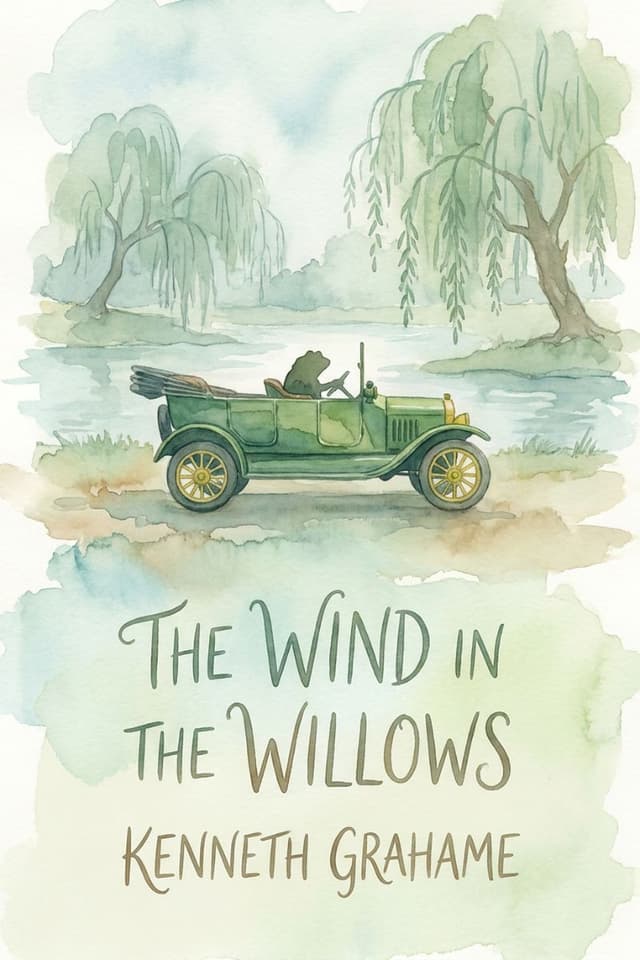
The Wind in the Willows
Read The Wind in the Willows by Kenneth Grahame for free on Novelhalla, and try out our easy-to-read modern edition of this classic book. You can also download the EPUB and read it on any device if you prefer!
The Plot
Spring Cleaning Can Wait
Mole is having the worst kind of good day. He's underground, whitewashing his little home, doing all the tedious spring cleaning that needs doing, when something snaps. Spring is happening up there, above the earth, and he suddenly can't stand being down here for one more second. He throws down his brush, bolts up through the tunnels, and bursts out into the sunlight.
And the world is glorious.
He wanders across meadows, drunk on fresh air and freedom, until he reaches the riverbank. He's never seen a river before. The glint of it, the chatter of it, the sheer aliveness of it stops him cold. And sitting on the bank, watching him with bright, friendly eyes, is the Water Rat.
Ratty is everything Mole isn't. Confident, worldly (at least by riverbank standards), and utterly in love with the water. He has a boat. He has a picnic basket. He has opinions about the best way to spend a summer afternoon, and every single one of them involves the river. Within hours, the two are inseparable.
Enter Toad
Ratty introduces Mole to the wider social world of the riverbank, and that means meeting Mr. Toad. Toad is wealthy, generous, boastful, impulsive, and completely incapable of sticking with anything for more than five minutes. When we meet him, he's just abandoned his latest obsession (a canary-yellow horse-drawn caravan) for something far more dangerous.
Motorcars.
Toad has seen one roar past on the open road and it has broken something in his brain. He is consumed. He buys car after car, crashes every single one, and cannot be reasoned with. His friends try. Ratty tries. The formidable Badger tries. Toad just grins, makes promises he has no intention of keeping, and sneaks out the first chance he gets.
His next joyride is going to land him in very serious trouble.
The Wild Wood
Meanwhile, Mole is growing braver. Maybe too brave. One winter afternoon, restless and curious, he ventures alone into the Wild Wood, a dense, dark forest that Ratty has warned him about. The place is home to weasels, stoats, and foxes, creatures who aren't exactly hostile but aren't exactly friendly either. As the light fades and the snow begins to fall, Mole realizes he is lost. And the Wood is watching him.
What follows is one of the most atmospheric sequences in the book. The creeping dread of being alone in a place that doesn't want you there. The faces in the dark. The whistling. And then, just when things seem worst, Mole stumbles onto something unexpected buried under the snow: a doormat. And below the doormat, a door. And behind the door, the most comforting home imaginable.
Badger's house.
Toad's Reckoning
Badger is old, gruff, solitary, and deeply decent. He lives in a vast underground home beneath the Wild Wood, and he does not suffer fools. He has been watching Toad's antics with growing concern, and when spring comes, he decides it's time to intervene.
What follows is one of the great comic interventions in literature. Badger, Rat, and Mole essentially stage what we'd now call an intervention, locking Toad in his own bedroom and trying to talk sense into him. Toad weeps, repents, swears he'll never touch another motorcar. He is very convincing.
He is also lying.
The moment he escapes, Toad steals a car. Not just any car. And the consequences this time aren't a ditch and a bruised ego. This time there are courts, and judges, and a prison cell in the deepest dungeon of the stoutest castle in all of England.
The Road Back
Getting into prison is easy enough. Getting out is another matter entirely. But Toad, for all his faults, has a peculiar gift for inspiring affection in unlikely people, and help comes from a direction he never expected.
Even if Toad manages to get free, there's a larger problem waiting for him. While he's been away, something has happened to Toad Hall. The weasels and stoats of the Wild Wood, sensing opportunity, have moved in. They've taken over his ancestral home, armed themselves, posted sentries, and are throwing parties in his dining room.
Reclaiming it will take more than Toad's bluster. It will take all four friends, a secret passage that only Badger knows about, and a plan that depends on every one of them doing the thing they do best.
Whether they can pull it off, and whether Toad can be saved from himself long enough to help, is a question only the book can answer.
About the Author: Kenneth Grahame
A Childhood on the River
Kenneth Grahame was born in Edinburgh in 1859, but Scotland didn't hold him long. His mother died of scarlet fever when he was five, and his father, broken by grief and drink, sent the children to live with their grandmother in Berkshire. It was there, in the village of Cookham Dean on the banks of the River Thames, that Grahame found the landscape that would define his life and his one great book.
His uncle took the children boating on the river. The meadows, the willows, the quiet backwaters of the Thames became Grahame's paradise. He carried that stretch of English countryside inside him for the rest of his life.
The Reluctant Banker
Grahame desperately wanted to attend Oxford, but his uncle refused to pay for it. Instead, at twenty, he became a clerk at the Bank of England. He was good at it. Too good. He rose through the ranks over nearly three decades, eventually becoming Secretary of the Bank, one of its most senior positions. It was a prestigious, stable, deeply respectable life.
It was also, by most accounts, not the life he wanted.
He began publishing essays and stories in his spare time. His collections The Golden Age and Dream Days, warm and nostalgic portraits of childhood, made him a literary celebrity in the 1890s. Critics adored him. But it would be another decade before he wrote the book that mattered.
A Story for Mouse
In 1899, Grahame married Elspeth Thomson. Their only child, Alastair, was born the following year, premature and blind in one eye. The boy, nicknamed "Mouse," was the center of his parents' world.
When Alastair was about four, Grahame began telling him bedtime stories about a mole, a water rat, and a reckless toad who lived on the banks of a great river. When Alastair went away on holiday in 1907, Grahame continued the stories in letters, spinning out the adventures of Toad in handwritten installments mailed to his son. Those letters became the seed of the novel.
Aftermath
Grahame retired from the Bank of England in 1908, the same year the book was published. He never wrote another novel. His later years were marked by one devastating loss: Alastair, struggling with depression and the pressures of academic life at Oxford, died on a railway track in May 1920, just days before his twentieth birthday. The death was officially ruled accidental, though most biographers believe otherwise.
Grahame became reclusive after his son's death, spending years abroad before settling in Pangbourne, Berkshire, near the river that had always been his refuge. He died of a cerebral hemorrhage in 1932 at age seventy-three. He was buried in Holywell Cemetery in Oxford, in the same grave as his son. His cousin, the novelist Anthony Hope, wrote the epitaph on his headstone: that he had left childhood and literature "the more blest for all time."
Fun Facts About the Book
Rejected by Publishers
Several publishers turned down the manuscript, and the critics who had loved Grahame's earlier work were baffled by it. They wanted more polished essays about childhood, not a story about talking animals in boats. The reviews were largely negative. The public, however, loved it immediately, and it has never been out of print since.
Theodore Roosevelt Was a Fan
President Theodore Roosevelt wrote to Grahame in 1909 to tell him he had read the book multiple times and had come to think of the characters as old friends. For a book that critics dismissed, it found some remarkable early champions.
The Original Title
The book was originally going to be called The Wind in the Reeds before Grahame changed it to The Wind in the Willows. The title refers to one of the book's most mysterious and beautiful chapters, in which the wind carries an unearthly music through the trees along the riverbank.
Ratty Is Not a Rat
The character called Ratty is actually a water vole, a plump, gentle, semiaquatic rodent native to British riverbanks. Water voles have since become one of Britain's most endangered mammals, and conservation efforts sometimes invoke Ratty's name to rally public sympathy.
Toad's Real-World Inspiration
Grahame reportedly saw elements of his son Alastair's stubborn, headstrong personality in the character of Mr. Toad. The character of Ratty, meanwhile, may have been inspired by Grahame's close friend, the writer Arthur Quiller-Couch, to whom he dedicated the book.
The Piper at the Gates of Dawn
Chapter seven is unlike anything else in the book. Mole and Rat go searching for a lost baby otter and encounter something transcendent on an island at dawn: a vision of Pan, the god of the wild, playing his pipes among the reeds. It's a moment of pure mystical awe dropped into the middle of a story about picnics and motorcars, and it remains one of the most debated and beloved passages in children's literature. Syd Barrett of Pink Floyd named the band's debut album after it.
Mr. Toad's Wild Ride
Disney adapted part of the book as the first half of their 1949 film The Adventures of Ichabod and Mr. Toad. The Toad segment became the basis for Mr. Toad's Wild Ride, one of Disneyland's original attractions, which has been giving children nightmares since 1955. The ride at Walt Disney World was controversially closed in 1998 and replaced with a Winnie the Pooh attraction.
Toad of Toad Hall
A.A. Milne, creator of Winnie-the-Pooh, loved the book so much that he adapted the Toad chapters into a play called Toad of Toad Hall in 1929. Milne admitted that the stage version could only capture one dimension of Grahame's book, the comic adventure, and missed the deeper, more lyrical chapters entirely.
Where Is the Riverbank?
Multiple real locations claim to be the inspiration for the book's setting. Cookham Dean in Berkshire, where Grahame grew up, is the strongest candidate. Mapledurham House, Hardwick House, and Fawley Court all claim to be the original Toad Hall. The village of Lerryn in Cornwall also makes a case. Grahame himself never definitively said.
Themes
Home and Belonging
At its heart, the book is about the pull of home. Mole leaves his underground house in the first chapter and spends the story learning what home really means. The most emotionally powerful scene in the book may be the moment he catches the scent of his own abandoned burrow on a winter night. Home in Grahame's world isn't grand or impressive. It's the place that knows you.
Friendship and Loyalty
Four very different creatures form a bond that sustains the entire story. Ratty's patient kindness, Badger's gruff dependability, Mole's quiet courage, and even Toad's bumbling affection all contribute to a portrait of friendship as something that endures imperfection. The friends don't give up on Toad, even when he makes it spectacularly easy to do so.
The Danger of Obsession
Toad is one of literature's great cautionary tales, and also one of its most lovable. His addiction to speed, novelty, and his own ego leads him from crash to crash, from loss to loss, and eventually to prison. The book treats his compulsions with humor but never pretends they aren't destructive. Toad's story asks whether someone who can't stop hurting themselves can be saved by the people who love them.
Nature as Sanctuary
The English countryside in this book isn't just a setting. It's a character, a philosophy, a way of life. The river, the meadows, the changing seasons offer a kind of peace that the wider world of motorcars and courtrooms can't provide. Grahame wrote the book during a period of rapid industrialization and technological change, and there's a quiet insistence throughout that the things worth having are slow, small, and close to the earth.
Class and Social Order
The riverbank has its own social hierarchy. Toad is landed gentry, Badger is old aristocracy gone reclusive, Rat is comfortable middle class, and Mole is the newcomer from below (literally). The weasels and stoats of the Wild Wood represent a disorderly underclass. The book's politics are deeply conservative in some readings, radical in others. Either way, the question of who belongs where, and who gets to decide, runs through every chapter.
The Book's Legacy
The Wind in the Willows has been adapted more times than almost any other children's book. The 1983 stop-motion animated version by Cosgrove Hall Films, featuring David Jason's voice, is considered one of the finest. There have been stage musicals, radio plays, television series across decades, and countless illustrated editions, with Ernest H. Shepard's 1931 illustrations and Arthur Rackham's 1940 paintings among the most treasured.
The book ranked sixteenth in the BBC's Big Read survey of Britain's best-loved novels. Mr. Toad was voted the thirty-eighth greatest fictional character of the twentieth century by Book magazine. The story has been taught in schools, quoted in Parliament, and cited in conservation campaigns.
But what keeps readers coming back isn't the fame or the adaptations. It's the voice. Grahame wrote a book that somehow manages to be simultaneously a comedy about a toad stealing cars, a meditation on the English landscape, a hymn to friendship, and a quiet spiritual experience involving a pagan god at dawn. No two readers seem to love the same parts best, and nearly all of them love it completely.
It is, as A.A. Milne called it, "a Household Book," the kind that everybody loves and quotes and reads aloud to every new guest. More than a century after its publication, it remains exactly that.