Novelhalla
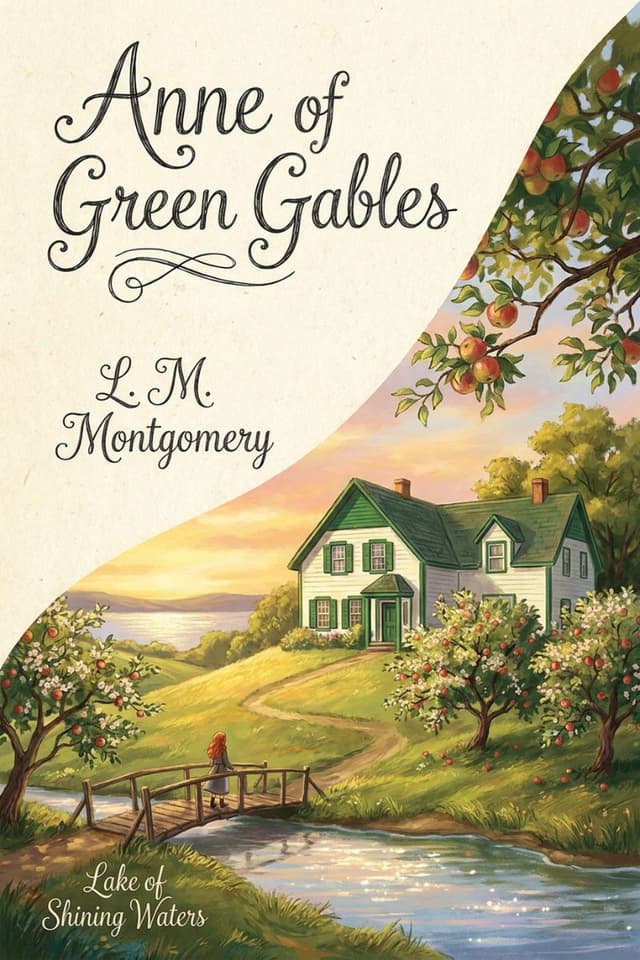
Anne of Green Gables
Read Anne of Green Gables by L. M. Montgomery for free on Novelhalla, and try out our easy-to-read modern edition of this classic book. You can also download the EPUB and read it on any device if you prefer!
The Plot
Anne of Green Gables is the story of an imaginative orphan girl who arrives by mistake at a Prince Edward Island farm and, through her spirit, creativity, and capacity for love, transforms both herself and the community around her.
A Mistake That Changes Everything
Matthew and Marilla Cuthbert are middle-aged siblings who run Green Gables farm in the quiet village of Avonlea on Prince Edward Island, Canada. Matthew is getting older and needs help with the farm work, so the Cuthberts decide to adopt an orphan boy from Nova Scotia.
When Matthew arrives at the train station, he finds not the expected boy but an eleven-year-old girl with red hair, freckles, and an unstoppable torrent of words. Anne Shirley talks the entire carriage ride home, enchanting the shy Matthew with her observations about cherry trees in bloom and her habit of giving poetic names to everything she sees.
Marilla is less charmed. She is practical, strict, and certain they cannot keep a girl who cannot help with farm labor. But after hearing about Anne's lonely childhood spent in orphanages and working for families who treated her as little more than a servant, Marilla's heart softens. Despite her better judgment, she agrees to let Anne stay.
Scrapes and Friendship
Anne's new life at Green Gables is a series of mishaps fueled by her wild imagination and fierce temper. When the village busybody Mrs. Rachel Lynde criticizes her red hair and skinny appearance, Anne explodes in fury. Marilla makes her apologize, but not before Anne has demonstrated that she is no ordinary child.
At school, Anne meets Diana Barry, a kind girl who becomes her "bosom friend." The two swear eternal friendship. Anne also meets Gilbert Blythe, a handsome boy who tries to get her attention by calling her "Carrots" and pulling her red braid. Anne, who despises her red hair above all things, smashes her slate over his head. Thus begins a rivalry that will last for years.
Anne's imagination leads her into one disaster after another. She accidentally gets Diana drunk on what she thinks is raspberry cordial but is actually currant wine, and Diana's mother forbids the girls from seeing each other. She dyes her hair green in an attempt to turn it black. She nearly drowns while acting out a romantic poem, floating down the river as the tragic Elaine.
Growing Up
As the years pass, Anne matures. A new teacher, Miss Stacy, recognizes Anne's intelligence and encourages her ambitions. Anne begins to channel her imagination into writing stories and excelling at her studies. She competes fiercely with Gilbert Blythe for top marks, though she still refuses to speak to him.
Anne earns a place at Queen's Academy in Charlottetown, where she trains to become a teacher. She wins the prestigious Avery Scholarship, which would allow her to attend university and pursue a Bachelor of Arts degree. Her future seems bright.
About the Author: Lucy Maud Montgomery
Early Life
Lucy Maud Montgomery was born on November 30, 1874, in Clifton (now New London) on the north shore of Prince Edward Island, Canada. Her mother, Clara Woolner Macneill Montgomery, died of tuberculosis when Maud was only twenty-one months old. Her grief-stricken father placed her in the care of her maternal grandparents and eventually moved west to Saskatchewan.
Raised by her strict and elderly grandparents in the village of Cavendish, young Maud was often lonely. She found companionship in her imagination, in books, and in the natural beauty of Prince Edward Island. She began writing poetry at age nine and kept a journal that she would maintain throughout her life.
Finding Her Voice
At fifteen, Maud spent a year with her father and stepmother in Prince Albert, Saskatchewan. The visit was unhappy, but she achieved her first publication there: a poem called "On Cape LeForce" appeared in a Prince Edward Island newspaper.
She returned gratefully to Prince Edward Island and continued her education at Prince of Wales College in Charlottetown, completing the two-year teaching program in one year. She taught at several Island schools while continuing to write, selling stories and poems to magazines across Canada, Britain, and America.
In 1895, she spent a year studying literature at Dalhousie University in Halifax, one of the few women of her time to pursue higher education. When her grandfather died in 1898, she returned to Cavendish to care for her grandmother, and she would remain there for the next thirteen years.
Anne Is Born
During her years caring for her grandmother, Montgomery wrote constantly. In 1905, she drafted a novel inspired by a newspaper clipping she had saved years earlier about a couple who had requested a boy from an orphanage but received a girl by mistake. She wrote the story of Anne Shirley sitting at her window overlooking the fields of Cavendish.
Five publishers rejected the manuscript. Discouraged, Montgomery put it away in a hatbox. When she rediscovered it during spring cleaning in 1907, she decided to try once more. L.C. Page and Company of Boston accepted it, and Anne of Green Gables was published on June 13, 1908.
The book was an immediate sensation, selling 19,000 copies in its first five months. Mark Twain wrote to Montgomery that she had created "the dearest, most lovable child in fiction since the immortal Alice."
Later Life
In 1911, after her grandmother's death, Montgomery married Ewan Macdonald, a Presbyterian minister she had been secretly engaged to for five years. They moved to Ontario, where she would spend the rest of her life, returning to Prince Edward Island only for visits.
She had three sons: Chester in 1912, Hugh (stillborn) in 1914, and Stuart in 1915. She continued to write bestselling novels while managing a household and supporting her husband in his ministry. She also dealt with private struggles: her husband suffered from severe depression, and she herself battled periods of intense emotional difficulty.
Montgomery was the first Canadian woman elected to the Royal Society of Arts in Britain in 1923. In 1935, King George V made her an Officer of the Order of the British Empire. She published twenty novels in her lifetime, along with hundreds of short stories and poems, and kept journals that would eventually fill thousands of pages.
Lucy Maud Montgomery died on April 24, 1942, at the age of sixty-seven. She was buried in Cavendish, Prince Edward Island, close to the home she had loved and immortalized in her fiction.
Fun Facts About the Book
An Instant Bestseller
Unlike many classics that took time to find their audience, Anne of Green Gables was a runaway hit from the start. It sold 19,000 copies in its first five months and went through ten printings in its first year. By the following year, it had already been translated into Swedish.
Rejected Five Times
Montgomery sent her manuscript to five publishers before finding success. After the fifth rejection, she stored the pages in a hatbox for over a year. Only a chance rediscovery during spring cleaning led her to try again with the publisher that finally said yes.
Mark Twain Was a Fan
The famous American author wrote to Montgomery praising Anne as "the dearest, most lovable child in fiction since the immortal Alice," comparing her to Lewis Carroll's beloved creation. For the creator of Tom Sawyer and Huckleberry Finn to praise a child character so highly was remarkable.
Inspired by a Real News Story
Montgomery got the idea for Anne from a newspaper clipping she had saved about a couple who applied to an orphanage for a boy but received a girl by mistake and decided to keep her. She combined this premise with her own experiences growing up on Prince Edward Island.
A Japanese Phenomenon
The novel has been enormously popular in Japan since a translation appeared in 1952 as part of the postwar school curriculum. Japanese tourists flock to Prince Edward Island, some dyeing their hair red and wearing it in braids. Japanese couples travel there to have weddings at Green Gables. In 1986, a Japanese businessman made news by signing a contract to import over one million dollars worth of potatoes simply because they came from Anne's island.
Banned by the Nazis
During World War II, the German and Soviet occupiers of Poland banned Anne of Green Gables because the character embodied individuality, loyalty to family, and resistance to authority. The Polish resistance movement distributed copies to its fighters as a reminder of the values they were fighting for.
More Than 50 Million Copies
Anne of Green Gables has sold over fifty million copies worldwide and been translated into at least thirty-six languages. It has never been out of print in English since its 1908 publication.
Eight Sequels
Though Montgomery was not particularly interested in continuing Anne's story, the demand from readers and her publisher led her to write seven sequels plus a posthumously published final volume. The series follows Anne from girlhood through marriage and motherhood.
The Real Green Gables
The farmhouse that inspired the setting belonged to cousins of Montgomery and still stands in Cavendish, Prince Edward Island. It is now part of Prince Edward Island National Park and receives hundreds of thousands of visitors each year.
Themes
The Power of Imagination
Anne's vivid imagination is both her greatest gift and the source of her troubles. She names ordinary places with romantic titles like "the White Way of Delight" and "the Lake of Shining Waters." She invents elaborate fantasies that help her survive loneliness but also lead her into scrapes. As she matures, she learns to channel her imagination into storytelling and academic achievement rather than letting it run away with her.
Belonging and Home
Anne has never had a real home. She has been passed from orphanage to foster families who wanted only her labor. Her desperate desire to stay at Green Gables drives much of the early story. Montgomery shows how finding a place where you are wanted transforms a person. Anne blossoms once she knows she belongs somewhere.
The Value of Friendship
The bond between Anne and Diana represents ideal friendship: loyal, supportive, and enduring through difficulties. Anne calls Diana her "bosom friend" and "kindred spirit." Montgomery suggests that deep friendship is essential to happiness and growth.
Growing Up Without Losing Yourself
Anne must learn to balance her romantic nature with practical reality. She must curb her temper and think before she speaks. But Montgomery never suggests Anne should abandon her imagination or become ordinary. The novel celebrates Anne's uniqueness while showing her mature into someone who can function in society without losing her essential self.
Found Family
Neither Matthew nor Marilla expected to become parents at their age, and certainly not to a girl. Yet Anne becomes the daughter they never knew they wanted. Montgomery shows that family is not only about blood relations but about the bonds of love and commitment that people choose to form.
The Beauty of the Natural World
Prince Edward Island itself is almost a character in the novel. Anne's appreciation for cherry blossoms, sunsets, and autumn woods runs throughout the story. Montgomery drew deeply on her own love for the Island landscape, creating descriptions that have drawn tourists to Prince Edward Island for over a century.
The Book's Legacy
Anne of Green Gables established L. M. Montgomery as one of the most widely read Canadian authors in history. The novel launched an entire industry of tourism on Prince Edward Island and inspired countless adaptations for stage, screen, and television.
The 1985 Canadian television miniseries starring Megan Follows became beloved worldwide and won an Emmy Award. Numerous stage adaptations have been performed, including an annual musical that has run in Charlottetown since 1965. Japan has produced multiple anime adaptations, and Netflix released a reimagined series called Anne with an E in 2017.
Beyond adaptations, Anne has influenced generations of readers and writers. She offered young girls a model of intelligence, independence, and creativity at a time when such qualities were not always encouraged in women. Her refusal to hide her opinions or suppress her imagination resonated with readers who felt like outsiders themselves.
The novel helped establish children's literature as a serious form capable of exploring themes of identity, belonging, and personal growth. Montgomery showed that books for young people could be both entertaining and meaningful.
More than a century after publication, Anne of Green Gables remains in print in dozens of languages. New generations continue to discover the red-haired orphan who talked her way into the hearts of two lonely siblings and an entire community. Anne's spirit of optimism, her capacity for friendship, and her faith that life holds endless possibilities continue to speak to readers around the world.