Novelhalla
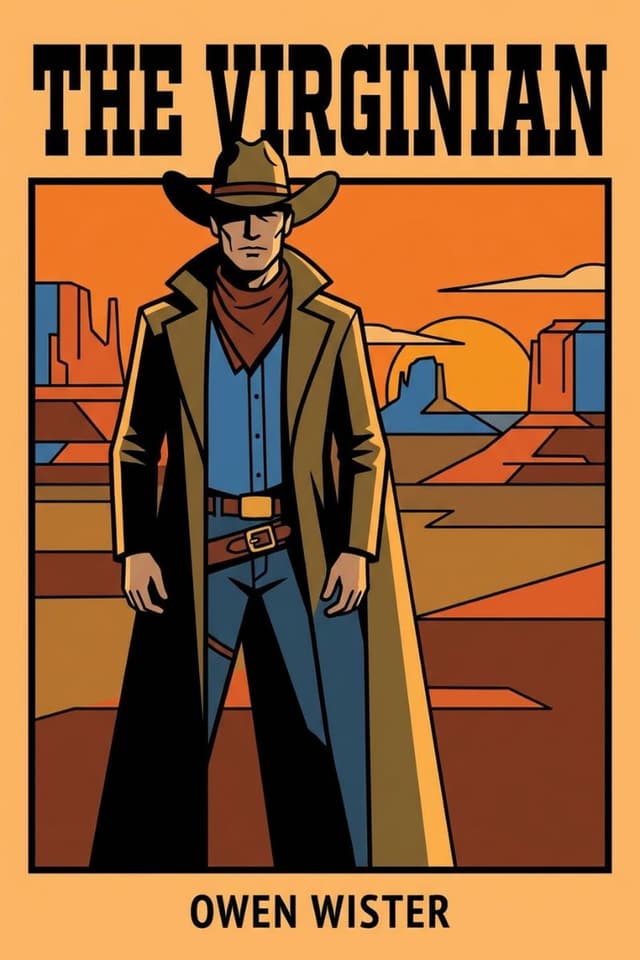
The Virginian
Read The Virginian by Owen Wister for free on Novelhalla, and try out our easy-to-read modern edition of this classic book. You can also download the EPUB and read it on any device if you prefer!
The Plot
The Stranger at Medicine Bow
A young man from back East steps off a train in Medicine Bow, Wyoming, and finds himself in a place that barely qualifies as a town. A scattering of buildings, a vast sky, and dust in every direction. He's here to visit a cattle ranch, and someone is supposed to meet him.
That someone is the Virginian.
He's tall, lean, impossibly self-possessed, and he doesn't give his real name. Nobody seems to know it. He's just the Virginian, a cowboy working for Judge Henry's Sunk Creek Ranch, and from the moment the narrator meets him, it's clear this is a man operating by a set of rules the East doesn't have a name for.
The two begin the long ride to the ranch, and a friendship takes root between the tenderfoot and the cowboy. But on their very first night in town, the narrator gets a glimpse of something else. A card game. A man named Trampas. An insult. And the Virginian's quiet, lethal response: a drawn pistol and a line that will echo through a century of American fiction.
The Schoolmarm
Molly Stark Wood arrives in Wyoming from Bennington, Vermont, to teach school at Bear Creek. She is educated, proper, strong-willed, and completely unprepared for the country she's entered. When her stagecoach nearly wrecks on a mountain road, a tall stranger appears to pull her to safety. She doesn't know his name.
She will.
The Virginian sets his sights on Molly with the same patient confidence he brings to everything else. She wants nothing to do with him. He's a cowboy. He's rough-mannered. He swaps babies at a barbecue as a practical joke and thinks it's hilarious. She tells him he's childish. He tells her she's a hypocrite. Somehow, this is the beginning of a courtship.
It takes years. He woos her with persistence, with humor, with a willingness to borrow her books and actually read them. She teaches him Shakespeare and Austen. He teaches her that intelligence and character don't require a diploma. The gap between his world and hers is enormous, and closing it is the slowest, most stubborn thing either of them has ever done.
The Foreman
The Virginian rises through the ranks at the ranch. Judge Henry, recognizing his natural authority, promotes him to foreman. It's a position that demands more than skill with cattle. It demands judgment. Leadership. The ability to manage men who don't always want to be managed.
One of those men is Trampas.
Trampas is everything the Virginian isn't: petty, dishonest, and dangerous in the cowardly way. He resents the Virginian's promotion. He undermines him at every turn. On a cattle drive, he tries to incite the other cowboys to mutiny, and the Virginian has to put down the rebellion without violence, using nothing but wit and a tall tale that leaves Trampas humiliated in front of the men.
But Trampas is patient too. And he holds a grudge the way some men hold a religion.
The Hardest Thing
Cattle rustling is bleeding the territory dry. The law is slow, corrupt, or simply absent. Ranchers begin taking justice into their own hands, and the Virginian finds himself pulled into a vigilante posse hunting down thieves.
One of the men they catch is Steve.
Steve is the Virginian's friend. A real friend, not a bunkhouse acquaintance. They've ridden together, laughed together, shared the kind of bond that men in hard country form when they have nobody else. And Steve has been rustling cattle.
The posse's verdict is hanging. The Virginian doesn't argue with the sentence. He doesn't try to let Steve slip away. He does his duty. But the weight of it nearly breaks him. This isn't a story that pretends justice comes easy or clean. The Virginian watches his friend die with courage, and carries that moment like a stone in his chest for the rest of the book.
When Molly finds out what he's done, she's horrified. Where she comes from, there are courts and lawyers and the presumption of innocence. She tells him she can't love a man who participates in a lynching. He tells her that out here, this is the only justice there is.
Whether she can accept that, and whether he can live with it, is a question the novel refuses to answer quickly.
Trampas
The tension between the Virginian and Trampas has been building for five years. Five years of sideways looks and muttered threats and the slow, grinding friction of two men who despise each other sharing the same territory.
It comes to a head on the eve of the most important day of the Virginian's life. Trampas issues a challenge that can't be ignored, and the Virginian faces a choice between the man he wants to be and the man this country demands he be.
The woman he loves begs him to walk away. Everything he's built, everything he's earned, everything he's endured hangs on what happens next.
What happens next is why this book invented a genre.
About the Author: Owen Wister
A Privileged Start
Owen Wister was born in 1860 in Philadelphia's Germantown neighborhood to a family of serious pedigree. His father was a wealthy physician. His mother, Sarah Butler Wister, was the daughter of Fanny Kemble, one of the most celebrated British actresses of the nineteenth century. The family moved in elite intellectual circles. Henry James was a family friend.
Wister attended boarding schools in Switzerland and England before enrolling at Harvard, where he graduated summa cum laude in music in 1882. He was a member of the exclusive Porcellian Club, where he became close friends with a fellow student named Theodore Roosevelt. He wrote the Hasty Pudding's most successful show. Franz Liszt praised his piano playing. By every measure, he was destined for a comfortable, cultured, thoroughly Eastern life.
Going West
It didn't work out that way. After studying music composition in Paris, Wister returned to the United States in poor health. His father pressured him into banking, which made him miserable. He suffered a nervous breakdown. His doctor prescribed the standard remedy of the era: go West.
In 1885, Wister traveled to a cattle ranch near Douglas, Wyoming. It changed everything.
He was fascinated by the landscape, the culture, the people. He kept meticulous journals. He returned to Wyoming and other Western territories nearly every summer for fifteen years, spending time with cattle ranchers during the turbulent period surrounding the Johnson County War. He saw enough real frontier life to fill a dozen novels, though he would need only one.
Back East, he dutifully earned a law degree from Harvard and practiced briefly in Philadelphia. He hated it. He began writing Western stories for Harper's Magazine and The Saturday Evening Post instead. His friend Roosevelt, by then a major political figure and fellow Western enthusiast, encouraged him relentlessly.
After the Virginian
Wister published The Virginian in 1902, dedicating it to Roosevelt. It was an instant sensation, reprinted fourteen times in its first eight months. He adapted it into a successful stage play the following year. Nothing he wrote afterward came close to matching it, though he continued writing fiction, political commentary, and biography for the rest of his life.
In 1898, he married his second cousin, Mary Channing Wister. They had six children. Mary died during childbirth in 1913, and Wister never remarried. His later years were devoted to nonfiction, including biographies of Ulysses S. Grant and Theodore Roosevelt. He died in 1938 at his estate in Rhode Island at age seventy-eight.
Fun Facts About the Book
The First Showdown
The climactic confrontation in the novel is widely considered the first literary "showdown" in Western fiction. Two men, a dusty street, a final reckoning. Every gunfight in every Western movie you've ever seen traces its DNA back to this book.
"When You Call Me That, Smile"
The Virginian's famous line to Trampas during their first confrontation became one of the most quoted phrases in American popular culture. It appeared in countless later Westerns in various forms and became shorthand for a certain kind of quiet, dangerous masculinity.
Dedicated to the President
Wister dedicated the novel to Theodore Roosevelt with an inscription noting that Roosevelt had seen some of these pages, praised some, and blamed one that Wister then rewrote. The two had bonded over a shared love of the American West, and Roosevelt was one of the book's earliest and most vocal champions.
The Nameless Hero
The Virginian never reveals his real name. Throughout the entire novel, no one calls him anything but "the Virginian." His friend Steve apparently calls him "Jeff," but even that may be a nickname. The deliberate anonymity was unusual for fiction of the era and gave the character a mythic quality that later Western heroes would imitate.
Born from Short Stories
The novel was assembled from a series of short stories Wister had published in Harper's Magazine and The Saturday Evening Post between 1893 and 1902. He stitched them together into a continuous narrative, which gives the book a slightly episodic feel, more like a life observed in chapters than a tightly constructed plot.
The Frog Situation
An oddity noted by readers for over a century: frogs play a surprisingly large role in the book. Between practical jokes involving frogs, meals featuring frogs, and general amphibian discussion, roughly a third of the novel involves frogs in one capacity or another. Nobody is entirely sure why.
Based on Real Events
The novel draws heavily on the Johnson County War of 1892, a bloody conflict between wealthy cattle barons and smaller ranchers in Wyoming. Wister, who spent time among the large ranchers, took their side in the novel. The vigilante justice depicted in the book, including the hanging scenes, reflects real practices of the era, though historians have since been far less sympathetic to the ranchers' position than Wister was.
Franz Liszt and Gary Cooper
The book's author had his piano skills praised by Franz Liszt. The book's most famous screen adaptation, the 1929 film, made Gary Cooper a star. It's hard to think of two more different worlds connected by a single piece of writing.
Themes
The Code of the West
The novel establishes a moral framework that would define the Western genre for the next century. A man is judged by his word, his courage, his willingness to act when action is required, and his refusal to act dishonorably even when it would be easier. The Virginian embodies this code so completely that he becomes its walking definition. The book asks whether such a code can survive contact with civilization, and whether civilization is better or worse for replacing it.
Justice Without Law
The most morally complex thread in the novel is its treatment of vigilante justice. When the courts are corrupt or absent, who keeps order? The Virginian participates in hangings that the book frames as necessary but never pretends are painless. The Eastern characters are horrified. The Western characters are resigned. The novel forces the reader to sit with the discomfort of both positions.
East Meets West
Molly and the Virginian represent two Americas trying to understand each other. She brings education, refinement, and a faith in institutions. He brings experience, instinct, and a faith in individual character. Their courtship is really an argument about what kind of country this is going to be, conducted through Shakespeare quotations and horseback rides.
Natural Aristocracy
Wister was deeply interested in the idea that true nobility has nothing to do with birth or breeding. The Virginian is a man without a name, without a family history, without formal education, and he is the most admirable person in the book. Judge Henry gives a speech about democracy meaning "let the best man win, whoever he is," and the novel takes this as its central proposition. It's a romantic idea, and the book is honest enough to show what it costs.
The Vanishing Frontier
The book was published in 1902, barely a decade after the Census Bureau declared the frontier officially closed. Wister knew he was writing about a world that was disappearing. The open range, the cattle drives, the lawless territories were giving way to fences, railroads, and statehood. The novel is a love letter to something already being lost, and that elegiac quality gives even its most adventurous scenes a bittersweet edge.
Historical Context
The Johnson County War
The novel's backdrop is a fictionalized version of one of the most violent episodes in Wyoming history. In 1892, wealthy cattle ranchers, frustrated by what they saw as rampant rustling and a corrupt local government sympathetic to small homesteaders, hired gunmen to invade Johnson County and kill suspected thieves. The invasion failed spectacularly when local citizens formed a posse of two hundred men, leading to a standoff that ended only when the U.S. Cavalry intervened on presidential orders.
Wister spent time in Wyoming during these years and sympathized with the large ranchers. The novel reflects that bias. Modern historians generally take a dimmer view of the cattle barons, many of whom used accusations of rustling to intimidate legitimate small ranchers and homesteaders. The hanging scenes in the novel, presented as harsh but just, look considerably different through a twenty-first century lens.
The Book's Legacy
The Virginian didn't just launch a genre. It built the archetype. The strong, silent cowboy hero. The schoolmarm from back East. The villain with a grudge. The showdown at sunset. The vast landscape as moral theater. Every Western that followed, from Zane Grey to Louis L'Amour to Lonesome Dove, owes something to this book.
The novel was adapted for film five times: a 1914 silent directed by Cecil B. DeMille, a 1923 silent, the landmark 1929 version that made Gary Cooper a star, a 1946 version with Joel McCrea, and a 2000 television movie with Bill Pullman. The NBC television series The Virginian ran from 1962 to 1971 for 249 episodes, becoming television's first ninety-minute Western and its third longest-running.
By its fiftieth anniversary in 1952, the novel had sold eighteen million copies. The Western Writers of America voted it the greatest Western novel of all time and renamed their annual award for best book the Owen Wister Award. There is a mountain in the Grand Tetons named after Wister, and streets near a home he once owned in California are named after his characters.
But the book's deepest legacy might be the question it planted at the heart of American storytelling: What makes a good man? Not a lawful man, not a polite man, not a credentialed man. A good one. The Virginian offered one answer, and American fiction has been arguing with it ever since.