Novelhalla
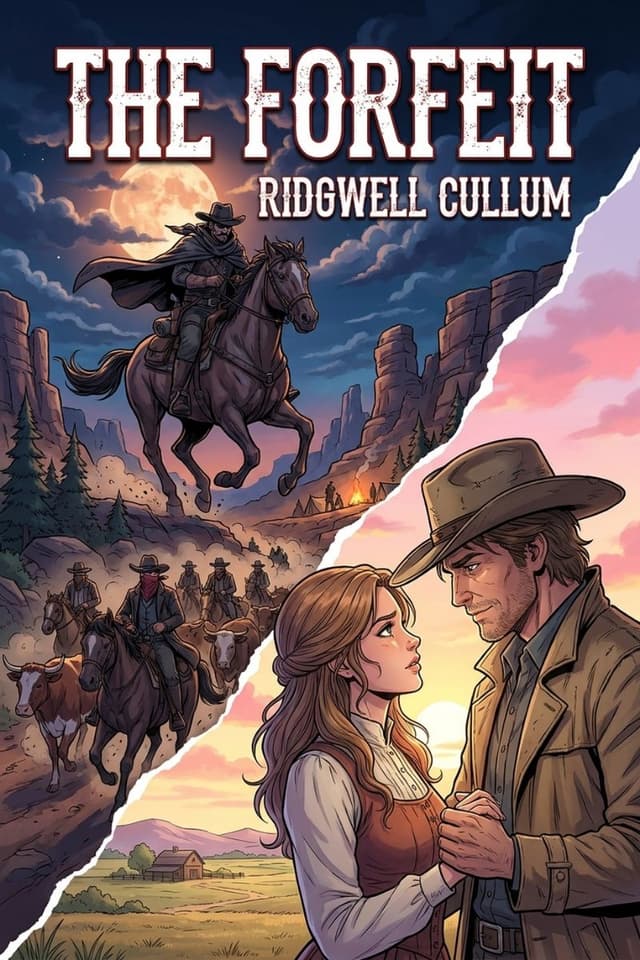
The Forfeit
Read The Forfeit by Ridgwell Cullum for free on Novelhalla, and try out our easy-to-read modern edition of this classic book. You can also download the EPUB and read it on any device if you prefer!
The Plot
Two Men and a Handshake
Jeffrey Masters and Bud Tristram are about to become partners on paper after years of being partners in everything but.
Jeff is young, fair, handsome, and about as flexible as a fence post. He does the figures. He does them at night, over a dead pipe, until they come out right, and they always come out right. Bud is twice his age, six feet three, permanently horizontal in a protesting rocking chair, and constitutionally incapable of worrying about money. Between them they've built two of the best spreads in northwestern Montana out of nothing, and they're about to buy the farm that joins them into one.
Bud has a daughter named Nan who comes in off the trail with dust on her boots and the mail in her hand, and who has been quietly in love with Jeff Masters since she was old enough to know what that meant. She's also smart enough to see what he is. Strong, honest, humorless, and running on a conscience so rigid it's more or less Puritan. She thinks a little human weakness would do him good.
The mail brings Jeff a letter, and his face changes.
The Other Half
The letter is from Ronald. Jeff's twin.
Jeff tries to explain it to Bud and can't quite manage it. He believes something he knows sounds crazy: that when the two of them were born, one nature got split between two bodies, and Ronny got everything Jeff hasn't got. The laughter. The charm. The taste for life. The weakness. Jeff is the cold one who'd rather work than eat. Ronny is the boy nobody can stay angry at.
Jeff says out loud that if anything ever happened to Ronny, everything worth anything in him would die.
Ronny is trapping somewhere in the Cathills, a hundred miles northwest, and he hasn't left a mail address. So Jeff is going to go find him. Bud, who could not care less about the fur, offers to ride along.
The Price of a Man
Twenty miles the other way, in the township of Orrville, Ju Penrose is holding forth behind his bar, and Ju Penrose has a theory. Every man has a price. Make the number big enough and there's nothing you can't buy.
He has a point to prove, because the ranchers' Vigilance Committee has just posted ten thousand dollars for information leading to the capture of the Lightfoot gang, the rustlers who have been helping themselves to Montana beef for five years without one man ever laying eyes on their camp. Ju is certain that money will find its Judas.
Bob Whitstone tells him he's wrong. Bob is the local gentleman failure, a millionaire's son who was disinherited for marrying the woman he wanted and who now has thirty acres of wheat, a two-room sod house, and a nightly saloon habit. He tells Ju that when he finds himself with a price, he hopes he won't live to be paid it.
Then Bob rides home, and his wife has news.
What Effie Found
Effie Whitstone went out that afternoon after a black-tailed deer, chased it further than she meant to, and came over a ridge onto a cattle track no ranch in the district could account for. She followed it. It ended at the lip of a valley, and down in that valley there was a stolen herd, three riders, and a thread of smoke coming out of a bluff.
She found the Lightfoot camp. Nobody in five years has found the Lightfoot camp.
She came home under gunfire and she came home certain of one thing: that ten thousand dollars is hers, and it is going to buy her out of the dirt floor and the cotton ceiling and the two years of grinding poverty she married into. Bob calls it blood money. He tells her she'll never wash it off. She tells him his scruples are just another way of avoiding work, and she is not entirely wrong.
Bob folds, because Bob always folds. He rides out to Dug McFarlane. And that night twenty-five armed ranchers go over the brink of that valley in the dark with a rope and a purpose, and they are riding into the exact stretch of country where Jeff Masters is looking for his brother.
Four Years Later
The Lightfoot business settles into something Orrville talks about the way towns talk about the night they finally did it.
Four years pass. Jeff Masters is a rich and respected man now, and at the polo club races he meets a widow named Elvine van Blooren. She's dark, beautiful, quiet, and expensively dressed, and she has arrived in this part of Montana from somewhere she doesn't discuss. She is very careful about what she says. She has money that nobody can quite account for. And she looks at Jeff Masters the way a woman looks at a door she has been trying to get through her entire life.
Nan Tristram watches this happen and says nothing, because Nan is the sort of person who doesn't.
Jeff is a man with a conscience like a bear trap. He has never in his life forgiven anything, and everyone who knows him knows it, and he is about to marry a woman whose past he has not asked a single question about.
Somewhere in Orrville, Ju Penrose is still behind his bar. Ju has never forgotten a face in his life, and he has been waiting five years for somebody to admit he was right about the price of a man.
About the Author: Ridgwell Cullum
The Name Was Fake and the Life Wasn't
He was born Sidney Groves Burghard in London on August 13, 1867, and Ridgwell Cullum was a pen name he wore so completely that he traveled under it. Almost nothing about his public identity was his actual name, which is a strange thing for a man whose novels are so preoccupied with people living under assumed ones.
Out at Seventeen
He left home around 1885, not yet eighteen, and went to South Africa to prospect for gold in the Transvaal. He came out of that and down to the Cape, where he got caught up in the fighting between British settlers and the Boers.
Then he heard about gold in the Yukon and went north for the Klondike, where by his own account he came very close to starving to death.
Then he crossed the border into Montana and became a cattle rancher, and this time it worked. He made money at it. Some accounts add that he served in the US Army in this period and may have been present during the Sioux troubles at Pine Ridge and Rosebud in 1890 and 1891, though that part is harder to pin down than the rest.
The Late Start
He was thirty-six before he published anything. The Devil's Keg came out in 1903, set in Alberta, and it sold well enough immediately that he quit ranching, moved back to Britain, and wrote full time for the next forty years.
The output was enormous. The Hound from the North. The Night Riders. The Watchers of the Plains. The Trail of the Axe. The Twins of Suffering Creek. The Golden Woman. The Way of the Strong. Roughly a book a year for four decades, nearly all of it set in the emptiest parts of the American and Canadian West, written from an armchair in England by a man who had actually done the work.
The Quiet End
Several of his novels were bought by the silent film industry in the 1910s and 1920s. He stayed private, gave almost no interviews, and left behind a body of work far larger than his surviving reputation. He died on November 3, 1943, at seventy-six, in Torquay, Devon, about as far from a Montana cow camp as it's possible to get.
Fun Facts About the Book
The British Edition Has a Different Name
American readers got it as it appears here in 1917 from George W. Jacobs and Company. British readers got the same novel as The Purchase Price. The two titles pull the story in slightly different directions, and both of them are correct.
There Was a Silent Film
Frank Powell directed a fifty-minute adaptation released in March 1919, starring House Peters, produced by Sunset Pictures and distributed through Pathé. Like most Sunset productions of that era, it is not easy to find today.
The Author Really Ran Cattle in Montana
The reason the ranch detail lands is that Cullum lived it. When Bud says he knows a steer and he knows grass and there isn't a brand in Montana he isn't familiar with, that's a former Montana cattleman writing what he knew. The rustling, the vigilance committees, the grazing guards, the corral politics, all of it is drawn from the real thing rather than from other westerns.
The Vigilance Committees Were Real Too
Montana had a long and genuinely brutal history of ranchers organizing themselves to hang cattle thieves without troubling the courts. A committee of two dozen armed stockmen riding out at midnight with a rope was not a novelist's invention, and Cullum's readers in 1917 knew it.
He Was Enormously Popular and Is Now Nearly Forgotten
Cullum was a bestseller on both sides of the Atlantic for two decades. Almost none of his fifty-odd novels are in print now. The western market moved on to Zane Grey and then to the paperback era, and a British author writing dense, psychological, romance-heavy frontier fiction fell out of fashion completely.
It's a Western That Cares About the Marriage
Half of this book is cattle and gunfire, and the other half is two people sitting in a room not saying what they mean. Cullum spends real time on the interior lives of women who married the wrong men, which is not what most people expect when they open a 1917 rustler novel.
The Twin Thing Is Set Up Very Deliberately
Jeff's speech to Bud about being only half a person without his brother is on the second page of the book, long before anything happens. Cullum plants it that early because he intends to collect on it later.
Themes
Everybody Has a Price
Ju Penrose says it in a saloon in chapter two and the entire novel is an argument with him about it. Bob denies it and finds out. Effie doesn't deny it at all. The book is genuinely interested in the difference between a person who sells something and a person who has never been offered enough to find out what they'd sell.
Blood Money and Whether It Exists
Effie's argument is a good one. Judges get paid. Sheriffs get paid. Hangmen get paid. Why should the person who supplies the information be the only one who works for free? Cullum lets her make the case and doesn't hand the reader an easy answer, which is more than most novels of the period would do.
Poverty Grinds People Down
Two years of a dirt floor turn a young woman who married for love into someone who will trade lives for cash without blinking. Cullum is unusually clear-eyed about this. Effie isn't a villain who arrived that way. The book shows you exactly what made her, month by month.
The Rigid Man
Jeff Masters has never bent on anything in his life, and everyone in the book says so admiringly. Nan is the only one who spots the problem, which is that a man who has never forgiven anything has no idea whether he could. Uncompromising virtue looks like strength right up until the moment it's asked to do something hard.
What You Owe the People You Love
Bud goes into the Cathills for no reason except that Jeff is going. Nan keeps her mouth shut about her own feelings because saying something would cost Jeff his happiness. Bob helps his wife do the one thing he thinks will destroy her. The novel is full of people quietly paying for someone else's decision.
The West as a Place to Disappear
Everyone in this book is running from something eastern. Bob from his father's money. Effie from what her family expected. Elvine from wherever she came from. Cullum, who did his own disappearing at seventeen, understood the appeal of a country where nobody can check your story.
Historical Context
Rustling and Rope Law in Montana
In the 1880s and 1890s the Montana range was too big to police and too valuable to leave alone. Cattle thieves worked in organized gangs, hid stolen stock in the broken country up against the mountains, and were essentially untouchable by any legal authority that existed out there.
What filled the gap was the stockmen's vigilance committee: ranchers pooling money, posting rewards, and taking care of the problem themselves, usually with a rope and always without a trial. It was effective and it was lawless, and the same men who used it wrote the laws of the state afterward.
The moral situation Cullum builds this novel on, where a hanging party is simultaneously the only justice available and an unmistakable act of murder, is not something he softened for fiction. That's how it actually was.
The Book's Legacy
Cullum was one of the biggest names in frontier fiction on both sides of the Atlantic in the 1910s, and this is one of his better-regarded books, mounted on a premise sharp enough that it still works a century later: a reward, a betrayal, and a man whose whole identity is built on never forgiving anyone.
The structure is the interesting part. Cullum spends eight chapters building a self-contained crime story, resolves it, then jumps four years forward and spends the rest of the novel on the consequences that nobody in those first eight chapters knew they were creating. That's a shape modern readers recognize immediately from television. In 1917 it was a real gamble.
What keeps it alive is that it isn't really a western in the shooting sense. The gunfight is the setup. The actual book is about a marriage with a secret inside it, and about whether people can survive being fully known by the person they love. That's a permanent subject, and it's why this one reads far less dated than the year on the copyright page suggests.
For anyone coming to Cullum for the first time, this is a good door in. It's tight, it moves, the dialogue in the saloon scenes is genuinely funny, and the ranch detail is real in a way that only comes from a man who spent years learning it the hard way before he ever wrote a word.