Novelhalla
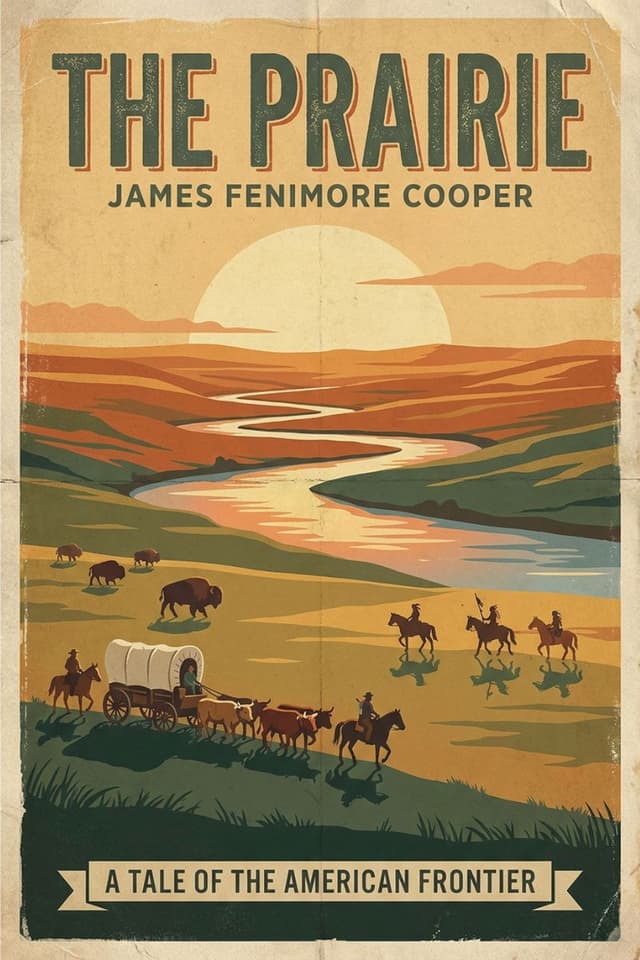
The Prairie
Read The Prairie by James Fenimore Cooper for free on Novelhalla, and try out our easy-to-read modern edition of this classic book. You can also download the EPUB and read it on any device if you prefer!
The Plot
The Old Man on the Prairie
The year is 1805. The Louisiana Purchase has flung open the gates to the West, and Americans are pouring through. One evening, on the vast treeless plains beyond the Mississippi, a wagon train of squatters grinds to a halt as the sun drops below the horizon. Leading this ragged clan is Ishmael Bush, a massive, fierce, lawless man who has dragged his wife Esther, their many sons and daughters, Esther's brother Abiram White, a young woman named Ellen Wade, and a pompous naturalist called Dr. Obed Battius into territory where civilization has no foothold.
They are not alone. Standing against the dying light like something ancient and immovable is a solitary figure: an old trapper, eighty-seven years old, lean and weathered, with a dog named Hector at his side. He has no name that anyone here would recognize. The frontier has known him by a dozen names across a dozen lifetimes. Out here, he is simply the trapper.
He has come west because the forests are gone. The settlements swallowed them. He has walked ahead of civilization his entire life, and now there is almost nowhere left to walk. The prairie is his last country.
Secrets in the Wagon
Something is wrong with the Bush caravan, and the old trapper can feel it. There's a covered wagon that no one is allowed near. Ellen Wade, Esther's niece, moves through the camp like someone trapped, not someone traveling. And after dark, the trapper stumbles onto a secret meeting between Ellen and a young bee hunter named Paul Hover who has followed her out onto the plains.
Before the night is over, a Sioux war party descends and captures the trapper, Paul, and Ellen. They escape, but the raiders strip Ishmael's camp of every horse and head of cattle, stranding the family on a rocky hilltop in the middle of open country with no way forward.
That's when a young army captain named Duncan Middleton rides into camp. He is searching for his wife, Inez, a beautiful young woman kidnapped from Louisiana by none other than Abiram White, Esther's own brother. Inez has been hidden in that covered wagon all along. Middleton has come to get her back, and the old trapper recognizes the young man immediately. He is the grandson of people the trapper knew in another life, decades ago, during the French and Indian Wars.
The lines are drawn. The trapper, Middleton, Paul, and the naturalist will try to free Inez and Ellen from the Bush clan. But the prairie doesn't care about anyone's plans.
Pursued Across Open Country
What follows is a chase that stretches across hundreds of miles of exposed, merciless landscape. The trapper and his allies rescue the women and flee, but Ishmael Bush and his sons are behind them, furious, armed, and relentless. Worse, the Sioux are tracking every party on the prairie with their own designs.
A stampede of wild bison nearly crushes the entire group. Only the ridiculous braying of the doctor's donkey turns the herd at the last second. A wall of prairie fire, set deliberately by the Sioux, threatens to consume them all until the trapper uses an old frontiersman's trick to burn a firebreak and save their lives.
And then there is Hard-Heart. A young Pawnee chief of extraordinary courage and dignity, Hard-Heart emerges from the burned prairie like something out of legend. He and the trapper understand each other immediately, the old man recognizing in this young warrior the same nobility he once saw in friends long dead. Hard-Heart offers sanctuary in his Pawnee village. But the Sioux are closing in from one direction and Ishmael from another, and the river crossing ahead may kill them before either enemy gets the chance.
Captives of the Sioux
They don't make it. Captured by the Sioux and dragged to the village of the chief Mahtoree, the group faces a nightmare of competing claims. Mahtoree wants Inez and Ellen for himself. Ishmael arrives demanding the prisoners he considers his property. Hard-Heart, also a captive now, faces the prospect of torture and death.
The Sioux offer Hard-Heart a way out: an old warrior wishes to adopt him, to make him Sioux and spare his life. All he has to do is renounce his people. The entire village watches to see what the young chief will do.
Meanwhile, the trapper works quietly in the background, translating, negotiating, watching for his moment. He has survived eighty-seven years on this continent by knowing when to talk and when to move. The question is whether talk or movement will be enough this time, with enemies on every side, a murderer hiding within the Bush family, and a reckoning that has been building since long before anyone set foot on the prairie.
A Murder, a Trial, and the Setting Sun
There is a death in the Bush family that no one can explain, and the truth, when it surfaces, will shake Ishmael's brutal certainty to its foundations. There is a battle on the river between nations. There is a judgment delivered on a barren rock under open sky, where the only law is the one a man carries in his own conscience.
And there is the old trapper, who has outlived everyone he ever loved, standing at the edge of the last wilderness left in America, facing a question the land itself seems to be asking: When the frontier is gone, what happens to the men who lived for it?
About the Author: James Fenimore Cooper
A Privileged Beginning
James Fenimore Cooper was born in 1789 in Burlington, New Jersey, the twelfth of thirteen children. His father, William Cooper, was a wealthy landowner and Federalist congressman who founded the settlement of Cooperstown in upstate New York. The family moved there when James was a year old, and he grew up on the edge of the frontier, surrounded by wilderness, Native Americans, and the rough energy of a settlement being carved from the forest.
He entered Yale at thirteen but was expelled after a prank. He then went to sea, first on a merchant vessel and later as a midshipman in the U.S. Navy. Those years on the water gave him the seamanship knowledge that would fuel a whole separate line of sea novels later in his career.
An Accidental Novelist
Cooper didn't set out to be a writer. Legend has it that he was reading an English novel aloud to his wife and declared he could write something better. She dared him to try. His first attempt, a novel of English manners called Precaution, was forgettable. But his second, The Spy, became the first American novel to achieve bestseller status both at home and abroad.
He found his true subject with The Pioneers in 1823, which introduced the frontier scout Natty Bumppo and launched what would become the five-novel Leatherstocking Tales. The Last of the Mohicans followed in 1826 and made Cooper internationally famous. He wrote The Prairie the following year while living in Paris with his family, completing the story of Natty Bumppo's life by sending his hero to die on the western plains.
Europe and Controversy
Cooper lived in Europe from 1826 to 1833, traveling through France, Switzerland, Italy, and Germany. He befriended the painter Samuel Morse and the Marquis de Lafayette, moved in elite intellectual circles, and continued writing prolifically. When he returned to America, he was dismayed by the political changes he found and began publishing social criticism alongside his fiction. This made him deeply unpopular with reviewers and the public, leading to years of bitter libel suits and counter-suits.
Final Years
Despite the controversies, Cooper returned to the Leatherstocking Tales with The Pathfinder (1840) and The Deerslayer (1841), which brought renewed acclaim. He wrote more than thirty novels in all, along with histories, political essays, and travel writings. He died in Cooperstown on September 14, 1851, one day before his sixty-second birthday.
Fun Facts About the Book
Written in Paris
Cooper wrote The Prairie while living in France, thousands of miles from the American plains. He had never actually visited the western prairies and relied on published accounts from explorers and travelers for his descriptions of the landscape. He had, however, made a point of meeting Native American chiefs from western tribes during their diplomatic visits to Washington, and drew on those encounters for his characters.
Natty Bumppo's Farewell (Originally)
Cooper intended The Prairie to be the final Leatherstocking Tale, bringing his famous hero's story to a close. Thirteen years later, public demand and his own renewed interest led him to write two more novels filling in Natty's earlier years. But The Prairie remains the chronological end of the saga, set in the last year of the trapper's life.
Cooper's Dare
The entire Leatherstocking saga exists because of a marital dare. Cooper was reading a novel to his wife, complained he could do better, and she challenged him to prove it. His first attempt flopped. His second became America's first homegrown bestseller. By the time he wrote The Prairie, he was the most famous novelist in America.
The Prairie as Ocean
Cooper had spent years at sea and wrote numerous naval novels. Readers and critics have long noticed that he treats the prairie like an ocean: vast, featureless, isolating, with the small bands of characters tacking toward and away from each other like ships. The landscape becomes a character in itself, indifferent and enormous, making every human conflict feel both urgent and insignificant.
Mark Twain's Famous Attack
Mark Twain's satirical essay "Fenimore Cooper's Literary Offenses" is one of the most celebrated takedowns in American literary history. Twain ridiculed Cooper's plotting, dialogue, and romantic style. But the essay, funny as it is, says more about the gap between Romanticism and Realism than about the actual quality of Cooper's work. Cooper never claimed to be writing realism. He was writing frontier romance, and millions of readers loved him for it.
A Worldwide Hit
The Leatherstocking Tales were translated into dozens of languages and became enormously popular throughout Europe. Balzac praised Cooper's portrayal of nature. The novels inspired adventure fiction in France, Germany, and Russia, and their influence on the Western genre in literature and film is immeasurable.
Themes
The Vanishing Frontier
The Prairie is an elegy for wildness. The old trapper has spent his entire life one step ahead of settlement, and now there is nowhere left to go. Cooper isn't subtle about the cost of westward expansion. The forests are gone. The animals are retreating. The people who knew the land first are being pushed to the margins. The trapper stands as a living monument to something America is in the process of destroying.
Law and Justice in Lawless Country
Out on the prairie, there are no courts, no sheriffs, no written codes. Every group in the novel operates by its own version of justice: the Bush family's brutal self-governance, the Sioux's warrior code, the Pawnee's traditions of honor, the trapper's personal morality shaped by a lifetime in the wild. Cooper asks what justice looks like when there's no institution to enforce it, and the answers are complicated and sometimes terrible.
Civilization vs. Nature
Ishmael Bush represents the worst of what civilization brings west: greed, destruction, the stripping of resources without thought for what comes after. The trapper represents a way of living with the land rather than conquering it. Cooper doesn't romanticize the frontier as paradise, but he makes clear that what's replacing it may be worse.
Noble and Ignoble
Cooper draws sharp contrasts between people of different races, cultures, and stations, but the lines don't fall where you might expect. The most honorable character in the book is a Pawnee chief. The most despicable is a white man. The old trapper, raised partly among Native Americans, bridges both worlds and belongs fully to neither. Cooper's racial attitudes are complicated and sometimes offensive by modern standards, but he consistently argues that character matters more than birth.
Age and Legacy
The trapper is eighty-seven years old. His body is failing but his mind is sharp and his spirit unbroken. The novel asks what a life lived on the frontier amounts to when the frontier itself is disappearing. What does a man leave behind when he has no family, no home, and no country that still looks the way he remembers it?
Historical Context
The Louisiana Purchase
The novel is set shortly after 1803, when the United States purchased roughly 828,000 square miles of territory from France, doubling the size of the nation overnight. The purchase opened the western plains to American settlement and set in motion the displacement of Native American nations that would define the next century of American history. Cooper's characters are among the first wave moving into this new territory, and the novel captures both the thrill and the tragedy of that moment.
The Book's Legacy
The Prairie completes one of the most important character arcs in American literature. Natty Bumppo, introduced as an old man in The Pioneers and followed through war, love, and adventure across five novels, reaches his end on the western plains. His death scene, facing the setting sun, is one of the most iconic moments in nineteenth-century American fiction.
The novel helped establish the literary mythology of the American West decades before the genre we now call the Western even existed. Every frontier hero who followed, from dime novel gunslingers to the protagonists of John Ford films, owes something to Cooper's vision of a solitary figure standing between civilization and wilderness.
The Leatherstocking Tales were wildly popular worldwide, translated into dozens of languages, and inspired generations of adventure writers. Balzac admired them. Scholars have studied them for two centuries. And while Cooper's prose style has its critics (Mark Twain chief among them), the power of his vision, a lone man watching America transform around him, knowing what's being lost, has never stopped resonating.
For modern readers, The Prairie offers something unexpected: an adventure novel that doubles as an environmental lament. Cooper saw, nearly two hundred years ago, what unchecked expansion would cost the American landscape and the people who lived on it. That the novel wraps this insight inside a story of kidnappings, prairie fires, buffalo stampedes, and warfare between nations only makes it more remarkable.