Novelhalla

The Deerslayer
Read The Deerslayer by James Fenimore Cooper for free on Novelhalla, and try out our easy-to-read modern edition of this classic book. You can also download the EPUB and read it on any device if you prefer!
The Plot
Two Men in the Wilderness
In the summer of 1740, two young frontiersmen emerge from the dense forests of colonial New York, making their way toward a pristine lake the settlers call Glimmerglass. They could not be more different.
Hurry Harry March is a giant of a man, loud and reckless, contemptuous of the native peoples he calls "savages." He is heading to the lake to warn his friend Thomas Hutter that Iroquois war parties, allied with the French, are raiding along the frontier. He also hopes to marry Hutter's beautiful daughter Judith, though she has shown little interest in him.
His companion is Natty Bumppo, known to the Delaware people who raised him as Deerslayer. He is young, honest to the point of naivety, and has never killed a man. He has come to meet his closest friend, the Mohican chief Chingachgook, and to help him rescue his beloved, a Delaware maiden called Wah-ta-Wah, who has been taken captive by a Huron war party.
Deerslayer carries a philosophy as distinctive as his name. He believes that every creature must act according to the "gifts" of its nature. A deer runs; a panther kills. A white man follows white ways; a red man follows red ways. Scalping, he insists, is a red gift. No matter how the frontier rewards such trophies, he will never take a scalp himself.
Hurry Harry finds this attitude ridiculous. To him, the only good Indian is a dead one, and a dead Indian's scalp is worth good money.
The Castle on the Lake
Tom Hutter has built two remarkable homes for himself and his daughters. Muskrat Castle stands on wooden piles in the middle of Glimmerglass, reachable only by canoe and defensible against attack. His other dwelling is the ark, a floating house that can be poled around the lake to escape danger.
Hutter is a secretive man with a shadowy past. His two daughters could not be more different. Judith is strikingly beautiful, intelligent, and spirited, with a reputation for being too fond of admiration. Her younger sister Hetty is simple-minded but deeply pious, believing that reading scripture to anyone, even hostile warriors, will turn their hearts toward peace.
When Deerslayer and Hurry Harry arrive, the Hurons are already nearby, and the frontier family must prepare for a siege. The lake that seemed like paradise is about to become a battleground.
A Question of Honor
Hutter and Hurry Harry devise a plan to sneak into the Huron camp at night and take scalps. The colonial government pays bounties for them, and the two men see easy money in murdering sleeping women and children.
Deerslayer refuses to participate. He will defend the castle, he will fight warriors in open combat, but he will not slaughter innocents for profit. It is not, he says, a white gift.
The raid goes badly. Hutter and Hurry Harry are captured, leaving Deerslayer alone to protect the two young women.
In the morning, trying to recover a drifting canoe, Deerslayer encounters a Huron warrior who wants the same boat. They negotiate, they struggle, and finally they fight. Deerslayer kills his first man. But he does not take the scalp. Instead, he tends to his dying enemy with respect, and the warrior, recognizing this honor, gives him a new name: Hawkeye.
The name he will carry for the rest of his life is born from this moment of killing tempered by compassion.
Siege and Rescue
What follows is a cat-and-mouse struggle between the small band of defenders and the Huron war party. Prisoners are taken and ransomed. Chingachgook arrives to help rescue his beloved. Judith Hutter, impressed by Deerslayer's integrity in a world of violent and self-serving men, finds herself falling in love with this strange young frontiersman who seems to want nothing but the freedom of the forest.
The stakes keep rising. Hutter's dark secrets begin to surface. Deerslayer's own life hangs in the balance as the Hurons seek revenge for their fallen warrior.
Through it all, the lake shimmers in the summer sun, beautiful and indifferent, a mirror reflecting both the glory of the wilderness and the violence that humans bring to it. Deerslayer sees God in every ripple of water and rustle of leaves. Others see only opportunity, danger, or profit.
The question the novel poses is whether a man can live by a moral code in a world that rewards brutality. Whether honor means anything when survival is at stake. And whether the pristine wilderness of America can survive the civilization advancing toward it.
About the Author: James Fenimore Cooper
The Founder's Son
James Fenimore Cooper was born on September 15, 1789, in Burlington, New Jersey, the twelfth of thirteen children. His father, William Cooper, was a prominent landowner who founded the settlement of Cooperstown at the source of the Susquehanna River in upstate New York. The family moved there when James was an infant, and he grew up in the wild country that would later inspire his most famous works.
William Cooper was a forceful, ambitious man who carved a community out of the frontier. Young James absorbed the stories of the wilderness, the settlers, and the native peoples who had lived there before. The landscape around Otsego Lake, called Glimmerglass in the novels, became the setting for four of his five Leatherstocking Tales.
Education and Early Life
Cooper entered Yale at thirteen but was expelled after a prank involving a donkey and a professor's chair. His father sent him to sea instead, first on a merchant vessel and then as a midshipman in the United States Navy. Those years gave him the experience that would later fuel his popular sea novels.
In 1811, he married Susan Augusta De Lancey, the daughter of a wealthy New York family. When his father died in 1809 and his inheritance dwindled through poor management and the deaths of his older brothers, Cooper faced financial pressure that would dog him for years.
An Accidental Novelist
According to family legend, Cooper became a writer on a dare. Reading a British novel aloud to his wife, he threw it down in disgust and declared he could write a better one himself. She challenged him to prove it.
His first attempt, Precaution (1820), was a tepid imitation of English domestic fiction. But his second novel, The Spy (1821), set during the American Revolution, became the first American novel to achieve bestseller status both at home and abroad. Cooper had discovered that American settings and American characters could captivate readers as effectively as anything from England.
Creating the American Myth
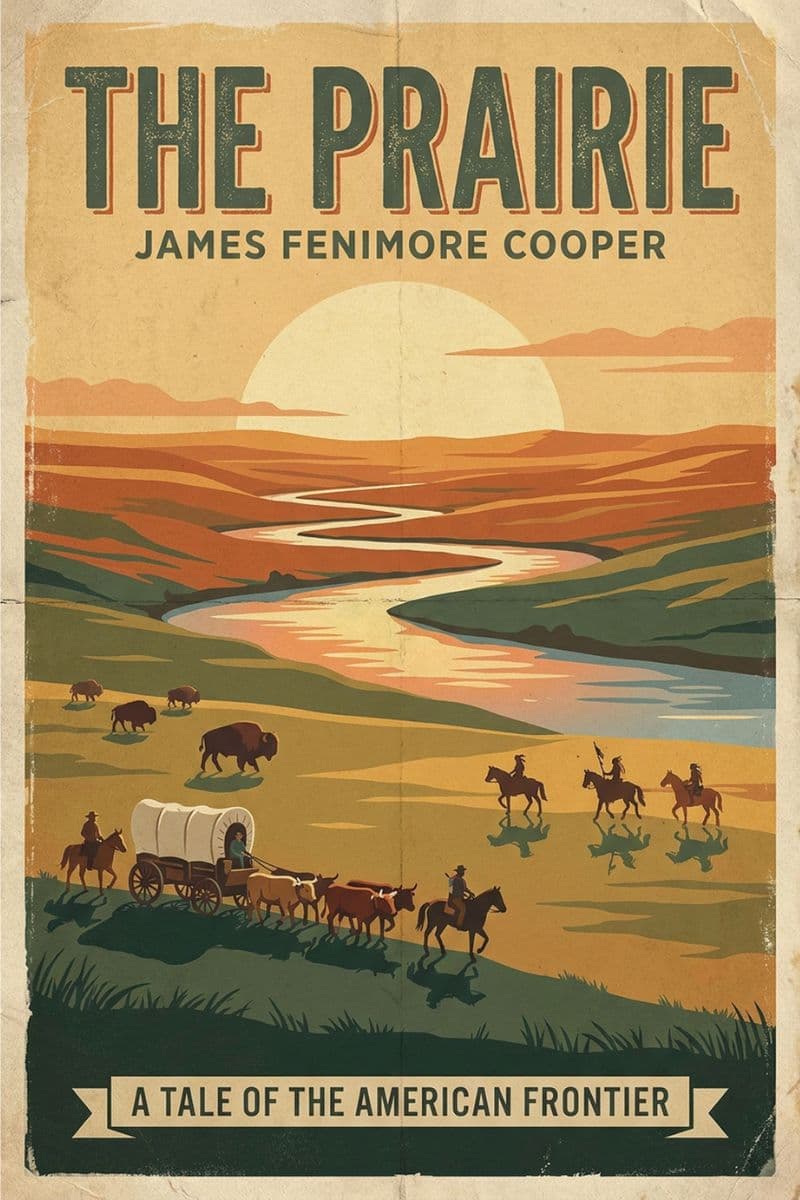
In 1823, Cooper published The Pioneers, introducing the character who would make him famous: Natty Bumppo, an aging frontiersman caught between the wilderness he loves and the civilization encroaching upon it. Readers were fascinated, and Cooper continued the story in The Last of the Mohicans (1826), which became his most popular work, and The Prairie (1827), in which the elderly Natty dies facing the western sunset.
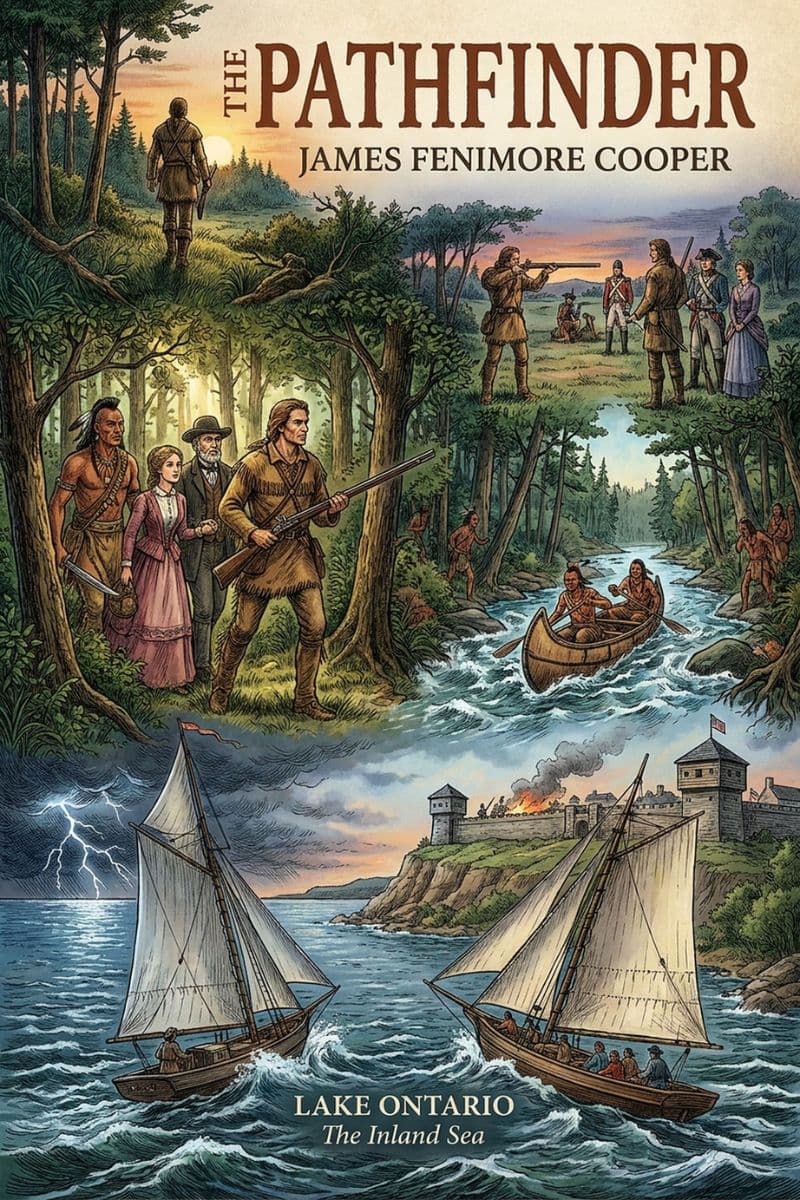
Cooper thought he had finished with the character, but public demand and financial necessity brought him back. The Pathfinder (1840) showed Natty in middle age, and The Deerslayer (1841) returned to his youth, completing the saga that spans sixty years of American frontier life.
Later Years
Cooper spent seven years in Europe (1826-1833), where he wrote several novels and developed increasingly critical views of both European aristocracy and American democracy. Upon returning home, he became embroiled in bitter disputes with neighbors, newspapers, and critics. His social criticism alienated many readers who had loved his adventure tales.
He continued writing prolifically until his death on September 14, 1851, one day before his sixty-second birthday, at Cooperstown. He produced over thirty novels, plus histories, travel books, and political essays. His sea novels were as influential in their genre as his frontier tales.
Fun Facts
The Last Written, First in Time
Although it was the fifth and final Leatherstocking Tale to be written, this novel is the first chronologically, showing Natty Bumppo as a young man who has never killed. Cooper returned to his hero's youth eighteen years after seemingly ending the series with Natty's death in The Prairie.
Glimmerglass Is Real
The lake in the novel is based on Otsego Lake in upstate New York, near the town Cooper's father founded. Cooper grew up on its shores and knew its waters intimately. The descriptions of the lake's beauty reflect his genuine love for the landscape of his childhood.
A Critical Battleground
Mark Twain's famous 1895 essay "Fenimore Cooper's Literary Offenses" used this novel as its primary target, claiming that Cooper violated 114 rules of literary art in two-thirds of a page. Twain's devastating wit shaped popular opinion of Cooper for generations.
But D.H. Lawrence, writing in 1923, called the same book "one of the most beautiful and perfect books in the world: flawless as a jewel and of gem-like concentration." The novel has always divided readers between those who find it tedious and those who find it sublime.
Schubert's Dying Wish
The Austrian composer Franz Schubert was such a devoted fan of Cooper's novels that on his deathbed, he reportedly asked for more of them to read.
Many Names for One Man
The hero is called Deerslayer at the start because he has only hunted animals. After killing his first man, the dying Huron warrior names him Hawkeye in recognition of his marksmanship and honor. Throughout the five Leatherstocking Tales, he is also known as Leatherstocking, Pathfinder, La Longue Carabine (Long Rifle), and simply "the trapper."
Film Adaptations
The novel has been adapted for film numerous times, beginning with a 1913 silent version actually filmed at Otsego Lake. A 1920 German silent film featured Bela Lugosi as Chingachgook. Later versions appeared in 1943, 1957, 1978, and as part of various television series.
The Prequel to a Classic
Readers who know Cooper only from The Last of the Mohicans may not realize that this novel introduces the same characters in their youth. Chingachgook appears here as a young chief seeking to rescue his beloved, and his future son Uncas is mentioned in the epilogue.
Themes
The Birth of a Warrior
The novel's subtitle, "The First War-Path," announces its central concern: how does a man become a killer? Deerslayer begins as someone who has never taken human life. By the novel's end, he has killed, but on his own terms. He refuses to scalp, refuses to murder innocents, refuses to abandon his principles even when survival might demand it. His evolution suggests that violence need not corrupt if it is bounded by honor.
Civilization vs. Wilderness
The pristine lake represents a paradise that cannot last. Cooper knew, writing in 1841, that the wilderness he described had already vanished. The novel is elegiac from its first pages, mourning a world being devoured by the advancing frontier. Deerslayer himself is caught between two worlds, raised by the Delaware but born white, belonging fully to neither civilization nor wilderness.
Moral Codes in Conflict
The novel presents competing ethical systems. Deerslayer's code of "gifts" suggests that different peoples should follow different ways. Hetty's Christian faith insists that scripture can convert anyone. Hurry Harry's brutal pragmatism dismisses all natives as subhuman. Hutter's lawless past suggests that the frontier attracts those fleeing civilized morality. None of these codes is entirely adequate to the complex situations the characters face.
The Critique of Racism
While Cooper's portrayal of native peoples reflects nineteenth-century attitudes that modern readers will find troubling, the novel is surprisingly critical of frontier racism. Hurry Harry's contempt for Indians is presented as ignorant and cruel. Deerslayer's respect for his Huron enemy, and his deep friendship with Chingachgook, offer an alternative model of cross-cultural relationship, even as Cooper's language reveals the limitations of his era.
Nature as Sacred
For Deerslayer, the wilderness is a cathedral. He sees God in the shimmer of the lake, the breath of wind, the light filtering through leaves. This pantheistic reverence for nature anticipates the American Transcendentalists and the later conservation movement. The novel suggests that something sacred is lost when civilization replaces wilderness.
The Book's Legacy
James Fenimore Cooper essentially invented the American frontier novel. Before him, American writers looked to England for their models and settings. Cooper proved that American landscapes, American history, and American character types could be the stuff of literature. Every Western novel, every frontier film, every tale of a lone hero caught between civilization and wilderness owes something to the Leatherstocking Tales.
Natty Bumppo became the template for the American hero: self-reliant, honest, skilled in woodcraft, uncomfortable with civilization's constraints, more at home with his native companion than with his own people. This figure reappears endlessly in American popular culture, from the Lone Ranger to Han Solo.
The novel also established themes that would preoccupy American literature for generations: the loss of wilderness, the encounter between European and native cultures, the tension between individual freedom and social order, the question of whether violence can ever be moral.
Mark Twain's attack damaged Cooper's reputation among literary critics, but readers have never entirely abandoned him. The Leatherstocking Tales remain in print, are taught in schools, and continue to inspire adaptations. For all their nineteenth-century conventions, they capture something essential about the American imagination: the dream of a wilderness paradise and the knowledge that we have already lost it.