Novelhalla
My Ántonia
Read My Ántonia by Willa Cather for free on Novelhalla, and try out our easy-to-read modern edition of this classic book. You can also download the EPUB and read it on any device if you prefer!
The Plot
My Ántonia is a novel of memory and longing, told by a man looking back at his childhood on the Nebraska prairie and the remarkable immigrant girl who came to represent everything he loved and lost about that vanished world.
Arrival on the Prairie
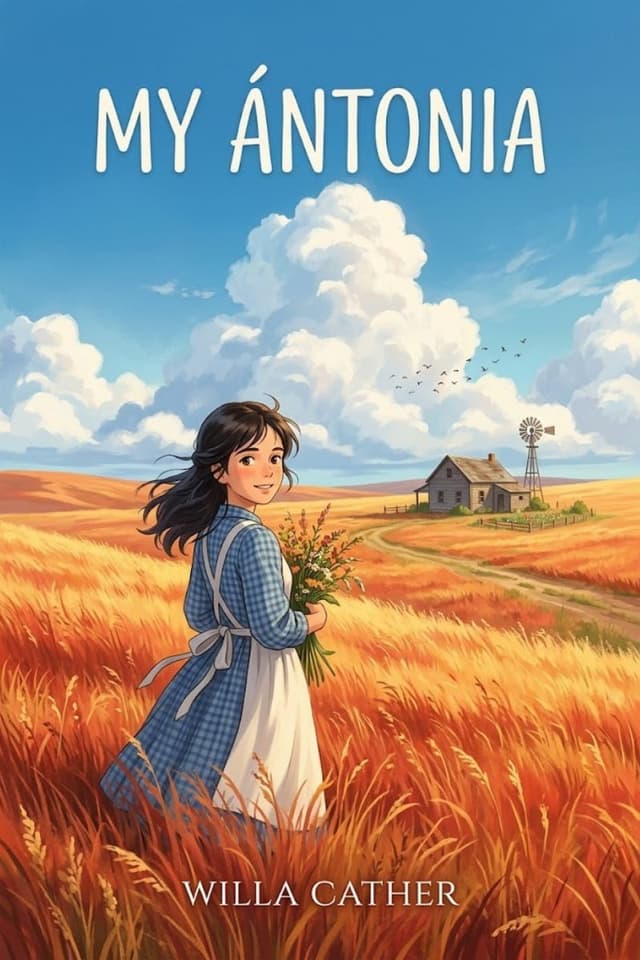
In the late 1880s, ten-year-old Jim Burden, newly orphaned in Virginia, travels by train across the country to live with his grandparents on their farm in Nebraska. On the same train is a Bohemian immigrant family, the Shimerdas, who are moving to the same region. The eldest daughter, Ántonia, is four years older than Jim, bright-eyed and eager despite the exhaustion of the long journey from Europe.
Jim's grandparents live in a comfortable farmhouse on the open prairie. The Shimerdas, who have been swindled by a fellow countryman, occupy a crude dugout carved into the earth, barely adequate shelter against the brutal Nebraska winters. Jim is overwhelmed by the vastness of the landscape, the endless grass, the enormous sky. He feels as if he has been dropped into another world.
Childhood Friendship
Jim and Ántonia quickly become friends. Her father, Mr. Shimerda, a refined man who played violin in the old country, asks Jim to teach his daughter English. The two children spend their days exploring the prairie together. Jim rides his pony while Ántonia walks beside him. They discover prairie dog towns and kill rattlesnakes. Jim teaches her words; she teaches him to see the land through different eyes.
The Shimerdas struggle through their first Nebraska winter. Mr. Shimerda, a gentle soul who never wanted to leave Bohemia, grows increasingly depressed. He misses his friends, his music, the familiar landscape of home. One January day, he takes his gun to the barn and shoots himself.
The suicide devastates the family and the community. Because Mr. Shimerda was Catholic and took his own life, there is disagreement about where he can be buried. He is finally laid to rest at the corner of his property, where two roads cross. For years afterward, Jim visits that grave, watching it become a small island of tall red grass as the country around it is plowed and fenced.
The Town
When Jim is thirteen, his grandparents decide to move into the town of Black Hawk so he can attend school more easily. Shortly afterward, Ántonia takes a job as a hired girl for the Harlings, a prosperous family who are neighbors of the Burdens. Jim sees her regularly again, and their friendship resumes.
Ántonia loves to dance. When a dancing pavilion opens in town, she and the other immigrant hired girls go every night they can. These girls, Norwegian and Bohemian and Swedish, have a vitality and joy that the proper town daughters lack. Jim is drawn to them, especially to Ántonia, but she tells him she can only think of him as a younger brother.
Mr. Harling forbids Ántonia to go to the dances, and when she refuses to stop, she loses her position. She goes to work for Wick Cutter, a sinister moneylender. Jim, who has developed a romantic attachment to Ántonia, tries to warn her, but she dismisses his concerns.
Leaving
Jim graduates from high school and prepares to leave for the University of Nebraska in Lincoln. Before he goes, he gathers with Ántonia and her friends for one last picnic in the country. They watch the sun set over the prairie, and Jim sees a plow left in a field silhouetted against the enormous red disk of the sun, an image of the pioneer life that is already passing away.
At the university, Jim throws himself into his studies, particularly the classics. He encounters Lena Lingard, one of the hired girls from Black Hawk, who has become a successful dressmaker in Lincoln. They begin a relationship that distracts Jim from his work. Eventually, he transfers to Harvard to make a fresh start.
While Jim is away, Ántonia becomes engaged to a railroad conductor named Larry Donovan and follows him to Denver. Days before the wedding, he abandons her. She returns to Nebraska, pregnant and humiliated. She gives birth to a daughter and goes back to work on her family's farm, doing the hard labor of a man.
Return
After graduating from Harvard and attending law school, Jim returns to Nebraska to visit his grandparents. He hears what has happened to Ántonia and drives out to see her. He finds her weathered by work and sorrow but unbroken in spirit. She shows him her baby daughter with pride. They spend a day together, and Jim leaves promising to return soon.
Twenty years pass. Jim becomes a successful lawyer in New York City. His marriage is unhappy and childless. He thinks often of Nebraska and of Ántonia but cannot bring himself to go back.
Finally, encouraged by a mutual friend, Jim returns to Nebraska and visits Ántonia on the farm where she lives with her husband, Anton Cuzak, a fellow Bohemian immigrant. They have a large brood of children, a fruit orchard, a cellar full of preserves. Ántonia has aged, but she has not lost what Jim calls "the fire of life." Her children adore her. Her husband, though worn down by hard work, is content.
Jim spends two days with the Cuzak family, playing with the children, listening to stories, remembering the past. When he leaves, he walks along the old road that once led to his grandparents' farm, now overgrown. He realizes that he and Ántonia possess together the incommunicable past.
About the Author: Willa Cather
Virginia Childhood
Willa Cather was born on December 7, 1873, in Back Creek Valley, Virginia, near Winchester. She was the eldest of seven children born to Charles Cather, a farmer, and Mary Virginia Boak, a former schoolteacher. Her early years were spent on her family's farm, Willowshade, in the lush hill country of the Shenandoah Valley.
When Willa was nine years old, her family joined relatives who had already moved to Nebraska. The journey west and the shock of the flat, treeless prairie left a permanent impression on the child. She later described her first sight of Nebraska as "a kind of erasure of personality," as if she had been dropped onto a blank page.
Nebraska
After eighteen months on a homestead farm, the Cather family moved into the town of Red Cloud, where her father opened a real estate and insurance business. Red Cloud would become Black Hawk in My Ántonia and serve as the setting for much of Cather's fiction.
In Red Cloud, Cather found the material that would fuel her writing life. She rode her pony to visit immigrant families in the countryside, listening to their stories, absorbing their languages and customs. She befriended the Bohemian, Swedish, Norwegian, and German families who were breaking the prairie sod. Among these neighbors was Annie Sadilek, a Bohemian girl who worked as a hired girl for one of Cather's closest friends and who would become the model for Ántonia.
Cather was an unusual child who resisted conventional femininity. For a time, she cut her hair short, wore boys' clothes, and signed her name "William Cather, M.D." She dreamed of becoming a doctor. She also read voraciously, devouring the classics and Russian novels in the attic room that was her refuge.
Education and Early Career
At sixteen, Cather left Red Cloud for the University of Nebraska in Lincoln, where she intended to study medicine. When a professor submitted one of her essays to a local newspaper without her knowledge and she saw her words in print, she changed course. She would become a writer.
At the university, Cather wrote theater and music criticism for the Nebraska State Journal. Her strong opinions and sharp prose made her a local celebrity. After graduating in 1895, she moved to Pittsburgh, where she worked as a magazine editor and later as a high school English teacher.
In Pittsburgh, Cather formed a close friendship with Isabelle McClung, a wealthy woman in whose family's home Cather lived for several years. She began publishing short stories and her first book of poems, April Twilights, in 1903. Her short story collection The Troll Garden followed in 1905.
New York and the Great Novels
In 1906, Cather moved to New York City to work for McClure's Magazine, eventually becoming its managing editor. It was a prestigious position, but the demands of the job left little time for her own writing. The novelist Sarah Orne Jewett, whom Cather met during this period, advised her to leave journalism and find her own voice.
Cather took the advice. In 1912, she resigned from McClure's and published her first novel, Alexander's Bridge. But it was her next book, O Pioneers! (1913), set on the Nebraska prairie of her childhood, that established her as a major American writer. The Song of the Lark (1915) followed, and then My Ántonia (1918), which many consider her masterpiece.
Later Years
The 1920s brought Cather both acclaim and honors. She won the Pulitzer Prize in 1923 for One of Ours, a novel about a Nebraska farm boy who dies in World War I. A Lost Lady (1923) and The Professor's House (1925) cemented her reputation. Death Comes for the Archbishop (1927), set in the Southwest, is often ranked among her finest work.
Cather lived for nearly four decades in New York City, sharing an apartment with her companion Edith Lewis, an editor who had been her friend since their university days. She was fiercely private, destroying many of her letters and forbidding quotation from those that survived. Her will prohibited adaptations of her novels.
In her later years, Cather grew increasingly distressed by the changes she saw in American society. She believed that the pioneer spirit she had celebrated was being destroyed by commercialism and modernity. Her final novel, Sapphira and the Slave Girl (1940), returned to the Virginia of her earliest childhood.
Willa Cather died in New York City on April 24, 1947, at the age of seventy-three. She was buried, as she wished, in Jaffrey, New Hampshire, a town she had loved and visited every year since 1916.
Fun Facts About the Book
Based on a Real Person
Ántonia is closely based on Annie Sadilek Pavelka, a Bohemian immigrant girl Cather knew in Red Cloud. Like Ántonia, Annie's father committed suicide during the family's first winter in Nebraska. Like Ántonia, Annie was abandoned by a railroad man and returned home pregnant. She later married a Czech farmer and had a large family. After the novel was published, Annie's husband would introduce himself as "the husband of My Ántonia," and one of her sons would say until he was an old man, "I'm Leo, the mischievous one." Annie herself wrote to a schoolgirl in 1955 that "most all is true that you read in the Book thoug most of the names are changed."
Cather's Personal Favorite
Cather said that if she had written only one thing in her life, it would have been My Ántonia. The story of Mr. Shimerda's suicide had haunted her since childhood, when she first heard about the real Francis Sadilek's death shortly after her family arrived in Nebraska. She told that story in her very first published piece of fiction, written as a college freshman.
Praised on Publication
My Ántonia was acclaimed from the moment it appeared. H.L. Mencken, the influential critic, called it "sound, delicate, penetrating, brilliant, charming" and said he knew of no novel that made the people of the western prairies more real. Randolph Bourne, in one of his last reviews before dying in the 1918 influenza epidemic, wrote that "here at last is an American novel, redolent of the western prairie, that our most irritated and exacting preconceptions can be content with."
A Radical Choice
Popular American novels of the time featured upper-class characters in polished settings. Cather's decision to make her heroine an immigrant hired girl was considered a bold artistic move. She elevated people who had been invisible in serious literature and made them the heart of an American classic.
The Male Narrator
Though Cather was a woman, she chose to tell the story through a male narrator, Jim Burden. Many elements of Jim's life parallel Cather's own: the move from Virginia to Nebraska as a child, the love of the classics, the career in the East. Some scholars see Jim as Cather's way of expressing feelings she could not voice directly.
Cather's Return
Like Jim Burden, Cather lost touch with the real Ántonia for many years. In 1915 or 1916, she visited Annie Sadilek Pavelka on her farm and found her surrounded by children and happily married. This reunion inspired the final section of the novel, in which Jim returns to find Ántonia fulfilled and content.
No Adaptations
Cather's will forbade dramatizations or adaptations of her novels. She believed that her stories depended on language and could not be translated to other media. A 1995 television movie of My Ántonia was made only after lengthy negotiations with the Willa Cather Trust.
The Pronunciation
The accent over the first letter of Ántonia indicates the Czech pronunciation of the name, with stress on the first syllable: AN-toh-nee-ah. In the novel, Jim notes that when Americans say the name with the accent on the second syllable, "they couldn't make it sound quite right."
Themes
Memory and the Past
My Ántonia is fundamentally a novel about remembering. Jim Burden writes his memoir as a middle-aged man looking back at his childhood, and his narrative is shaped by nostalgia, longing, and loss. The past appears more vivid and meaningful than the present. Cather suggests that our deepest selves are formed in childhood and that we spend our adult lives trying to recover what we have lost.
The Immigrant Experience
The novel portrays the struggles and triumphs of European immigrants on the American frontier. The Shimerdas face poverty, language barriers, cultural isolation, and the devastating loss of Mr. Shimerda to suicide. But Ántonia and her family also bring vitality, music, and a connection to old-world traditions that enrich the prairie communities. Cather celebrates the immigrant contribution to American life while showing its costs.
The Land
The Nebraska prairie is almost a character in the novel. Jim describes his first sight of it as a kind of obliteration: "I felt erased, blotted out." But he comes to love the vast sky, the changing seasons, the wild grasses. The land shapes everyone who lives on it. Ántonia's strength comes from her connection to the soil she works. The novel mourns the passing of the wild prairie as it is tamed and fenced.
Pioneer Spirit
The novel celebrates a particular moment in American history, the era when settlers broke the prairie and built new lives from nothing. Cather sees this pioneer generation as heroic, possessed of courage and vitality that later generations lack. The famous image of the plow silhouetted against the setting sun captures this theme: the pioneer achievement is magnificent but fleeting.
Gender and Work
Ántonia defies conventional gender roles. After her father's death, she works in the fields like a man, proud of her strength and endurance. Even when this hard labor coarsens her, she maintains her essential self. Cather presents women's work, whether in fields or kitchens, as valuable and dignified. The hired girls have more life in them than the respectable town daughters who never have to labor.
Friendship and Love
The relationship between Jim and Ántonia is complex and never fully resolved. Jim loves Ántonia, but whether romantically or as a symbol of his lost youth remains ambiguous. She tells him she can only think of him as a younger brother. They take different paths through life but remain connected by their shared past. Cather suggests that some relationships cannot be defined by conventional categories and that the deepest bonds are formed in childhood.
Success and Fulfillment
Jim becomes a successful lawyer but is unhappy in his marriage and feels unfulfilled. Ántonia endures hardship and disgrace but finds contentment as a farm wife and mother of many children. Cather questions conventional definitions of success, suggesting that material achievement and social respectability matter less than love, family, and connection to the land.
The Book's Legacy
My Ántonia was immediately recognized as a masterpiece and has remained central to American literature for over a century. It established Cather as one of the major novelists of her generation and brought the Great Plains into the American literary imagination.
The novel helped legitimize regional literature as serious art. Before Cather, novels set in the rural Midwest were often dismissed as provincial. My Ántonia demonstrated that the lives of immigrant farmers could be as rich and meaningful as those of Boston Brahmins or New York socialites.
Cather's portrait of Ántonia created one of the most memorable characters in American fiction. Ántonia joins Hester Prynne, Huck Finn, and Jay Gatsby in the pantheon of figures who embody something essential about the American experience. She represents resilience, vitality, and the immigrant contribution to national identity.
The novel influenced later writers who explored memory, place, and the American past. Its lyrical prose style and its structure as a series of remembered episodes rather than a tightly plotted narrative offered a model for fiction that values texture over action.
My Ántonia has been translated into more than forty languages and remains widely read and taught. It speaks to anyone who has ever felt nostalgia for a lost home or wondered what became of the people they knew in childhood. Cather's evocation of the prairie landscape, her celebration of ordinary heroism, and her meditation on time and memory continue to move readers more than a century after the novel first appeared.
For Cather, the book held special meaning. She believed that an artist's materials must come from impressions formed before adolescence. My Ántonia was her attempt to capture those early impressions, to preserve the world of her Nebraska childhood before it vanished completely. In giving that world to readers, she achieved a kind of immortality for the people and places she loved.