Novelhalla
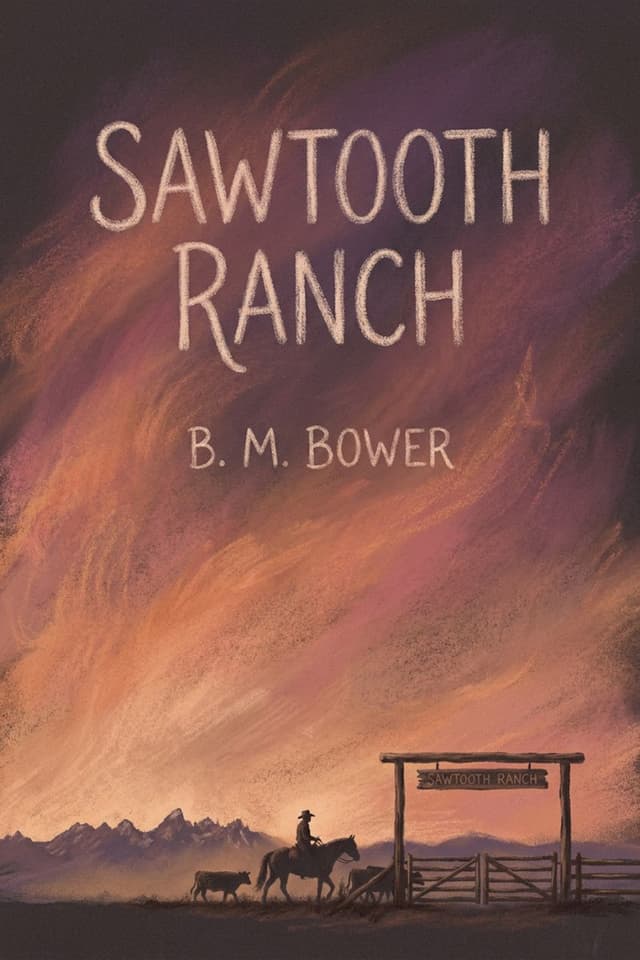
Sawtooth Ranch
Read Sawtooth Ranch by B. M. Bower for free on Novelhalla, and try out our easy-to-read modern edition of this classic book. You can also download the EPUB and read it on any device if you prefer!
The Plot
A Cattle King's Daughter (In Her Own Mind)
Lorraine Hunter has told everyone in Los Angeles that she's a Western girl. Her father, she says, is a cattle king in Idaho whose herds feed on a thousand hills. She's ridden horses since before she could walk. She can spot the landmarks of his range in the background of the movies she watches.
Almost none of it is true. Lorraine has spent her life in the Casa Grande, a shabby apartment house her mother runs, with peeling pillars out front and the smell of other people's cooking in the hallway. What she does have is three years of work in silent Westerns, including a sixteen episode serial called "The Terror of the Range." She's learned to gallop a very docile horse, dance what passes for a square dance on camera, and thrill to men dying in gobs of red paint. She knows her West the way anyone knows a thing they've only ever seen on a screen.
Then her mother announces a new husband, and Lorraine announces she's going to Idaho.
Twenty Miles of Sagebrush
Echo, Idaho, turns out to be a poor imitation of every Western set she's ever stood on. No father waiting. No cowboys at the hitch rails. The liveryman's teams are all out and won't be back for days, so Lorraine, who belongs to a hiking club and has walked farther than this for fun, decides to walk the twenty miles to her father's ranch.
She's four hours into the sage when the wind comes up cold, and the sky behind her starts to fill with something enormous. She's seen stage lightning. She knows exactly how it's made. She's never once believed a storm could kill anybody.
Ahead of her, in the last of the light, sit the square black shapes of her father's ranch buildings. She runs for them. When the sky splits open and lights the whole world white, she sees that they aren't buildings at all.
What the Lightning Shows Her
She's still crouched in the rocks when a horseman rides into view between two boulders, and a gun goes off.
What Lorraine sees in the next few flashes is a man on the ground, another man working fast over him, a boot forced through a stirrup, and a quirt coming down hard on a horse's rump. Then a horse going past her down the road at a gallop with something bouncing along beside it.
By morning she's soaked, feverish, out of her head, and babbling to a young Sawtooth rider named Lone Morgan about a murder he'd very much prefer to believe she dreamed.
Everyone Would Rather She Dreamed It
Here's what makes this country what it is. Brit Hunter and his partner Frank Johnson run the Quirt, a section and a half of land and maybe three hundred head, surrounded on nearly every side by the Sawtooth Cattle Company. The Sawtooth counts its cattle in the tens of thousands. Its president is Bill Warfield, a state senator, a booster, a benefactor, a man who lifts his hat politely to the small ranchers he intends to swallow. He owns the land. He also, as Brit puts it, owns the sheriff, the coroner, the judge, and the stock inspector.
Small outfits around here have a way of ending. Some sell out. Some go to the penitentiary as cattle thieves. And some die by accident, and a coroner's jury agrees that's exactly what happened.
When Lorraine finally recovers enough to be delivered to her father's grimy two room cabin, she discovers that everyone she tells about that night gives her the same careful advice. Forget it. Keep quiet. You were sick, you imagined it, and a stranger who talks like that gets talked about.
Then a man rides into the Quirt yard while Lorraine is home alone, asks a lot of easy questions about exactly where she spent the night of the storm, and takes off his brown hat to show her how ordinary it is.
The Little Fishes
There's a Swedish government hunter named Swan Vjolmar wandering the hills with a dog named Yack, grinning at everybody, saying strange things about words that arrive in his head, and looking very closely at a dead man's saddle. There's Lone Morgan, who was raised in feud country and taught that other men's business is other men's business, and who is finding that principle harder to hold onto than it used to be. There's Bob Warfield, the owner's son, who thinks women are all the same and thinks well of himself besides. And there's a girl who has spent three years being kidnapped and rescued in front of a camera, sitting in a cabin with no books and no neighbors, slowly working out that the only person in this valley refusing to accept the official story is her.
Lorraine wanted the real West. What she's found is a range war being run quietly, legally, and very patiently, by men who never have to fire a shot in daylight.
About the Author: B. M. Bower
Bertha Muzzy
She was born Bertha Muzzy in Minnesota in November 1871, and her family moved west to Montana at the end of the 1880s. She taught school, married Clayton Bower at around nineteen, and had three children. The marriage was not a happy one, and money was always short. The family ended up in a hayfield cabin about a mile outside Big Sandy, Montana, which she nicknamed Bleak Cabin.
That country is where she learned the material that made her career. Big Sandy in the 1890s meant open range, roundups, and cowboys, and she paid attention to all of it: brands, horses, the specific way working men talk when nobody important is listening.
Becoming B. M. Bower
She started writing short stories around 1900, partly to get some money of her own. Her breakthrough was Chip, of the Flying U, serialized in Popular Magazine and then published as a novel with illustrations by her Montana friend Charles M. Russell, the cowboy artist. It was a hit on the scale of The Virginian.
The initials were deliberate. Publishers doubted readers would buy range fiction from a woman, so she stayed B. M. Bower, and for years plenty of her fans assumed she was a man. She left her first marriage, married the Western writer Bertrand Sinclair, and later married a third time, to Robert Ellsworth Cowan. She kept the pen name through all of it.
The Working Novelist
Bower wrote at a professional clip for the rest of her life, producing somewhere between fifty seven and sixty eight novels depending on who's counting, plus a mountain of short fiction. She eventually settled in Los Angeles, where roughly twenty of her books and stories were turned into films, and she did screen work herself. She had a famously unromantic view of frontier life, once describing it as ninety percent monotonous isolation and ten percent thrill.
She died in Los Angeles in July 1940, at sixty eight. She had made and lost a great deal of money. She had also, more or less single handedly, proven that a woman could write commercially successful Westerns for thirty five straight years.
Fun Facts About the Book
It Has Two Names
American readers got this story in 1920 under the title "The Quirt," named for the little ranch at the center of it. When Methuen published it in Britain the following spring, they renamed it after the big outfit instead, and that's the version many readers know today. Same book, two titles, and the swap quietly changes whose story you think you're about to read.
She Was Writing About Her Own Industry
By 1920 Bower had been watching her own work get turned into silent Westerns for years, and she was not starry eyed about it. She'd already spent a whole novel, The Phantom Herd, satirizing a movie crew trying and failing to capture the real West on film. Lorraine's education as a movie cowgirl isn't invented from the outside. It's an insider's joke.
The Villain Is a Politician
Bower's bad guy isn't a rustler in a black hat. He's a state senator who also runs a reclamation company, cultivates a reputation as the region's benefactor, and does his damage through land patents, leases, and a friendly coroner's jury. For a 1920 Western, that's a startlingly modern choice of monster.
The Real West Is Boring, On Purpose
Bower spends real page space on how little there is to do at the Quirt. Lorraine reads a horse doctor book out of desperation, then shops an entire mail order catalog for fun. It's a joke, and it's also Bower's honest position on frontier life, which she never romanticized the way her competitors did.
A Hero Trained Not to Get Involved
Lone Morgan's whole moral education comes from growing up next to a Blue Ridge feud, where the family rule was to mind your own business and let others do the same. Bower gives her cowboy hero the exact temperament that lets a place like the Sawtooth country function, then drops a witness in his lap.
Swan
The Swedish government hunter is one of Bower's odder inventions: enormous, cheerful, apparently guileless, tracking coyotes across the hills with a dog named Yack, and claiming that information sometimes just arrives in his head. Watch what he does when nobody's looking.
The Girl Isn't a Damsel
Lorraine walks twenty miles into open country carrying her own bag rather than wait two days for a wagon. Her problem isn't weakness. It's that her entire model of how the world works came out of a projector.
Themes
The Manufactured West Versus the Real One
The book's central joke, and eventually its central argument, is the gap between the West as entertainment and the West as a place where people actually live. Lorraine arrives with a head full of posses and bandits and finds gray sage, tired men in overalls, and a violence so quiet nobody will say it out loud. Bower is writing a Western about how Westerns lie.
Power That Wears the Law Like a Coat
The Sawtooth doesn't need outlaws. It has patents, leases, a reclamation company, and a senator, plus the sheriff and the coroner and the judge. Bower's interest is in what happens to justice in a place where every institution answers to the same man, and how ordinary people learn to describe that situation as bad luck.
Minding Your Own Business
Nearly every decent character in the book is committed to not getting involved, and every one of them has good reasons. Silence is how they've survived. Bower treats that survival instinct seriously rather than sneering at it, which is what makes the pressure on it interesting.
The Little Fishes
The opening frames the whole story: small fish sharing a pool with big ones, disappearing now and then, while the others dart around and stay. It's a book about the economics of consolidation, told through people who own a section and a half and three hundred cows.
What Loneliness Does to People
Brit's wife left because she couldn't stand the isolation. Brit stayed and got quiet and bitter. Swan talks to himself because there's nobody else. Lorraine nearly loses her mind from having nothing to read. Bower keeps circling the psychological cost of empty country.
An Imagination Is Worth Something
Everyone in the valley treats Lorraine's movie-fed head as a liability, and mostly it is. But she's also the only person in the country who still believes a story can have a different ending, and Bower is careful not to make that ridiculous.
Historical Context
By 1920 the open range Bower had known in Montana was gone, replaced by fenced holdings, federal grazing leases, irrigation and reclamation schemes, and the kind of businessman-politician who could turn all of it into leverage. At the same time, the Western had become a mass entertainment product, with serials and two reelers pumping out cowboys by the hundred for audiences who'd never seen a cow. This book sits exactly on that seam. It's a story about the death of the small rancher, written by someone who'd watched it happen, aimed at readers whose idea of ranching came from a movie theater.
The Book's Legacy
Bower is remembered mostly for the Flying U books, the cheerful Montana comedies that made her name, which means this darker, stranger novel tends to get overlooked. Readers who find it are usually surprised by how sour it is about power and how funny it is about Hollywood.
Its real interest now is as an early meta-Western. Decades before revisionist Westerns made a genre out of puncturing the myth, a woman who'd sold dozens of range novels and watched them turned into silent films wrote a book whose heroine has to unlearn everything the movies taught her. Bower knew both sides of that transaction personally, and she was in a position to be merciless about it.
It's also a good argument for Bower's larger reputation. She was the first woman to build a long career writing commercial Westerns, she did it under initials because the market demanded it, and she spent that career writing women who ride, argue, notice things, and refuse to be handled. Lorraine Hunter, sitting in a cold cabin working out that everyone around her is lying for her own good, is a fine example of what she was actually up to.