Novelhalla
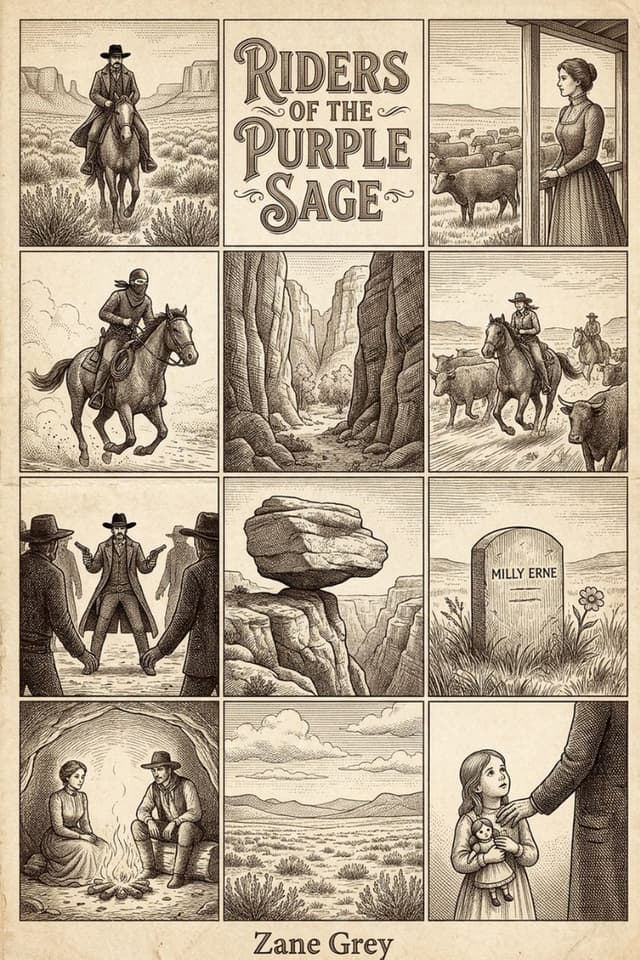
Riders of the Purple Sage
Read Riders of the Purple Sage by Zane Grey for free on Novelhalla, and try out our easy-to-read modern edition of this classic book. You can also download the EPUB and read it on any device if you prefer!
The Plot
The Woman Who Owns Everything and Can't Keep Any of It
Southern Utah, 1871. The little border settlement of Cottonwoods exists because of one thing, and that's Amber Spring, the water that makes green grass possible on a purple sage upland that would otherwise kill you. The spring belongs to Jane Withersteen. So do the village cottages, the great ranch, the thousands of cattle, and the fastest horses in the sage. Her father founded the place and left it all to her.
She's young, she's unmarried, and she's the wealthiest person for a hundred miles. Elder Tull, who already has two wives, intends to make her the third, and to take the estate along with her.
Jane's crime, in the eyes of the men who run Cottonwoods, isn't refusing him. It's that she keeps company with outsiders. She employs a Gentile rider named Bern Venters. She dotes on a motherless little girl named Fay Larkin. She insists that kindness across that line is her own business.
The book opens with Tull and his men in Jane's own yard, preparing to strip Venters and whip him, while Jane stands there arguing, pleading, and getting nowhere. And then somebody comes riding up out of the sage.
Lassiter
He's dressed in black leather, and his guns hang low, and he sits his horse like a man who's already decided how this goes. The men in Jane's yard recognize the name before he finishes saying it, and they scatter.
He doesn't want work, and he doesn't want thanks. He wants to know where a woman named Milly Erne is buried. Milly came to Cottonwoods years ago, a stranger, broken by something nobody will discuss, and she died there, and Jane loved her. Lassiter wants the grave. He won't say why he wants it, and Jane, who has spent her whole life inside this community, suddenly realizes she doesn't actually know the answer to a question she's never thought to ask.
What she does know is that this man has a reputation for what his hands do, and that he now has a reason to stay.
The Invisible Hand
Nobody in Cottonwoods threatens Jane. That isn't how it works.
What happens instead is that her red herd drifts off into the canyons with the rustlers and doesn't come back. Her riders quit, one at a time, offering no explanation and not meeting her eyes. Her best horses go missing in the night. Her hands are cut off from her one by one, quietly and politely, by people she's known since childhood, and every single loss is blamed on the outlaw Oldring and his band, and on the slight, silent figure who rides with them and never shows his face.
Jane is being squeezed. She knows it. She also knows exactly how to make it stop, and she'd rather lose the ranch.
And the terrible arithmetic she keeps doing is this: the one man on earth who could end her trouble in about four seconds is standing right there, and she has spent every hour since he arrived trying to make sure he never draws.
The Other Story
Meanwhile Venters, stripped of his horse, his job, and his standing, does the only thing left to him and rides into Deception Pass after the rustlers.
Deception Pass is a labyrinth of canyons nobody has mapped, where Oldring's men vanish with other people's cattle and reappear hundreds of miles away with clean stock. Venters goes in angry and half starved, with two dogs and a rifle, intending to find the rustlers' hole and settle a score.
What happens to him in that canyon country sends the novel down a completely separate road for a long stretch, into stone country so remote that the men hunting him have no idea it exists, and into a life that has nothing whatsoever to do with Cottonwoods.
The two stories run in parallel, miles and weeks apart, and they keep almost touching.
What It's All Building Toward
By the middle of the book, the pressure on Jane has become something close to unbearable. Her faith is the thing she loves most and the thing being used to strangle her. Her stubbornness is costing her everything she owns. Lassiter is still waiting, still watching, still wearing his guns, and still asking about a grave.
And the answer to his question is buried a great deal closer to Jane Withersteen than she has ever let herself consider.
About the Author: Zane Grey
A Boy Named Pearl
He was born Pearl Zane Gray on 31 January 1872 in Zanesville, Ohio, a town named for his mother's family. His father was an itinerant dentist and sometime preacher with strong opinions about how a boy should spend his time, and young Pearl spent his fishing, playing baseball, and scribbling adventure stories, all three of which his father regarded as a waste.
He got even with the name eventually. He dropped the Pearl, changed the spelling of Gray, and became Zane Grey.
The Dentist Years
Baseball was his ticket out. He was good enough as a ballplayer to earn a scholarship to the University of Pennsylvania, where he played shortstop, and good enough afterward to be offered professional contracts. Instead he took the dental degree his father wanted, graduating in 1896, and opened a practice in New York City.
He picked New York deliberately. It was where the publishers were. He spent roughly six years half-heartedly filling teeth while writing in every spare hour, collecting rejections, and eventually paying to publish his first novel, Betty Zane, himself in 1903. It sold poorly.
Then he met Lina Elise Roth, called Dolly. They married in 1905, and she did something nobody else had done: she believed him. She put her own money behind him, edited and corrected his manuscripts for the rest of his life, and told him to quit dentistry. He quit.
The West
In 1906 he met Charles Jesse "Buffalo" Jones, an aging plainsman on a lecture tour who wanted somebody to write his life story. Jones took him to the Arizona Strip and the Grand Canyon country in 1907 on a mountain lion hunt, and Grey came back a different writer. The trip gave him The Last of the Plainsmen, then The Heritage of the Desert in 1910, and eventually the landscape and the conflicts of this book.
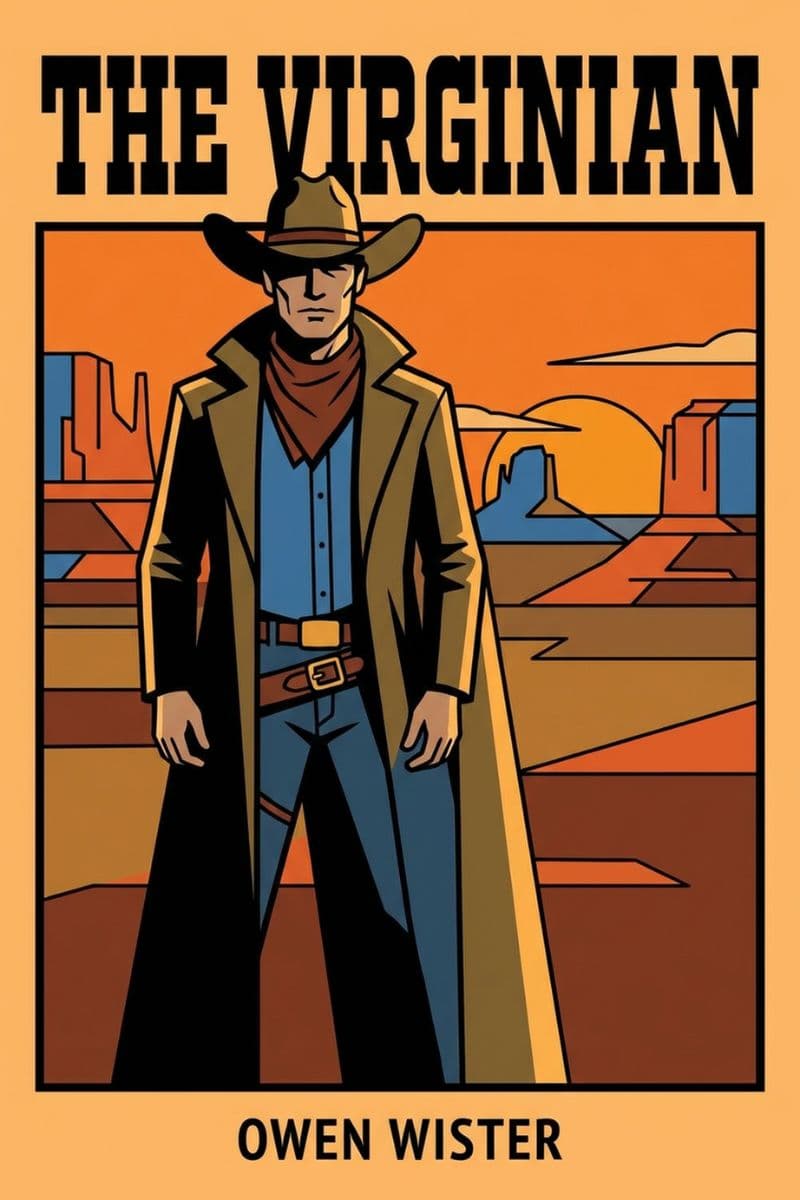
He also did his homework. He read Owen Wister's The Virginian closely enough to take it apart, studying how the thing was built before he tried building one himself.
The Empire
After 1912 he never had to worry about money again. By the 1920s he was among the highest-paid authors in America, writing westerns, fishing books, hunting books, baseball books, and children's books, close to ninety titles in all. Hollywood adapted him over and over, more than a hundred films in his lifetime and after.
He used the money exactly as he'd always intended. He fished obsessively, held saltwater records, kept a yacht, and became a minor celebrity in New Zealand for his deep-sea catches. He had houses in Altadena, on Catalina Island, in Tahiti, and a cabin in Arizona's Tonto Basin.
The End
A stroke in 1937 slowed him down, but only slightly. He made one more fishing expedition to Australia afterward. On 23 October 1939, having just finished his morning practice session with a weighted rod, he died of a heart attack at his home in Altadena. He was sixty-seven. He's buried at Lackawaxen, Pennsylvania, the little Delaware River town where he and Dolly started out.
Fun Facts About the Book
Two Publishers Turned It Down
The manuscript was rejected outright by two houses, which feared the subject matter would offend their readers and subscribers. Grey went over their heads and made a personal appeal to Frederick Duneka, a vice president at Harper & Brothers who had been Mark Twain's editor. Duneka and his wife read it, liked it, and were also nervous about it. Harper agreed to publish, bought the book and magazine rights, and then handed it to a senior editor with instructions to soften it.
There's a Version Grey Actually Wrote
That editor didn't just trim the content. He made changes to tone, diction, and style throughout. For nearly a century, the only version anybody could read was the house-edited one. The original manuscript was eventually recovered and published as a restored edition, which is a genuinely strange thing to be able to say about one of the best-selling novels in American history.
It Was Serialized in a Fishing Magazine
The story first reached readers in installments in Field & Stream, starting in January 1912. Grey was a lifelong angler who'd broken into print with a fishing story in the first place, so of all the magazines in America, that one running his great western is a fairly perfect accident.
The Army Wouldn't Give It to Soldiers
During the Second World War, the government printed enormous numbers of cheap paperbacks called Armed Services Editions and shipped them to troops overseas. This book, one of the most popular American novels in existence and precisely the sort of thing a homesick soldier would want, was turned down for the program because of how it treats its subject.
The Sage Isn't Purple
Not usually, anyway. It's a gray-green shrub for most of the year and only turns purple briefly when it blooms. Grey liked the color enough to paint it across mountains, sunsets, slopes, valleys, and just about every other surface in the book. Nobody has ever suggested that Riders of the Gray Sage would have sold two million copies.
He Found the Valley After He Invented It
The hidden valley at the heart of the story is usually connected to Betatakin, a spectacular alcove canyon in northern Arizona. Grey visited it in 1913 with the trader and guide John Wetherill, a year after the book came out, and his field journal records the disorienting feeling of standing in a place that seemed to belong to his own past rather than to the world. He wrote the valley first, and then went and stood in it.
A Sequel, Five Films, a Comic Book, and an Opera
The Rainbow Trail followed in 1915, set a few years later and picking up threads left dangling here. The novel has been filmed five times, in 1918, 1925 with Tom Mix, 1931, 1941, and 1996 with Ed Harris and Amy Madigan. Dell put out a comic book version in 1952. And in 2017, Arizona Opera staged it as a full opera, its first world premiere, which then went out to broadcast audiences across Europe.
Themes
Faith and the People Who Run It
The most interesting thing Grey does here is refuse to let Jane's belief be the villain. She isn't a woman who needs to be talked out of her religion. She's a woman whose religion is being used as a set of levers by a handful of men who know exactly where she's vulnerable. Her loyalty is real, her charity is real, and both of them are being turned into weapons against her. Watching her try to hold onto the first while surviving the second is the book's actual engine.
The Price of Keeping Your Hands Clean
Jane's defining decision is that she will not let violence be done on her behalf, no matter what it costs. The novel takes that seriously and then makes her pay for it, week after week, in cattle and horses and riders and dignity. Grey doesn't stack the deck. He just keeps asking how much a principle is worth and lets you do the arithmetic alongside her.
Vengeance as a Way of Life
Lassiter has organized his entire existence around one unfinished piece of business, and he's been at it long enough that you have to wonder what's left of the man underneath. The book is honest about what that does to a person, and about the fact that giving it up may not be any easier than carrying it.
Land, Water, and Power
Whoever holds Amber Spring holds Cottonwoods. Everything else in the novel is downstream of that, literally. It's a remarkably clear-eyed portrait of how control actually works in dry country, where you don't need an army if you own the only water for a hundred miles.
Escape and Its Limits
Half the book is about people trying to disappear, into canyons, into hidden valleys, into new names. Grey is drawn to the fantasy of a place so remote that the world can't reach it, and he's also interested in whether such a place can hold a human being for long.
The Country Itself
Grey wrote landscape better than he wrote almost anything else, and the sage, the cliffs, the stone, and the light aren't scenery here. They set the terms. People are patient or brave or ruined in direct proportion to what the ground demands of them, and Grey's great trick, the one other western writers spent decades trying to copy, was making the size of the country produce a matching size in the characters.
The Book's Legacy
This is the book that built the western.
Not the first one. Owen Wister's The Virginian got there a decade earlier, and Grey studied it carefully. But this is the one that fixed the shape of the thing in the popular imagination and sold it to everybody. The silent stranger in black who rides in from nowhere, says little, and turns out to be the only person willing to act. The woman whose land and independence are under siege. The corrupt local power that wears respectability like a coat. The canyon country as a moral proving ground. Every one of those became standard equipment, and a century of novels, films, and television ran on parts manufactured here.
Louis L'Amour worked in the tradition Grey established. So did the men who made Shane, and, at a couple of removes, the ones who put Clint Eastwood on a horse and told him not to say much.
The sales were enormous and stayed enormous. Grey's books have sold tens of millions of copies, this one alone reportedly past two million, and he remained among the most widely read American authors for decades after his death.
The title alone escaped into the culture. At least three separate country and western bands took the name Riders of the Purple Sage in the 1930s and 40s, one of them a fixture of national radio, and in 1969 a country-rock group in California called itself the New Riders of the Purple Sage and carried the phrase into a completely different century and a completely different audience, most of whom had no idea it started as a novel about a Utah water rights dispute.
Modern readers arrive with their guard up and tend to be surprised twice. First by the prose, which is lush to the point of excess and occasionally magnificent, especially whenever Grey stops narrating and just looks at the country. And second by Jane Withersteen, who is a far more substantial and conflicted character than the genre's reputation would lead you to expect, and whose long, stubborn, costly refusal to do the easy thing is the reason the book is still worth reading.