Novelhalla
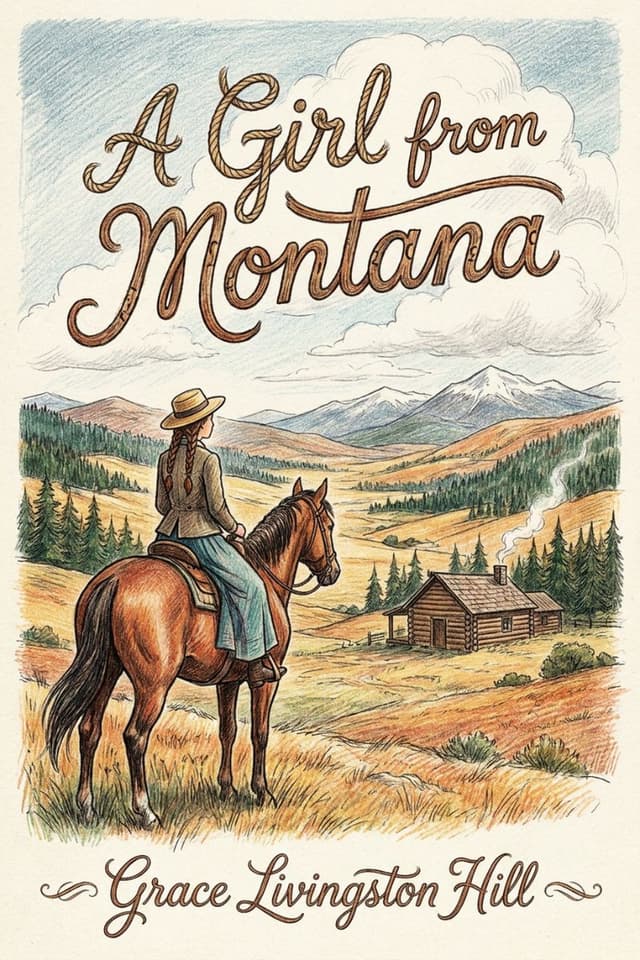
A Girl from Montana
Read A Girl from Montana by Grace Livingston Hill for free on Novelhalla, and try out our easy-to-read modern edition of this classic book. You can also download the EPUB and read it on any device if you prefer!
The Plot
The story opens in the mountains of Montana, where Elizabeth stands in her family's cabin surrounded by the ghosts of tragedy. Her mother died years ago. Her father followed. Her siblings are gone one by one. Now her last brother has been murdered by a rough man who runs with a dangerous crowd, and that same man has declared his intention to claim Elizabeth for himself.
With nothing left to lose and everything to fear, Elizabeth arms herself with her brother's pistols, takes the best horse, and rides into the wilderness at nightfall. She has one destination in mind: Philadelphia, where her mother's family lives, people she has never met but whose address she carries like a talisman. She knows only that her mother came from somewhere back East, from people called Bailey, and she means to find them.
The journey across the wild country is harrowing. Elizabeth must hide from pursuit, survive on what she can find, and navigate terrain that would challenge any rider. Along the way, she encounters George Benedict, a young man from a wealthy Eastern family who has become separated from his hunting party. He is utterly out of his element in the wilderness, and Elizabeth, despite her own desperate circumstances, cannot leave him to perish.
They travel together for several days, sharing food and fire, forming an unlikely bond between the rough Western girl and the refined Eastern gentleman. George is struck by Elizabeth's courage and natural grace, while she finds in him a kindness she has rarely encountered. But their paths must diverge when George receives word of a family emergency and must return East by a faster route.
Elizabeth continues alone, eventually reaching Philadelphia after an epic journey. She finds not one but two grandmothers: the wealthy, socially prominent Grandmother Bailey of Rittenhouse Square, and the plain, working-class Grandmother Brady of a modest neighborhood. Her experiences with each are strikingly different. Grandmother Bailey offers her education, refinement, and entry into high society. Grandmother Brady offers warmth, practicality, and the company of ordinary people.
As Elizabeth adapts to her new life, she never forgets the young man who befriended her in the wilderness. But George Benedict moves in the highest circles of Philadelphia society, and Elizabeth believes him attached to another woman. The path to their reunion is neither straight nor simple, complicated by misunderstandings, social barriers, and Elizabeth's own growth from wild girl to young woman of faith and character.
About the Author: Grace Livingston Hill
Family of Writers
Grace Livingston Hill was born on April 16, 1865, in Wellsville, New York, into a family steeped in writing and Presbyterian ministry. Her father, Charles Montgomery Livingston, was a minister who also wrote on theological topics. Her mother, Marcia Macdonald Livingston, published several romances. Most influential was her aunt, Isabella Macdonald Alden, who wrote popular Christian fiction under the pen name "Pansy" and encouraged young Grace's literary ambitions.
Early Writing
Grace began writing stories as a child, and her aunt helped publish her first work when she was just twelve years old. Her first significant novel, "A Chautauqua Idyl," appeared in 1887 when she was twenty-two, written specifically to fund a family trip to the Chautauqua assembly in New York. This early success pointed toward her future career combining romance with Christian themes.
Marriage and Tragedy
In 1892, Grace married Thomas Franklin Hill, a Presbyterian minister. They settled in Germantown, Pennsylvania, and had two daughters, Margaret and Ruth. These years were happy but brief. In 1899, Thomas died suddenly of acute appendicitis, leaving Grace a widow at thirty-four with two young children to support.
Writing as Necessity
Forced to earn a living, Grace moved to Swarthmore, Pennsylvania, and threw herself into writing with new intensity. She produced a syndicated newspaper column on Sunday school lessons, wrote stories for Christian publications, and began turning out novels at a remarkable pace. By the end of her life, she had published over seventy-nine books.
Second Marriage
In 1904, Grace married Flavius Josephus Lutz, an organist at her church. The marriage proved unhappy, and the couple separated around 1914. Grace's religious convictions prevented her from seeking divorce, but she quietly dropped her husband's name from her publications.
Later Years and Legacy
Grace continued writing prolifically into her eighties, averaging two to three books per year through decades of work. She founded a mission Sunday school near Swarthmore in 1926 and remained active in church work throughout her life. She died of cancer on February 23, 1947, in Swarthmore. Her final novel was completed by her daughter Ruth for posthumous publication. Her books have sold millions of copies and remain in print, making her one of the pioneers of Christian romance fiction.
Fun Facts About the Book
Western Setting from the East
Grace Livingston Hill had never visited Montana when she wrote this novel. She relied on letters from a correspondent in Cowan, Montana, to whom the book is dedicated, for details about the Western landscape and way of life. The dedication thanks this friend for "bright, breezy letters" that aided her in writing Elizabeth's experiences.
Real Philadelphia Locations
While the Montana scenes were researched from afar, the Philadelphia sections draw on Hill's own knowledge of the area where she lived. Rittenhouse Square, West Philadelphia, and Willow Grove Park were all real locations familiar to Hill and her readers. Willow Grove was a famous trolley park where thousands gathered for concerts and entertainment.
Christian Endeavor Society
The Christian Endeavor meetings that play an important role in Elizabeth's spiritual development were part of a real international youth movement. Founded in 1881, Christian Endeavor societies existed in churches across America and beyond. Hill herself was deeply involved in Christian Endeavor work and wrote for their publications.
Publication History
The novel was first published in 1907, though some editions list 1908 or 1922. Like many of Hill's books, it went through multiple printings and editions as her popularity grew. The story was widely read during the early twentieth century when Hill was at the height of her fame.
The Name Elizabeth
The heroine is called by different names throughout the novel, reflecting her different identities. In Montana she is "Bess" or "Bessie." Her grandmothers call her different names. The wealthy Baileys prefer "Elizabeth," while the Bradys call her "Lizzie." These names reflect the class differences she must navigate.
Autobiographical Elements
Like Elizabeth, Hill herself had to adapt to straitened circumstances and make her own way in the world after tragedy struck. The novel's themes of faith sustaining a young woman through difficulty reflect Hill's own experience of widowhood and the necessity of supporting her family through her writing.
Themes
Faith and Transformation
Elizabeth's journey is spiritual as well as physical. She begins with vague notions about God and ends with genuine Christian faith. Her encounters with Christian Endeavor meetings, kind believers, and Scripture transform her understanding of life and give her strength to face her challenges.
Class and Character
The novel explores how character matters more than social position. Elizabeth's two grandmothers represent opposite ends of the social scale, yet both have something to offer. True worth comes not from wealth or refinement but from honesty, kindness, and faith.
East and West
The contrast between the wild Montana frontier and refined Philadelphia society structures the entire novel. Elizabeth must learn to navigate a world utterly foreign to her experience without losing the strengths her harsh upbringing gave her. The East offers culture and comfort but also pretension and superficiality.
Self-Reliance and Providence
Elizabeth survives through her own courage and skills, yet the novel presents her success as guided by divine providence. Her chance meeting with George, her discovery of her grandmothers, and her ultimate happiness are portrayed as God's work in her life.
Innocence and Corruption
Elizabeth's naivety, born of her isolated upbringing, exposes her to dangers she does not understand. Yet her very innocence protects her in some ways, as her straightforward honesty and lack of guile win the trust of those who can help her. The novel contrasts her natural goodness with the corruptions of both frontier lawlessness and high society pretension.
Love and Worthiness
The romance between Elizabeth and George must overcome barriers of class, geography, and misunderstanding. Elizabeth believes herself unworthy of a man from his world, while circumstances keep them apart. The resolution comes only when both have proven their characters through trial.
The Book's Legacy
"The Girl from Montana" exemplifies Grace Livingston Hill's approach to fiction: adventure and romance suffused with Christian faith and moral teaching. The novel's combination of Western adventure, fish-out-of-water comedy, and spiritual journey created a template Hill would return to throughout her career.
The book remains in print and continues to find readers who appreciate its blend of exciting narrative and earnest faith. While some elements have dated, the story's core appeal, a brave heroine finding love and faith against the odds, retains its power.
Hill's influence on Christian romance fiction is immense. She demonstrated that novels could be both entertaining and edifying, reaching readers who might never pick up a religious tract but would eagerly follow the adventures of a plucky heroine. Modern Christian romance owes much to her pioneering example.