Novelhalla
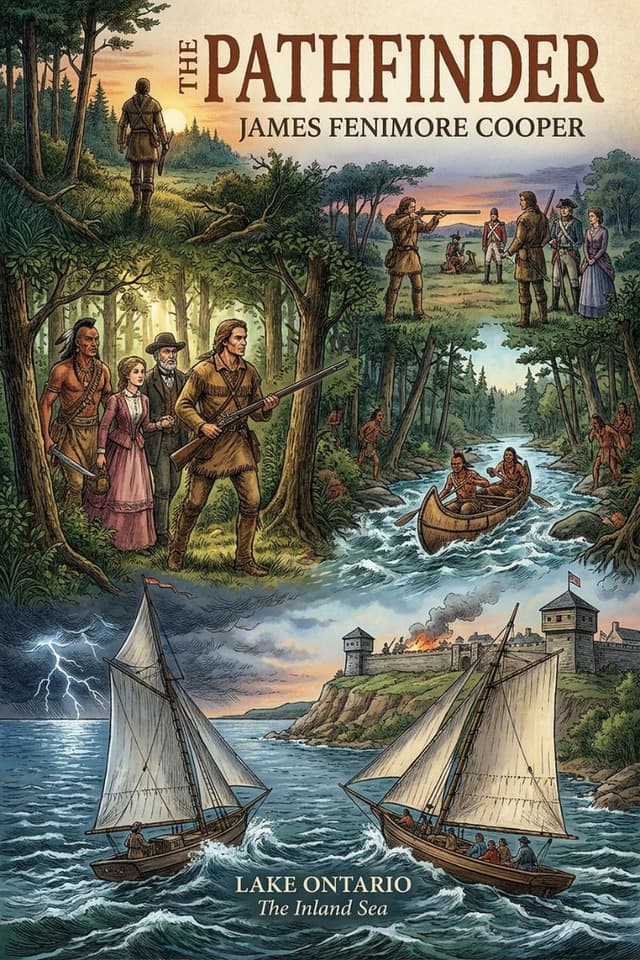
The Pathfinder
Read The Pathfinder by James Fenimore Cooper for free on Novelhalla, and try out our easy-to-read modern edition of this classic book. You can also download the EPUB and read it on any device if you prefer!
The Plot
Into the Wilderness
Somewhere in the vast, untouched forests of upstate New York, a young woman is making a journey she was never meant to survive. It's the 1750s. The French and Indian War is tearing through the frontier, and nineteen-year-old Mabel Dunham is traveling through enemy territory to reach her father at a remote British fort on the shores of Lake Ontario.
She's not alone. Her uncle Charles Cap, a salty ocean sailor completely out of his element in the woods, walks beside her. And guiding them through the trees are two very different men: Arrowhead, a Tuscarora Indian whose loyalties are unclear, and the man everyone calls the Pathfinder.
The Pathfinder
Natty Bumppo is around forty years old, and he is the best woodsman alive. He can track a deer through a rainstorm, shoot the wick off a candle at a hundred yards, and read the forest the way other men read books. He's lived his entire adult life in the wilderness with his closest friend, the Mohican warrior Chingachgook, and he has never wanted anything else.
Until now. Because Pathfinder has fallen in love with Mabel Dunham, and it's the first time he's ever felt anything like it. This hardened frontiersman who can face a war party without flinching becomes tongue-tied and uncertain around a girl half his age. He knows he's too old for her, too rough, too wild. But Mabel's father, Sergeant Dunham, is an old friend who wants this match. He's practically promised his daughter's hand.
There's just one problem. A young freshwater sailor named Jasper Western has also joined the party, and from the moment he and Mabel meet, something sparks between them that Pathfinder can see but refuses to name.
The Journey
The trip to the fort nearly kills them. Hostile war parties haunt the forest, and the group barely escapes an ambush that leaves them scattered and shaken. Arrowhead and his wife, a quiet Tuscarora woman called Dew of June, vanish during the chaos. Were they captured, or did they betray the group to the enemy? No one is sure, and that uncertainty is going to matter later.
Jasper proves himself on the dangerous river passage, navigating rapids and falls with a skill that borders on reckless genius. Pathfinder leads them through the woods with the calm authority of a man who has never been lost in his life. Together, they deliver Mabel safely to the fort, and her father welcomes her with open arms.
But safety at the fort is an illusion. The war is closing in from every direction.
A Question of Loyalty
At the fort, Mabel finds herself the center of unwanted attention. Lieutenant Davy Muir, a smooth-talking quartermaster who has already buried three wives, begins courting her aggressively. Her father pushes Pathfinder's suit. And Jasper watches quietly from the edges, saying nothing about what he feels.
Then a letter arrives that changes everything. Someone in the British ranks is a spy for the French. The evidence points directly at Jasper Western. He speaks French fluently. He knows the lake and its channels better than any Englishman should. The suspicion falls on him like a shadow, and suddenly the young man Mabel trusts most is the one everyone else believes is a traitor.
Pathfinder refuses to believe his friend is guilty. But duty is duty, and when an expedition sets out aboard Jasper's cutter, the Scud, to relieve a remote island garrison in the Thousand Islands, Jasper sails under armed watch.
The Island
What happens on that island is the heart of the novel, and it's terrifying. Sergeant Dunham takes most of his men to intercept French supply boats, leaving Mabel behind with a skeleton crew. The island feels safe. It isn't.
Dew of June reappears from the forest with a warning: an attack is coming. Mabel tries to raise the alarm, but the men around her don't listen. The corporal dismisses her fears. Muir waves her off.
And then a rifle shot cracks through the trees, and everything falls apart.
Mabel barricades herself in the blockhouse with the door bolted and the sounds of violence erupting outside. She is alone, armed, and surrounded by enemies who want her alive for reasons that make her blood run cold. The garrison has been overrun. And the people who should have protected her either couldn't or wouldn't.
Someone gave away their position. Someone led the enemy straight to this island. And the answer is not who anyone expects.
Three Men and a War
The siege that follows is one of Cooper's finest set pieces: desperate, claustrophobic, and laced with the constant threat of betrayal. But threaded through the gunfire and survival is the quieter, more painful story of three people caught in an impossible triangle.
Pathfinder loves Mabel with everything he has. Jasper loves her too but won't say it. And Mabel, who respects and admires one man while her heart pulls her toward another, has no good options in a world where her father's wishes carry the weight of law.
The war will force all three of them to show who they really are. And what Pathfinder discovers about himself, about love, and about what it truly costs to be a good man may be harder than any battle he's ever fought.
Whether he can survive that discovery with his heart intact is a question the frontier has no answer for.
About the Author: James Fenimore Cooper
Frontier Boyhood
James Fenimore Cooper was born on September 15, 1789, in Burlington, New Jersey, the eleventh of twelve children. When he was barely a year old, his father William Cooper moved the family to a vast estate on the shores of Otsego Lake in upstate New York, where he had founded a frontier settlement that would become Cooperstown.
Young James grew up on the edge of the wilderness, surrounded by deep forests and the stories of settlers and traders who passed through. His father was a wealthy landowner, judge, and congressman, so Cooper enjoyed a privileged childhood even in a wild landscape. He was sent to private school in Albany at eleven and enrolled at Yale at thirteen, making him one of the youngest students on campus.
Expelled and Adrift
Cooper's time at Yale ended spectacularly. After a string of pranks that included blowing up a fellow student's door with gunpowder and smuggling a donkey into a classroom, he was expelled in his third year. With no degree and few options, he went to sea in 1806, first as a common sailor on a merchant vessel and then as a midshipman in the United States Navy.
His naval service took him to Lake Ontario, among other postings, and gave him firsthand experience with the Great Lakes region that would later become the setting for The Pathfinder. He resigned his commission in 1811, married Susan Augusta De Lancey on New Year's Day, and settled into the life of a gentleman farmer.
An Accidental Novelist
Cooper became a writer almost by accident. While reading a novel aloud to his wife, he remarked that he could write a better one himself. She challenged him to do it. His first attempt, Precaution, was a forgettable imitation of English society fiction. But his second novel, The Spy, published in 1821, was a sensation, and Cooper never looked back.
Over the next three decades, he produced more than thirty novels, including the five Leatherstocking Tales that made his frontier scout Natty Bumppo one of the most iconic characters in American fiction. The Pioneers came first in 1823, followed by The Last of the Mohicans in 1826, The Prairie in 1827, and then, after a thirteen-year gap, The Pathfinder in 1840 and The Deerslayer in 1841.
Later Years
Cooper spent seven years living in Europe with his family, serving as U.S. Consul in Lyon, France, and traveling through Italy, Switzerland, and England. When he returned to America in 1833, he settled permanently at Cooperstown and threw himself into political writing, social criticism, and a series of bruising libel lawsuits against newspaper editors who had attacked him.
He died at Cooperstown on September 14, 1851, one day before his sixty-second birthday, and was buried in the family plot at Christ Episcopal Church. His wife Susan survived him by only a few months.
Fun Facts About the Book
The Only Love Story
The Pathfinder is the only novel in the entire Leatherstocking Tales series where Natty Bumppo falls in love. Across five books spanning his youth to his death, this is the single moment where the great frontiersman opens his heart to another person in a romantic way. Cooper understood that this vulnerability would transform how readers saw his hero, and he used it to devastating effect.
Cooper Knew the Lake
The "inland sea" of the title is Lake Ontario, and Cooper wasn't writing from imagination alone. As a young navy midshipman, he was stationed at Oswego on the lake's southern shore and traveled extensively through the region. He later said his descriptions were "as nearly accurate as is required by the laws which govern fiction." The storms, the islands, and the navigational challenges in the novel all draw from real experience.
A Risky Resurrection
Cooper had essentially killed off Natty Bumppo in The Prairie, published thirteen years earlier. Bringing him back for The Pathfinder was what Cooper himself called a "hazardous experiment." Readers had mourned the character's death, and reviving him risked undermining one of the most famous endings in American fiction. Cooper solved the problem by setting the new book earlier in Natty's life, filling in the years between youth and old age.
The Pathfinder Became a Real Nickname
The title gave a famous name to real American history. After the novel's publication, the explorer John C. Fremont became widely known as "the Pathfinder" for his expeditions through the American West. The nickname stuck so completely that most people forgot it originated with Cooper's fictional hero.
Mark Twain's Revenge
Mark Twain famously savaged Cooper's writing in his 1895 essay "Fenimore Cooper's Literary Offences," calling it stilted, improbable, and guilty of nearly every crime a novelist could commit. The essay is hilarious and brutal, but it also reveals how seriously later American writers took Cooper's influence. You don't write a takedown that vicious of someone who doesn't matter.
Balzac Was a Fan
While Twain mocked him, the great French novelist Honore de Balzac was an enthusiastic admirer. Victor Hugo declared Cooper greater than Walter Scott, the reigning king of historical romance. Whatever his flaws, Cooper's ability to conjure the wilderness and its moral weight captivated readers across two continents.
Themes
The Wilderness as Cathedral
Pathfinder doesn't go to church. He doesn't need to. For him, the forest is where God lives, unmediated by walls or clergy or doctrine. Cooper writes the American wilderness as a sacred space, vast and dangerous and beautiful, where a person's true character is revealed in ways that polite society can never manage. It's a deeply American idea, and Pathfinder is its purest expression.
Love and Self-Knowledge
Pathfinder has spent decades mastering the forest, but he knows nothing about his own heart. Falling in love at forty strips away his confidence and forces him to confront a part of himself he never knew existed. The novel asks whether a person can be supremely capable in one world and completely helpless in another, and the answer is painful and honest.
Trust and Treachery
The question of who is loyal and who is a traitor runs through the entire novel. Jasper is suspected of spying. Arrowhead's allegiance shifts. Muir's motives are murky. In a frontier war where alliances are fluid and survival depends on reading other people correctly, the ability to judge character becomes as important as the ability to shoot straight.
Civilization Versus the Wild
Mabel represents the settled world of towns, education, and domestic life. Pathfinder represents the untamed frontier. Their connection raises a question that neither of them can easily answer: can two people from fundamentally different worlds build a life together, or will the gap between who they are always be wider than the love they share?
What Love Costs
This is not a simple romance where the hero gets the girl. It's a story about what happens when love collides with honesty, when desire runs up against what's right, and when the bravest thing a person can do has nothing to do with rifles or war parties. The emotional stakes in this novel are higher than the physical ones, and Cooper doesn't flinch from the cost.
The Book's Legacy
The Pathfinder occupies a unique place in the Leatherstocking Tales and in American literature more broadly. While The Last of the Mohicans remains Cooper's most famous work, many readers and critics consider The Pathfinder his most emotionally complex. It's the book where Cooper's legendary frontiersman becomes fully human, and the result is a story that lingers long after the gunsmoke clears.
The novel helped establish the Great Lakes as a literary landscape, bringing the vast freshwater seas of the American interior into fiction for the first time. Cooper's depiction of Lake Ontario as both beautiful and terrifying, an inland ocean capable of storms as violent as anything on the Atlantic, opened new territory for American storytelling.
More broadly, Cooper's frontier novels created the template for an entire genre. The lone, skilled hero navigating a dangerous landscape, torn between civilization and wilderness, has echoed through American culture from westerns to war films to science fiction. Natty Bumppo is the ancestor of every frontier protagonist who came after him.
The Pathfinder's treatment of love also sets it apart. In a genre typically defined by action, Cooper wrote a novel where the most important conflict is internal. That's a remarkably modern idea for a book published in 1840, and it's why The Pathfinder continues to surprise readers who come to it expecting nothing more than a frontier adventure.