Novelhalla
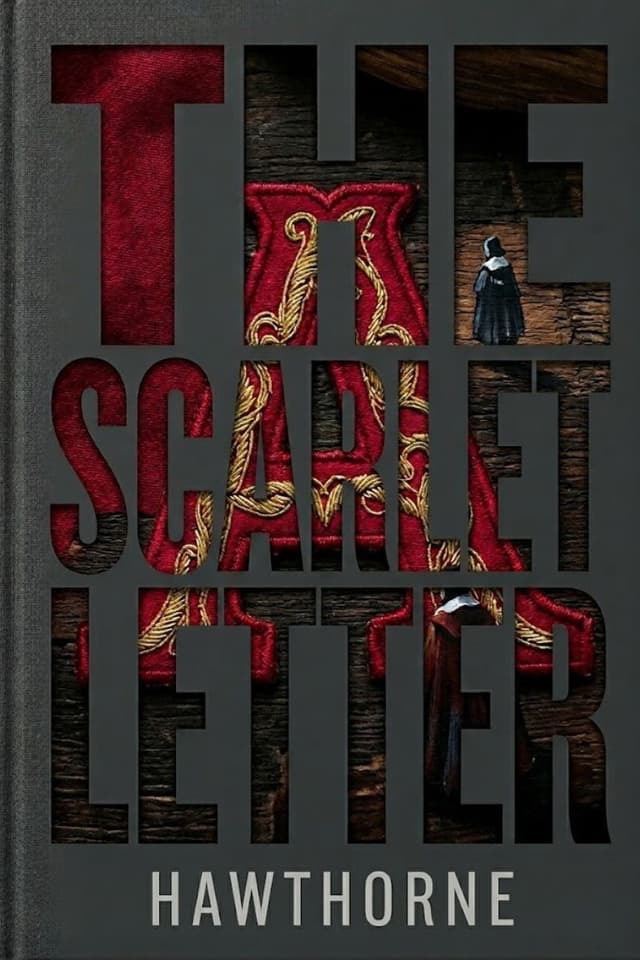
The Scarlet Letter
Read The Scarlet Letter by Nathaniel Hawthorne for free on Novelhalla, and try out our easy-to-read modern edition of this classic book. You can also download the EPUB and read it on any device if you prefer!
The Plot
The Woman on the Scaffold
Boston, 1642. A young woman walks out of a prison into the sunlight, carrying an infant in her arms and wearing a scarlet letter "A" embroidered on her dress. The crowd is already gathered. They've been waiting for this.
Her name is Hester Prynne. She has committed adultery. In Puritan Massachusetts, that means public humiliation, permanent branding, and a lifetime of shame. She must stand on the town scaffold for hours while the community stares, judges, and demands that she name the father of her child.
She refuses.
The magistrates press her. The townspeople press her. Even the beloved young minister Arthur Dimmesdale is sent to urge her to confess the man's identity. Hester looks at him and says nothing.
Watching from the edge of the crowd, unrecognized, is a man who has just arrived in Boston after years of captivity. He is older, slightly misshapen, with sharp intelligent eyes. He is Hester's husband. And he is very, very interested in learning the name she won't speak.
The Doctor
Roger Chillingworth, as he now calls himself, visits Hester in prison. He is calm. Almost eerily so. He doesn't rage about the affair. He acknowledges his own fault in marrying a young, passionate woman and then disappearing for years. But he makes one thing clear: he will find the man who fathered this child. And he makes Hester swear never to reveal his true identity.
She agrees. It is the worst promise she will ever make.
Chillingworth settles into Boston as a physician. There is only one patient who truly interests him: the Reverend Arthur Dimmesdale, the town's most gifted and admired young minister, who has recently fallen ill with a mysterious ailment of the heart.
The Letter
Hester is released from prison and moves to a small cottage at the edge of town, between the settlement and the wild forest. She makes her living as a seamstress. Her needlework is extraordinary, sought after for every occasion except weddings, because even the people who want her craftsmanship won't let her touch anything sacred.
She raises her daughter Pearl alone. Pearl is strange. Beautiful, wild, intelligent, and possessed of an unsettling ability to see things that adults refuse to acknowledge. She is obsessed with the scarlet letter on her mother's chest. She asks about it constantly. She seems to understand, in some wordless, childlike way, what it really means.
The townspeople want to take Pearl away. They say Hester is unfit. Hester fights for her daughter with a ferocity that surprises everyone, and it is Dimmesdale who speaks on her behalf, arguing that the child should stay with her mother.
It's an act of quiet courage. It's also a tell.
The Leech
Chillingworth has moved in with Dimmesdale, ostensibly to treat his failing health. But something else is happening. The doctor probes. He asks leading questions. He watches the minister with the patient, predatory attention of a man who suspects he is close to something. The relationship between healer and patient begins to curdle into something darker. Dimmesdale feels a growing unease around Chillingworth, an instinctive revulsion he can't explain.
One night, Chillingworth finds what he's been looking for. He pulls back the sleeping minister's shirt and sees something on his chest. The novel doesn't tell us exactly what it is. But Chillingworth's reaction is unmistakable. He has his answer.
And now the real torment begins.
The Forest
Years pass. Hester watches Dimmesdale deteriorate. She watches Chillingworth feed on his suffering like something parasitic. And she is bound by her promise to say nothing.
Finally, she can't bear it anymore. She arranges to meet Dimmesdale alone in the forest, outside the reach of Puritan law and judgment. It is the first honest conversation they've had in seven years. She tells him the truth about Chillingworth. She tells him they can still escape, start over, take a ship to Europe and live as a family.
For one brief, brilliant moment in the woods, Hester removes the scarlet letter. She lets down her hair. The sunlight finds her for the first time in years. It's as if the weight of an entire society lifts off her shoulders.
But Pearl, playing nearby, doesn't recognize her mother without the letter. She won't come to her. She won't cross the brook that separates them until Hester puts the letter back on.
Whatever freedom looked like in the forest, it can't follow them home.
The Sermon
The plan is set. A ship is leaving Boston. They will be on it. But the night before they're meant to sail, Dimmesdale delivers the most powerful sermon of his life to the gathered town. Something has shifted in him. Something is building toward a decision.
And Hester learns that Chillingworth has booked passage on the same ship.
There is no escape. There has never been any escape. Whatever happens next will happen here, in this town, on that scaffold, in front of everyone.
About the Author: Nathaniel Hawthorne
The Salem Inheritance
Nathaniel Hawthorne was born on July 4, 1804, in Salem, Massachusetts, into a family that had been rooted in the town since the 1600s. His ancestors were not gentle people. One was a magistrate who sentenced a Quaker woman to public whipping. Another was a judge in the Salem witch trials. Hawthorne was haunted by this legacy his entire life. He even added a "w" to the family name, Hathorne, as if he could distance himself from the bloodline with a single letter.
His father, a sea captain, died of yellow fever when Nathaniel was four. His mother retreated into a near-permanent mourning, and the boy grew up quiet, bookish, and often alone, reading in the dusty library of the old family house.
The Solitary Writer
After attending Bowdoin College, where his classmates included the future poet Henry Wadsworth Longfellow and future president Franklin Pierce, Hawthorne returned to Salem and spent twelve years in what he called his "owl's nest," reading and writing in near-total seclusion. He published stories and sketches, many of them exploring Puritan guilt and hypocrisy, but earned almost nothing from his work.
Love and Struggle
In 1838, Hawthorne became engaged to Sophia Peabody, a painter and intellectual. They married in 1842 and settled in Concord, Massachusetts, where their neighbors included Ralph Waldo Emerson and Henry David Thoreau. Hawthorne liked them well enough but never fully embraced their Transcendentalist philosophies. He preferred the company of his old college friend Franklin Pierce.
The Hawthornes had three children: Una, Julian, and Rose. They struggled financially for most of their marriage. Hawthorne worked at the Boston Custom House, spent time at the utopian commune Brook Farm, and eventually took a post as Surveyor at the Salem Custom House, which he lost when the political administration changed.
The Masterpiece
Fired from his government job and grieving his mother's death, Hawthorne threw himself into writing. He began The Scarlet Letter in September 1849 and finished it in February 1850, a remarkable five-month burst of creation. When he read the final chapter aloud to Sophia, she wept so hard she went to bed with a headache. Hawthorne considered this "a triumphant success."
The novel was an instant bestseller, selling out its first printing of 2,500 copies within ten days. It made Hawthorne famous. It did not make him rich.
Later Years
The House of the Seven Gables and The Blithedale Romance followed, along with children's books and a campaign biography for Franklin Pierce that helped his friend win the presidency. Pierce rewarded Hawthorne with a diplomatic posting to Liverpool, England. Hawthorne traveled through Europe and wrote The Marble Faun, his final completed novel. His health declined steadily in his last years. He died in his sleep on May 19, 1864, at age fifty-nine, while traveling with Pierce through New Hampshire.
Fun Facts About the Book
The Puritans Really Did This
Hawthorne didn't invent the concept of the scarlet letter. A 1658 Plymouth Colony law required people caught in adultery to wear "two Capitall letters namely A D cut out in cloth and sowed on theire vpermost Garments." If they ever removed the letters, they would be publicly whipped. Hawthorne condensed the punishment to a single letter and turned a colonial regulation into a symbol that has endured for nearly two centuries.
Sophia's Headache
When Hawthorne finished writing the final chapter, he read it aloud to his wife Sophia. She broke down in tears and went to bed with a severe headache. Far from being alarmed, Hawthorne wrote to a friend that he took her reaction as proof the book worked. He was right.
It Almost Wasn't a Novel
Hawthorne originally planned for "The Scarlet Letter" to be a long short story in a collection called "Old-Time Legends." His publisher, James T. Fields, convinced him to expand it into a standalone novel. Hawthorne doubted it would be popular. Fields, who clearly had a better sense of the market, was vindicated within days.
The Custom House Controversy
The novel opens with a long introductory essay called "The Custom-House," in which Hawthorne describes his time working at the Salem Custom House and pretends to have discovered the scarlet letter and an old manuscript in the building's attic. The essay was partly autobiographical and partly revenge: Hawthorne used it to settle scores with the political establishment that had fired him. Salem residents were furious. Hawthorne refused to change a word.
Pearl and Una
The character of Pearl was almost certainly inspired by Hawthorne's eldest daughter, Una, who was about the same age as Pearl when the novel was written. Una was known for being spirited, willful, and perceptive, qualities Hawthorne seems to have channeled directly into his fictional child.
One of the First Bestsellers
The Scarlet Letter was one of the first mass-produced books in America. The initial print run of 2,500 copies sold out in ten days. A second edition followed almost immediately. Despite this, Hawthorne earned only about $1,500 from the book over the next fourteen years. Bestseller status didn't mean what it means today.
The Names Tell the Story
Hawthorne loaded his characters' names with meaning. Chillingworth is cold and chilling. Dimmesdale is dim, obscured, unable to step into the light. Pearl is the precious thing born from transgression. Even Hester's name echoes Hestia, the Greek goddess of the hearth, the keeper of home and fire in a community that wants to put her flame out.
Themes
Public Shame and Private Guilt
The novel's great insight is the difference between being punished and punishing yourself. Hester wears her shame on the outside and, over years of quiet endurance, transforms it into something almost dignified. Dimmesdale hides his guilt on the inside, and it eats him alive. The person who confesses survives. The person who conceals is destroyed. Hawthorne isn't interested in who sinned. He's interested in what happens after.
The Hypocrisy of Moral Authority
The Puritans who judge Hester are not better people than she is. They are simply people who haven't been caught. The novel is relentless on this point. The most respected man in Boston is secretly the most guilty. The most shamed woman is, in many ways, the most honest. Hawthorne grew up in the shadow of ancestors who executed innocent people in the name of righteousness, and his fury at institutional hypocrisy runs through every page.
The Cost of Revenge
Chillingworth begins the novel as a wronged man with a legitimate grievance. By the end, he has become something monstrous. His obsession with vengeance doesn't just destroy his target; it hollows him out from the inside. Hawthorne suggests that the desire to punish can be more corrosive than the original sin.
Identity and Reinvention
Every major character in the novel is wearing a disguise or performing a role. Hester is forced to be "the adulteress." Dimmesdale performs "the saint." Chillingworth pretends to be "the doctor." Only Pearl, the child, is entirely herself, and the adults find her honesty terrifying.
Women's Defiance
Hester Prynne has been called the first true heroine of American fiction. She refuses to name her lover. She refuses to collapse under the weight of public judgment. She takes the letter they force her to wear and embroiders it with gold thread, making their instrument of shame into something beautiful. She raises her daughter alone, supports herself with her own labor, and becomes a quiet force of charity in a community that tried to destroy her. Hawthorne was writing in the wake of the first women's rights convention at Seneca Falls, and Hester's stubborn, elegant defiance makes her feel startlingly modern.
The Book's Legacy
The Scarlet Letter has never been out of print since its publication in 1850. It is routinely listed among the greatest American novels ever written, and The Guardian ranked it sixteenth on its list of the hundred best novels in the English language. D.H. Lawrence called it "a perfect work of the American imagination." Henry James described it as "the finest piece of imaginative writing yet put forth in the country."
The novel has been adapted for stage and screen dozens of times, beginning with a 1908 silent film. A celebrated 1926 silent version starred Lillian Gish as Hester. The 1995 film starring Demi Moore took significant liberties with the plot. The 2010 comedy Easy A, starring Emma Stone, reimagined the story's themes of public shaming and sexual double standards in a modern high school setting.
The scarlet letter itself has become one of the most recognized symbols in Western literature, shorthand for public shaming, moral hypocrisy, and the punishment of women for transgressions that men commit with impunity. In an age of social media pile-ons and public cancellations, the novel feels less like a historical artifact and more like a warning.
Hawthorne intended his book as an exploration of what happens when a society decides it has the right to define and destroy a person based on a single act. Nearly two centuries later, we are still having that conversation.