Novelhalla
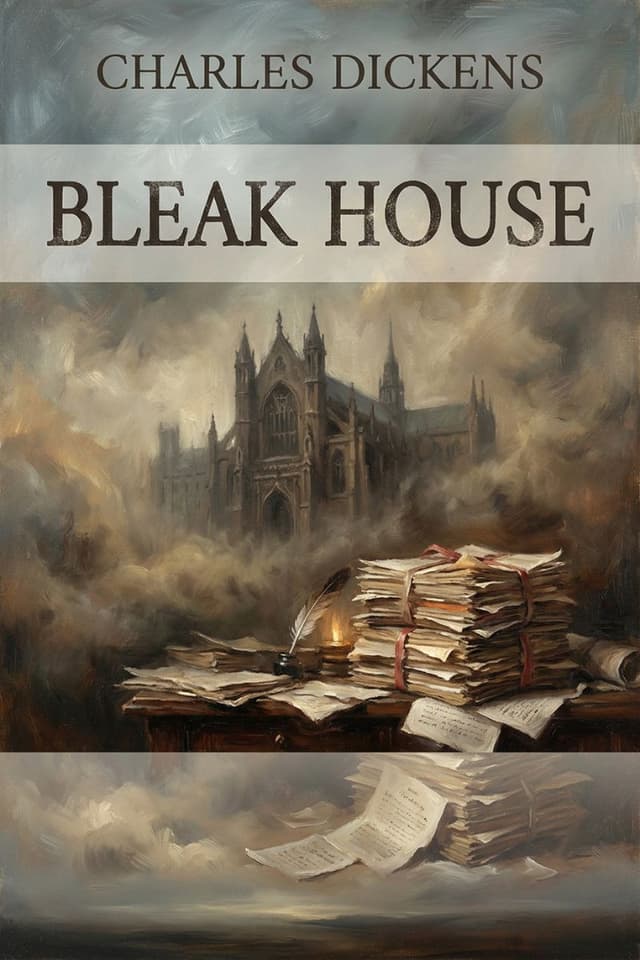
Bleak House
Read Bleak House by Charles Dickens for free on Novelhalla, and try out our easy-to-read modern edition of this classic book. You can also download the EPUB and read it on any device if you prefer!
The Plot
Bleak House opens with fog. Fog everywhere. Fog in the streets, fog on the river, fog in the eyes and throats of everyone in London. And at the heart of the fog sits the Court of Chancery, where the endless case of Jarndyce and Jarndyce has been grinding on for generations, consuming lives and fortunes in a tangle of legal proceedings that no one can untangle or escape.
Two Narratives
The novel weaves together two different voices. One is a grand, sweeping, present-tense narrator who describes the fog-choked world of London, the aristocrats in their townhouses, the lawyers in their chambers, the poor in their slums. The other is Esther Summerson, a young woman of mysterious parentage who tells her own story with modesty and warmth.
Esther has been raised by a stern godmother who told her she was her mother's disgrace and should have never been born. When her godmother dies, Esther is sent by the mysterious John Jarndyce to live at his home, Bleak House, as a companion to his two young wards, Ada Clare and Richard Carstone. Ada and Richard are caught up in the Jarndyce case, potential heirs to a fortune that may or may not exist once the lawyers are done with it.
A Web of Connections
What seems at first like several separate stories gradually reveals itself as one vast interconnected web. The haughty Lady Dedlock, wife of the ancient Sir Leicester, hides a secret that connects her to the lowest slums of London. A law writer named Nemo dies in a miserable garret, and his death sets off a chain of consequences that reaches into the highest society. A relentless lawyer named Tulkinghorn begins to suspect Lady Dedlock's secret and pursues it with cold determination.
Meanwhile, Richard Carstone becomes obsessed with the Chancery case, convinced that when it finally resolves, he'll be rich. He drifts from career to career, unable to commit to anything while the case dangles its false promise before him. Ada loves him but watches helplessly as the suit destroys him.
Mystery and Detection
A murder occurs, and the novel becomes something like a detective story, with Inspector Bucket of the Metropolitan Police conducting an investigation that cuts across every level of society. Secrets that characters have buried for decades come pushing up through the surface. The fog begins to clear, but what it reveals is not always welcome.
Esther's own story takes dark turns. She discovers truths about her parentage that shake her understanding of herself. She survives a serious illness that changes her forever. She must choose between different possible futures, different kinds of love, different versions of who she might become.
The Reach of Chancery
Throughout it all, the Court of Chancery grinds on. It touches everyone in the novel, directly or indirectly. It ruins the hopeful and destroys the vulnerable. It feeds an entire ecosystem of lawyers, clerks, law-stationers, and hangers-on. Dickens uses it as a symbol for everything wrong with a society that lets institutions crush individuals, that mistakes procedure for justice, that loses sight of human beings in clouds of paperwork and precedent.
About the Author: Charles Dickens
Early Life
Charles Dickens was born in Portsmouth in 1812, the second of eight children. His father was a naval clerk with a fatal weakness for living beyond his means. When Dickens was twelve, his father was imprisoned for debt, and young Charles was sent to work in a boot-blacking factory, pasting labels on bottles. The shame and misery of this experience haunted him for life and fueled his sympathy for the poor and exploited.
Rise to Fame
Dickens began his career as a journalist and court reporter, learning shorthand and covering Parliament. He started publishing comic sketches under the pen name "Boz," and in 1836 began the serialization of The Pickwick Papers. Its success was explosive. At twenty-four, Dickens was the most popular writer in England.
The Great Novels
Over the next three decades, Dickens produced a stream of novels that defined the Victorian era: Oliver Twist, Nicholas Nickleby, A Christmas Carol, David Copperfield, A Tale of Two Cities, Great Expectations, and many more. He published most of them in monthly or weekly installments, writing against deadlines while managing a complicated personal life, editing magazines, and giving public readings.
Personal Life
Dickens married Catherine Hogarth in 1836 and had ten children with her. The marriage grew unhappy, and in 1858 he separated from Catherine under scandalous circumstances, having fallen in love with a young actress named Ellen Ternan. He kept this relationship secret for the rest of his life.
Death
Dickens drove himself relentlessly, and his public reading tours exhausted his health. He suffered a stroke in 1870 and died the next day at fifty-eight. He was buried in Westminster Abbey despite his wish for a modest funeral. He left his final novel, The Mystery of Edwin Drood, unfinished.
Fun Facts About the Book
The Spontaneous Combustion Controversy
One of the novel's most memorable scenes involves a character dying by spontaneous combustion. Critics attacked Dickens for including something so scientifically impossible. He defended himself vigorously, citing documented cases and insisting it could really happen. Modern science says he was wrong, but he never backed down.
The First Detective
Inspector Bucket is often cited as one of the first detective characters in English fiction. He predates Sherlock Holmes by decades. Dickens based him partly on a real Scotland Yard inspector he knew, and Bucket's methods—his keen observation, his deceptive friendliness, his relentless pursuit—established templates that detective fiction still follows.
Serialization
Bleak House was published in twenty monthly parts between March 1852 and September 1853. Each installment ended with a cliffhanger to keep readers buying. Dickens wrote under constant deadline pressure, often finishing an installment just before it went to press.
Two Narrators
The novel's dual narrative structure was innovative for its time. The contrast between the impersonal, present-tense chapters and Esther's warm, past-tense voice creates a complex effect. Some readers find Esther's modesty cloying; others find her deeply moving. Dickens was doing something deliberately experimental with the form.
Real Targets
Dickens based his attack on Chancery on real abuses. Cases really did drag on for generations. Legal costs really did consume entire estates. Reforms were already underway when he wrote, but Bleak House helped accelerate them. The Court of Chancery was eventually abolished in 1873.
The Crossing Sweeper
The character of Jo, a homeless boy who sweeps a street crossing for pennies, became one of Dickens's most famous creations. His death scene, with its repeated refrain of the Lord's Prayer, was considered almost unbearably moving by Victorian readers. Dickens used Jo to indict a society that let children live and die in such misery.
Length
Bleak House is one of Dickens's longest novels, running to over 350,000 words. It has more than fifty named characters. The plot is extraordinarily complex, with connections between characters that only become clear hundreds of pages after they're introduced.
Themes
The Law's Delay
The Court of Chancery embodies institutional cruelty. It's not that the people in it are evil; many are simply doing their jobs. But the system itself destroys lives with grinding indifference. Dickens shows how institutions can become ends in themselves, perpetuating their own existence while forgetting the human purposes they were meant to serve.
Secrets and Shame
Nearly every major character harbors a secret. Lady Dedlock's hidden past drives much of the plot, but she's hardly alone. The novel suggests that Victorian society runs on concealment, that respectability is often just a mask over buried truths. When secrets surface, the consequences are devastating.
Connection and Responsibility
The novel keeps revealing unexpected connections between characters who seem to occupy different worlds. The great lady and the street sweeper, the lawyer and the law writer, the respectable and the outcast—all are linked. Dickens argues that society is one interconnected whole and that the suffering of the poorest reflects on everyone.
Charity True and False
Bleak House is full of characters who claim to do good. Mrs. Jellyby neglects her own children while obsessing over African missions. Mrs. Pardiggle bullies the poor with religious tracts. Against these Dickens sets Esther's quiet, practical kindness and John Jarndyce's genuine generosity. True charity, the novel suggests, begins at home and works outward.
Disease and Contagion
A fever that begins in the slum called Tom-all-Alone's spreads outward to touch the highest levels of society. Dickens uses disease as a metaphor for social connection: you cannot wall yourself off from the poor, because their misery will find you eventually. Neglect breeds pestilence that respects no boundaries.
The Book's Legacy
Bleak House is often considered Dickens's masterpiece, or at least a leading candidate for the title. Its ambitious structure, its social criticism, its gallery of characters, and its fog-drenched atmosphere have influenced countless later writers.
The novel helped establish the conventions of detective fiction. It pioneered techniques of multiple narration that later novelists would develop further. Its portrait of institutional dysfunction remains relevant whenever bureaucracies crush the people they're supposed to serve.
Bleak House has been adapted many times for stage, film, and television. The 2005 BBC miniseries is particularly well-regarded. But the novel's full power can only be experienced on the page, in the accumulation of detail and voice across its vast length.
For readers willing to commit to its scale, Bleak House offers one of the great reading experiences in English. It's funny and sad, angry and tender, sprawling and intricately constructed. It shows Dickens at the height of his powers, wielding the novel as both entertainment and weapon, making readers laugh and cry and think and, perhaps, act.