Novelhalla
The Knave of Diamonds
Read The Knave of Diamonds by Ethel M. Dell for free on Novelhalla, and try out our easy-to-read modern edition of this classic book. You can also download the EPUB and read it on any device if you prefer!
The Plot
The Woman at the Window
Anne Carfax is standing alone at an open window during a ball, breathing cold night air like someone who has been suffocating. The ballroom below is all music and light. She wants no part of it.
She is Lady Carfax, married to Sir Giles, a wealthy man twice her age with a vicious temper and a drinking problem that is getting worse by the year. Her marriage is a prison she entered voluntarily and from which she has no intention of escaping. Divorce isn't an option she'll consider. Anne is a woman of duty, and duty means staying.
Then a man appears beside her. He's American, dark, sharp-eyed, and unsettling in a way she can't quite name. His name is Napoleon Errol, and everyone calls him Nap.
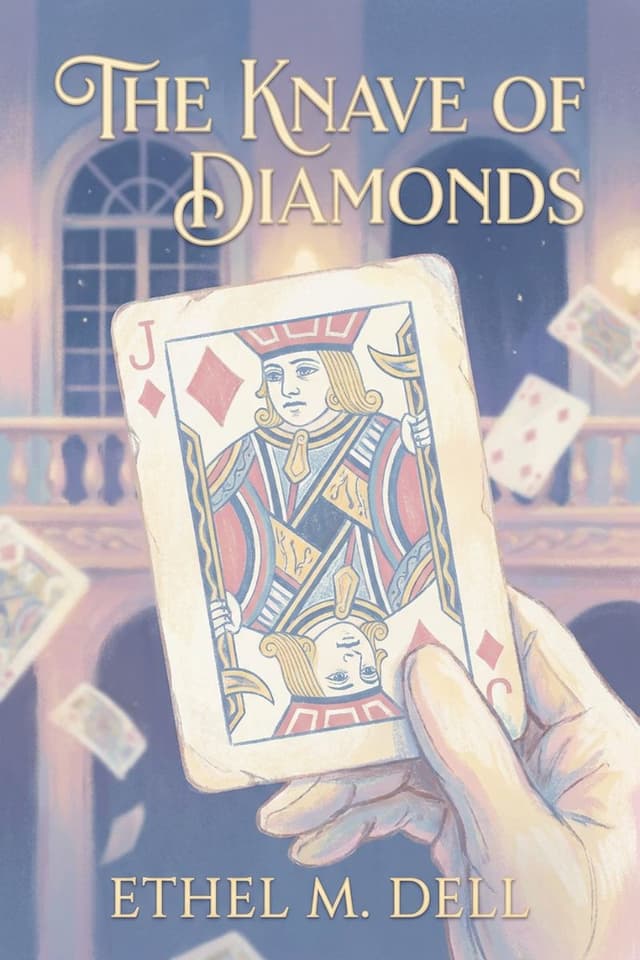
He deals her a card. The Knave of Diamonds.
The Errol Brothers
Nap is one of three brothers who have settled in the English countryside, and the family is unlike anything the local society has encountered. There's Lucas, the eldest, a man of extraordinary moral character who has been confined by a physical disability for years but whose quiet authority holds the entire family together. Bertie, the youngest, is all warmth and boyish enthusiasm.
And then there's Nap.
Nap is thirty years old, magnetic, restless, and dangerous. He collects women the way other men collect stamps. His own motto could be summed up as: anyone for a change, but no one for long. He's charming when it suits him and brutal when it doesn't. Even Lucas, who loves him, can't always control him.
But something about Anne stops Nap cold. She isn't impressed by him. She isn't afraid of him. She treats him with a calm, level dignity that he has never encountered before, and it gets under his skin in a way that nothing else has.
A Dangerous Friendship
What begins as a social acquaintance slowly becomes something more complicated. Anne and Nap are drawn together, pulled into each other's orbit at parties and gatherings and rides through the countryside. Their conversations are sharp, funny, and charged with an electricity that neither of them fully acknowledges.
Sir Giles notices. He is a cruel man when sober and a terrifying one when drunk, and he is drunk with increasing frequency. He turns his rage on Anne, and the glimpses Dell gives us of their private life are enough to make your stomach tighten.
Nap sees what's happening. And Nap is not a patient man.
The Knave's Gambit
Here is where the book gets its teeth. Nap wants Anne. Not casually, not as another conquest, but with a consuming intensity that frightens even him. He begins to push, to test the boundaries of her resolve, to make his feelings unmistakable.
Anne will not budge. She is married. She made a vow. It doesn't matter that her husband is a monster. It doesn't matter that Nap makes her feel alive for the first time in years. She will not betray her principles, not for comfort, not for love, not for anything.
This sets up a collision that drives the rest of the novel. Nap's volcanic temperament wars with Anne's immovable sense of honor. He is a man used to getting what he wants, and she is a woman who has decided, at enormous personal cost, that some things matter more than happiness.
The Breaking Point
The situation escalates. Sir Giles grows more violent. Nap grows more reckless. Lucas watches from the sidelines, understanding everything, loving his brother, and fearing what Nap is becoming.
Because here's the real question at the heart of this book: can Nap become a better man? He loves Anne. He might even love her enough to change. But his worst instincts are powerful, and the line between devotion and obsession is thinner than he thinks.
Something is going to break. Whether it's Anne's resolve, Nap's self-control, or the entire fragile arrangement that keeps everyone civil, the novel hurtles toward a crisis that will demand the best and worst from every character in it.
Who survives it, and what they become on the other side, is something Dell makes you earn page by page.
About the Author: Ethel M. Dell
The Shy Girl from Streatham
Ethel May Dell was born on August 2, 1881, in Streatham, a comfortable suburb of London. Her father was a clerk in the City. She had an older sister and brother. The family was middle class, respectable, and thoroughly ordinary.
Dell herself was anything but, though you'd never know it to look at her. She was painfully shy, quiet to the point of near-invisibility, and content to let her family dominate the conversation. But beneath that retiring exterior, she was writing stories of wild passion, fierce men, and women trembling on the edge of desire. Her cousins used to count the number of times she used the words "passion," "tremble," "pant," and "thrill" in a single manuscript.
The Breakthrough
Dell spent years writing her first novel, The Way of an Eagle. Eight publishers rejected it. The ninth, T. Fisher Unwin, picked it up for their First Novel Library series. Published in 1911, it went through thirty printings by 1915. Readers devoured it. Critics were appalled. Dell didn't care.
The Knave of Diamonds followed in 1912, her second novel, and the books kept coming. Dell wrote over thirty novels and several volumes of short stories between 1911 and her death, earning between £20,000 and £30,000 a year, an enormous sum for the era. She was one of the bestselling authors in the English-speaking world.
Marriage and Privacy
In 1922, at the age of forty, Dell married Lieutenant-Colonel Gerald Tahourdin Savage, a decorated soldier who resigned his commission after the wedding. He devoted himself entirely to his wife, becoming her fierce protector against the outside world. The marriage was happy and childless. They poured their affection into their dogs.
Dell was virtually impossible to find. Photographs of her are extremely rare. She never gave an interview. She never engaged with critics. She simply kept writing, kept earning, and kept her private life exactly that.
Legacy and Death
Dell was diagnosed with breast cancer in 1929 and underwent surgery. The cancer returned in 1939. She died on September 17, 1939, at age fifty-eight, just two weeks after Britain entered World War II.
Her husband, as a reserve officer, rejoined the army after her death. She left an estate of nearly £33,000.
Fun Facts About the Book
The Critics vs. The Readers
Few authors have experienced such a dramatic split between critical opinion and popular success. Literary critics of the era savaged Dell's work. George Orwell mentioned her repeatedly as an example of popular trash. Dorothy Sayers used her as shorthand for escapist fiction. Noel Coward lumped her in with literature for the illiterate. None of it mattered. Readers bought her books by the tens of thousands, and The Knave of Diamonds remained one of her most beloved titles.
Dell's Second Novel
The Knave of Diamonds was only Dell's second published novel, appearing in 1912, just a year after The Way of an Eagle made her famous. It shows a writer already fully in command of her style, confident enough to make her hero genuinely unlikable for long stretches and her heroine a married woman rather than the expected innocent.
The American Invasion
The Errol brothers are Americans in English country society, and Dell's attempts to write American dialect are a source of quiet amusement. Every American character says "real" constantly and "guesses" things at every opportunity. It's charming in its wrongness and gives the book an unintentional comedy layer.
Barbara Cartland Was a Fan
The romance queen Barbara Cartland personally selected The Knave of Diamonds for inclusion in her "Library of Love" reprint series in the 1970s. In her introduction, Cartland wrote that Dell was the first romantic novelist she ever read and that the book's hero excited her and its heroine was everything she thought a woman should be.
A Heroine Who Isn't a Virgin
For a novel written in 1912, the choice to make Anne a married woman dealing with an abusive husband rather than a blushing young ingenue was remarkably bold. Dell's heroines tend to be morally upright rather than conventionally sheltered, and Anne is one of her finest creations, a woman whose strength comes from her principles rather than her innocence.
Themes
Duty vs. Desire
The central tension of the novel, pulled taut and never slackened. Anne wants Nap. The book doesn't pretend otherwise. But she has made a commitment, and she believes that commitment matters more than her own happiness. The novel takes her position seriously rather than treating it as an obstacle to be overcome.
The Redemption of a Rake
Nap is not a good man when the story begins. He's a womanizer, a manipulator, and a man whose charm is a weapon he deploys without conscience. The novel asks whether love can transform a person, not in a fairy-tale way, but through genuine struggle and failure and hard-won change. Dell doesn't make it easy or clean.
The Trap of Marriage
Anne's marriage is a cage, and Dell doesn't shy away from showing it. Sir Giles is violent, controlling, and deteriorating. But the social and moral codes of Edwardian England offer Anne no escape. The novel is quietly devastating in its portrayal of a woman who is trapped not by physical chains but by her own sense of right and wrong.
The Power of Character
Lucas Errol, confined and physically diminished, is the moral center of the novel. He sees everything, understands everyone, and holds his fractured family together through sheer force of character. In a book full of passionate, volatile people, the quietest person in the room is the most powerful.
Passion as a Destructive Force
Dell was famous for writing about passion, and The Knave of Diamonds shows both its allure and its danger. Nap's intensity is what makes him compelling, but it's also what makes him dangerous. The line between love and possession, between devotion and obsession, is the tightrope the entire novel walks.
The Book's Legacy
The Knave of Diamonds helped cement Ethel M. Dell's reputation as the queen of Edwardian romance. Along with The Way of an Eagle, it established the template that would define her career: morally complex heroines, dangerously charismatic heroes, and plots that moved at a breathless pace through emotional territory that polite society preferred to ignore.
Dell's influence on popular romance fiction is hard to overstate. She was writing alpha-male heroes and emotionally intense love stories decades before the genre had a name. Barbara Cartland, one of the bestselling romance authors of all time, credited Dell as her earliest inspiration.
The novel also offers a fascinating window into Edwardian social dynamics, particularly the tension between old English aristocracy and brash American wealth, the suffocating constraints placed on women, and the rigid moral codes that governed even the most private feelings.
Dell has largely faded from literary memory, dismissed by the same critical establishment that dismissed her during her lifetime. But for readers who love romance with real teeth, with heroes who aren't always heroic and situations that don't resolve easily, The Knave of Diamonds remains a startlingly modern read hidden inside an Edwardian gown.