Novelhalla
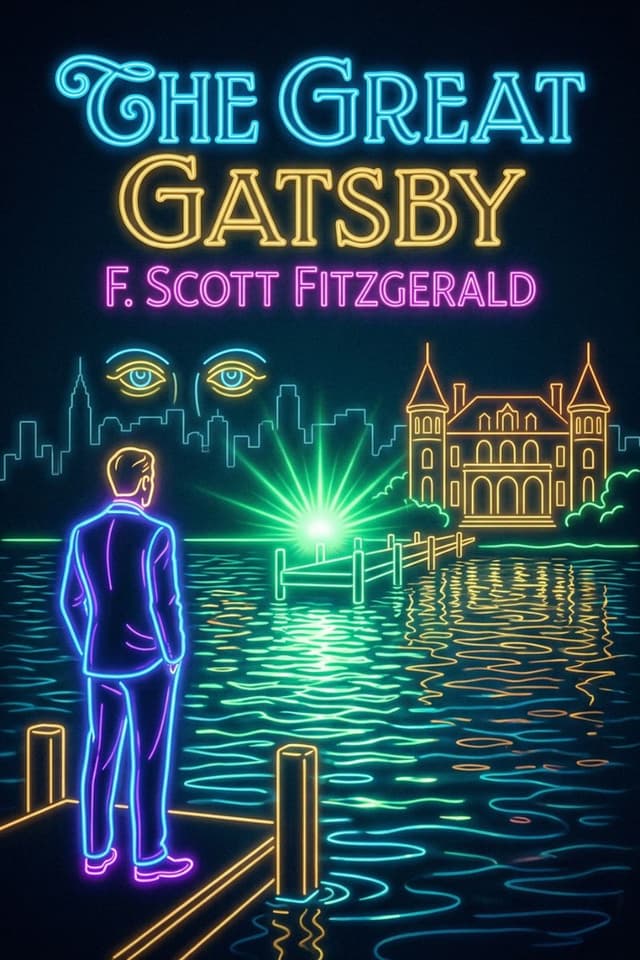
The Great Gatsby
Read The Great Gatsby by F. Scott Fitzgerald for free on Novelhalla, and try out our easy-to-read modern edition of this classic book. You can also download the EPUB and read it on any device if you prefer!
The Plot
The Neighbor
It's the summer of 1922, and Nick Carraway has just moved to Long Island. He's a young man from Minnesota, a Yale graduate, a World War I veteran, and now a bond salesman in New York. He's rented a small house in West Egg, the less fashionable of two wealthy communities that sit across a bay from each other. His cottage is wedged next to an enormous mansion that belongs to a man named Gatsby.
Nick doesn't know Gatsby yet. Nobody really does. What Nick knows is that Gatsby throws parties. Colossal, legendary, wildly extravagant parties. Hundreds of people show up every weekend to drink his champagne and dance in his gardens. Most of them have never met their host. Most of them don't even know what he looks like. The rumors fill in the gaps: he killed a man, he was a German spy, he's a bootlegger, he's an Oxford man. Gatsby is whatever you want him to be.
Across the bay in East Egg, where the money is older and the manners are sharper, lives Nick's cousin Daisy Buchanan and her husband Tom. Tom is rich, physically imposing, casually cruel, and having an affair that he barely bothers to hide. Daisy is charming, beautiful, and trapped in a way that doesn't become fully clear until it's too late. Their friend Jordan Baker, a professional golfer with a streak of casual dishonesty, fills in the rest of Nick's social circle.
It all seems like a glittering, if slightly rotten, summer among the very rich. It is not.
The Green Light
Nick finally meets Gatsby, and the man himself is both more and less than the legend. He's gracious, almost painfully polite, and there's something restless behind his smile. He calls everyone "old sport." He has a way of looking at you as if you're the only person in the world who matters.
What becomes clear, slowly and then all at once, is that everything Gatsby has built, the mansion, the parties, the fortune, the entire shimmering architecture of his life, exists for a single purpose. Across the bay, at the end of Daisy's dock, there is a green light. Gatsby has been watching it for years.
He wants Daisy. Not the Daisy who exists now, married and wealthy and worn slightly thin by life with Tom, but the Daisy he loved five years ago, before the war, before everything changed. He wants to reach back through time and recover something he lost, and he has spent every day since building a world designed to make that possible.
Nick becomes the bridge. Gatsby asks him to arrange a meeting with Daisy. The meeting happens. And for a brief, intoxicating moment, it seems like Gatsby might actually get what he wants.
The Crack in Everything
But the past doesn't come back. Not the way you want it to.
Tom Buchanan is no fool, whatever else he might be. He sees what's happening between Gatsby and Daisy, and the confrontation, when it comes, is not the romantic showdown Gatsby imagined. Tom knows things about Gatsby's fortune. He knows where the money comes from. And in a stifling hotel room on the hottest day of the summer, with everyone's nerves already shredded, the truth starts to come apart in ways none of them can control.
What follows is a chain of events so fast and so devastating that it takes Nick, and the reader, several chapters to fully understand what happened. There is a car. There is a road through the valley of ashes. There is a woman. There is a pair of painted eyes on a billboard, staring down at a wasteland between the wealth of Long Island and the wealth of Manhattan.
And by the time the dust settles, Nick is left standing in Gatsby's empty garden, trying to make sense of what these people have done to each other.
About the Author: F. Scott Fitzgerald
Early Life
Francis Scott Key Fitzgerald was born in 1896 in St. Paul, Minnesota, named after the author of "The Star-Spangled Banner," a distant relative on his father's side. His family had just enough status to mix with the wealthy but never enough money to belong among them. This gap between aspiration and means would become the great subject of his life and work.
He attended Princeton University, where he befriended future literary critic Edmund Wilson, wrote for the college humor magazine, and contributed to the Triangle Club musicals. He never graduated. In 1917, convinced he would die in the war, he dropped out and joined the Army. Stationed at a training camp in Alabama, he started writing his first novel and fell in love with Zelda Sayre, an eighteen-year-old Southern belle from a prominent family. She was wild, beautiful, and unwilling to marry a man without money.
The Jazz Age
Fitzgerald's first novel, This Side of Paradise, was published in 1920 and became an immediate sensation. A week later, Zelda married him. The two of them became the most glamorous young couple in America, embodying the reckless energy of the decade Fitzgerald himself named "the Jazz Age." They drank, they partied, they spent money they didn't have. They lived in New York, on Long Island, and in rented villas on the French Riviera, where Fitzgerald befriended Ernest Hemingway and became part of the expatriate literary community later known as the Lost Generation.
Between the parties, Fitzgerald wrote constantly. Magazine stories for The Saturday Evening Post paid the bills. His second novel, The Beautiful and Damned, sold well. But the serious literary achievement he wanted kept slipping away from him, lost in the noise of his own celebrity and the escalating chaos of his marriage.
The Masterpiece Nobody Bought
Fitzgerald wrote The Great Gatsby on the French Riviera in 1924, revising it extensively through the winter with his editor, Maxwell Perkins. He believed it was the best thing he had ever written. He expected it to sell 80,000 copies. It sold fewer than 20,000 in its first year. By the time Fitzgerald died, total sales had not reached 25,000.
The critical reception was better but not overwhelming. T. S. Eliot, Edith Wharton, and Willa Cather praised the book, but most reviews treated it as a minor work by a writer whose best days might be behind him.
The Decline
The years after Gatsby were brutal. Zelda suffered a severe mental breakdown in 1930 and was diagnosed with schizophrenia. She would spend much of the rest of her life in institutions. Fitzgerald's drinking, always heavy, became debilitating. His fourth novel, Tender Is the Night, published in 1934, was met with indifference. He went to Hollywood to write screenplays, earned poorly, and drank himself into declining health.
Fitzgerald died of a heart attack on December 21, 1940, at the age of forty-four, in the apartment of his companion, columnist Sheilah Graham, in Hollywood. He believed himself a failure. His books were out of print. At his funeral, Dorothy Parker reportedly stood over his coffin and quoted a line from Gatsby about the poor son of a bitch.
Afterlife
What Fitzgerald never saw is the story's second act, and it's more extraordinary than anything he wrote. Five years after his death, his forgotten novel was distributed free to American soldiers during World War II, and a million of them read it. Within a decade, it had entered high school classrooms across the country. It has now sold over thirty million copies. It sells half a million more every year. The man who died thinking himself forgotten is now considered one of the greatest American writers who ever lived.
Fun Facts About the Book
The Title Fitzgerald Never Loved
Fitzgerald was never satisfied with calling the novel The Great Gatsby. His preferred title was Trimalchio in West Egg, a reference to a wealthy party-thrower in the ancient Roman novel Satyricon. His editor, Maxwell Perkins, told him the reference was too obscure and nobody would know how to pronounce it. Fitzgerald also considered Gold-Hatted Gatsby and, in a last-minute panic just weeks before publication, Under the Red, White, and Blue. Perkins gently shut down each alternative. Fitzgerald accepted the title but never stopped wishing it were something else.
The Cover Art That Changed the Book
Before Fitzgerald finished writing the novel, his editor sent him an early sketch of the cover art by the little-known Spanish artist Francis Cugat. The painting, now called Celestial Eyes, shows a woman's face floating above a carnival nightscape, with eyes that seem to gaze down from the heavens. Fitzgerald was so struck by the image that he wrote to Perkins: "For Christs sake don't give anyone that jacket you're saving for me. I've written it into the book." Scholars believe the painting influenced the novel's famous billboard of Doctor T. J. Eckleburg, whose enormous painted eyes stare over the valley of ashes. It's one of the rare cases in literary history where cover art shaped the contents of the book rather than the other way around.
The World War II Rescue
In 1944, only 120 copies of The Great Gatsby sold in bookstores. That same year, the Council on Books in Wartime printed 155,000 free pocket-sized copies for American soldiers through the Armed Services Editions program. Soldiers read the books until they fell apart, passing torn chapters to friends. Each copy was read an estimated seven times. Over a million soldiers encountered Gatsby this way. The novel's postwar revival, which turned it into the most assigned book in American high schools, can be traced directly to those soldiers carrying a little paperback in their breast pockets on the way to Normandy.
Ginevra King
Daisy Buchanan was partly inspired by Ginevra King, a wealthy Chicago debutante Fitzgerald fell in love with at eighteen. Their romance was passionate but doomed by class: her family looked down on Fitzgerald's modest background, and he reportedly overheard someone at a party say that "poor boys shouldn't think of marrying rich girls." He kept every letter she sent him for the rest of his life. The specific pain of loving someone whose world you can't quite enter runs through the entire novel.
Zelda's Verdict
When Zelda Fitzgerald read the manuscript, she reportedly called it "a beautiful book." But some scholars have noted that Zelda's own writing, including her diaries and letters, appears to have been drawn upon by Fitzgerald for his fiction. In her review of The Beautiful and Damned, Zelda jokingly accused her husband of plagiarizing her diary. The degree to which Fitzgerald mined his wife's life and words for material remains one of the more uncomfortable questions in American literary history.
The Sales Numbers
In 1925, Fitzgerald predicted the novel would sell 80,000 copies. It sold fewer than 20,000 in its first year. When he died in 1940, total lifetime sales were roughly 25,000. Today, the book has sold over thirty million copies and continues to sell approximately 500,000 a year. The gap between what the book earned in Fitzgerald's lifetime and what it has earned since is staggering and heartbreaking in roughly equal measure.
The Shortest of the Greats
At around 47,000 words, The Great Gatsby is an unusually short novel, especially for one that regularly tops lists of the greatest American fiction. Fitzgerald's earlier novels were considerably longer and looser. The economy and precision of Gatsby, where every sentence carries weight and every image means something, is a deliberate artistic choice that Fitzgerald fought hard to achieve. He spent months cutting and restructuring on the advice of Perkins, and the result is a book with essentially no wasted words.
Themes
The American Dream
The novel's most famous subject. Gatsby believes that with enough money and enough determination, he can reinvent himself and reclaim the past. The green light at the end of Daisy's dock is the American Dream made visible: beautiful, beckoning, and just out of reach. The question the novel asks, without quite answering, is whether the dream was ever real or whether it was always a mirage over the water.
Class and Money
West Egg and East Egg sit across the same bay, but the distance between them is vast. Gatsby has money, but he doesn't have breeding. Tom Buchanan has both and wields them like weapons. The novel draws a sharp, unsparing line between wealth that is earned and wealth that is inherited, and it shows how the old-money class protects itself with a carelessness that amounts to cruelty.
The Corruption of Desire
Gatsby doesn't just want Daisy. He wants the version of himself that loving Daisy represents. His desire has become so tangled with his identity that he can no longer distinguish between the woman and the dream. The novel suggests that this kind of longing, beautiful as it is, is also deeply destructive, not because wanting things is wrong, but because wanting them this badly blinds you to what they actually are.
The Unreliable Narrator
Nick Carraway tells us at the very beginning that he reserves all judgment. He then proceeds to judge everyone and everything. How much of what we're reading is filtered through Nick's biases, his blind spots, his own unacknowledged desires? The novel invites this question without ever quite resolving it, and the result is a story that shifts depending on how much you trust the person telling it.
Carelessness
Tom and Daisy are, in Nick's devastating assessment, careless people. They smash things up and retreat into their money, leaving others to clean up the mess. The novel's most damning critique is not of greed or ambition but of a specific kind of moral negligence available only to the very rich: the ability to break lives without ever having to look at the wreckage.
The Book's Legacy
The Great Gatsby is routinely called the Great American Novel, and it might actually deserve the title. It has sold over thirty million copies, is assigned in nearly every American high school, and has been adapted into five films, most notably the 2013 Baz Luhrmann version starring Leonardo DiCaprio, which grossed over $350 million worldwide.
The novel entered the public domain on January 1, 2021, and the immediate flood of new editions, prequels, graphic novels, and adaptations confirmed what everyone already knew: Gatsby belongs to everyone now.
But the book's real legacy is harder to pin down than sales figures and film grosses. Fitzgerald captured something about America that no one has captured better, the way hope and corruption exist in the same breath, the way money promises freedom and delivers something else entirely, the way we keep reaching for a future that looks a lot like an idealized past. The last line of the novel is among the most quoted in American literature, and it endures because it says something true about how we all live, not just in the Jazz Age, but right now. We beat on. We keep reaching. And the current keeps pulling us back.