Novelhalla
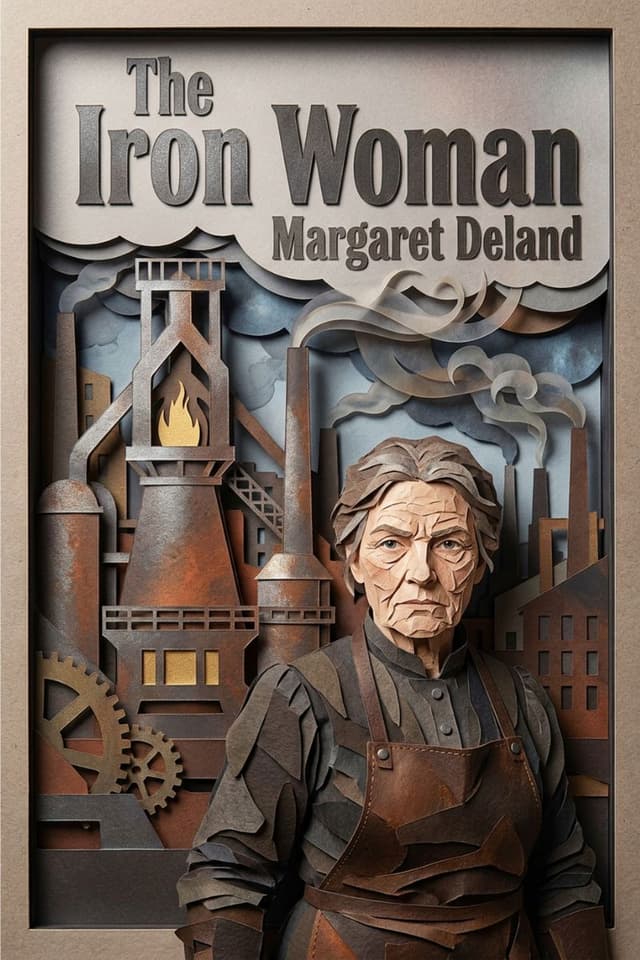
The Iron Woman
Read The Iron Woman by Margaret Deland for free on Novelhalla, and try out our easy-to-read modern edition of this classic book. You can also download the EPUB and read it on any device if you prefer!
The Plot
Four Children in a Smoky Town
The story opens in Mercer, a grimy industrial town on the Ohio River where soot from the iron works settles on everything. Four children are growing up in each other's orbits, and the dynamics between them will shape the rest of their lives.
Elizabeth Ferguson is a force of nature even at eight years old. Passionate, commanding, quick to rage and quicker to love, she rules the other children with sheer intensity. She lives with her bachelor uncle Robert Ferguson, a bitter man who manages the Maitland Iron Works and has decided, after being jilted in his youth, that women are mostly vain and useless. The one exception he'll allow is his boss.
That boss is Sarah Maitland, the iron woman herself. She inherited the mill from her late husband, who barely survived the marriage, and she runs it with a competence that impresses even the men who resent taking orders from a woman. She is tall, plain, blunt, and utterly consumed by work. She finds genuine joy in the roar and heat of the foundry. She does not find much joy in anything else, including, it turns out, getting to know her own children.
Her son Blair is charming, artistic, and spoiled rotten. Everyone adores him. Everyone gives him what he wants. His half-sister Nannie is gentle and devoted, living in Blair's shadow and their mother's neglect. And then there's David Richie, adopted son of the mysterious widow Helena Richie, who has come to Mercer carrying secrets from a painful past. David is quiet, stubborn, and honest to a fault.
Growing Up, Growing Apart
The children grow up. Blair becomes a young man who finds his mother's rough manners and obsession with the iron works embarrassing. He has no interest in the business. He wants beauty, refinement, escape. David goes off to study medicine and comes back a doctor with a position at a hospital in Philadelphia. Nannie remains sweet and self-sacrificing. And Elizabeth becomes exactly the kind of woman you'd expect from a girl who bit her own arm in fury as a child: brilliant, magnetic, and dangerously impulsive.
The romantic entanglements begin to knot. Elizabeth and David are drawn to each other, but Elizabeth is also drawn to Blair, who pursues her with the confidence of someone who has never been told no. What starts as childhood attachment twists into something much more complicated, and Elizabeth finds herself making a choice between two men who could not be more different: one who represents passion and beauty, and one who represents steadiness and truth.
She makes the wrong choice. Or maybe the right one. It depends on when you ask her.
The Iron Woman's Reckoning
Sarah Maitland has poured everything into two things: her iron works and the belief that she raised her son to be honorable. When Blair's actions reveal that she may have failed spectacularly at the second, it breaks something in her that the foundry fires never could. The woman who bent iron to her will cannot bend her own child.
What follows is a collision between love and duty, passion and honor, that pulls every character into its wake. Helena Richie, who has spent years atoning for her own past mistakes, watches the younger generation heading toward a disaster she recognizes all too well. Nannie, loyal to a fault, faces an impossible choice of her own. And over it all looms the iron works, belching smoke and making money, a monument to Sarah Maitland's iron will and everything it cost her.
The question at the heart of this novel isn't whether Sarah Maitland is strong. Everyone knows she's strong. The question is whether strength, when it comes at the expense of everything soft and human, leaves anything worth inheriting.
And the iron works don't care about the answer.
About the Author: Margaret Deland
A Difficult Beginning
Margaret Deland was born Margaretta Wade Campbell in 1857 in Allegheny, Pennsylvania, just outside Pittsburgh. Her mother died giving birth to her. Her father died two weeks later. She was raised by her aunt and uncle on a family estate called Maple Grove, overlooking the Ohio River in Manchester, Pennsylvania. The industrial landscape of her childhood, the smoke and steel and river towns, would become the backdrop for her most important fiction.
She was educated in Pittsburgh and at the Pelham Priory boarding school in New Rochelle, New York. In 1875, she made a bold move for a young woman of her era: she announced she would study art at Cooper Union in New York City. She became an instructor of drawing at what would later become Hunter College.
Marriage and Compassion
In 1880, she married Lorin F. Deland, and the couple settled in Boston. What they did next shocked polite society. Over four years, the Delands took in roughly sixty unmarried mothers and their babies at their Beacon Hill home, providing shelter and support at a time when these women were treated as outcasts. It was an act of radical compassion that would inform Deland's fiction for the rest of her career.
She began writing verses for her husband's greeting card business, and a friend sent some of her poems to Harper's New Monthly Magazine. Her first poem was published in 1885. Her first poetry collection followed in 1886, and her first novel, John Ward, Preacher, became a sensation in 1888 when it dared to dramatize a marriage destroyed by religious fanaticism.
A Major Career
Deland became one of the most widely read American authors of her generation. She published more than thirty books over a career spanning five decades. Her "Old Chester" stories, set in a fictionalized version of the Manchester where she grew up, were beloved for their warmth and sharp observation of small-town life. Her "problem novels," including The Awakening of Helena Richie and its sequel, tackled subjects like marital abuse, women's autonomy, and moral compromise with unusual directness.
She and her husband maintained a summer home called Greywood in Kennebunkport, Maine, for nearly fifty years. After Lorin's death in 1917, Deland went to France to do war relief work, organizing the Author's Fund for the Relief of Wounded Soldiers. She was awarded the Legion of Honor by the French government for her efforts.
Recognition and Later Years
In 1926, Deland was elected to the National Institute of Arts and Letters alongside Edith Wharton, Agnes Repplier, and Mary E. Wilkins Freeman. The admission of these four women was described at the time as having "marked the letting down of the bars to women" in the literary establishment.
She published two memoirs in her later years and remained active in Boston literary circles until her death in 1945 at the age of eighty-seven.
Fun Facts About the Book
A Sequel You Don't Need the First Book For
The novel is a sequel to The Awakening of Helena Richie (1906), which tells the earlier story of David's adoptive mother and her escape from a devastating first chapter of life. But the sequel stands completely on its own. Helena is a supporting character here, and the novel gives you everything you need to understand her history through context. Many readers come to this book first and go back to the prequel afterward.
Serialized Over a Full Year
The novel was first published in monthly installments in Harper's Monthly from November 1910 through October 1911, meaning readers waited nearly a year to find out how the tangled love plot resolved. The book edition followed in September 1911 from Harper & Brothers.
A National Bestseller
The novel was a bestseller in 1911, appearing alongside titles by Harold Bell Wright and Gene Stratton-Porter on the year's top-selling lists. Deland was at the peak of her popularity, and the book drew enthusiastic letters from readers. One first-edition copy survives with a handwritten letter from Deland herself, thanking a fan for his kind words about the novel.
Pittsburgh in Disguise
Mercer, the fictional town where the novel takes place, is a thinly veiled Pittsburgh. The iron works, the soot, the river, the social stratification between mill owners and workers, and the nearby small town of Old Chester (based on Manchester, Pennsylvania) all draw directly from Deland's childhood landscape. Readers from Pittsburgh recognized it immediately.
Illustrated by F. Walter Taylor
The first edition featured illustrations by F. Walter Taylor, an artist known for working primarily in charcoal in an impressionist style. Taylor, who lived from 1874 to 1921, created atmospheric black-and-white plates that captured the smoky industrial setting of the novel.
A Lost Film
The novel was adapted into a silent film in 1916, directed by Carl Harbaugh and starring Nance O'Neil as Sarah Maitland and Evelyn Brent in an early role. The film is now considered lost, one of the countless silent-era movies that did not survive the decades before film preservation became standard practice.
An Unusual Heroine for 1911
Sarah Maitland is not the romantic lead. She's not young, not beautiful, not interested in love. She's a middle-aged businesswoman who runs a steel mill. In 1911, a female character who defines herself entirely through work, who finds the foundry more compelling than the parlor, was genuinely radical. Deland doesn't fully endorse Sarah's choices, but she doesn't mock them either. She takes this woman seriously, and that alone was remarkable.
Themes
Work as Identity
Sarah Maitland doesn't just work. She is her work. The iron mill isn't something she does; it's who she is. Deland explores what happens when a person builds their entire identity around labor and productivity, and whether a life that impressive on the outside can be hollow at its core. It's a question that feels startlingly modern.
The Cost of Neglect
Sarah's devotion to the iron works comes at a price, and her children pay it. Blair has been spoiled materially but starved emotionally. Nannie has been overlooked entirely. The novel traces how parental absence, even from a parent who is physically present, shapes the adults children become. Sarah doesn't fail because she's a bad person. She fails because she never learned the language of connection.
Passion Versus Honor
The love triangle at the center of the novel isn't a simple contest between a good man and a bad one. Blair isn't a villain. David isn't flawless. Elizabeth is drawn to both of them for real, complicated reasons, and her choices have consequences that ripple outward through every relationship in the story. Deland is interested in what happens when desire and duty point in different directions, and she doesn't offer easy answers.
Women's Autonomy and Its Limits
Sarah Maitland runs a steel mill in an era when women couldn't vote. Elizabeth Ferguson is brilliant and passionate but has almost no control over her own economic fate. Helena Richie carries the weight of past choices that society will never let her fully escape. The novel is quietly furious about the narrowness of women's options, even as it portrays women who push against those limits with everything they have.
The Weight of the Past
Helena Richie's history haunts the present. Sarah Maitland's parenting failures catch up with her. Robert Ferguson's old heartbreak poisons his ability to trust. Everyone in this novel is shaped by something that happened before the story begins, and the question of whether people can outrun their own histories drives the plot as much as the love story does.
Forgiveness and Moral Compromise
Nobody in this novel is purely good or purely bad. Deland is fascinated by the gap between moral ideals and messy human behavior. Characters make terrible decisions for understandable reasons. The novel asks not whether people are perfect, but whether they can be forgiven for being human.
Historical Context
The Industrial Age in Full Swing
The novel is set in the decades before the turn of the twentieth century, when the Pittsburgh region was the iron and steel capital of America. The description of the Maitland works, with its soot and danger and relentless production, reflects the real industrial landscape that Deland grew up in. This was the era of Andrew Carnegie and Henry Clay Frick, when fortunes were being made in steel and the human cost of that production was staggering. Placing a woman at the head of an iron works was Deland's way of exploring what power does to a person, stripped of the usual gender assumptions.
The Woman Question
Deland wrote during a period of intense debate about women's roles. The suffrage movement was gaining momentum, women were entering the workforce in greater numbers, and the old certainties about separate spheres were crumbling. Deland herself held complicated views on women's rights. She advocated for more autonomy while also believing in the practical realities of marriage and motherhood. Her fiction reflects that tension, portraying women who push boundaries but also pay for it.
The Book's Legacy
The novel was one of Deland's biggest commercial successes and cemented her reputation as a writer willing to tackle uncomfortable questions about work, family, and moral compromise. Sarah Maitland remains one of the most striking female characters in early twentieth-century American fiction, a woman who refuses to be defined by domesticity at a time when that refusal was almost unthinkable.
The book's portrait of a workaholic parent, a child raised with everything except attention, and a community tangled in secrets and desire feels remarkably current. Strip away the gaslight and the iron works and you have a story that could unfold in any modern suburb.
Deland's reputation faded after her death, as it did for many popular women writers of her era. But readers who discover her now often find themselves startled by how sharp and modern her observations feel. The Iron Woman in particular rewards contemporary readers with its refusal to simplify its characters or resolve its tensions neatly. It's a novel about what people owe each other, and whether love and ambition can coexist, and it doesn't pretend the answers are easy.