Novelhalla
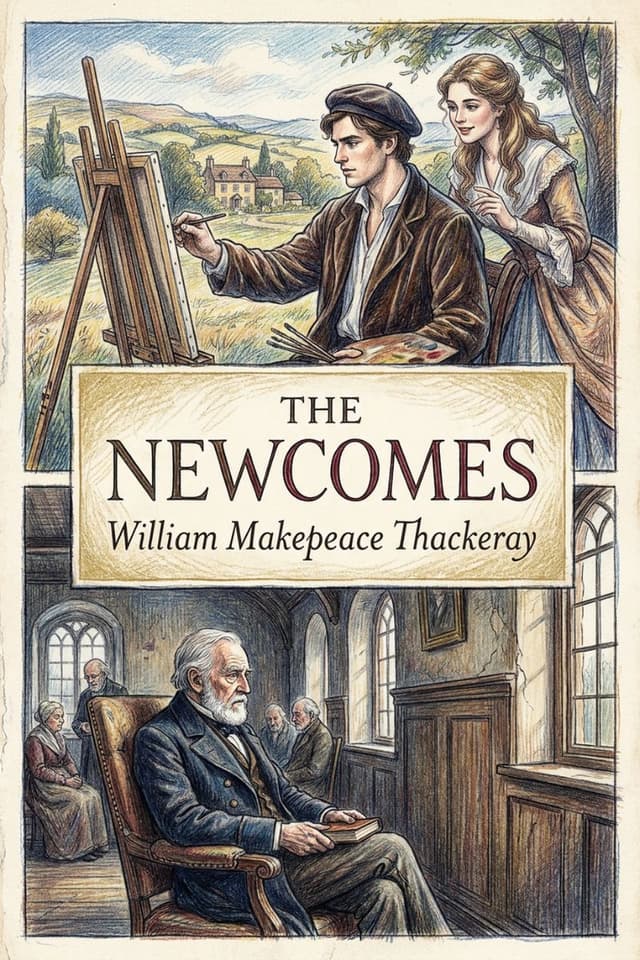
The Newcomes
Read The Newcomes by William Makepeace Thackeray for free on Novelhalla, and try out our easy-to-read modern edition of this classic book. You can also download the EPUB and read it on any device if you prefer!
The Plot
The Colonel Comes Home
Colonel Thomas Newcome is one of the finest men you will ever meet in fiction. Kind, generous, honorable, and hopelessly naive about the world his family actually lives in. He has spent most of his adult life in India with the British Army, far from the drawing rooms and dinner parties of London society. When he finally returns to England, he brings with him a heart full of love for his son Clive and absolutely no understanding of how vicious respectable people can be.
The Newcome family has done well for itself. Over several generations, they have risen from humble origins into wealth and banking respectability, and some branches have started marrying into the aristocracy. They are, as the subtitle tells us, a Most Respectable Family. Thackeray means this the way a knife means the word "sharp."
Clive
The Colonel's son is charming, talented, and deeply impractical. Clive wants to be a painter. In a family of bankers and social climbers, this is roughly equivalent to announcing you want to join the circus. But the Colonel, who adores his boy with a devotion that borders on blindness, supports the dream. He wants Clive to be happy. He wants Clive to have the freedom he never had.
Clive travels through Europe. He studies art in Rome. He falls in with bohemians and aristocrats. And he falls in love with his cousin Ethel Newcome, a beautiful, intelligent young woman trapped in a family that sees her primarily as a commodity to be traded on the marriage market.
Ethel
Ethel is the prize everyone wants to broker. Her father, Barnes Newcome, is the head of the respectable branch of the family, and he is cold, greedy, and ruthless. Her grandmother, the formidable Countess of Kew, has plans for Ethel that involve a wealthy marriage and nothing else. Love is not part of the equation. Love is for people who can't afford better.
Ethel knows what's being done to her. She's too smart not to see it. But knowing you're trapped and escaping the trap are two different things, and the pressures of family, money, and social expectation bear down on her with crushing force.
Clive loves Ethel. Ethel has feelings for Clive. The family will not allow it.
The Marriage Market
What follows is a sprawling, devastating portrait of what happens when love and money occupy the same room and money wins. Clive is maneuvered into marrying Rosey Mackenzie, a pretty, sweet, utterly superficial young woman who is everything Ethel is not. It is a pleasant marriage on the surface and a catastrophe underneath. Clive does not love Rosey. He never will.
Meanwhile, Ethel watches her own brother Barnes destroy his marriage through cruelty so extreme that his wife runs away with another man. The spectacle of this wreckage changes something in Ethel. She begins to question everything her family has taught her about what a woman's life should look like.
And through it all, the Colonel moves like a gentle giant through a world that doesn't deserve him, believing the best of everyone, trusting people who will eventually destroy him.
The Fall
The Colonel invests his fortune in the Doyen and Doyen Banking company, a venture that promises great returns. He puts everything in. He encourages others to do the same. When the bank collapses, it takes everything with it. The Colonel is ruined. Clive is ruined. And Rosey's mother, the vicious Mrs. Mackenzie, descends on the household to make absolutely certain that everyone knows exactly whose fault this is.
The Colonel, broken and humiliated, the kindest man in a novel full of unkind people, retreats to the Grey Friars almshouse, a charity home for the destitute. The man who gave everything finds himself with nothing, surrounded by the ruins of every good intention he ever had.
Whether kindness survives in a world built on money and manners is the question the novel has been building toward. And Thackeray, who understood that world better than almost anyone, is not in the business of easy answers.
About the Author: William Makepeace Thackeray
Born in the Empire
William Makepeace Thackeray was born in Calcutta, India, in 1811. His father was a senior official in the East India Company. His mother's story reads like something out of one of his novels: she was sent to India after her family told her that the man she loved, Henry Carmichael-Smyth, had died. It wasn't true. They simply wanted a better match for her. She married Thackeray's father instead. The truth came out in spectacular fashion when Richmond Thackeray unknowingly invited the supposedly dead Carmichael-Smyth to dinner. After Richmond died in 1815, Anne married Carmichael-Smyth, the man she had loved all along.
Young William was sent to England at five years old. On the voyage home, the ship stopped at St. Helena, where a servant pointed out Napoleon and told the boy that the prisoner ate three sheep a day and all the children he could get his hands on.
The Gambler
Thackeray attended Charterhouse School, which he despised so thoroughly that he later rechristened it "Slaughterhouse" in his fiction. He moved on to Trinity College, Cambridge, where he discovered a talent for gambling that was considerably more developed than his talent for studying. He lost over fifteen hundred pounds in a single night of cards.
He came into a substantial inheritance at twenty-one: roughly twenty thousand pounds, a fortune by the standards of the day. He burned through it with breathtaking speed. Gambling. Two failed newspapers. Bad investments in Indian banks that collapsed. Within a few years, the wealthy young gentleman was broke and needed to find a way to earn a living for the first time in his life.
He tried law. He quit. He tried art, studying painting in Paris. He wasn't good enough. Finally, almost by default, he turned to writing. It was the only thing that stuck.
Tragedy and Fame
In 1836, Thackeray married Isabella Shawe. They had three daughters, but after the birth of the third child in 1840, Isabella sank into severe depression. During a sea crossing to Ireland, she threw herself overboard. She was pulled from the water, but she never recovered. She spent the rest of her life in care, outliving her husband by thirty years, locked in a permanent state of detachment from reality.
Thackeray raised his daughters with help from his mother and threw himself into work. He wrote for magazines under a parade of absurd pen names: Michael Angelo Titmarsh, George Savage Fitz-Boodle, The Fat Contributor. He wrote satirical sketches for Punch. And then, in 1847, he published Vanity Fair, and everything changed. The novel made him famous overnight. Suddenly he was Dickens's only rival, the two greatest novelists in England, circling each other with a mixture of respect and jealousy that eventually curdled into an outright feud.
The Final Years
Thackeray followed Vanity Fair with a string of major novels: Pendennis, Henry Esmond, and The Newcomes, which many considered his finest work. He lectured in America and England. He ran for Parliament and lost by thirty-three votes. He founded the Cornhill Magazine in 1860.
His health deteriorated throughout his fifties, worsened by overeating and heavy drinking. On the morning of December 24, 1863, his servants found him dead in bed. He had suffered a stroke during the night. He was fifty-two. Thousands attended his funeral at Kensal Green Cemetery, including Dickens, who reportedly wept.
Fun Facts About the Book
The Birth of "Capitalism"
The Newcomes contains the first known use of the word "capitalism" to describe an economic system. Thackeray coined it almost casually, embedded in a novel about the marriage market and the corrupting influence of money. A word that would come to define the modern world was invented by a Victorian satirist making fun of wealthy families.
Thackeray's Most Popular Novel
During his lifetime, The Newcomes was actually Thackeray's most popular novel, outstripping even Vanity Fair in public affection. Victorian readers loved Colonel Newcome with a passion that surprised even Thackeray. The Colonel's fate at the end of the book reportedly caused readers across England to weep openly.
The Charterhouse Connection
The Grey Friars almshouse where Colonel Newcome ends his days is based on Charterhouse, the school Thackeray attended and hated as a boy. Charterhouse was originally a medieval monastery that also served as an almshouse for elderly men. Thackeray, who despised the school, transforms it into a place of grace and dignity for his most beloved character. It's one of the most quietly devastating ironies in his work.
Connected to Vanity Fair
The Newcomes takes place a decade or two after Vanity Fair, and some characters from the earlier novel appear in the background. The narrator is Arthur Pendennis, the hero of Thackeray's novel Pendennis. Thackeray was building a shared literary universe long before the concept became fashionable.
Clive Was Based on a Real Painter
Thackeray based aspects of Clive Newcome's character on the painter Frederic Leighton, whom he met in Rome. Leighton would go on to become President of the Royal Academy and one of the most celebrated artists of the Victorian era. He was also the only British artist ever to be elevated to the peerage.
Illustrated by Richard Doyle
The original serial publication featured illustrations by Richard Doyle, a celebrated Punch magazine artist. Doyle's illustrations ranged from literal depictions of scenes to fantastical, symbolic renderings of characters and events, giving the novel a visual layer that complemented Thackeray's satirical tone.
A Novel You Could Live In
Critics have noted that The Newcomes contains hundreds of references to real poets, painters, novels, politics, and cultural events of the period. The result is less like reading a novel and more like being dropped into Victorian England itself. One scholar described it as "almost a miniature education in the Victorian era."
Themes
The Marriage Market
The novel's central obsession. Thackeray shows a world where marriages are financial transactions dressed up in white lace. Women are assets to be deployed. Men are evaluated by their income. Love is an inconvenience that complicates otherwise sensible arrangements. The subtitle, "Memoirs of a Most Respectable Family," drips with the understanding that respectability and genuine human feeling are often incompatible.
Goodness in a Cruel World
Colonel Newcome is good. That's his defining quality and his fatal flaw. He trusts people. He believes in honor. He loves without conditions. And the world around him, built on calculation and self-interest, punishes him for every one of these virtues. The novel asks whether decency can survive contact with society, and the answer it gives is not comfortable.
Money and Corruption
The Newcome family's rise from trade to banking to aristocratic aspiration is a map of how money reshapes identity. Each generation pushes further from its origins and closer to a respectability that requires the suppression of anything honest or raw. By the time we reach Barnes Newcome, the family has produced a man who is all surface and no soul.
Parents and Children
The Colonel's love for Clive is the emotional core of the book. It is boundless and, in its way, destructive, because the Colonel's blindness to his son's real needs is as damaging as the calculated cruelty of other parents in the novel. Every parent in the book is shaping their children, and almost none of them are doing it well.
Art Versus Commerce
Clive wants to paint. His family wants him to be respectable. This tension runs through the novel like a fault line. Thackeray, who once wanted to be an artist himself before financial ruin forced him into writing, understood the cost of choosing beauty in a world that only values profit.
Women as Property
Ethel Newcome sees clearly what is being done to her and to every woman in her world. She is being sold. The currency is respectability and the buyer is whoever offers the best title or the fattest bank account. Her slow rebellion against this system is one of the most compelling threads in the novel, and Thackeray writes it with a sympathy that was unusual for his era.
The Book's Legacy
The Newcomes was considered by many Victorian readers to be Thackeray's masterpiece, and Colonel Newcome became one of the most beloved characters in English literature. Anthony Trollope ranked Thackeray above Dickens, and The Newcomes was a significant reason why.
The novel's influence ripples outward in ways that are easy to miss. It contains the first recorded use of the word "capitalism." It pioneered the idea of a shared fictional universe, connecting characters across multiple novels. And its unflinching examination of the marriage market as an economic institution laid the groundwork for generations of fiction about money, class, and the terrible things respectable people do to their children.
Modern readers may find the novel long. It is long. It was published in twenty-four serial installments and it feels like it. But within that sprawl are scenes of extraordinary power: Clive's doomed romance with Ethel, the Colonel's slow ruin, and a final sequence in the Grey Friars almshouse that has reduced readers to tears for over a century and a half. If you have the patience for a novel that moves at the pace of life itself, The Newcomes rewards it with a portrait of Victorian England so complete and so human that you can practically smell the coal smoke and hear the church bells.