Novelhalla
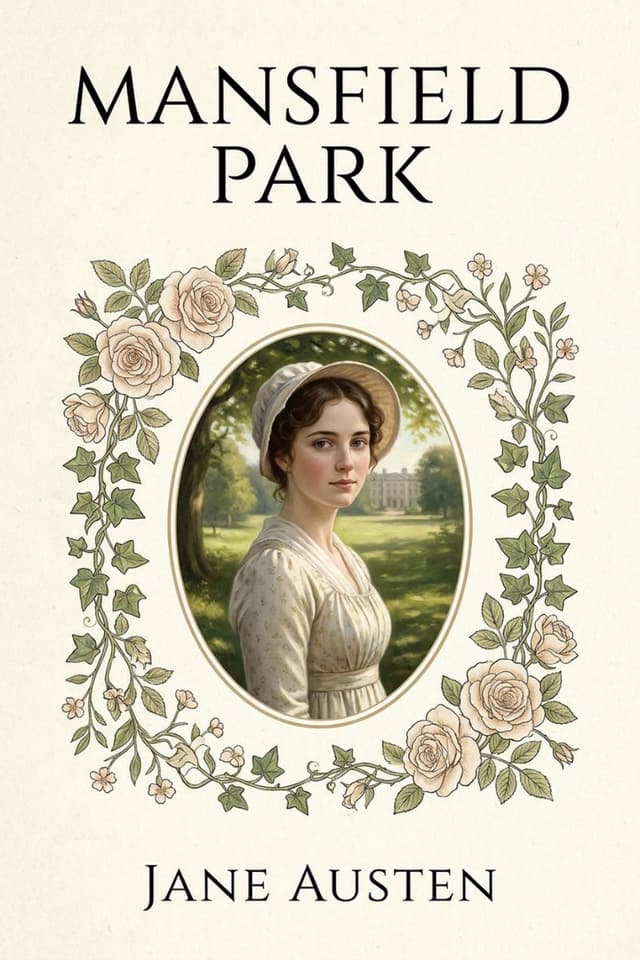
Mansfield Park
Read Mansfield Park by Jane Austen for free on Novelhalla, and try out our easy-to-read modern edition of this classic book. You can also download the EPUB and read it on any device if you prefer!
The Plot
The Poor Relation
Fanny Price is ten years old when she's sent away from home. Her mother married badly, a naval lieutenant with a drinking problem, and the family has too many children and too little money. So Fanny is shipped off to live with her wealthy aunt and uncle, Sir Thomas and Lady Bertram, at their grand country estate, Mansfield Park.
She arrives shy, overwhelmed, and terrified. The house is enormous. Her cousins Tom, Edmund, Maria, and Julia are polished and confident in ways Fanny can't begin to imitate. Her Aunt Norris, who arranged the whole scheme, makes sure Fanny never forgets her place. She is the charity case. The afterthought. The girl who should be grateful just to be in the room.
Only Edmund, the younger son, is kind to her. He listens. He encourages her. He treats her like she matters. And quietly, without meaning to, Fanny falls in love with him.
The Crawfords
Years pass. Fanny grows up in Mansfield Park's shadow, useful to everyone and noticed by no one. Then the Crawfords arrive.
Henry and Mary Crawford are the half-siblings of the local clergyman's wife, and they bring London glamour, sharp wit, and a dangerous appetite for entertainment into the quiet world of Mansfield. Henry is charming, restless, and incapable of leaving women alone. He flirts shamelessly with Maria, who is engaged to the wealthy but spectacularly dim Mr. Rushworth, and with Julia, who watches her sister get all the attention and seethes.
Mary Crawford is something else entirely. She's funny, magnetic, and utterly pragmatic about money and marriage. She sets her sights on Edmund, but his plan to become a clergyman is a problem for her. She wants a man with ambition, status, a London life. A country parson is not what she had in mind. And yet she can't quite let him go.
Edmund, meanwhile, is falling for Mary. Hard. He talks to Fanny about it constantly, never realizing what each conversation costs her.
The Play
With Sir Thomas away on business in Antigua, the young people decide to stage a play. Tom Bertram's friend Mr. Yates arrives buzzing with theatrical fever, and soon the whole group is caught up in rehearsals for Lovers' Vows, a risque drama about illegitimate children and women who fall for men beneath their station.
Edmund objects. Fanny objects. But one by one, everyone's resistance crumbles. Edmund agrees to take a part opposite Mary Crawford, and the rehearsals become a pressure cooker of flirtation and jealousy. Henry and Maria rehearse their scenes with an intensity that has nothing to do with acting. Julia sulks. The billiard room gets converted into a theater. The whole household tips toward chaos.
And Fanny? Fanny is the only one who holds her ground. She refuses to act. She watches everything. She sees what no one else wants to admit: that the play isn't harmless fun. It's making visible all the cracks that already exist.
Then Sir Thomas comes home.
The Proposal
The play is shut down. Henry Crawford leaves without a word to Maria, who marries Mr. Rushworth in a blaze of wounded pride. The Crawfords and Bertrams scatter and regroup. But the real surprise comes when Henry Crawford, bored and looking for a new game, decides to make Fanny fall in love with him.
He doesn't expect what actually happens. Spending time with Fanny, seeing her kindness, her steadiness, her refusal to be impressed by surfaces, Henry falls genuinely in love. He proposes marriage.
Fanny says no.
The reaction is volcanic. Sir Thomas is furious. This is an advantageous match for a girl with no money and no prospects, and Fanny's refusal looks like rank ingratitude. Henry is rich. He's well-connected. He says he's reformed. Everyone tells Fanny she's being foolish.
But Fanny has watched Henry Crawford for months. She's seen how he treated her cousins. She knows what charm looks like when it has nothing underneath it. And she cannot betray her own judgment, even when every powerful person in her life is telling her to.
Portsmouth
Sir Thomas sends Fanny home to Portsmouth. The official reason is to visit her family. The real reason is punishment, a reminder of the poverty she came from, meant to soften her resistance to Henry's proposal.
It works, in a way. Fanny's family home is cramped, noisy, and chaotic. Her father barely notices her. Her mother is exhausted and distracted. The house that should feel like home feels foreign. Fanny aches for Mansfield Park, for the quiet, the order, the life she's grown into.
Henry Crawford follows her there. He's attentive. He's patient. He seems genuinely changed. And for the first time, Fanny begins to waver.
Then letters start arriving from Mansfield. Something is very wrong. Tom Bertram is dangerously ill. And there are rumors, terrible rumors, about Henry Crawford and someone he was never supposed to see again.
The careful world of Mansfield Park is about to come apart. And every truth Fanny quietly held onto while everyone else looked away is about to matter more than anyone imagined.
About the Author: Jane Austen
Early Life
Jane Austen was born in 1775 in Steventon, Hampshire, where her father was the rector. She was the seventh of eight children in a close, affectionate family that valued reading, writing, and wit. She began writing stories as a teenager, producing sharp parodies and comedies for family entertainment.
A Writer's Life
Austen never married, though she received at least one proposal and may have had a brief romance that ended unhappily. She lived with her family her entire life, moving from Steventon to Bath (a city she disliked) to Southampton and finally to Chawton, where she did most of her mature writing.
She published four novels during her lifetime: Sense and Sensibility (1811), Pride and Prejudice (1813), Mansfield Park (1814), and Emma (1815). All were published anonymously, credited only to "A Lady." She earned modest sums and a small following but nothing like the fame that would come later.
Final Years
Austen began experiencing health problems in 1816, likely from Addison's disease, though the diagnosis is uncertain. She continued writing through her illness, working on Persuasion and beginning a new novel, Sanditon. She died in July 1817 at age 41 in Winchester, where she had gone seeking medical treatment.
Persuasion and Northanger Abbey were published together posthumously in December 1817, with a biographical note by her brother Henry that finally revealed her identity to the public.
Legacy
Austen's reputation grew steadily through the 19th century and exploded in the 20th. Her novels have never been out of print. She is now considered one of the greatest writers in English, her work endlessly adapted, analyzed, and adored.
Fun Facts About the Book
Austen's First Fully Original Novel
Mansfield Park was the first of Austen's novels to be conceived and entirely written during her mature years at Chawton. Her earlier published works, Sense and Sensibility and Pride and Prejudice, were both revisions of manuscripts she had drafted in her twenties. This was something new, written from scratch by a woman in her late thirties with a sharper eye and a deeper understanding of human weakness.
An Instant Bestseller (That Nobody Reviewed)
The first edition of about 1,250 copies sold out within six months, earning Austen at least £320, the most profitable edition of any of her books published during her lifetime. Despite this commercial success, not a single critic reviewed it until 1821, four years after her death. The public loved it. The literary establishment simply didn't notice.
Austen's Own Assessment
Austen herself wasn't entirely sure about this one. In a letter to her brother Francis, she wrote that she had something in hand which she hoped would sell well on the strength of Pride and Prejudice, though it was "not half so entertaining." She wasn't wrong about the tone being different, but she may have underestimated just how much that difference would divide readers for the next two centuries.
The Opinions List
Since no reviews appeared, Austen collected reactions herself. She compiled a list called "Opinions of Mansfield Park" from family and friends. The responses were fascinatingly split. Her publisher praised its morality. Her sister Cassandra thought it clever but not as brilliant as Pride and Prejudice. Some readers loved Fanny. Others couldn't stand her. The debate started in Austen's own drawing room and hasn't stopped since.
The Scandalous Play
The play the characters rehearse, Lovers' Vows, was a real and genuinely controversial work. Translated from German by Elizabeth Inchbald, it dealt with illegitimate children and class-crossing romance, subjects that were shocking for an amateur drawing-room performance. Austen chose it deliberately. The roles the characters pick mirror their real desires and moral failings with uncomfortable precision.
The Harry Potter Connection
J.K. Rowling named Argus Filch's cat Mrs. Norris after the bullying aunt in Mansfield Park. Rowling, a devoted Austen fan, chose the name because both characters share a talent for lurking in the background, spying on everyone, and making life miserable for those with less power.
Austen Knew This World
Austen's portrayal of the clergy and the navy in Mansfield Park drew directly from her own life. Her father was a clergyman, one of her brothers entered the church, and two others, Francis and Charles, served as naval officers during the Napoleonic Wars. When William Price comes home glowing with stories of life at sea, that's Austen writing from family experience.
The Slavery Question
The Bertram family's wealth comes partly from a plantation in Antigua, and there's a moment where Fanny asks Sir Thomas about the slave trade and is met with dead silence. Scholars have debated for decades what Austen intended by this scene. Some believe the novel's very title references Lord Mansfield, the judge whose 1772 ruling was seen as a landmark in the fight against slavery in England. What's certain is that Austen read and admired the abolitionist Thomas Clarkson and that the silence in that scene speaks volumes.
Themes
Moral Courage in Quiet People
Fanny Price doesn't have the wit of Elizabeth Bennet or the charm of Emma Woodhouse. What she has is the ability to see clearly and the strength to act on what she sees, even when everyone around her is telling her she's wrong. The novel argues that moral vision matters more than social polish, and that the person standing silently in the corner might be the only one in the room who understands what's really happening.
The Dangers of Performance
Everyone in Mansfield Park is performing. The Crawfords perform charm. Maria performs contentment with her engagement. Sir Thomas performs authority without real understanding. The theatrical subplot makes this literal: when the characters put on a play, the roles they choose reveal who they truly are. Only Fanny refuses to act, and the novel rewards her for it.
The Cost of Being Overlooked
Fanny spends most of the novel invisible. She's useful to Lady Bertram as a companion, tolerated by her cousins, and bullied by Mrs. Norris, but no one truly sees her until it's almost too late. The novel is a quiet indictment of families that elevate status over substance and treat kindness as something to be exploited rather than valued.
Persuasion and Pressure
Fanny is pressured constantly. To be grateful. To accept Henry Crawford. To conform. To be less of a burden. The novel tracks what happens when a person without power or privilege is told, over and over, to surrender her own judgment for the comfort of those around her. It's a story about what it costs to say no when everyone wants you to say yes.
Home and Belonging
Where does Fanny belong? Not in Portsmouth, where she grew up in poverty. Not quite at Mansfield Park, where she's always the poor relation. The novel asks whether belonging is something you're born into or something you earn through character and love, and whether the people who build a home matter more than the people who merely inherit one.
Surface Versus Substance
Henry Crawford is everything society says a good match should be: rich, handsome, well-spoken. Fanny has none of those advantages. But the novel slowly, carefully reveals that surface qualities can't survive pressure, while depth of character can. Mansfield Park doesn't trust appearances. It trusts the people who look past them.
The Book's Legacy
Mansfield Park has always been Austen's most polarizing novel. It lacks the romantic sparkle of Pride and Prejudice and the comic energy of Emma. Its heroine is quiet where Austen's other heroines are vivid. And that's precisely what makes it remarkable.
For readers who love it, and many do fiercely, Mansfield Park is Austen's most emotionally honest work. It's a novel about what it feels like to be overlooked, to love someone who doesn't see you, to know you're right when everyone insists you're wrong. Fanny Price is not the heroine most readers expect, but she may be the one they need.
The novel has been adapted for screen several times, including a 1983 BBC miniseries that stays faithful to the text, a 1999 film by Patricia Rozema that reimagines Fanny as a bolder, more outspoken character, and a 2007 television adaptation. Each version grapples with the same challenge: how to translate Fanny's interior strength into something visible on screen.
In recent decades, the novel's engagement with slavery and empire has brought it new attention. Scholars continue to debate the meaning of the Antigua passages and the "dead silence" that greets Fanny's question about the slave trade. Whatever Austen intended, she created a novel that rewards rereading more than almost any other in her catalog. Every time you return to Mansfield Park, you notice something you missed before. That's not an accident. That's Austen at the height of her powers, hiding depth beneath a surface so still you might mistake it for simplicity.