Novelhalla
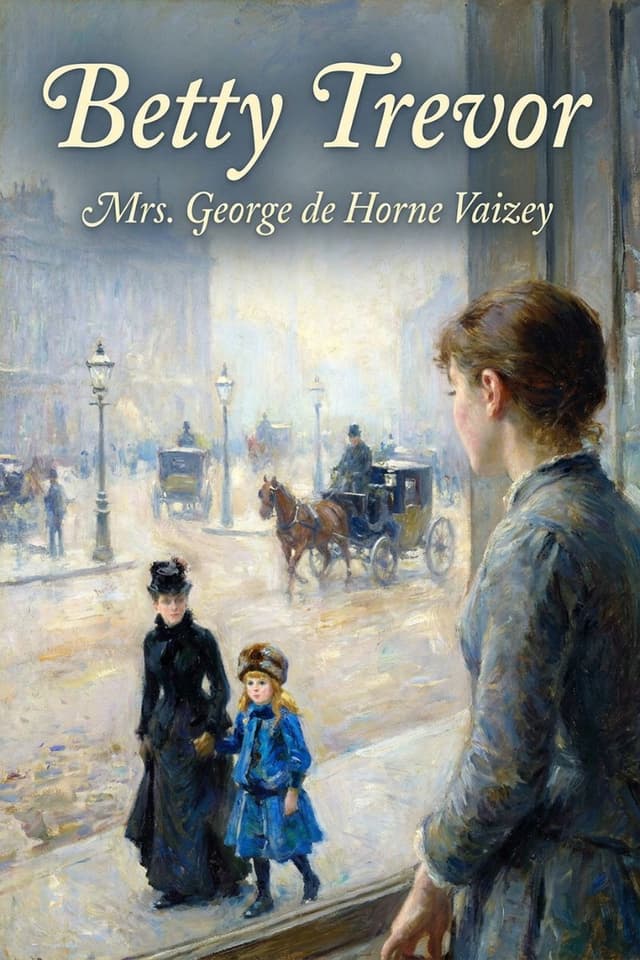
Betty Trevor
Read Betty Trevor by Mrs. George de Horne Vaizey for free on Novelhalla, and try out our easy-to-read modern edition of this classic book. You can also download the EPUB and read it on any device if you prefer!
The Plot
Five Faces at the Window
The Trevors have been in the Square three months and they already know everything about their neighbours, none of it true.
Number 15 belongs to two old maiden ladies the children have christened Emily and Hannah, and they've worked out the whole financial arrangement between them from the timing of the electric lights. Number 17 holds a young woman so happy she must surely be engaged, plus an invalid mother nobody has ever seen. Number 14, the big grey house on the good side of the Square, contains the Pampered Pet: sixteen, golden-haired, expensively dressed, walked round the gardens by a governess for the benefit of her complexion, and hated with a full and generous heart by seventeen-year-old Betty Trevor.
Betty is the eldest of five in a doctor's house that pays a heavy rent for a fashionable address and eats up the difference in linoleum. She wants to be beautiful and stately. She is, by her own furious verdict in the mirror every morning, a fright. She wants a drawing-room that isn't half furnished, a sister who doesn't look better in five minutes than she does in an hour, and a brother who doesn't defend the girl across the road. What she has is a candle, an attic window, and a perfect view into the Pet's bedroom, where a maid brushes that hair every night, up and down, up and down, like a machine.
Then eight-year-old Pam, who says exactly what she thinks and is never wrong, looks up from her sewing and asks whether this is what they mean by envy, hatred, and malice.
The Girl on the Other Side of the Glass
Here's what the five faces at the window can't see.
Cynthia Alliot is sixteen, an only child, with a father off with his regiment in India and a mother who gave up everything to stay in England and be her companion. Her day runs lessons, musical exercises, constitutional, luncheon, more studies, dinner, polite conversation, performances upon the piano. She has watched the doctor's children take their schoolroom tea together, in pairs, with the big girl pouring out, and she has counted them, and named them privately to herself, and she wants to know them so badly that when they play a cruel little trick on her through the drawing-room window she plays along rather than spoil their fun.
Her mother has no intention whatsoever of letting her meet them.
One Parcel, One Long Black Thread
The twins, Jack and Jill, are the sort of children who look at a November fog and see an opportunity. Their current specialty involves a prettily wrapped parcel of cotton wool, the pavement outside the Square gardens, and a thread long enough to twitch it out of reach at the exact moment a stranger bends to pick it up.
They work through a fine lady, a man in a light overcoat, an overloaded old woman, and an errand boy with excellent aim. Then comes a heavy, elderly gentleman with a stiff walk and a stifled groan, and the joke stops being a joke.
What arrives out of that disaster is General Terence Digby: purple-faced, protuberant-eyed, magnificently furious, a man who can denounce two children back to the dawn of civilisation without pausing for breath, and who has a great deal to say about the Employers' Liability Act and what a hundred pounds a week might do to a doctor's household. He is also a lonely old bachelor who has outlived nearly everyone he loved, who once asked one girl to marry him and was refused, and who has never quite stopped being grateful to her for saying no.
He does not tell the children who she was.
The House Full of Empty Rooms
The pretty lady from Number 17 turns out to be Mrs Gervase Vanburgh, who is married, radiantly happy about it, barely older than Betty in spirit, and troubled by exactly one thing in life: that she has nothing to be good about. She grew up one of six sisters in a house so noisy the neighbours called them the houseful of girls. Now she has a beautiful home, a husband who adores her, and a horror of what she calls the selfishness of two.
So she has done something her circle would consider distinctly odd. She has driven round to three London homes for governesses, left cards, and thrown open her whole house every Saturday afternoon from three until seven to any lady who cares to call. Tea in the drawing-room, a proper northern high tea in the dining-room, easy chairs by the library fire, and her own workroom upstairs for anyone who wants to try wood-carving.
She needs help running it. She has decided, without asking, that Betty is going to give it.
Betty walks home from that first afternoon with a friend and a vocation and the whole world newly repainted, and finds Jill waiting in the hall with her arms folded, because Jill saw the pretty lady first, and Jill has just been told she's too young for a grown-up party, and Jill has promised, through her teeth, to be even with her sister about this.
Four households, one square of black railings, and a set of connections nobody's parents would have arranged on purpose. Somewhere underneath it all runs an old love story that none of these children have the least idea they're standing on top of.
About the Author: Mrs George de Horne Vaizey
Jessie Bell of Liverpool
She was born Jessie Bell in Liverpool in 1857, the daughter of a Scottish insurance broker named David Bell and his wife Elizabeth Morris Barton. There were seven children in the house, four brothers and two sisters besides herself, and that crowded, teasing, elbow-to-elbow family life became the raw material of nearly everything she ever wrote. When you read the Trevors jostling for position at the schoolroom window, you're reading something she remembered rather than invented.
Mrs Henry Mansergh
In 1883 she married Henry Mansergh, a cotton broker. Their daughter Gwyneth Alice was born in 1886. The marriage was not the happy ending her novels tended to promise: her husband struggled with addiction and died in 1894, and she wrote both the addiction and the aftermath into her later fiction, quietly and without naming it. Her first books, A Girl in Springtime and A Rose Coloured Thread, went out under the name Mrs Henry Mansergh.
The Cruise
The turn in her life reads like one of her own plots. Her daughter Gwyneth, then about twelve, found an unpublished manuscript of her mother's in a drawer and posted it off to a short story competition without permission. It won. The prize was a Mediterranean cruise. On that cruise Jessie met George de Horne Vaizey, and they married in Liverpool in March 1898. Their son George, born in 1900, grew up to be a writer himself.
Everything she published from then on carried her second husband's name.
Writing From a Chair
Early in the new century she caught typhoid, and out of it came rheumatoid arthritis that left her permanently disabled and in a wheelchair for the rest of her life. She kept working. Roughly thirty-three books came out under the Vaizey name, along with a steady stream of short stories and magazine pieces, most of them serialised in girls' papers before appearing between covers. She died on 23 January 1917, at fifty-nine.
What She Was Known For
Her biggest success was Pixie O'Shaughnessy, the irrepressible Irish schoolgirl who eventually got two sequels and a devoted following. But the books that keep drawing readers back are the family ones, the ones about too many children and not quite enough money, where the drama is a lost examination or a mortifying blush or a sister who takes something that wasn't hers to take.
Fun Facts About the Book
It Came Out in 1907
By then she was ten years into her career, at the height of her powers as a writer of family stories, and confident enough to build an entire novel out of nothing more dramatic than five people looking out of a window at people looking back.
The Pretty Lady Is a Returning Character
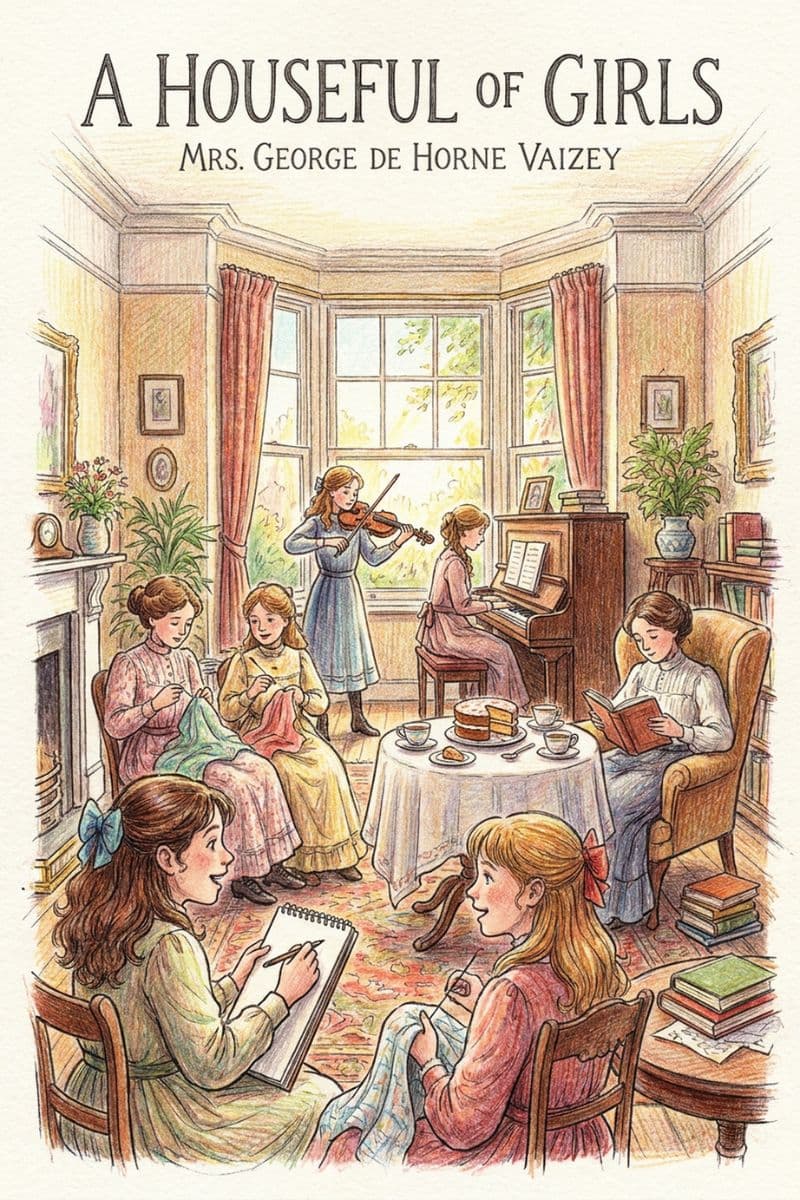
Mrs Gervase Vanburgh, the young married woman at Number 17, was Nan Rendell. The Rendell sisters were the heroines of an earlier Vaizey novel, and their creator put the nickname straight into this book's dialogue as a wink for anyone who'd read it. When Nan mentions the sisters who were called the houseful of girls, the portraits on her overmantel are of characters her original readers already knew and loved.
You don't need to have read that book first. This one stands entirely on its own.
The Square Is a Lie
The narrator gives the Trevors' address as Brompton Square and then places it on the north side of Hyde Park, between the Marble Arch and Lancaster Gate. The real Brompton Square is nowhere near there. It sits south of the park in Knightsbridge. Vaizey borrowed a genuine London name and moved it somewhere else entirely, presumably so that no actual resident could recognise their own front door in the character list.
Nan's Saturdays Have a Real Source
Nan credits her whole scheme to a novel by Sir Walter Besant, and she gets almost everything about it wrong except the part that mattered. The book is Katharine Regina, published in 1887, and the line that lodged in her memory is a governess asking whether there's a single woman in all of London who cares enough to open her house to people like her for a few hours a week. Besant was a professional agitator for social causes in fiction. Two decades later, one of his throwaway characters is still recruiting.
The Illustrations
Early editions came with plates by Victor Prout, who illustrated several of Vaizey's books. Later printings advertised seven full-page illustrations plus a frontispiece, and secondhand copies in the original pictorial cloth binding still turn up.
The Economics Are Exact
Watch how carefully the money is tracked. Four shillings to last until the end of the quarter. A palm for the drawing-room at seven and six, which is out of reach. Jill's fourpence a week. A carpet that covers two-thirds of the floor with linoleum making up the rest, in a dining room designed for furniture the family doesn't own. Vaizey knew precisely what a professional man's respectability cost and precisely who paid for it.
The Nickname Rule
The Trevors could settle every question about their neighbours in thirty seconds with the Directory in their father's consulting room. They refuse on principle. Made-up names are better, because you can manufacture them to suit.
Themes
Envy
The novel opens with it and never quite lets it go. Betty envies the Pet her face, her clothes, her fire, her maid, her only-childness. Then it envies Jill her charm, and it envies practically everyone their luck. What makes the book more than a moral tract is that Vaizey lets the envy be genuinely delicious. Betty enjoys it. Giving it up is going to cost her something.
The Quarter-Hour Resolution
Betty resolves to become a perfect character with roughly the seriousness of choosing between two ribbons, dresses the part with her hair parted meekly down the middle, and lasts fifteen minutes before snapping at the twins on the stairs. Nobody in this book improves in a straight line. That's the joke, and it's also the point.
Loneliness on Both Sides
The girl with everything spends her afternoons pretending to read so she can watch the family who despise her. The family who despise her think she has nothing to want. Vaizey builds the whole novel on the gap between how a life looks through a window and how it feels from inside.
Being of Some Use
Nan Vanburgh has a rich husband, a beautiful house, and a nagging conviction that being happy isn't a moral achievement. Dr Trevor spends his days in other people's sickrooms and comes home to a family trained never to burden him. Betty is pushed towards a tiresome invalid she can't stand, precisely because her father can see that her horizon is entirely blocked by herself.
Sisters
Jill's furious "I'll be even with you" is not a throwaway line, and Pam's small piping conscience is not decoration. The book is far more interested in how sisters wound and rescue each other than in anything happening with the boys.
What a Girl Is For
Jill announces cheerfully that she'll marry a rich man with dogs and horses and never have to bother about earning. The General, who is not a subtle man, tells her flatly that treating marriage as board and lodging ruins two lives instead of one. Coming from a book of 1907 aimed at teenage girls, it lands harder than you'd expect.
The Awkward Age
Dr Trevor's private theory is that young people in the stage between childhood and maturity turn restless and eccentric, and the wise adult response is to be judiciously blind and let the reins run loose. Miles is unbearable. Betty is impossible. Jack is drifting. The novel watches them all with enormous patience and refuses to be shocked.
Historical Context
The governesses at the centre of Nan's Saturday afternoons weren't a sentimental invention. Educated women without money had almost nowhere respectable to go in Victorian and Edwardian London. Teaching in other people's houses paid badly, ended abruptly, and left them socially stranded: too refined for the servants' hall, not eligible for the drawing room. Charitable institutions ran homes where they could board between positions, and a woman living in one might genuinely have nowhere to spend a free afternoon that didn't cost money she didn't have.
The London square is doing similar work. A single square could run from a great grey stone house with three windows either side of the door to a shabby corner property whose front entrance is technically in a side street, and everyone living there knew exactly where they fell on that scale. The Trevors pay for the address and can't afford the furniture. That isn't a metaphor. That was a recognisable way to live.
The Book's Legacy
Vaizey never became a household name the way Louisa May Alcott or, later, Angela Brazil did, and among her own titles this one has always stood in the shadow of the Pixie books. It has never been filmed or dramatised. It has no famous line.
What it has is staying power of a quieter kind. It has been reprinted continuously for well over a century, mostly by publishers who specialise in rescuing exactly this sort of book, and it holds a steady place among collectors of Edwardian girls' fiction. Read now, it works as social history that doesn't feel like homework: the household budgeting, the calling cards, the rules about who may visit whom and after how long, the sheer physical closeness of a big family in a house slightly too small.
It also survives because the central situation refuses to date. Five people at a window, inventing lives for strangers they can see but not reach, convinced that everyone on the other side of the glass has it easier. Swap the window for a screen and the book barely needs translating.