Novelhalla
A Houseful of Girls
Read A Houseful of Girls by Mrs. George de Horne Vaizey for free on Novelhalla, and try out our easy-to-read modern edition of this classic book. You can also download the EPUB and read it on any device if you prefer!
The Plot
Six of Them
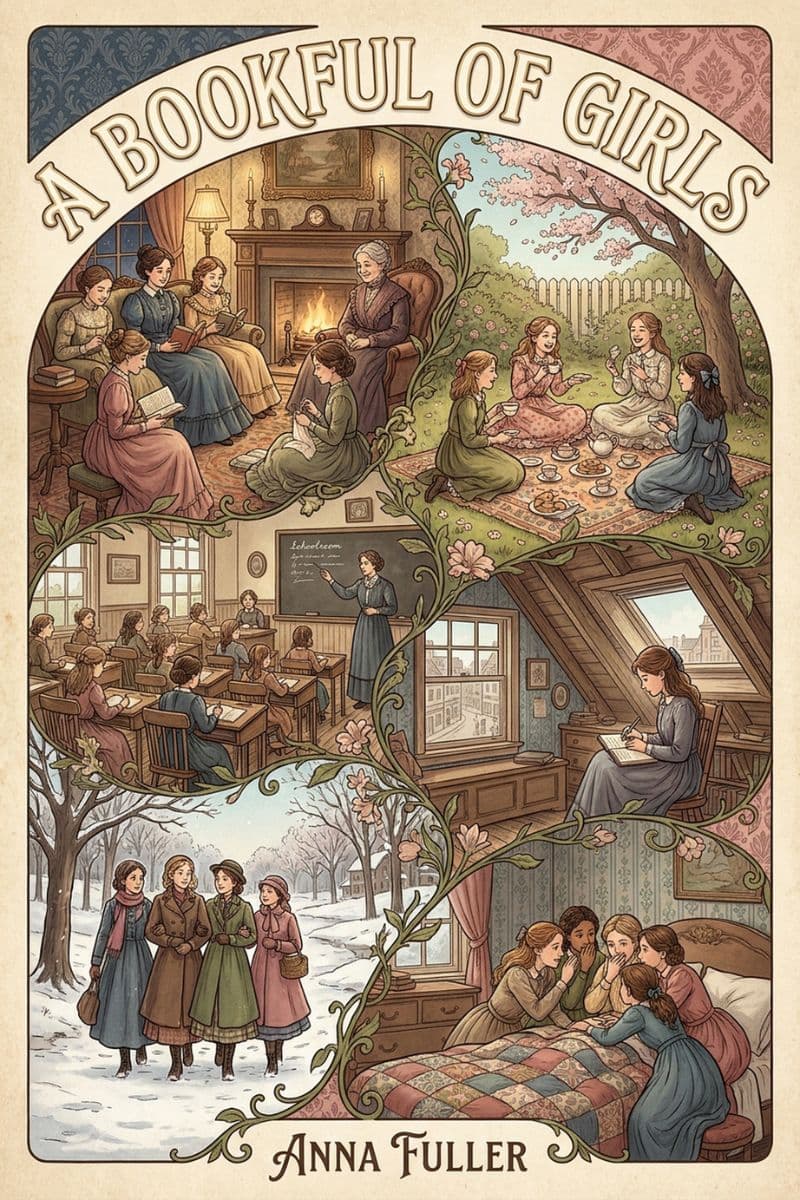
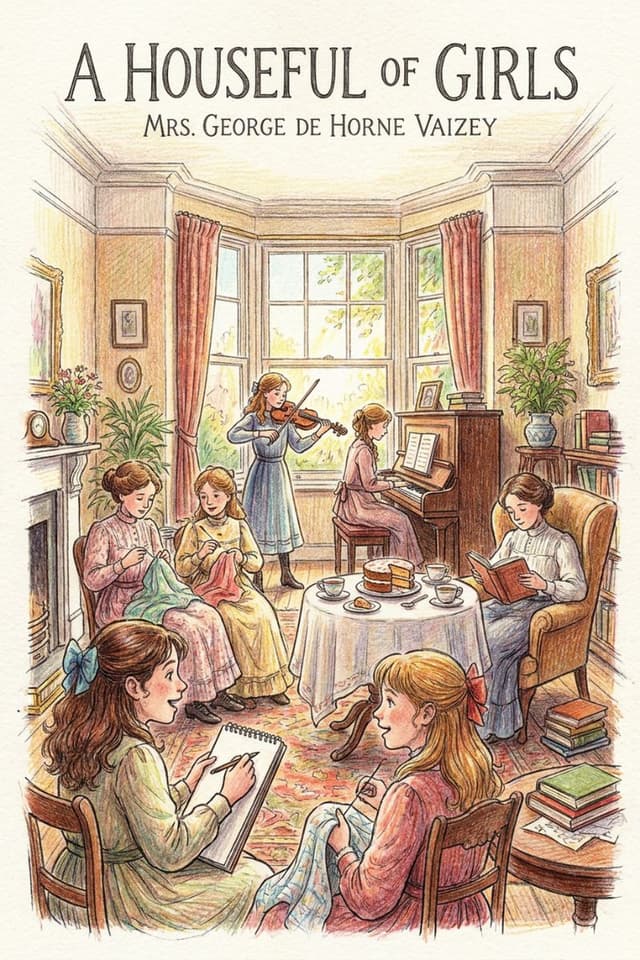
There are six Rendell girls, and when they're all in the schoolroom at once, passers-by in the road below have been known to estimate the numbers at anywhere from twelve to twenty. This is a slander. There are only ever six people talking simultaneously, and each of them considers it a positive duty to state her own opinion, undiscouraged by the fact that nobody within earshot is listening.
Maud is twenty-three, the eldest, musical, endlessly capable, and so busy taking care of everyone else that her brother calls her Maud of all work. Lilias is the beauty and knows it, declares sweetly that she's far too stupid to be useful, and privately intends to marry a duke at the earliest opportunity. Nan is eighteen, or possibly still twelve, depending on the hour: she carves wood, hammers copper, cannot keep her hair up to save her life, and leaves a trail of hairpins through the house like a shedding animal. Elsie is sixteen and has decided that life is tragic, that she is unappreciated, and that whatever is planned will certainly be ruined by rain. Agatha and Christabel, fourteen and fourteenish, are saving up to found a select academy for young ladies where all the errors currently being committed against them will be corrected.
Presiding over the lot is a tiny, pretty, meek-looking mother whose will could stop a train, and a father who plays tennis, tells them the day's gossip under protest, and lives in open dread of the moment his daughters finish growing up.
The Sale
The scheme starts with a genuine impulse: the Mission is in debt, and sixpence a week doesn't stretch far when there's a birthday every month. It escalates, as schemes in that household do, into a garden sale in strawberry season, with little tables under Japanese umbrellas, tea in a tent, a refreshment stall at threepence a cup, punt rides on the river at threepence a head, and Nan's carved oak on a stall grandly labelled High Art.
Their mother listens to the entire glorious plan and asks one quiet question: is this being proposed for the good of the Mission, or for their own amusement? The silence that follows is the most interesting thing in the chapter.
She gives them a week to be sure of their own minds. Five months to make the work. And a warning that they have arrived at her door brimming with enthusiasm many times before, and that most of those bubbles burst inside forty-eight hours.
The House Across the Road
Meanwhile, the Grange has been sold.
It's the finest house in the neighbourhood, it faces the Rendells' own across the high road, and it has stood empty long enough to count as a personal grievance. Now the deeds are signed and the workmen are in, and the girls settle into the porch-room window to conduct a full-scale surveillance operation: the blue paper going up in the bedroom, the horrible brown paper in the little room over the door, the vanloads of furniture unloading in the road. Carved Indian cabinets. Screens like the ones over the windows of a harem. Rugs that are priceless and shabby at the same time. Nothing anywhere that looks remotely like it belongs in a girl's bedroom.
Never mind. They've already invented the daughters. Véronique, the eldest, who rides an Arab charger. Gabrielle, who is mignonne and has a skin of snow and roses. Evangeline of the tawny locks. There is a fourth, whose characteristics were sadly interrupted by the arrival of the governess.
Elsie, in one of her prophetic moods, announces that this will prove an Epoch, that the fate of the Vanburghs and the fate of the Rendells will be inextricably woven together, and that in years to come they'll look back on this evening as a milestone. She's laughed at, of course.
She happens to be entirely right.
The family arrives after dark, without warning, and what the Rendells eventually discover behind that great nailed door is nothing any of them imagined.
Maud's Four Years
Four years ago, Jim brought his friend Ned Talbot home from Oxford. Ned put his foot in a rabbit hole, sprained it badly, and spent weeks at Thurston House while Maud read to him, played to him, lost to him at Halma, and talked to him about everything under the sun. He said less in return, but he's a quiet man, and a word from him counts for more than a speech from anyone else. He's been back twice a year ever since. And Jim has just mentioned that Ned's business has taken a turn upward, and that for the first time in his life he could support a wife.
Ned arrives unannounced on the very worst afternoon of the year, in the middle of spring cleaning, when Maud is on her knees on the drawing-room floor with her hair coming down, her cheeks scarlet, and the good blue blouse she has been hoarding for months hanging useless in the wardrobe upstairs. Lilias, who looks lovelier in a working smock than most women do at a ball, kneels down beside him to help with the carpet, and gushes over the daffodils, and mentions in her sweet flutelike voice that Mr Talbot has already promised to help her with the punt at the sale, because of course she can't manage it alone.
Only Nan knows what her eldest sister is hoping for. Nan spends that evening watching Ned's eyes very carefully indeed, and doesn't like everything she sees.
One Dare, One Disguise, One Doorbell
And then Chrissie dares Nan to do something outrageous involving the Grange, a costume, and the nerve to walk up to that nailed front door and ring the bell.
It's a joke. It's meant to last thirty seconds and end in a shriek of laughter from behind the hedge. Nan has never in her life refused a dare, has never once got through a stunt without falling over something, and has absolutely no idea who is going to open that door.
Six sisters, one Mission sale, one empty house filling up, and a summer that all of them will be measuring the rest of their lives against.
About the Author: Mrs George de Horne Vaizey
The Original Houseful
She was born Jessie Bell in Liverpool in 1857, daughter of a Scottish insurance broker named David Bell and his wife Elizabeth Morris Barton. There were seven children: four brothers and two sisters besides herself. Everything she later wrote about crowded, argumentative, fiercely loyal families came out of that house. The Rendells talking six at a time, the private jokes, the ranking by age, the sheer volume of it all, none of that is research.
Mrs Henry Mansergh
She married Henry Mansergh, a cotton broker, in 1883, and their daughter Gwyneth Alice was born in 1886. It was not the happy ending her fiction tended to hand out. Her husband struggled with addiction and died in 1894, and she began publishing seriously afterwards, at first under the name Mrs Henry Mansergh. She used her own life freely in her books, including the parts nobody talked about in print in 1900.
The Manuscript in the Drawer
Around the time she was writing the Rendell sisters, her daughter Gwyneth, then about twelve, found an unpublished manuscript of her mother's in a drawer and sent it off to a short story competition without asking. It won. The prize was a Mediterranean cruise. On board she met George de Horne Vaizey, and they married in Liverpool in March 1898. Their son George, born in 1900, became a writer himself.
Everything from then on was published under her second husband's name, which is why the woman who wrote these books is known to posterity by a name that isn't hers.
Writing From a Wheelchair
Early in the new century she contracted typhoid and developed rheumatoid arthritis out of it. She spent the rest of her life disabled and in a wheelchair, and kept working through all of it. Around thirty-three books appeared under the Vaizey name, most of them serialised in girls' magazines first. She died on 23 January 1917, at fifty-nine.
What She's Remembered For
Pixie O'Shaughnessy, her irrepressible Irish schoolgirl, was the commercial hit and got two sequels. But the family stories are the ones people keep coming back to, and this is the family story: too many daughters, not quite enough money, one house, and every emotion in it happening in public.
Fun Facts About the Book
It Started in a Magazine
The novel began appearing in The Girl's Own Paper on 6 October 1900, taking the lead spot in the issue, and came out as a book from the Religious Tract Society shortly afterwards. The Girl's Own Paper was the biggest thing in British girls' publishing, a penny a week, and its readers followed these six sisters in weekly instalments before anyone could hold the whole story in their hands.
That serial origin shows in the construction. Chapters tend to end on a door opening, a letter arriving, or somebody walking in at precisely the wrong moment.
Kitty Was Real
Kitty, the girl from down the road who comes in daily to share the Rendells' schoolroom, sprawls in a chair, flings her cap across the room, and can never find her gloves again, was drawn from the author's own daughter Gwyneth, nicknamed Kit. Vaizey said outright that Gwyneth really did share lessons with a family of five sisters who were in many ways like the Rendells.
So the girl who found the manuscript that changed her mother's life ended up inside her mother's most popular family novel, under her own nickname.
The John Gilpin Road
Christabel likes to stand at her bedroom window and imagine she can see John Gilpin galloping past with his bald head bare and the bottles swinging at his sides. That's William Cowper's runaway horse from 1782, and the road really does run that way, out of London and up towards Hertford. Chrissie's stated reason for pinning his picture to her wall is that she feels a duty to support local talent, and as far as she can establish, Gilpin is the only celebrity who has ever come through the neighbourhood.
A House with Two Faces
Thurston House is a grey, gaunt, town-looking building sitting hard on a busy high road, with cyclists and charabancs and dust going past the front windows all day. Walk through it and out the other side and you find a lawn, old trees, a meadow running down to the river, a punt and a canoe waiting. The girls call the south rooms "our country house" and the front ones "our town house," and refuse to give up either.
Nan Grows Up in Another Book
Years later Vaizey wrote a companion novel in which one of these six sisters turns up as a married woman in a London square, still hopeless at doing her own hair, still incapable of leaving a good practical joke alone, and now running a scheme of her own that would horrify her neighbours. If you like these people, there's more of them.
The Illustrations
Victor Prout illustrated it, as he did several of Vaizey's books, and the plates are part of why original copies still turn up in the secondhand trade.
Spring Cleaning Was a Curriculum
Mrs Rendell refuses to hire extra help for the annual upheaval. It happens deliberately in the Easter holidays, each daughter takes a task, and nobody is excused. This wasn't eccentricity. Teaching girls exactly what running a household cost, in hours and in knuckles, was considered part of their education, and the novel takes real pleasure in the details: the cold beef eaten standing up, the fight over who gets the first hot bath, the nails scattered under the carpet at the worst possible moment.
The Money Is Counted
Sixpence a week. Three and fourpence in the world, with three birthdays coming. An old yellow sash that will wash and cut down into sachets, and hair ribbons with the crushed parts cut out and flowers embroidered over the stains. Vaizey's girls are not poor, but their pocket money is finite and she never once pretends otherwise.
Themes
Being Useful
The question runs through everything. Maud is useful to the point of invisibility. Lilias has decided that being decorative is a full-time occupation and has arranged her life accordingly. Nan wants desperately to help and breaks something every time she tries. The novel is fond of all three of them and is not remotely neutral about which one it admires.
Mixed Motives
Mrs Rendell's question about the sale, whether it's for the Mission or for themselves, is the moral spine of the book, and the answer Nan gives is refreshingly honest: both. It's for the poor and it's for the fun, and she can't see why that should be a problem. Her mother doesn't quite let her off, but she doesn't refuse either. For a novel published by a religious society, it's remarkably relaxed about the fact that people do good things for tangled reasons.
The Beauty and the Sister
Lilias is one of Vaizey's sharpest creations because she isn't a villain. She's serenely, cheerfully unconscious of her own selfishness. She poses without knowing she's posing. She takes what's in front of her because it's always been in front of her. Watching a family love someone and see through her at exactly the same time is the most grown-up thing in the book.
Imagination Against Reality
The girls build Véronique and Gabrielle and Evangeline out of nothing but curtains and packing cases, and then have to live with what actually arrives. Vaizey does this repeatedly: her characters invent their neighbours, then meet them, and the meeting is always more interesting and less convenient than the invention.
Waiting
Maud has been quietly hoping for four years. She can't ask, she can't hint, she can't do anything but be pleasant and available and hope the man notices. The novel is completely clear-eyed about how much power she doesn't have, and how much of a young woman's life could be spent in that particular holding pattern.
The Loud House
Six people talking at once is played for comedy, and it is comedy. But it also means nobody in that family gets to have a private feeling for long, and the two sisters who most need privacy are the two who suffer most. The noise is the joy of the book and the problem of it.
Historical Context
Novels like this reached their readers first through the weekly story papers, and The Girl's Own Paper was the giant of the field: a penny a week from 1880 onwards, published by the Religious Tract Society alongside its brother paper for boys, mixing serial fiction with improving articles, sheet music, and answers to correspondents. A girl in 1900 didn't buy this book. She waited for Saturday.
That context explains a good deal about the novel's shape and its manners. The charity sale for a Mission in debt, the assumption that daughters will be taught to run a house, the careful handling of engagements and calls and who may invite whom, all of it belongs to a very specific world. What's striking is how little the emotional content has been sanded down to fit it. Vaizey wrote for a religious publisher and still put jealousy, vanity, self-pity, and quiet romantic misery on the page without apologising for any of it.
The Book's Legacy
This is the Vaizey title that gave a phrase to her readership. A houseful of girls became the shorthand for the Rendells, and years afterwards, when one of them reappeared as a grown woman in another of her novels, she introduced herself by it and expected to be recognised.
It has never been adapted for film or television. It has no famous line. What it has is a long, quiet afterlife in reprints and among collectors of Edwardian girls' fiction, and a reputation as the warmest thing Vaizey wrote outside the Pixie books.
Read now, it sits in a recognizable tradition that runs from Little Women through to every story since about a crowded house of sisters with distinct personalities and competing ambitions. The specifics have dated completely. The carpets, the calling cards, the governess, the sale of work in aid of the Mission. The rest has barely moved: the sister who is prettier and doesn't have to try, the sister who does everything and is thanked for none of it, the one who breaks things while helping, the one who enjoys being miserable, and the shared conviction of all six that no family so charming has ever existed in the history of the world.