Novelhalla
The Rebel of the School
Read The Rebel of the School by L. T. Meade for free on Novelhalla, and try out our easy-to-read modern edition of this classic book. You can also download the EPUB and read it on any device if you prefer!
The Plot
The Girl Nobody Talks To
Ruth Craven is beautiful, brilliant, and invisible. She attends the Great Shirley School on a foundation scholarship, which means she doesn't pay fees, which means the paying girls want nothing to do with her. Ruth walks to school alone, sits alone, and goes home alone. She's been sent to Coventry, the old Victorian punishment of total social exile, and she bears it quietly because the scholarship is her only path to a future. Her grandfather is kind but aging. There is no safety net.
Ruth doesn't complain. She studies. She keeps her head down. She is exactly the kind of girl the system is designed to grind into grateful silence.
Then Kathleen O'Hara arrives.
The Wild Irish Girl
Kathleen is fifteen, Irish, wealthy, and absolutely untamable. Her father has sent her from their castle in Ireland to get a proper English education. Kathleen has other plans.
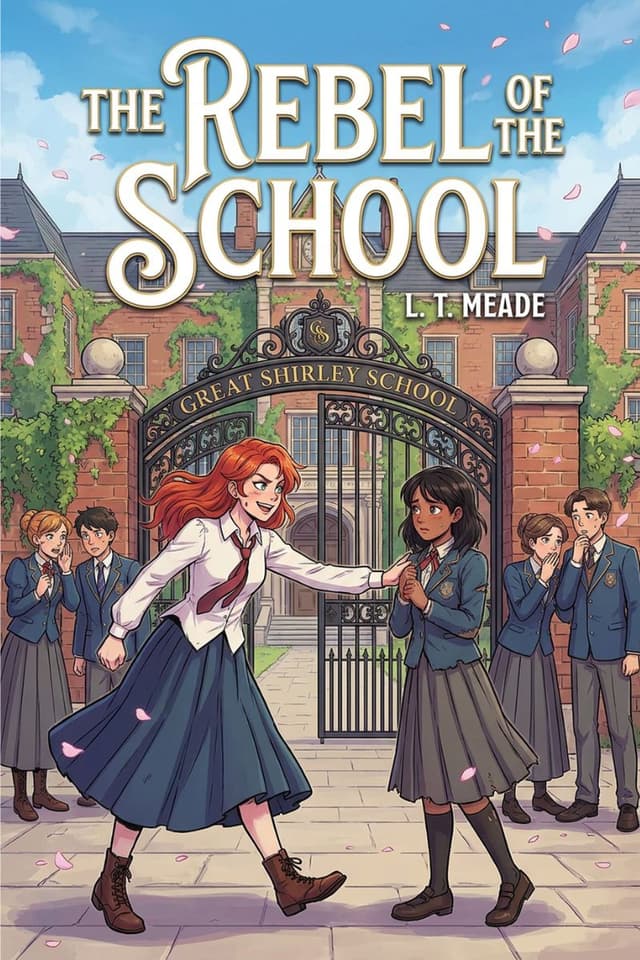
On her very first day, she spots Ruth in a crowd of four hundred girls, pushes through the lot of them, takes Ruth by the arm, and announces that they are going to be friends. She doesn't ask. She doesn't care that Ruth is a foundation girl. She doesn't care that the other students are staring. Kathleen O'Hara has decided, and when Kathleen decides something, the decision tends to stick.
The problem is that Kathleen doesn't just befriend Ruth. She befriends all the foundation girls. She crosses every invisible social line the school has drawn between the girls who pay and the girls who don't, and she does it loudly, cheerfully, and without the slightest interest in the consequences.
She is living with the Tennant family, a respectable household connected to the paying students. Alice Tennant tries to steer her toward the right sort of friends. Cassandra Weldon, the school's most admired senior girl, tries to reason with her. Kathleen ignores them both. She finds the class divisions of English school life baffling and infuriating, and she has absolutely no intention of playing along.
The Queen and Her Secret Society
Kathleen's rebellion takes on a shape. She forms a secret society called the Wild Irish Girls, with herself as queen and the foundation girls as her loyal court. There are clandestine meetings, treats sent from Dublin, whispered plans. For girls who have spent years being looked down on, Kathleen's attention feels like a revolution. She makes them feel seen. She makes them feel chosen.
But here's the thing about Kathleen: she is generous, impulsive, warm-hearted, and almost completely blind to the fact that her rebellion has no real cost for her. She is the daughter of a wealthy Irish family. If the school expels her, she goes home to a castle. If the foundation girls get caught, they lose everything.
Ruth sees this. Ruth is smart enough and honest enough to understand the danger. But Kathleen is magnetic. She is the first person who has ever looked at Ruth and seen someone worth fighting for. Walking away from that isn't simple.
The Stakes
Ruth is working toward a scholarship that could change the entire trajectory of her life. Cassandra Weldon is competing for one too. The school's governors are watching. And the secret society is getting harder to hide.
A theft complicates things. Suspicion falls in uncomfortable directions. The school authorities begin asking questions. Ruth finds herself caught between her loyalty to Kathleen, who showed her kindness when no one else would, and her obligation to herself, her grandfather, and the future she has been quietly building in the margins.
Kathleen, meanwhile, is having the time of her life. She doesn't understand why everyone keeps warning her. She doesn't grasp that the rules she's breaking weren't written for girls like her. They were written for girls like Ruth.
The Reckoning
The governors call Ruth before them. They want to know about the secret society. They want names. Ruth knows that telling the truth could save her scholarship and her reputation. She also knows what it would mean for the girls who trusted her, and for the girl who trusted her first.
The question the novel asks is devastating in its simplicity: What do you owe a friend who would burn down your house to keep you warm?
About the Author: L. T. Meade
An Irish Childhood
Elizabeth Thomasina Meade was born in 1844 in Bandon, County Cork, Ireland. Her father was a Church of Ireland rector, and she grew up in a quiet rectory in Nohoval, near Kinsale. She was educated at home by a governess and began writing stories as a teenager. When she told her father she wanted to make a living as a writer, he was horrified. In their family, no woman had ever worked for money.
London and a New Life
After her mother died and her father remarried, Meade no longer felt at home. She moved to London in her early thirties and began preparing for her writing career by studying in the Reading Room of the British Museum. She married solicitor Alfred Toulmin Smith in 1879, and the couple had three children.
Writing under the name L. T. Meade, she became one of the most prolific English-language authors of her era. At her peak, she was publishing ten or more novels a year, earning a substantial income at a time when most novelists couldn't support themselves. She wrote nearly 300 books across her career.
The Queen of Girls' Fiction
Meade's 1886 novel A World of Girls sold 37,000 copies and is credited with establishing the girls' school story as a genre. The midnight feasts, the fierce friendships, the wise headmistresses, the false accusations and noble self-sacrifice that would define a century of girls' school fiction trace back to her. Every boarding school story from Enid Blyton to J.K. Rowling owes her a debt.
But Meade was far more than a children's author. She edited Atalanta, one of the most prestigious girls' literary magazines of the Victorian era, from 1887 to 1893. She wrote crime fiction for The Strand Magazine alongside Arthur Conan Doyle. She created female villains and detectives decades before they became common in the genre. She was a feminist, a member of the Pioneer Club, and an advocate for women's education and professional independence.
Final Years
Meade and her husband retired to Oxford, where she continued writing until the end. She died on October 26, 1914. She had been so prolific that eleven new titles were published under her name in the years after her death. Despite being one of the most widely read authors of her generation, her name has largely faded from public memory, a fate she shares with many women writers who were beloved in their time but excluded from the literary canon that was built after them.
Fun Facts About the Book
The Wild Irish Girl Tradition
Kathleen O'Hara is part of a character type Meade returned to repeatedly: the wild, spirited Irish girl dropped into the rigid world of an English school. She wrote similar characters in Wild Kitty and Light O' the Morning. As an Irishwoman living in London, Meade was working through her own complicated relationship with English social expectations and Irish identity. Her Irish heroines are always the most alive people in the room, even when they're causing chaos.
Secret Societies and Irish Politics
Scholars have noted that the secret society in the novel carries echoes of real Irish political tensions. Published in 1902, during a period of intense debate about Irish Home Rule, the story's themes of secret organizations, informers, and a patronizing English establishment would have resonated with adult readers beyond the school gates. Whether Meade intended the political parallel is debated, but the parallel is hard to miss.
The Foundation Girl Question
The Great Shirley School's division between paying students and foundation scholars reflects a real feature of Victorian education. Endowed schools often provided free places for poorer students, but the social dynamics between scholarship girls and fee-paying girls were exactly as fraught as Meade depicts. Ruth's situation, brilliant but vulnerable, one misstep from losing everything, captures something true about what it meant to be educated above your station in Victorian England.
A Protagonist Who Is Also the Antagonist
One of the novel's most interesting qualities is that Kathleen is both the heroine and the source of nearly all the trouble. Readers are drawn to her warmth and energy, but Meade never lets them forget that Kathleen's rebellion is partly selfish. She wants to feel free, and she uses other girls' loyalty to achieve that feeling without bearing any of the risk herself. It's a remarkably modern piece of character writing.
Nearly 300 Books
L. T. Meade published close to 300 books in her lifetime. The Rebel of the School appeared in 1902, during the most productive period of her career, when she was averaging roughly ten titles a year. That pace would be staggering for a modern author. She managed it while raising three children and editing a major literary magazine.
Themes
Class and Its Invisible Walls
The Great Shirley School has four hundred students, but it really has two schools inside one building. The paying girls and the foundation girls share classrooms and corridors but exist in separate social worlds. Kathleen's crime isn't breaking rules. It's crossing a line that everyone else has agreed to pretend is natural.
The Cost of Friendship
The novel's emotional center is the question of what friendship actually demands. Kathleen offers Ruth warmth, visibility, and belonging, three things Ruth has never had. In return, the friendship asks Ruth to risk her scholarship, her reputation, and her future. The exchange is deeply unequal, and the novel knows it.
Rebellion and Privilege
Kathleen's rebellion looks brave from the outside. She defies the school's class system, champions the underdog, and refuses to bow to convention. But Meade is sharp enough to show that Kathleen can afford to rebel because she has nothing to lose. The girls who follow her have everything to lose. The novel asks who really pays the price when privileged people start revolutions.
Loyalty and Betrayal
When Ruth is called before the governors, she faces a choice that has no good answer. Loyalty to Kathleen means risking her own future. Honesty with the authorities means betraying the girls who trusted her. The novel treats this dilemma with genuine seriousness, never reducing it to a simple moral lesson.
Women's Education and Opportunity
Running beneath the school drama is a quieter story about what education means for girls who have no other path to independence. Ruth's scholarship isn't just academic achievement. It's survival. The novel understands that for some girls, school isn't about learning Latin. It's about whether they'll have a life of their own or not.
The Book's Legacy
The Rebel of the School is one of L. T. Meade's most enduring school stories and a fascinating window into the genre she helped create. Its exploration of class conflict within a girls' school anticipates the social dynamics that would drive school fiction for the next century.
The novel's refusal to make Kathleen a simple hero or villain gives it a psychological depth that feels surprisingly modern. She is charming, infuriating, generous, and careless all at once, the kind of character readers argue about long after they've finished reading.
For readers interested in the roots of the girls' school story, or in Victorian fiction that takes young women's lives and choices seriously, The Rebel of the School is a rewarding discovery. It's also a portrait of a world where the distance between a paying student and a scholarship girl could feel as vast as the distance between Ireland and England, and where one fierce, reckless friendship could blow the whole arrangement apart.