Novelhalla
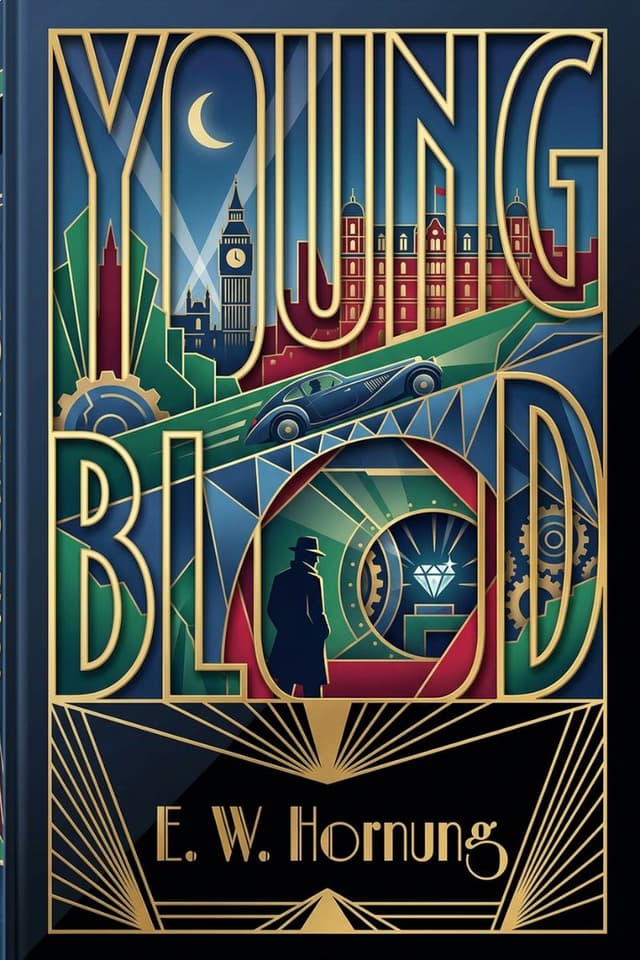
Young Blood
Read Young Blood by E. W. Hornung for free on Novelhalla, and try out our easy-to-read modern edition of this classic book. You can also download the EPUB and read it on any device if you prefer!
The Plot
The Happiest Morning of His Life
Harry Ringrose turns twenty-one on the train home, and he has never been happier in his life.
He's been two years in Africa, ostensibly for his health, actually for the adventure, and he's coming back with a sunburnt face, a villainous sombrero, a box of ostrich eggs, and enough stories to dine out on for a decade. He's also coming back with exactly two shillings to his name, because he spent everything, which strikes him as a magnificent joke. His father is a wealthy ironmaster and will find it funny too. Harry gives the two shillings away to a porter on the platform for the sheer pleasure of arriving home flat broke.
Then a few small things go wrong in a row. The porter won't keep the coin. A boy Harry has known since infancy walks straight past him with his nose in the air. And when Harry comes over the crest of the hill and looks down at the house he's been dreaming about for two years, the blinds are down, no chimney is smoking, and there's no statuette on the windowsill where a statuette has always been.
He puts his fist through the coloured glass of the porch and climbs in. The hall is empty. The stairs are bare. Every room is stripped to the plaster, and in one of the grates there's an auctioneer's list from a sale that happened earlier that month.
Then he hears wheels on the gravel.
The Man in the Cab
The man who gets out is a complete stranger, and he's come a long way in a hurry to be here first.
His name is Gordon Lowndes, he's got a shiny frock coat and a shabby tall hat and very quick eyes behind gold-rimmed glasses, and he's been Harry's father's closest friend for two years without Harry ever having laid eyes on him. He's also the bearer of a piece of news he'd have very much preferred to deliver at the docks.
The iron trade has been dying for a decade. The house belonged to the bank years ago. And this past spring, with the creditors closing in, Harry's father took ten thousand pounds that had been raised for him by four business friends, and vanished. He was traced as far as a café in Dieppe on Easter Eve and no further. The newspapers call him the missing ironmaster. His name is a word in his own town now, which is why the porter wouldn't take the coin.
Harry calls Lowndes a liar to his face. Lowndes takes it with a shrug and produces his pocketbook full of cuttings.
And then Harry does the thing that will shape the rest of the book. He seizes the man's hand in his father's stripped study and makes him swear to help prove there's been foul play, because Harry has decided he would rather his father were murdered than a thief.
Pluck Lost, All Lost
The new home is a small flat in Kensington, in a many-windowed red-brick block where you can hear the neighbours' piano through the wall.
His mother is there, white-haired now in a way she wasn't two years ago, surviving on a fraction of her marriage settlement and handing most of the remainder over to the men her husband borrowed from. There's no servant, because there's no room for one. She's bought back a few of her own pictures and a few of her own spoons out of the sale.
What follows is the part of the book that will make you wince with recognition. A twenty-one-year-old with no degree, no profession, no commercial handwriting, and no bookkeeping tries to find work in London in 1898. His clerical uncle arrives to be helpful and spends twenty minutes establishing, in the gentlest and most crushing terms available, that his nephew is qualified for nothing. The tailors who were happy to dress the ironmaster's son want a guarantee before they'll cut a coat. The grocers who supplied the family for twenty years won't take his curios on commission. And the three of his father's old friends his mother privately writes to all say no.
Harry's one weapon is a motto from his old schoolmaster, which he recites to his mother at two in the morning on the worst night of his life. Money lost, little lost. Honour lost, much lost. Pluck lost, all lost.
He's going to need it.
The Millionaire in the Making
And then there's Gordon Lowndes, who is one of the great comic creations of late Victorian fiction and also the most interesting problem in the book.
He's a company promoter. He's up to his chin in the biggest scheme of the century, which he cannot name yet, and which hinges entirely on whether the Earl of Banff will or won't, and the Earl will decide this week. He's going to make Harry Secretary at three hundred a year. He scatters half sovereigns, orders three suits and an Inverness cape from a tailor he has just finished verbally flaying, and believes as a matter of sacred principle that a man owes it to his fellow creatures to get to windward of his creditors by any means available. He'll tell you, laughing, about the time he blackmailed a surgeon-baronet for a thousand pounds, and somehow the story makes you like him more.
Harry's mother adores him. Harry's uncle says flatly that the man isn't honest. Harry, who came to London swearing he'd never take a favour from anybody, finds himself laughing at Lowndes's jokes against his own will and coming round to him by inches.
Then Harry goes down to Richmond for dinner. He follows a young woman up the long hill, sees her struggling with a travelling bag, takes it off her over her furious objections, and discovers that the bag is full of coals she's just borrowed from a neighbour. The house she carries them to has a manservant at the door, a name on the gate that belongs on a palace, one gas bracket in the drawing room, and a butcher standing on the hearthrug refusing to leave until he's paid thirty-eight pounds seventeen and fourpence.
That's Lowndes's daughter, and that's Lowndes's house. It's also Harry's first real friend since he landed.
The Question He Stopped Asking
So Harry has two mysteries in front of him, and he only knows about one.
The first is Gordon Lowndes: whether he's a magnificent buccaneer who really is about to be rich, or a man drowning so loudly that nobody has noticed the water. Harry's living depends on the answer, and so does his mother's, and so, increasingly, does something else he isn't ready to name.
The second is the one he swore an oath about in an empty house and then abandoned within twenty-four hours, when a letter in his father's handwriting took the last of his hope away. Harry has agreed to stop asking what happened at the Café Suisse in Dieppe.
The book has not agreed to anything of the kind.
About the Author: E. W. Hornung
A Boy from an Iron Town
Ernest William Hornung, called Willie by everyone who knew him, was born in Middlesbrough in June 1866, the youngest of eight children and the third son. His father, John Peter Hornung, had been christened Johan Petrus in Transylvania, worked in shipping in Hamburg, and came to Britain in the 1840s to deal in coal and iron. For a good while he prospered.
Willie went to a preparatory school in Moffat and then to Uppingham, where he was well liked and fell permanently in love with cricket despite being hampered at it by bad eyesight, asthma, and a general constitution that was never robust.
Australia
At seventeen his health got worse, and the family did what Victorian families did: they sent him somewhere warm and dry. He left Uppingham in December 1883 and sailed for Sydney.
He spent about two years there, working as a tutor to a family in the Riverina district of New South Wales, putting in time on remote sheep stations, sending material to the Bulletin, and starting the manuscript that would become his first novel. It was two years out of a fifty-four year life, and by the reckoning of every biographer he's had, it made him. He drew on Australia for the rest of his career.
He came home in February 1886. His father died that November, his coal and iron business having come apart, leaving the family in reduced circumstances.
Fleet Street and the Doyles
Hornung went to London and worked as a journalist and jobbing story writer, often under a pseudonym, publishing his first story under his own name in 1887. It was the period of the Whitechapel murders and a general public fascination with crime, and something in that interest stuck to him permanently.
The Australian manuscript came out in the Cornhill Magazine in five parts in 1890 and then as a book, and it was well received. In 1891 he joined two cricket clubs, one of which, the Idlers, included Arthur Conan Doyle, Jerome K. Jerome, and Robert Barr.
He'd already met Doyle's sister Constance, called Connie, and they married in September 1893. Their only child, a son, was born in 1895, named Arthur for his godfather Conan Doyle and Oscar, almost certainly, for the Hornungs' mutual friend Oscar Wilde. It was by Oscar that the boy was known.
Raffles
In 1898, the year this book came out, Hornung published six short stories in Cassell's Magazine under the heading "In the Chains of Crime." They introduced a cricketing gentleman burglar named A. J. Raffles and his hapless accomplice Bunny Manders, and they made him famous.
Doyle had told him not to write them. He thought they were superbly done and morally indefensible, and said so: you must not make the criminal the hero. Hornung collected them the following year as The Amateur Cracksman and dedicated the volume to his brother-in-law with eight words about imitation and flattery. Doyle wasn't amused, and the dedication quietly disappeared from later editions.
Three more Raffles books followed, along with a large number of other novels that critics generally liked better and readers generally bought less of.
The War
Oscar Hornung left Eton in 1914 meaning to go up to Cambridge. He volunteered instead, took a commission in the Essex Regiment, and was killed at Ypres on 6 July 1915, aged twenty.
Hornung's fiction stopped. He edited a private volume of his son's letters home, joined an anti-aircraft unit, and then went to the YMCA, first working with soldiers on leave in England and then going out to France to run a canteen and library behind the line at Arras. In February 1918 he borrowed a staff car and went to find his son's grave near Ypres. The following month the German spring offensive drove him back to Amiens and then home.
He wrote poetry through all of it, and afterwards published an account of his time in France that his biographers rate among the best front-line records of the war.
The End
His health, never good, never recovered from the war work. In February 1921 he and Connie went south to convalesce, and he caught a chill on the train that turned into influenza and then pneumonia. He died on 22 March 1921, aged fifty-four, and was buried at Saint-Jean-de-Luz, in a grave next to George Gissing's. Conan Doyle, coming back from a lecture tour of Australia, got the news in Paris and made it south in time for the funeral.
Doyle wrote afterwards that Hornung was a Johnson without the learning and with a finer wit, and that his books, good as they were, never quite caught the quickness of the man.
Fun Facts About the Book
He Was Writing His Own Homecoming
Look at the shape of it. A teenager is shipped abroad for his health. He works as a tutor to a family in a hot, remote, foreign place. He comes home in his early twenties to find that his father's coal and iron fortune has collapsed underneath him and the family's prosperity is gone.
That's Harry Ringrose's story, and it's also, allowing for the difference between disgrace and plain misfortune, Hornung's own. He was seventeen when he left for Sydney, he tutored a family in the Riverina, and he landed back in England in February 1886 to a father who was in financial trouble and dead within the year. He published this book twelve years later.
It's worth knowing going in, because it explains why the scenes of genteel scrambling ring so exactly true. The humiliations here aren't imagined.
The Title Comes from a Children's Book
The epigraph is from Charles Kingsley's The Water Babies, a set of verses about how everything looks wonderful when you're young and rather less so later. Hornung takes the phrase about young blood having its course and hands it to a hero who's about to find out what that costs.
It Came Out the Same Year as Raffles, from the Same House
Cassell published this in 1898. Cassell's Magazine ran the first Raffles story in June of the same year. So the novel sits right on the hinge of Hornung's career: the last substantial thing he wrote before the gentleman thief arrived and swallowed his reputation whole.
If you want to see what Hornung could do when he wasn't being the man who wrote Raffles, this is one of the better places to look. It's also a useful thing to keep in mind when Gordon Lowndes turns up, because Hornung was clearly already interested in the specific problem of a charming crook.
The Ship Was Real
Harry sails home on the Sobraon, and she existed. Built in 1866, the largest composite sailing vessel ever constructed, iron frames and teak planking, two acres of canvas, capable of sixteen knots, and the crack passenger clipper of the Australia run for twenty-five years. She carried a farmyard of livestock so her passengers could have fresh milk and eggs. Her homeward passages called at Cape Town, which is exactly how a young man coming back from Africa would have found himself aboard her.
She finished her working life as a training ship in Sydney Harbour under a different name and was finally broken up in 1941.
His Brother-in-Law Was Sherlock Holmes's Creator
Hornung married Conan Doyle's sister. The two men played cricket together, visited Scotland Yard's Black Museum together, and had a relationship that ran warm and cold for thirty years. Doyle was genuinely fond of him and genuinely disapproved of Raffles, and Hornung was genuinely irritated by Doyle's habit of going over his head, which came to a head during the war.
His Biographers Can Barely Find Him
For a man who was one of the most widely read authors of his day, Hornung left remarkably little behind. One biographer called him a true man of mystery, and pointed out that the Dictionary of National Biography had no entry for him at all until 1993, when he was finally added in a supplementary volume with the faintly insulting title Missing Persons.
Themes
The Prodigal Who Comes Home to Nothing
Hornung sets the whole thing up as a homecoming story and then removes the home. Harry has spent two years rehearsing the dinner party where he tells everyone about the leopards and the lion in the moonlight, and he arrives to a house with the pictures taken off the walls. The novel is very interested in what happens to a young man's idea of himself when the world he was going to be impressive in stops existing.
Pluck
The book's stated creed is that money and even honour can be survived, and nerve can't. Hornung means it, but he's also honest about the fact that pluck by itself doesn't pay the rent, doesn't qualify you for a desk in an office, and can look uncomfortably like the recklessness that got everyone into this. Harry's courage and Harry's improvidence are the same trait.
The Charm of the Man You Shouldn't Trust
Gordon Lowndes is the real achievement here. He's generous, funny, loyal, physically fearless, entirely without principle, and possibly ruining everyone who comes near him. Hornung refuses to resolve him into either a good man or a villain, and he understands exactly how the confidence works: not by deceiving you, but by making you enjoy yourself so much that you stop asking.
Respectable Poverty
Nobody in this book starves. What they do is much more recognisable and much more grinding. They count sixpences. They borrow coal from a neighbour and pray nobody sees. They keep a manservant they can't pay because dismissing him would be an admission. They pay interest on a debt they didn't incur out of an income they can't live on. Hornung is superb on the enormous amount of effort that goes into not appearing poor.
Fathers
Every young man in this novel is being measured against an older one, and the older ones are a mixed lot: a disgraced father, a chilly uncle who is right about almost everything and kind about none of it, and a surrogate who is warm, generous, and possibly a fraud. Harry has to work out which of them, if any, he wants to become.
Making a Living by Writing
Harry's notion that he might write for the magazines starts as a family joke and turns into something else. Hornung, who broke into print as a jobbing London journalist under other people's names, knows precisely how that goes, and the chapters about it are among the most clear-eyed things in the book about what talent is actually worth when you need money this month.
Historical Context
Why the Furnaces Were Killing Him
The novel's disaster has a real economic engine behind it. British pig iron was the foundation of Victorian industrial wealth, and in the last quarter of the century the price collapsed and stayed collapsed. Lowndes lays out the arithmetic for Harry in about four sentences: a price that was over five pounds a ton in his childhood, two pounds ten by the time he was seven, and never averaging two pounds for a decade after that, which meant a loss on every ton produced and a few hundred pounds gone every week for years.
That's what it looked like from inside a family that kept its carriages and its garden and its reputation for another decade while the ground gave way underneath. Readers in 1898 needed no explanation at all. Plenty of them had watched it happen.
The Age of the Company Promoter
The other engine is the limited liability company. The legislation that let ordinary investors risk only their stake had produced, by the 1890s, an entire London ecosystem of men like Gordon Lowndes: promoters who turned struggling private concerns into public companies, who courted titled men to sit on boards and lend respectability to a prospectus, and who lived on the float between one scheme and the next.
Harry's father refuses to do it, on the grounds that he'd rather go down with the ship than let in shareholders, and Lowndes thinks that's the biggest mistake a man can make. It's a perfectly genuine moral argument of the period, and the novel puts both sides of it in front of you without telling you who's right.
The Book's Legacy
The honest answer is that Raffles ate it.
Hornung wrote something like twenty novels and a great many stories, and one of his biographers concluded that everything except Raffles and possibly Stingaree has been forgotten. That's roughly accurate as a description of the twentieth century's verdict, and it's not entirely fair as a description of the books.
Contemporaries rated him higher than posterity has. George Orwell, no soft touch, called Hornung a very conscientious and on his level a very able writer, and said that anyone who admires sheer efficiency has to admire his work. Critics of his own day repeatedly praised the plainness of his prose, his structure, and his talent for mystery and surprise, and complained mainly that his best gifts were being spent on making crime entertaining.
This book is the evidence for that complaint. There's no burglary in it and no gentleman thief, and it's still recognisably by the man who would invent both a few months later: the same interest in how a likeable scoundrel operates, the same refusal to let you settle on a verdict, the same brisk unfussy sentences that get out of the story's way.
It's also, quietly, one of the better Victorian novels about money. Not fortunes and inheritances, which the period had in abundance, but the daily mechanics of being suddenly poor in a society that treats poverty as a moral failing. Harry's job hunt, his uncle's arithmetic about the price of pipe tobacco, his mother's spoons, and a leather bag full of borrowed coal are the sort of details that don't date, because the feelings attached to them haven't changed at all.
For most of a century you could only find it in second-hand shops. It's readily available again now, which is the best thing that's happened to Hornung's reputation since Graham Greene decided Raffles was worth a play.