Novelhalla
Jack and Jill
Read Jack and Jill by Louisa May Alcott for free on Novelhalla, and try out our easy-to-read modern edition of this classic book. You can also download the EPUB and read it on any device if you prefer!
The Plot
A Snowy Afternoon in Harmony Village
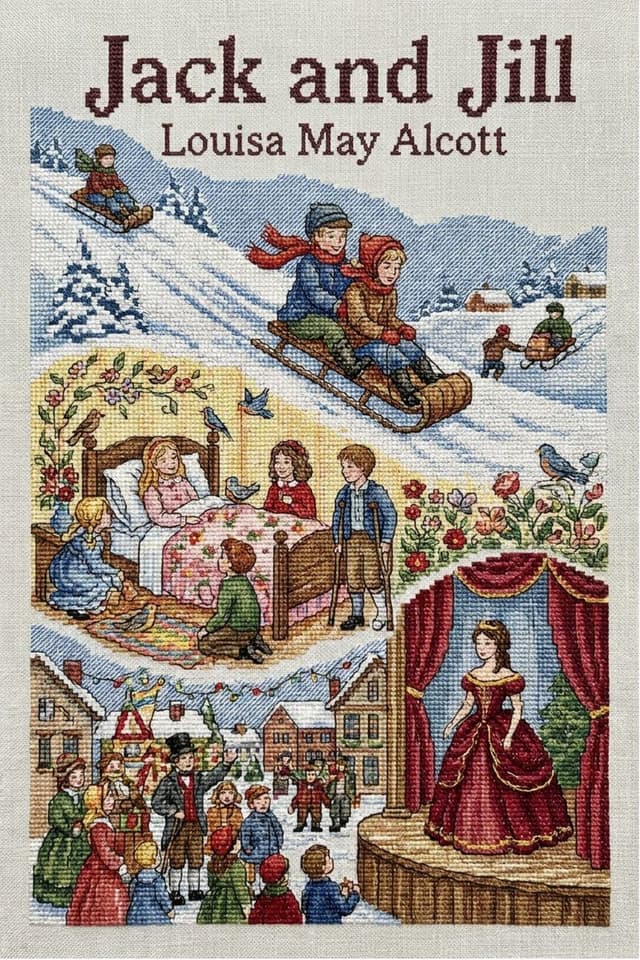
It's a bright December day, the first good snow of the season, and every kid in Harmony Village is out on the hills with a sled. There are three long coasting runs. One is a gentle slope where the little ones play. One goes out over the frozen pond. The third starts at the very top of the steep hill and stops at a rail fence on a high bank above the road.
Jack Minot is the town's golden boy, cheerful and good-natured, the kind of kid who can't say no to anybody. Janey Pecq is a black-eyed, red-cheeked little firecracker who lives in a tiny cottage next door to his family's big house. They're always together, so the boys started calling her "Jill," after the nursery rhyme. It's a cute joke until the afternoon it stops being funny.
Somebody tells Jill she wouldn't dare take the most dangerous run on the hill. Jill has never turned down a dare in her life. Jack knows it's a bad idea, but he's not about to let her go down alone. By evening the rumors are flying all over the village about broken bones and worse, and two families are waiting to find out how bad things really are.
Two Patients, One Long Winter
Neither Jack nor Jill is going anywhere for a long time. Jack's mother, Mrs. Minot, is warm and wise, and she decides the best medicine is to have both kids recover under her roof. Jill's mother is a widow who supports her daughter by sewing and nursing, so the move is a gift, but it also puts a restless, quick-tempered girl in a fancy house she's never felt part of.
Being stuck in bed is miserable when you're young and used to running wild. Jack and Jill get cranky. They fight, they sulk, and they say things they don't mean. Then they decide to try to be good patients, which turns out to be a lot harder than it sounds.
A Village Full of Friends
The rest of the gang won't let their injured friends fade into the background. There's Frank, Jack's serious, bookish older brother. Gus Burton is so tall that on a sled his heels seem to be at the top of the hill while his head's at the bottom. Ed Devlin is the sweet-tempered boy everybody loves. Ralph Evans dreams of being an artist. Joe Flint can be a bit of a grump.
The girls have their own problems. Merry Grant is a dreamy, delicate girl growing up on a noisy farm with three big brothers who tease her for her "fine lady" ways. Molly Loo has no mother. She lives with her absent-minded father, a careless housekeeper, a pile of cats, and her little brother Boo, who badly needs someone to look after him.
Secrets, Schemes, and Missions
As the weeks crawl by, the sickroom becomes the center of everything. There are whispered Christmas surprises, mysterious packages, homemade newspapers, and a big theatrical show to plan. Mrs. Minot gives the girls a challenge she calls their "missions," a small, quiet job each girl takes on to make the people around her happier. Merry, Molly, and Jill each start working on theirs, with very different results.
Spring is coming, though, and so are new questions. Jill's injury is the kind that doesn't heal on a schedule, and the adults aren't saying much about it. The boys are growing into young men with big plans. And over one long, eventful year, the friends who went down that hill together are about to find out how much a single winter can change them.
About the Author: Louisa May Alcott
Early Life
Louisa May Alcott was born on November 29, 1832, the daughter of Bronson and Abigail May Alcott, and she arrived on her father's birthday. She was born in Germantown, Pennsylvania. Two years later the family moved to Boston, and in 1840 to Concord, which stayed the family home for the rest of her life. Her father was a brilliant idealist but a poor provider. In 1843 and 1844 the family lived briefly at Fruitlands, an experimental utopian community in Harvard, Massachusetts, which quickly failed.
Her schooling was anything but ordinary. Most of it came from her father, with extra lessons from family friends including Emerson, Nathaniel Hawthorne, Thoreau, and Margaret Fuller. Watching her family struggle, young Louisa promised herself she'd "teach, sew, act, write, anything to help the family; and I'll be rich and famous and happy before I die, see if I won't."
Working Years
She kept that promise the hard way. On top of writing, she worked as a teacher, governess, and Civil War nurse, and she campaigned for abolition, women's rights, and temperance. She loved the stage, too. She and her sister Anna organized the "Concord Dramatic Union" with their friends in Concord.
Her big break came in 1868. Her best-known book, Little Women, was written at the request of an editor, Thomas Niles. It made her famous almost overnight, and she followed it with a long run of popular books for young readers. She also had a secret career. Nobody connected her to the lurid thrillers she wrote under the name A. M. Barnard until the end of the 20th century, and like her children's books, they came quickly and paid well.
Grief and Family
The years around this book were some of the hardest of her life. Her youngest sister May had a daughter, Louisa May, known as Lulu, on November 8, 1879, and died from complications of childbirth on December 29, 1879. May had asked that Lulu be sent to live with Louisa, who would raise her. Alcott spent her last eight years caring for Lulu and her aging parents, and she kept writing a lot despite chronic health problems.
Final Years
She died of a stroke in Boston on March 6, 1888, just two days after her father died, and she was buried in Sleepy Hollow Cemetery in Concord, the town that shaped so much of her fiction.
Fun Facts About the Book
It First Ran in a Magazine
The story was first serialized in St. Nicholas magazine from December 1879 to October 1880, and it's part of the Little Women Series. St. Nicholas was one of the most popular children's magazines of its time, so plenty of kids read each new installment as it came out.
Written at a Fast Clip
Alcott sent sample chapters to her editor, Mary Mapes Dodge, and when Dodge liked them, she wrote four more. She was writing one chapter a day, even though her journal says she was pegging away "very slowly."
Written Through Heartbreak
Alcott started the novel at the end of 1879, when her sister May was about to give birth. She wanted to be in Paris for the delivery, but she decided not to go because she knew she'd be seasick and didn't want to be a burden. Parts of the book were written while May was dying. That makes the book's warmth and the comfort its characters give one another even more moving.
The Kids Were Real (Sort Of)
Harmony Village is basically Concord in disguise. Alcott based the story on local Concord children and said that "Jack and Jill are right out of our own little circle." The book turned into a bit of a local event. Several children wanted to be in it.
A Local Dedication
The book is dedicated "To the schoolmates of ELLSWORTH DEVENS", which ties the story to a real group of Concord young people Alcott knew.
A Nursery Rhyme With a Twist
The book opens with Alcott's own take on the old rhyme, where Jack and Jill go up the hill "To coast with fun and laughter" rather than to fetch a pail of water. It's a playful start to a story that gets serious fast.
The Manuscript Survives
Pieces of Alcott's handwritten draft still exist. A manuscript page held at BYU shows her making changes as she worked. The Concord Free Public Library also has part of a chapter in manuscript.
Themes
Patience Through Hard Times
At its core, this is a book about what happens when life suddenly stops you in your tracks. Two active kids have to learn to be still, deal with pain and boredom, and find ways to be happy anyway. Alcott never pretends it's easy. The kids get angry, sad, and petty along the way.
Small Acts of Kindness
The girls' "missions" are the heart of the book's message. Alcott suggests that you don't have to do something grand to make a difference. You can tidy up a dreary home, look after a little brother, or keep a cheerful face for someone who's suffering, and it can change the whole mood of a household.
Friendship and Loyalty
Jack follows Jill down that hill because he won't let her go alone, and that loyalty carries through the whole book. The friends rally around the two invalids with gifts, games, newspapers, and plays, so the sickroom ends up full of life.
Growing Up
Every kid in Harmony Village is at that awkward point between childhood and adulthood. The boys are thinking about college and careers. The girls are working out who they want to be. The book follows that shift with a lot of tenderness.
Community
This is really a story about a whole village, not just two kids. Neighbors look after each other, mothers trade wisdom, and everybody's lives are tangled together in ways that only a small town can manage.
Learning Beyond the Classroom
Alcott had strong opinions about education, and they come through here. Her characters learn as much from illness, chores, friendship, and play as they do from books, and the adults in the story care about whether the kids are healthy and happy, not just whether they get good grades.
The Book's Legacy
When it came out, reviewers compared it to Little Women and praised how true to life it felt, though some critics didn't like its romance. Its fans have always said it captures small-town New England in the 1800s better than almost anything else.
Parts of the book were later turned into a Christmas play, which fits a story so full of holiday secrets and homemade theatricals. LibriVox volunteers have recorded it as a full-cast dramatic reading, and it's been reissued in recent years as part of The Louisa May Alcott Hidden Gems Collection.
Scholars who study the book focus on how Alcott writes about disability and education. For ordinary readers, the appeal is simpler. It's got a big, lively cast of kids, a cozy winter sickroom full of schemes and surprises, and some real emotional weight under the coziness. If you love Little Women and wish it went on longer, this lesser-known Alcott story is a great next read.