Novelhalla
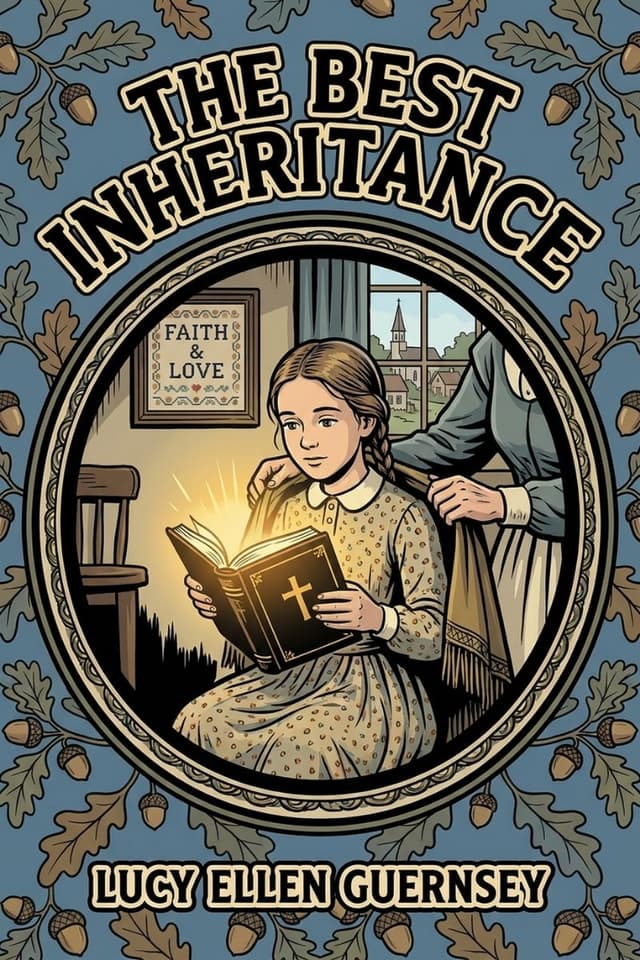
The Best Inheritance
Read The Best Inheritance by Lucy Ellen Guernsey for free on Novelhalla, and try out our easy-to-read modern edition of this classic book. You can also download the EPUB and read it on any device if you prefer!
The Plot
The Girl at the Gate
Nelly Ryan is thirteen years old and leaning on a broken gate in front of a one-room cottage, watching thirty girls from the boarding school walk past on their way to church. They're clean. Their boots have no holes. Their collars are white.
Nelly looks down at her own frock, which is torn in three places and stiff with grease, and at her hands, which are black to the wrists from feeding the cow and hauling slop buckets, and she starts to cry. Not loudly. She's had this cry before. What she says to herself is that there's no use in her ever trying to be anybody.
She can't read. She has never been to school and never will, because the family owns one cow, and somebody has to watch it, and that somebody is her. Her father died in state prison. Her mother drank herself to death. Her grandmother raised her and loves her and smokes a black pipe on a stool by the stove all day, and has exactly one plan for their future.
The Money from Ireland
Granny Ryan is descended, at a distance she keeps revising upward, from the Earls of Glengall. She's certain that a letter is coming from the old country any day now, and a gentleman with a carriage and footmen, and after that it's silks and satins and a title, and Nelly will be called Lady Eleanor, and every neighbor who ever watched them collect swill will have to watch them ride past.
Nelly used to love these stories. She could listen for hours. Lately they've started to taste like nothing, and she's begun to say out loud that she doesn't believe a word of it, which wounds her grandmother badly. The house is falling down now. The garden is nothing but weeds and old bones. And the fortune has been arriving any day now for Nelly's entire life.
What Nelly wants isn't a carriage. She wants to be decent this year.
Soap, and a Shuttle
A young woman stops at the gate one Sunday, asks Nelly why she's crying, and gives her a bunch of violets and a printed card with a hymn on it. That's all. But Nelly notices her own filthy fingers have already smudged the pretty card, and something in her snaps awake, and she goes inside and asks her grandmother where the soap is.
That question is the whole book, really.
Following that thread leads Nelly to a fancy-goods shop downtown, to a woman behind the counter making something called tatting with a little shuttle and a length of thread. Nelly asks to learn. She's told it's easy to do and almost impossible to teach. She tries for over an hour, gets nowhere, throws the shuttle down in tears, and decides that she will not be beaten by a piece of string.
There's real money in it, as it turns out. Six shillings a spool. Enough to buy a secondhand spelling book, which is the other thing Nelly wants, because there's a girl down the road who has offered to teach her to read a little every evening when the milk gets delivered.
Meanwhile a gentleman with a sketchbook stops on the road to draw her twice, and gives her an old Irish coin as a keepsake, and won't show her what he's drawn.
The Trouble Granny Won't Name
Nelly gets clean. She gets a frock. She learns her letters, and then words of two syllables, and then, slowly, the truth that the girls in the shop have been watching her work and quietly deciding something about her.
But granny is changing. She's grown irritable, then bitter, then strange, muttering to herself in Irish and refusing to say why. And one afternoon Nelly comes home to find the gate hanging open, the cow lowing for water that nobody has brought her, the fire dead, and her grandmother sitting on her stool in the cold, rocking and keening.
The cottage was never paid for. There's a man in town who holds the debt, granny hasn't paid even the interest in a year, and she spent the money on something she won't discuss. They can be put out on the street whenever he chooses.
Nelly is thirteen, going on fourteen. She has some money of her own, honestly earned, sitting in a shopkeeper's cash box. And she is about to climb a flight of stairs to the office of a rich old man she has never met, who takes one look at her clothes and tells her to get out, that he doesn't give money to beggars.
About the Author: Lucy Ellen Guernsey
A Rochester Childhood
Lucy Ellen Guernsey was born in 1826 in Pittsford, New York, one of several daughters of James T. Guernsey, a businessman and philanthropist of the Rochester area whose interests ran in unusual directions. He is credited with helping introduce horticulture to western New York. He was an antislavery man well before that was a comfortable position to hold in the North. And he was a friend to the Seneca, close enough to the chiefs Red Jacket and Cornplanter that the friendships were remembered long after his death.
That mix of business sense and social conscience went straight into his daughter, who spent her whole life on the same two tracks.
Sixty Books in Thirty Years
Guernsey never married and never had children, which didn't stop her from writing about them constantly. Between roughly 1855 and 1885 she published more than sixty books, most of them through the American Sunday-School Union in Philadelphia. She lived for many years with her sister Clara, also a writer, and the two of them collaborated on at least one book.
Her range was wider than the Sunday-school label suggests. She wrote contemporary stories about poor children in American towns, and she wrote long historical novels set in Tudor and Stuart England, one of which was praised in the Saturday Review for how accurately it caught the manners of the period.
Critics then and now agree on the flaw: she wrote fast, and the plotting shows it. They also agree on the strength, which is dialogue. Her characters talk like people talk, and the grandmothers and shopgirls and cranky old landlords in her books sound like they were transcribed rather than composed.
The Work Behind the Books
The stories weren't a substitute for doing anything. Guernsey founded the first sewing school in Rochester for working-class children, which is essentially the plot of this book performed in real life. She helped establish a Home for Aged Women. She taught an adult Bible class. She was president of her church's missionary society in the 1880s.
For the last eleven years of her life she edited a religious paper called The Parish Visitor, which was written specifically to be handed out in prisons, hospitals, and poor homes. She died in Rochester in 1899, at seventy-three.
Fun Facts About the Book
The Author Argued with Her Readers Before They Could Argue Back
The book opens with a short note in which Guernsey defends her own numbers. She knew people would say a thirteen-year-old couldn't possibly earn what Nelly earns, so she consulted an experienced woman on the point, reported that the figures were not exaggerated, and offered evidence: a woman largely confined to bed and sofa who had earned nearly seven hundred dollars in three years doing fine tatting. It's a strange and wonderful thing to find at the front of a children's book, a preemptive strike against skeptics.
It Was Published by a Missionary Organization
The American Sunday-School Union started in Philadelphia in 1817 and became one of the most prolific publishers of children's books in the country. Its people planted Sunday schools in rural communities across the frontier and supplied them with libraries, which meant that for a huge number of nineteenth-century American children, this organization was the only source of books they ever saw. That's the pipeline this story traveled through.
The Author Ran the Real Version
Guernsey founded Rochester's first sewing school for working-class children. This is a book about a poor girl whose life changes when a shop woman teaches her a skill she can sell, written by a woman who spent her spare time teaching poor children skills they could sell.
The Title Page Didn't Have Her Name On It
The first edition credited the book to "the author of Irish Amy," an earlier and evidently popular story of hers. Naming authors was optional in the Sunday-school trade, and many contributors gave their work for free.
Tatting Was a Real Trade
Modern readers may assume the lacework is decorative filler. It wasn't. Tatting and fine embroidery were among the very few skilled trades a woman could practice at home, sitting down, and be paid decently for, which mattered enormously for women who were sick, disabled, elderly, or caring for someone else. The book takes the economics seriously, down to the price per spool and the fact that dirty fingers make the product worthless.
The Grandmother Is the Most Interesting Person in It
Granny Ryan is a Sunday-school-book villain on paper: shiftless, superstitious, sponging off a fantasy. In practice Guernsey can't quite bring herself to write her that way. She's affectionate, funny, quick to forgive, sharp about how words break hearts worse than they break bones, and she does one substantial and secret thing for her granddaughter that Nelly doesn't discover until much later.
It Sat Unread for Over 150 Years
The book was digitized and put on Project Gutenberg in 2023, with a volunteer-read audiobook following. Before that it existed as scattered copies in library basements and dealer catalogues. It's not a rediscovered masterpiece. It's something more useful: a completely ordinary book from a completely vanished publishing world, which is exactly what almost never survives.
Themes
Two Kinds of Fortune
The whole story is a quiet argument between granny's inheritance and Nelly's. One is a title, a park in Ireland, and a letter that never comes. The other is a shuttle, a spelling book, a clean pair of hands, and a reputation among the neighbors for showing up when you say you will. The book is not subtle about which one it favors, but it's honest enough to show why the fantasy is so hard to give up. For an old woman with nothing, the daydream is food and firewood.
Being Poor Is Treated as a Character Flaw
More than one respectable woman in this book looks at Nelly and assumes she steals. Someone calls her a rag-bag. Someone calls her an object. Guernsey clearly finds this contemptible and lets the shopkeeper deliver the killing line about how the people they catch stealing are usually better dressed. But she also has a shop woman explain the other side to Nelly, and that explanation is uncomfortable, and the book lets it stand.
False Pride Cuts Both Ways
Nelly is ashamed of collecting slop and terrified a customer will see her doing it. She's told, in effect, that there's nothing shameful about honest work and that a genteel lady who lies about selling her embroidery is the more ridiculous of the two. Her shame is treated as real and as a problem, not as something to be lectured away.
Nobody Rescues Her
Adults hand Nelly opportunities. Not one of them hands her an outcome. She learns the tatting by sitting on a rock and refusing to quit. She buys her own book after being told to stop pestering for a free one. When the disaster hits, the grown woman who loves her sits on a stool and wails, and it's the thirteen-year-old who counts the money and goes downtown. The book is completely clear-eyed about which of them is the adult.
Grace Instead of Bookkeeping
Nelly spends most of the story convinced that heaven is a place for good people and that she doesn't qualify, and quietly wretched about it. This being an 1867 Sunday-school book, the answer arrives, and it's the one you'd expect. What's notable is how much space Guernsey gives to the misery first, and how precisely she describes the specific exhaustion of trying to earn something you can't earn.
The Cow
There is a cow named Crummie who follows Nelly around, lows after her when she stops to talk to other children, and represents the entire economy that keeps this household alive. She's also the reason Nelly can't go to school. She is, in the most literal sense, both what's feeding the girl and what's holding her back, and Guernsey never once points that out.
The Book's Legacy
There isn't one, and that's the honest answer.
This was one of over sixty books by a woman who wrote them faster than anyone could reasonably read them, published by a religious organization that produced this kind of thing by the ton and shipped it to Sunday schools across the country. It was never reviewed into the canon. It was never adapted. It went out of print and stayed there. Its author is remembered, if at all, for a historical novel or two.
What it offers now is different. It's a clear window into a specific world: Irish immigrant poverty in an American town just after the Civil War, the actual mechanics of how a girl with no schooling could scrape her way into literacy and a wage, the price of a spool of thread, what a landlord's interest payment was, what a stranger's contempt sounded like out loud. The characters aren't types. Granny Ryan in particular is far too alive for the moral she's supposed to be carrying.
It's also short, it's free, and it moves. Guernsey wrote for children who were learning to read, which means she wrote plainly, and plain writing ages better than fine writing. A century and a half after everyone stopped reading it, a girl leaning on a broken gate and deciding she is tired of being ashamed still lands exactly as hard as it was meant to.