Novelhalla
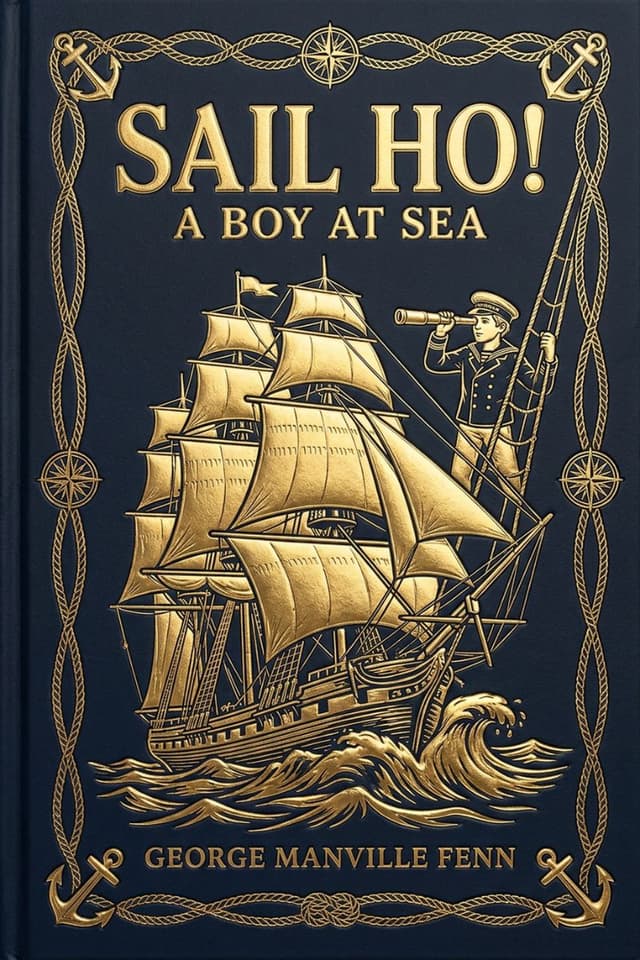
Sail Ho! A Boy at Sea
Read Sail Ho! A Boy at Sea by George Manville Fenn for free on Novelhalla, and try out our easy-to-read modern edition of this classic book. You can also download the EPUB and read it on any device if you prefer!
The Plot
A Boy, a Dock, and a Rotten First Impression
Alison Dale is seventeen, and he's wanted to go to sea for as long as he can remember. He's grown up on his father's yachts along the Cornish coast, he can box the compass, he can handle a line, and he's spent months counting down to the morning he finally boards a real ship bound for the other side of the world.
Then the morning arrives, and it's grey and drizzling, and the docks are filthy, and within about ninety seconds of stepping aboard the Burgh Castle a falling spar nearly splits him in half.
It doesn't get much more encouraging from there. His fellow apprentice, Nicholas Walters, is sour, boastful, and convinced he's the senior man on the strength of exactly one previous voyage. The crew is a rough, sullen, half-drunk collection that looks nothing like the smart clipper hands Alison had pictured. And Captain Berriman is a bluff, iron-tempered man who believes that on his deck he'll be obeyed whether he's right or wrong.
The ship clears the river, the weather turns filthy, and Alison's first days at sea are spent nursing a seasick messmate who hates him for it.
The People You Get Stuck With
A long voyage under sail forces strangers into each other's pockets for months, and the Burgh Castle carries an odd assortment. There's John Denning, a young invalid passenger sent to sea for his health, sharp-tongued and proud and inexplicably hostile to the ship's doctor. There's his sister Lena, patient with him in a way that makes you wonder what the last few years have cost her. There's Mr Preddle, an enormous, gentle, thoroughly unseaworthy naturalist who has filled the forward deck with trays of live trout and salmon he's transporting to New Zealand, and who aerates them with a pair of kitchen bellows because otherwise they die.
And there's Bob Hampton, an old salt with two inseparable messmates, who takes a liking to Alison and tells him sea stories on the night watches.
Alison, being the sort of boy who talks to everybody, ends up as the hinge between all of them. Which means he's also the one who starts noticing the things nobody's saying out loud.
Small Things That Aren't Small
Early in the voyage, the captain knocks a sailor down for insolence. The man is Jarette, half French, quick, clever, and wearing a silver ring in his ear, and old Hampton says quietly that this is the sort of man who doesn't forget a blow.
After that, Alison keeps catching little things. Walters leaning over the bulwarks, talking to Jarette in bad French, in a low voice. Jarette calling him "my friend." Two figures coming down out of the main-top in the dark, one after the other, when there's no earthly reason for anyone to be up there. Jarette waking with a hand at Alison's throat and murmuring that it isn't ripe yet, wait a little.
And then there's the captain himself, who has started giving orders and countermanding them, driving the men half mad, until Alison overhears the first mate and the doctor discussing, in the careful voices of men who know what they're saying, whether Berriman ought to be relieved of his command.
Alison is told to keep it to himself. He does. He also can't stop turning it over.
The Night the Ship Changes Hands
It comes at about two bells, in a heat so heavy Alison is sleeping badly anyway.
A voice giving orders. A scuffle. A fall. Then a pistol shot, a door bursting in, a scream, and the ship wallowing down in the trough of the sea because nobody is steering her.
Alison gets on deck into total darkness and runs, because something invisible is swinging at him and then chasing him, forward to a forecastle that turns out to be full of men fighting, and back across the deck, and up onto the poop, until there's nowhere left to go but straight up the mizzen shrouds. So he climbs, twenty feet above the deck, and hangs there in the dark, listening to the men underneath work out where he's hidden.
Below him, someone hammers at a locked cabin door. A sharp voice tells the man inside to lie down, and fires through it.
Alison knows that voice.
What he doesn't know yet is that the Burgh Castle has months of open ocean ahead of her, that the people he cares about are scattered behind locked doors and under guard, and that a mutiny is only the beginning of the problem. Somebody now has to get this ship back.
About the Author: George Manville Fenn
Early Life
George Manville Fenn was born in Pimlico, London, in January 1831, the third child and eldest son of a butler. There was no money for a gentleman's education, so he gave himself one, teaching himself French, German, and Italian along the way. Between 1851 and 1854 he trained at Battersea Training College for Teachers, and afterward took charge of a national school at Alford in Lincolnshire.
Ink and Type
Teaching didn't hold him. Fenn moved into printing, editing, and publishing a string of short-lived magazines, none of which made him rich. His break came in 1864, when a sketch he wrote for All the Year Round caught the attention of its editor, Charles Dickens. That opened doors. He began contributing to Chambers's Journal and Once a Week, and in 1866 he wrote a series of articles on working-class life for The Star that were popular enough to be collected into four volumes.
In 1870 he became editor of Cassell's Magazine, and a few years later he bought Once a Week outright and ran it until it folded in 1879.
The Boys' Book Machine
Fenn's first story for boys, Hollowdell Grange, appeared in 1867, and after that the floodgates opened. He wrote adventure stories, school stories, sea stories, and novels for adults, and he wrote them relentlessly. More than 170 of his books are thought to have been published in volume form, many of them serialized first in magazines like the Boy's Own Paper. He wrote for the theatre as well.
He married Susanna Leake, and they had eight children, two of whom, Annie Sarah and Clive Robert, became novelists themselves.
Later Years
Fenn and his family settled at Syon Lodge in Isleworth, Middlesex, where he built up a personal library of twenty-five thousand volumes and, for a hobby, took up making telescopes. He kept writing almost to the end. His final book was a biography of his friend and great rival in the boys' adventure trade, G.A. Henty. He died at home on 26 August 1909, aged seventy-eight.
Fun Facts About the Book
It Was Published by a Religious Society
The first edition came out in 1893 from the Society for Promoting Christian Knowledge, issued "under the direction of the General Literature Committee." The SPCK was one of the major suppliers of wholesome reading for Victorian boys, and a large chunk of the adventure fiction of the era reached its readers through exactly this kind of improving-literature pipeline. It's a slightly funny provenance for a book that spends a good deal of its length on pistols, knives, and men trying to kill each other in the dark.
The Illustrator Was One of the Best Marine Artists Alive
The original edition carried plates by William Heysham Overend, who had been illustrating for the Illustrated London News since 1875, when he covered the Nares Arctic expedition. For a decade he was arguably the paper's second most prominent artist, and he built a reputation as one of the finest naval illustrators of the period, with a knowledge of warships past and present that almost nobody could match. He'd also illustrated books for G.A. Henty. He died in 1898 at only forty-six.
The Hero Is a Boy Named Alison
It threw the book's modern editor, and it'll probably throw you for a page or two as well. Fenn never explains it, never remarks on it, and simply lets his narrator be a boy called Alison Dale. It's the sort of small period oddity that you stop noticing about thirty pages in.
The Whole Thing Is a Man Remembering
Fenn opens not with the ship but with an older man musing about how little a human life amounts to against the age of starlight, and how the years fall away when you look back. Then he catches himself, says he isn't going to talk astronomy, and drops you straight into a shout of "Be-low!" and a falling spar. That framing matters more than it looks like it will. Everything you read is being told by someone who survived it and has had a long time to think about it.
Fenn Was Never a Sailor
He was a butler's son from Pimlico who trained as a schoolteacher and then spent his life in magazine offices. The rigging, the watches, the slang, the smell of the tarred ropes going soft in the tropics, all of it came out of research, reading, and an enormous personal library rather than a berth on a real clipper.
The Fish Are Not a Joke
Mr Preddle's trays of trout and salmon look like comic relief, and they are, but they're also completely accurate. Fenn dropped a genuine Victorian institution into the middle of his adventure story, and if you know the history, the fish stop being funny and start being interesting.
Themes
The Difference Between Wanting Adventure and Having One
Alison spends years dreaming of the sea and then gets miserable, wet, and nearly killed within the hour. The book keeps setting his expectations next to the reality and letting you watch the gap. This is a story about a boy discovering that the thing he wanted is real, which means it's heavier, dirtier, and considerably more dangerous than the version in his head.
Who Actually Deserves to Be Obeyed
Captain Berriman believes authority is authority, right or wrong. Jarette believes authority belongs to whoever takes it. Mr Brymer and the doctor spend uneasy nights wondering whether they have the right to remove a man who holds legal command. Alison has to work out, in the middle of all this, what makes an order worth following, and the book doesn't hand him an easy answer.
The Company You Keep
Walters drifts toward Jarette because he feels slighted, and because Jarette flatters him. Alison drifts toward Bob Hampton because Hampton is decent and tells good stories. Both boys are told by their officers not to be too familiar with the crew. Only one of them picks the right sailors, and the reason has less to do with rank than with character.
Usefulness
Nearly everyone aboard is quietly worried about being useless. Denning is an invalid who hates being pitied. Preddle is too big, too soft, and too clumsy to stand up in a swell. Alison is the most junior person on the ship and gets told outright by the captain that he's not much use. What each of them turns out to be good for, when it matters, is one of the real engines of the story.
Cruelty and Discipline
Fenn is genuinely interested in where one becomes the other. A blow struck in a moment of temper is the small stone that starts the avalanche, and the book is honest about the fact that a hard man and a wicked man can look identical from the forecastle.
Improvisation
The heroes here don't win through brute force. They win, when they win, by thinking, by using what's actually available on a ship, and by noticing what other people overlook. Bellows for a fish trough, a running noose on a fishing line, a set of shrouds in the dark. Everything Alison knows how to do turns out to matter eventually.
Historical Context
The Long Run to New Zealand
The Burgh Castle is loaded with seed boxes and crates of agricultural implements stencilled for Auckland and Wellington, which places her squarely on one of the great emigrant and cargo runs of the age. In the 1880s and 1890s a sailing ship bound from London to New Zealand faced months at sea, down past the Azores, through the tropics, and into the Southern Ocean, with no radio, no help, and no way to report anything that went wrong until she made port. That isolation isn't a plot convenience. It's just what the route was.
The Fish in the Trays
Victorian settlers in New Zealand and Australia badly wanted the rivers of home, so acclimatisation societies formed to import English fish, birds, and game, and they shipped them out on ordinary passenger vessels. Committee members with shipping connections often got the passage cheap or free, and the animals travelled in cages and tanks on deck. Survival rates were brutal. Getting more than a quarter of your stock to the other end alive counted as a success. Salmon and trout ova were packed in moss and buried in ice for the three-month voyage, and the first shipments simply cooked in the tropics or hatched too early and died.
So when Preddle stands there gloomily netting dead trout off the surface, sighing that he won't have many left by the time he reaches New Zealand, he's doing something hundreds of real men actually did, and failing at it in exactly the way they actually failed.
The Book's Legacy
In his own lifetime Fenn was one of the most widely read authors in Britain. His books sat on the shelves of half the boys in the country, handed out as school prizes and Sunday-school rewards, and his name was spoken in the same breath as G.A. Henty and R.M. Ballantyne.
Literary fashion hasn't been kind to him. Stevenson's Treasure Island, published a decade before this one, became immortal, while Fenn's enormous output slid quietly out of print. Part of that is sheer volume. It's hard to build a towering reputation when you've written a hundred and seventy books and readers don't know which one to pick up first.
This is a good one to pick up first. It's tight, fast, and surprisingly restrained about its violence, which mostly happens just off the edge of the page, and the heroes consistently look for a way through that doesn't involve killing anybody. Modern readers who come to it tend to be startled by how relentlessly it moves. There's no long Victorian throat-clearing, no wandering digressions, just complication piling on complication until you're several chapters further than you meant to go.
It belongs to the same tradition as Mutiny on the Bounty and Treasure Island, the one where the sea is beautiful and the real danger is always the people you're locked on the ship with. If you like that tradition, this is a book that deserved better than obscurity.