Novelhalla
Rebecca of Sunnybrook Farm
Read Rebecca of Sunnybrook Farm by Kate Douglas Smith Wiggin for free on Novelhalla, and try out our easy-to-read modern edition of this classic book. You can also download the EPUB and read it on any device if you prefer!
The Plot
The Girl on the Stagecoach
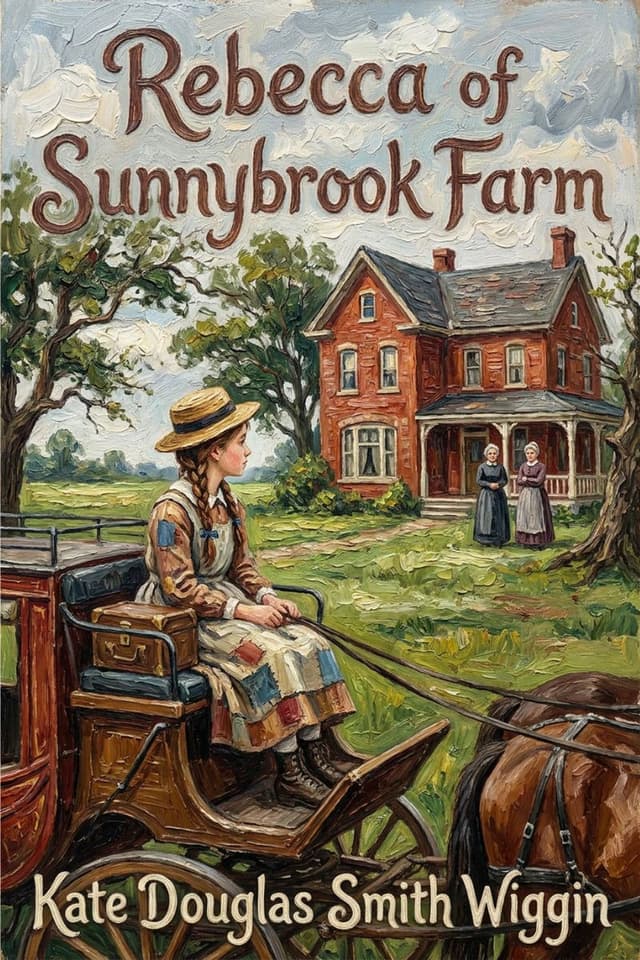
Rebecca Rowena Randall is ten years old, full of opinions, bursting with imagination, and riding a stagecoach into a life she didn't choose. Her father is dead. Her mother is drowning in debt on a failing farm with seven children to feed. The plan is simple: send Rebecca to live with her two spinster aunts in the quiet town of Riverboro, Maine, where she'll get an education and become one less mouth to feed back home.
There's just one problem. The aunts wanted her older sister Hannah. Hannah is sensible, tidy, and good at housework. But Rebecca's mother couldn't spare Hannah. So she sent Rebecca instead.
By the time the stagecoach rolls into Riverboro, Rebecca has already charmed the driver, Mr. Cobb, with her conversation, her curiosity, and her absolute inability to sit still. She has also named her family's miserable little farm "Sunnybrook" because that's the kind of girl she is. She looks at a broken-down place and sees possibility.
Her Aunt Miranda is going to have a different reaction entirely.
The Brick House
Miranda Sawyer is rigid, sharp-tongued, and deeply suspicious of anything that reminds her of Rebecca's father, a charming, unreliable man who, in Miranda's view, ruined her sister's life. And Rebecca is all Randall. She talks too much, daydreams too often, ruins her clothes, and has a way of looking at the world that makes no practical sense whatsoever.
Aunt Jane is softer. She sees something in Rebecca that Miranda refuses to acknowledge. Jane becomes Rebecca's quiet protector in the brick house, teaching her to sew and cook and navigate Miranda's impossible standards, while also giving her room to breathe.
But Rebecca keeps colliding with Miranda's expectations. She's messy where Miranda demands order. She's passionate where Miranda demands restraint. She writes poems when she should be scrubbing floors. And the harder Miranda tries to train the Randall out of her, the more Rebecca seems to be exactly, stubbornly, wonderfully herself.
The Soap and Mr. Aladdin
School brings Rebecca a best friend in Emma Jane Perkins and a knack for getting tangled up in other people's problems. When the Simpson children, a large and struggling family not unlike her own, start selling soap to earn commissions, Rebecca throws herself into helping with the kind of enthusiasm that tends to either save the day or cause a disaster.
It's during this soap-selling adventure that Rebecca meets a young businessman who is so taken with her spirit that he buys their entire stock. Rebecca, who has been reading fairy tales her whole life, immediately dubs him "Mr. Aladdin." His real name is Adam Ladd, and he sees something remarkable in this girl. Something worth investing in.
It's a small encounter, but it sets something in motion. Rebecca doesn't know it yet, but she's beginning to collect the people and the chances that will shape her future.
Growing Up in Riverboro
The years pass, and Rebecca grows. She excels at school, especially in English. She composes songs and stories that make people stop and listen. She makes mistakes, gets scolded, picks herself up, and tries again. She nearly runs away once, heartbroken by Miranda's constant criticism, but old Mr. Cobb talks her into staying with a kindness she never forgets.
Rebecca earns a place at the high school in Wareham, where a new teacher, Miss Emily Maxwell, recognizes her talent and becomes the mentor she's been waiting for. Adam Ladd turns up again as a trustee at the school, quietly opening doors for Rebecca that she doesn't even realize are being opened.
She's becoming someone. A young woman with intelligence, warmth, and a gift for words. But Sunnybrook Farm is still struggling. Her mother is still alone with all those children. And the mortgage doesn't care how many poems Rebecca can write.
The Weight of Two Worlds
Rebecca is caught between two lives. There's the life she's building in Riverboro and Wareham, the education, the friendships, the slowly dawning sense that she might be capable of something extraordinary. And there's the life pulling her back, the poverty of Sunnybrook, the family that needs her, the debts that won't stop growing.
She wins a writing prize that helps with the mortgage. She dreams of a teaching job in Augusta. She's almost there, almost free, almost able to stand on her own and help her family at the same time.
But life in Riverboro has its own plans for Rebecca. And the question of whether this girl, with all her brightness and all her burdens, can hold both worlds together is one that only the turning of pages will answer.
About the Author: Kate Douglas Wiggin
A Philadelphia Childhood
Kate Douglas Smith was born in 1856 in Philadelphia. Her early years were happy, though shadowed by the Civil War and the death of her father when she was just three. Her widowed mother moved the family to Portland, Maine, and later remarried, settling in the small village of Hollis, Maine. Kate grew up in rural New England, surrounded by the kind of tight-knit community and country landscape that would later fill her most famous book.
The Kindergarten Pioneer
After her stepfather's death left the family in financial difficulty, Kate moved to California, where a chance meeting with the social reformer Caroline Severance changed the course of her life. Severance introduced her to the kindergarten movement, and in 1878, Kate opened the Silver Street Free Kindergarten in San Francisco, the first free kindergarten on the West Coast. The children were from the city's poorest neighborhoods, and Kate threw herself into the work with passion and flair. With her sister Nora, she established a training school for kindergarten teachers, and the two women were instrumental in founding over sixty kindergartens for underprivileged children across San Francisco and Oakland.
Writing to Fund a Mission
Kate married lawyer Samuel Bradley Wiggin in 1881, which required her to resign from teaching under the customs of the time. Still devoted to her schools, she began writing to raise money for them. Her first books, The Story of Patsy and The Birds' Christmas Carol, started as fundraising efforts and became genuine literary successes. When her husband died suddenly in 1889, Kate retreated to Maine to grieve and write. In 1895, she married New York businessman George Christopher Riggs, who became one of her greatest supporters.
Rebecca and Beyond
In 1903, she published Rebecca of Sunnybrook Farm, which became an instant bestseller. Mark Twain called it "beautiful and moving and satisfying." Jack London wrote her a fan letter so enthusiastic it read like a love confession. The book made Wiggin one of the most popular authors in America and cemented her reputation beyond the world of education.
Final Years
Wiggin continued to write, travel, and advocate for children's welfare for the rest of her life. She never had children of her own, an irony she carried with grace given her life's devotion to the young. In 1923, while in England as a delegate to the Dickens Fellowship, she fell ill and died of bronchial pneumonia at age sixty-six. At her request, her ashes were scattered over the Saco River in Maine, the landscape she had loved since childhood.
Fun Facts About the Book
An Instant Bestseller
Rebecca of Sunnybrook Farm was a sensation from the moment it was published in 1903. It has never been out of print. For a children's novel written at the turn of the twentieth century, that's a remarkable feat of staying power.
Mark Twain Was a Fan
Mark Twain praised the book warmly, and Jack London wrote Wiggin a letter that has become famous in literary circles. London told her he would have searched the entire world to find Rebecca and make her his own daughter, and asked why he couldn't have been the one to buy those three hundred cakes of soap. It was the kind of passionate reader response that most authors only dream about.
Rebecca's Full Name
Rebecca Rowena Randall gets her middle name from a character in Sir Walter Scott's Ivanhoe. Wiggin wove literary references throughout the novel, reflecting Rebecca's own love of books and storytelling. The name "Rebecca" itself became wildly popular in the early twentieth century thanks in part to the novel's success.
She Named the Farm
In the book, the Randall family farm isn't actually sunny or particularly brook-like. Rebecca named it "Sunnybrook" herself because she saw beauty where others saw hardship. It's one of the first things the reader learns about her, and it tells you everything you need to know about how her mind works.
Three Film Adaptations
The novel was adapted for film three times: in 1917 starring Mary Pickford, in 1932, and most famously in 1938 starring Shirley Temple. The Temple version was a hit but bore almost no resemblance to the actual novel, turning Rebecca into a radio singing sensation rather than a small-town girl with a gift for words. Studio records noted that the only things taken from the book were "a few minor instances, the character of the little girl and the title."
The Broadway Connection
Wiggin co-wrote a stage adaptation of the novel with Charlotte Thompson, and it was produced on Broadway in 1909. Before its New York opening, it toured Boston and New England to warm receptions.
Born from Real Life
Wiggin drew on her own experiences growing up in rural Maine to build the world of Riverboro. The small-town rhythms, the one-room schoolhouses, the social dynamics of neighbors who know everything about each other: these came straight from memory. Wiggin understood this world because she had lived it.
Written by a Pioneer
Wiggin wasn't just a novelist. She was one of the most important figures in the American kindergarten movement. The same woman who created Rebecca also founded schools, trained teachers, and spent decades fighting for the idea that young children deserved care, play, and education. Rebecca's fierce belief in the goodness of people reflects Wiggin's own philosophy about what children need to thrive.
Themes
The Power of Personality
Rebecca transforms every room she enters. Not because she's perfect, but because she's alive. She talks, she imagines, she cares intensely. The novel suggests that personality, genuine warmth and curiosity and the willingness to engage with the world, is a kind of superpower. It can't pay the bills, but it can open doors that money alone never could.
Poverty and Pride
The Randall family's poverty is not quaint or picturesque. It's the kind that forces a mother to send her child away because she can't afford to keep her. Rebecca carries the weight of her family's need through every chapter, and the novel never lets the reader forget that her education, her friendships, and her opportunities all exist in tension with the debt back at Sunnybrook.
Rigid Rules vs. Wild Spirits
Miranda represents order, propriety, and control. Rebecca represents imagination, spontaneity, and feeling. The novel doesn't simply declare one right and the other wrong. Miranda's rigidity comes from real experience and real fear. Rebecca's wildness comes with real costs. The story is about what happens when these two forces have to share a house, and whether they can learn anything from each other.
The Education of a Girl
At its heart, this is a story about a girl getting the chance to become who she's meant to be. Rebecca's education isn't just about school, though she thrives there. It's about learning to navigate a world that has strong opinions about how girls should behave, what they should want, and how much room they're allowed to take up.
Chosen Family
Rebecca builds a family around herself in Riverboro. Aunt Jane, Mr. Cobb, Emma Jane, Miss Maxwell, Adam Ladd: these people become her network of support, her safety net, her champions. The novel gently argues that the family you build can be just as sustaining as the family you're born into.
The Book's Legacy
Rebecca of Sunnybrook Farm helped establish a template for the spirited-girl novel that would echo through the twentieth century. You can trace a line from Rebecca through Anne of Green Gables, Pollyanna, and countless other stories about bright, imaginative girls who refuse to be dimmed by circumstance.
The 1938 Shirley Temple film made the title famous worldwide, though it told a completely different story. For decades, many people knew Rebecca only through Temple's version, which turned a quietly powerful coming-of-age novel into a musical comedy about radio stardom. Readers who return to the original book are often surprised by how much richer and more complex it is.
The novel remains a vivid portrait of rural New England at the turn of the century, a world of stagecoaches and one-room schoolhouses and neighbors who keep careful track of one another's business. But it endures because of Rebecca herself: a girl who looks at a hardscrabble life and insists on finding the light in it, not because she's naive, but because she's brave.