Novelhalla
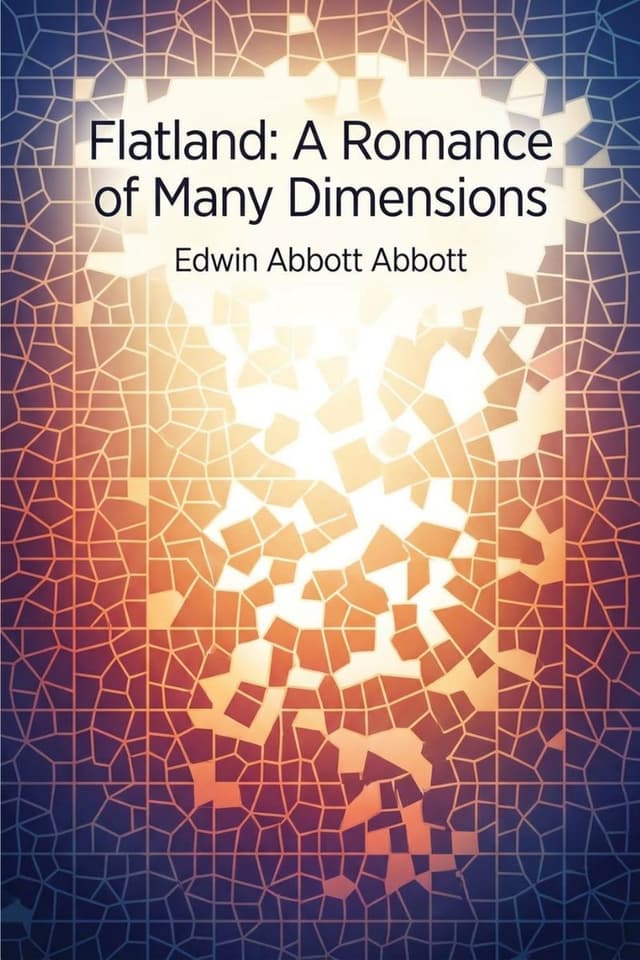
Flatland: A Romance of Many Dimensions
Read Flatland: A Romance of Many Dimensions by Edwin Abbott Abbott for free on Novelhalla, and try out our easy-to-read modern edition of this classic book. You can also download the EPUB and read it on any device if you prefer!
The Plot
A World of Two Dimensions
Imagine a universe where everything exists on a single flat plane. No up, no down. Just length and width, stretching endlessly in every direction. This is Flatland, and its inhabitants are geometric shapes: triangles, squares, pentagons, hexagons, and the elite circles who rule over all.
Our narrator is A. Square, a respectable middle-class gentleman with four equal sides. He lives a comfortable life with his wife and children, navigating a society where your shape determines everything about your existence. The more sides you have, the higher you rank. Women, who are merely straight lines, occupy the lowest rung of society. Soldiers and workers are sharp, dangerous triangles. Professionals like our narrator are squares. Nobles are hexagons, octagons, and beyond. And at the very top, so many-sided they appear perfectly round, are the priestly Circles who control all knowledge and power.
Square explains the rules of his world with the certainty of someone who has never questioned them. How to recognize other shapes by touch and sight. Why women must announce themselves with a constant humming sound so they do not accidentally impale anyone with their needle-sharp bodies. Why irregular shapes, those born with unequal sides or angles, are either corrected through surgery, locked away, or destroyed. The laws seem harsh, but Square accepts them as the natural order of things.
Dreams and Visions
Everything changes on the last night of the year 1999, when Square experiences a series of visions that shatter his understanding of reality.
First, he dreams of Lineland, a world of only one dimension. Its inhabitants, simple points and lines, can only perceive forward and backward along a single endless path. When Square tries to explain the concept of "left" and "right" to the King of Lineland, the monarch cannot comprehend it. The idea of a second dimension is beyond his imagination. He dismisses Square as either mad or a conjurer.
Square wakes frustrated by the King's stubborn refusal to accept the obvious truth of a larger reality. He has no idea that he is about to learn exactly how that feels.
The Visitor from Beyond
Later that night, something impossible enters Square's house: a voice from nowhere, speaking of mysteries he cannot fathom. Then a circle appears, but not like any circle Square has ever seen. This one grows and shrinks, materializing and vanishing in ways that violate every law of Flatland physics.
The visitor is a Sphere, a being from Spaceland, a world of three dimensions. The Sphere tries to explain the concept of "up" to Square, but how do you describe height to someone who has never experienced it? Square cannot conceive of what the Sphere is describing. To him, it sounds like mystical nonsense, perhaps even dangerous heresy.
The Sphere grows impatient. He rises above Flatland and looks down at Square's house, describing the interior rooms and every object inside them, knowledge impossible to possess in a world where you can only see the edges of things. Square is rattled but unconvinced. The Sphere tries another approach, touching Square from the inside, a sensation so bizarre and terrifying that our narrator screams for help.
Finally, the Sphere resorts to the only argument that will work. He lifts Square bodily out of Flatland and into the third dimension.
The View from Above
What Square sees changes him forever. From above, he can look down at his world and see everything at once: the insides of houses, the internal organs of his fellow Flatlanders, secrets that could never be glimpsed from within the plane. The experience is overwhelming, beautiful, and deeply unsettling.
The Sphere explains his mission. Once every thousand years, he visits Flatland to share the Gospel of Three Dimensions with a chosen apostle, hoping that gradually, over millennia, the inhabitants might be educated to accept higher truths. It never goes well.
Square's mind, now expanded, races forward. If there are three dimensions, why not four? Five? An infinite progression of higher realities, each invisible and inconceivable to those below? When he proposes this to the Sphere, the three-dimensional being dismisses the idea as absurd. The Sphere, who moments ago was preaching the importance of transcending dimensional limitations, cannot imagine anything beyond his own experience.
Square also visits Pointland, a world of zero dimensions inhabited by a single being who believes himself to be the entire universe. The Point cannot conceive of anything outside himself. Every sound, every stimulus, he interprets as his own thought. He is perfectly self-satisfied and utterly alone.
Return to Flatland
The Sphere deposits Square back in his world, and now the real struggle begins. Square has seen the truth. He knows there is more to reality than the flat plane everyone accepts as the totality of existence. He must share this revelation.
But Flatland is not ready for such dangerous ideas. The rulers have suppressed knowledge of the third dimension for centuries. Those who speak of it are imprisoned or worse. Square's own brother, who once caught a glimpse of the truth, has already been silenced.
Square faces a choice that will determine the rest of his life: stay silent and live comfortably in willful ignorance, or proclaim the truth and suffer the consequences.
About the Author: Edwin Abbott Abbott
A Victorian Polymath
Edwin Abbott Abbott was born in London on December 20, 1838, into a family where education was the family business. His father, Edwin Abbott, was headmaster of the Philological School in Marylebone. His mother, Jane Abbott, was his father's first cousin, which explains the distinctive doubled surname that made the author so memorable.
Abbott attended the City of London School, then went on to St. John's College, Cambridge, where he distinguished himself in an extraordinary range of subjects. He earned highest honors in classics, mathematics, and theology, demonstrating the breadth of intellect that would later produce such an unusual work of fiction.
Educator and Reformer
In 1862, Abbott took holy orders in the Church of England. After teaching positions at King Edward's School in Birmingham and Clifton College, he was appointed headmaster of his old school, the City of London School, in 1865. He was just twenty-six years old.
Over his twenty-four year tenure, Abbott transformed the institution. He was unusually progressive for his time, insisting that the study of English literature should be central to education rather than treated as inferior to Latin and Greek. He introduced practical sciences into the curriculum. He championed education for women and the lower classes, believing that knowledge should not be a privilege reserved for the elite.
His students included H.H. Asquith, who would become Prime Minister of the United Kingdom. Abbott was known as an inspiring teacher with a passion for truth and an impatience with those who refused to see beyond their narrow assumptions.
A Man of Many Books
Abbott was extraordinarily prolific. His "Shakespearian Grammar" (1870) became a standard reference work that scholars still consult today. He wrote textbooks on Latin, guides for home education, and a biography of Francis Bacon. His theological works, including "The Kernel and the Husk" and several religious romances, explored liberal Christianity and placed him at the forefront of progressive Anglican thought.
Yet of his more than fifty published works, only one achieved lasting fame.
Later Life
Abbott retired from the City of London School in 1889 at age fifty, not from exhaustion but to devote himself fully to writing. He continued producing books for nearly three more decades.
His wife Mary, whom he had married in 1863, died in 1919. Abbott himself passed away on October 12, 1926, at the age of eighty-seven. In his lengthy obituary in The Times, this book was not even mentioned. The theological and educational achievements that had defined his career seemed far more important at the time.
History, as it often does, had other ideas.
Fun Facts
A Pseudonymous Square
Abbott published the book under the pen name "A. Square," the same name as his narrator. The choice was a mathematical pun (A Square = A²), and it allowed Abbott to maintain distance from a work that was quite different from his serious academic publications.
Ignored Then Rediscovered
When published in 1884, the book attracted modest attention. Some reviewers found it clever; others were puzzled. It sold respectably but was hardly a sensation. Abbott's obituaries decades later did not mention it.
Everything changed after Einstein. When the theory of relativity made the fourth dimension a topic of popular fascination in the early twentieth century, readers rediscovered this strange little Victorian book that had anticipated so many ideas about dimensional thinking. A 1920 letter in the journal Nature praised Abbott as "a prophet" who had intuited truths about space and time decades before the physicists caught up.
The Misogyny Controversy
Even in 1884, readers complained about the portrayal of women in Flatland. The depiction of females as mindless, dangerous line segments struck many as offensive. Abbott addressed these criticisms in his preface to the second edition, explaining that the narrator was writing as a historian who had "identified himself (perhaps too closely) with the views generally adopted by Flatland." The satire was meant to criticize Victorian attitudes toward women, not endorse them.
Abbott had spent his career advocating for women's education. His own daughter, Mary, topped her classics class at Girton College, Cambridge. The harsh treatment of women in Flatland was intended as a mirror held up to his own society, not a prescription for how things should be.
Illustrated by the Author
The geometric diagrams throughout the book were drawn by Abbott himself. They provide essential visual aids for understanding how Flatlanders perceive their world and how beings from higher dimensions might appear to them.
Carl Sagan's Favorite Teaching Tool
Physicist and science communicator Carl Sagan used the concepts from this book in his landmark television series "Cosmos" (1980) to explain the fourth dimension to mass audiences. By dipping an apple in ink and pressing it through a flat surface, Sagan demonstrated how a three-dimensional object would appear to two-dimensional beings: as a series of changing shapes, mysterious and incomprehensible. He then asked viewers to consider that we might be just as limited in our perception of higher dimensions.
Stephen Hawking also referenced the book when discussing the theoretical properties of two-dimensional space.
A Story in Two Parts
The book is divided into two distinct sections. The first half, "This World," describes Flatland society in satirical detail. The second half, "Other Worlds," tells the story of Square's dimensional adventures. Many readers find these two halves almost feel like different books, one a social satire and one a philosophical adventure.
Adapted and Expanded
The book has inspired numerous sequels, including "Sphereland" by Dionys Burger (1957), which updates the mathematical concepts. Multiple films have been produced, including animated shorts and a 2007 feature film. The story has been referenced in "Star Trek: The Next Generation," "Futurama," and countless other works of science fiction.
Themes
The Limits of Perception
The central insight of the book is that every conscious being is trapped within the limits of its own dimensional existence. The Point cannot imagine the Line. The Line cannot imagine the Plane. The Plane cannot imagine Space. And Space, as the Sphere inadvertently demonstrates, cannot imagine whatever lies beyond. We are all prisoners of our perspectives, confidently asserting that what we can perceive is all that exists.
The Tyranny of Conformity
Flatland is a totalitarian society disguised as a natural hierarchy. Those who question the established order are eliminated. Those born irregular are destroyed or confined. Knowledge that might destabilize the ruling class is ruthlessly suppressed. The comfortable majority goes along with these cruelties because they benefit from the system and cannot imagine alternatives.
Education as Liberation
Square's transformation comes through education, through being shown something beyond his previous experience. Abbott spent his life believing that education could free people from the limitations of birth and class. The book dramatizes both the liberating power of expanded understanding and the fierce resistance such liberation provokes from those invested in ignorance.
The Arrogance of the Enlightened
Even the Sphere, the being from a higher dimension who brings truth to Flatland, cannot conceive of dimensions beyond his own. His smugness about his superior perspective blinds him to the possibility of still greater realities. Those who have transcended one limitation often assume they have transcended all of them.
Class, Gender, and Power
The rigid hierarchy of Flatland mirrors Victorian England, where birth determined destiny and women were denied education, property, and voice. The book exaggerates these inequalities to the point of absurdity, making them impossible to ignore. A square's number of sides matters no more than a person's parentage, the book suggests, yet societies organize themselves around such arbitrary distinctions and defend them as natural law.
The Book's Legacy
This book accomplished something remarkable: it made abstract mathematical concepts emotionally vivid. Generations of readers have come to understand dimensionality not through equations but through the experience of imagining what it would feel like to be lifted out of everything you know into a reality you could never have conceived.
The book anticipated ideas that would become central to twentieth-century physics. Though Abbott was a theologian and literary scholar, not a mathematician, his imaginative exploration of higher dimensions proved prophetic. When Einstein's theories made the fourth dimension a matter of serious scientific discussion, readers returned to this Victorian curiosity and found it more relevant than ever.
Beyond its mathematical legacy, the book remains a sharp satire of social conformity and closed-mindedness. The way Flatland's rulers suppress inconvenient truths, the way its citizens accept brutal hierarchies as natural, the way even the enlightened Sphere cannot imagine beyond his own experience: these observations remain painfully accurate.
For a book of fewer than 100 pages, written as a "romance of many dimensions," Abbott created something that continues to expand minds more than a century after its publication. It is simultaneously a geometry lesson, a social critique, a philosophical parable, and a genuine work of imagination. It asks readers to consider that reality might be far stranger and larger than anything we can currently perceive, and that the greatest obstacle to understanding is the certainty that we already know everything worth knowing.