Novelhalla
Northanger Abbey
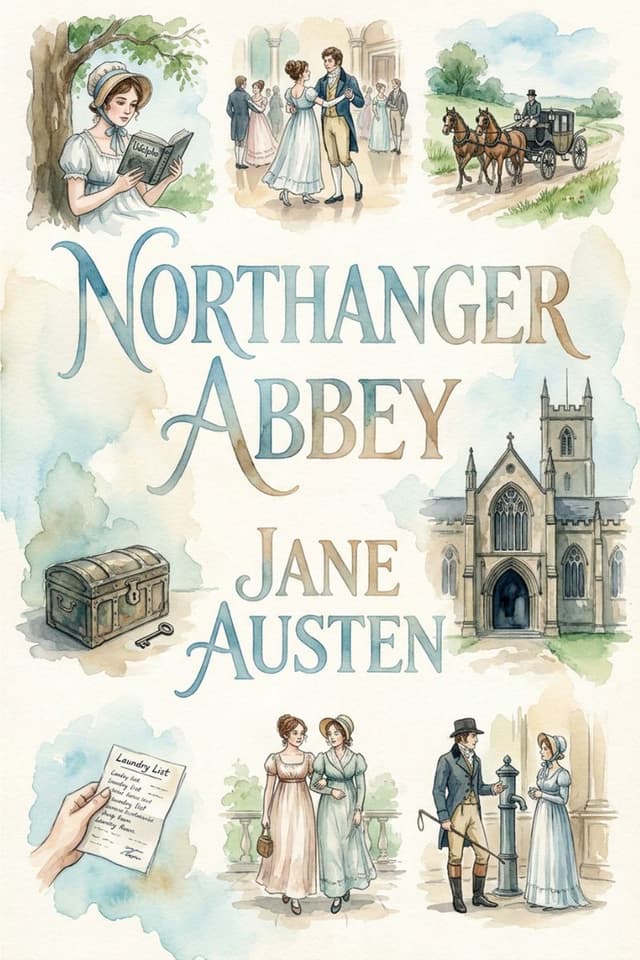
Read Northanger Abbey by Jane Austen for free on Novelhalla, and try out our easy-to-read modern edition of this classic book. You can also download the EPUB and read it on any device if you prefer!
The Plot
An Unlikely Heroine
The novel opens with one of the most famous introductions in English fiction: a cheerful announcement that its heroine, Catherine Morland, has absolutely no business being one. She is seventeen, the daughter of a country clergyman with nine other children, and there is nothing tragic, mysterious, or exceptional about her. She is pretty enough without being beautiful, clever enough without being brilliant, and possessed of no particular talents. She cannot draw. She has no ear for music. She has never rescued anyone from anything.
What Catherine does have is an appetite for novels. She devours Gothic fiction, the more sensational the better, and her head is full of ruined castles, sinister villains, imperiled heroines, and mysterious manuscripts discovered behind secret panels. She adores Ann Radcliffe's The Mysteries of Udolpho and wants to know if every book she hears about is properly "horrid."
When wealthy family friends Mr. and Mrs. Allen invite Catherine to accompany them to Bath for the social season, her real education begins.
Bath
Bath in the 1790s is a glittering machine for socializing. There are balls, concerts, promenades, and an endless circuit of pump rooms and assembly halls where the whole point is to see, be seen, and determine who is worth knowing. Catherine arrives knowing no one and understanding nothing about how any of it works.
She quickly makes two connections that will pull her in opposite directions. The first is Henry Tilney, a young clergyman who is witty, well-read, and playfully irreverent. He teases Catherine about her Gothic novels, talks about muslin with suspicious expertise, and treats her with the kind of good-humored attention she has never experienced. His sister Eleanor is quiet, kind, and genuinely interested in Catherine's company. Catherine likes them both immediately.
The second connection is Isabella Thorpe, a young woman a few years older than Catherine who latches onto her with extravagant warmth. Isabella calls Catherine "dearest creature" approximately every ten minutes, adores the same novels, and seems to offer the kind of intense female friendship Catherine has been reading about. Isabella's brother John is a loud, boastful bore who is friends with Catherine's brother James at Oxford, and the Thorpes quickly become entangled with the Morlands through this connection.
Catherine, innocent and trusting, does not notice what is obvious to the reader: that the Thorpes' affections are strategic and their interest in the Morlands is not entirely what it seems.
Complications
Bath becomes a tug-of-war for Catherine's time and loyalty. The Thorpes constantly press her into outings that conflict with her plans to see the Tilneys. John Thorpe lies and maneuvers. Isabella's devotion begins to show cracks. Catherine, who has never had to stand up for herself against anyone more forceful than a sibling, must slowly learn to say no and to read the difference between genuine affection and performance.
Then General Tilney, Henry and Eleanor's imposing father, invites Catherine to visit the family estate at Northanger Abbey. A real abbey. She has read about abbeys. She knows what happens in them.
On the journey there, Henry amuses himself by spinning a Gothic tale of what Catherine's first night will be like, complete with storms, secret doors, and bloodstained parchments. Catherine half-believes him. Her imagination is already racing. And the abbey, when she arrives, gives it plenty to work with.
About the Author: Jane Austen
Early Life
Jane Austen was born on December 16, 1775, in the village of Steventon, Hampshire, where her father was the rector. She was the seventh of eight children in a noisy, affectionate, intensely literary household. Her father supplemented his clerical income by tutoring boarding students, and the family home was always full of people, books, and conversation. Her closest companion was her older sister Cassandra, and the two were nearly inseparable for their entire lives. Neither ever married.
The Austens were great readers and great performers. They staged plays in the barn, wrote stories for one another's amusement, and devoured novels from the local circulating library. Jane began writing as a young teenager, producing sharp, funny parodies that she collected in three handwritten notebooks. The family passed them around and laughed.
A Writer's Life
Austen completed her first three novels while still living at Steventon, all before she turned twenty-five. None was published at the time. Her father submitted one to a London publisher, who rejected it by return post without reading it. Another was sold for ten pounds to a bookseller who sat on the manuscript for thirteen years.
In 1801, her father retired and moved the family to Bath. Austen was reportedly miserable there. She wrote little during the Bath years and the unsettled period that followed her father's death in 1805, when she, Cassandra, and their mother lived on the charity of relatives, moving from place to place without a settled home.
Everything changed in 1809, when her brother Edward provided the three women with a cottage in the village of Chawton, Hampshire. In that small house, at a tiny writing desk, Austen revised her earlier manuscripts and wrote three new novels. Sense and Sensibility came out in 1811, Pride and Prejudice in 1813, Mansfield Park in 1814, and Emma in 1815. All were published anonymously, credited only to "A Lady."
Final Years
Austen began to decline in health around 1816, likely from Addison's disease, though the diagnosis remains uncertain. She continued writing through her illness, completing Persuasion and beginning a new novel called Sanditon. She died on July 18, 1817, in Winchester, at the age of forty-one. She was buried in Winchester Cathedral.
Persuasion and Northanger Abbey were published together in December 1817, with a biographical notice by her brother Henry that identified her as the author of all six novels for the first time.
Legacy
Austen's reputation has only grown since her death. Her novels have never gone out of print. She is now regarded as one of the greatest writers in the English language, her work endlessly adapted, studied, quoted, and loved across the world. Her face appears on the British ten-pound note.
Fun Facts About the Book
First Written, Last Published
Northanger Abbey was the first of Austen's novels to be completed and readied for publication, probably around 1798 or 1799. It was also the last to appear in print, published posthumously in 1817. In the nearly two decades between, Austen wrote, revised, and published four other novels, becoming a quietly celebrated author while her first book gathered dust on a publisher's shelf.
The Ten-Pound Hostage
In 1803, Austen's brother Henry sold the manuscript, then titled Susan, to a London publisher named Benjamin Crosby for ten pounds. Crosby advertised the novel as forthcoming, then simply never published it. For six years Austen waited. In 1809, she wrote to Crosby under the pseudonym "Mrs. Ashton Dennis," demanding an explanation. The initials of her fake name spelled out M.A.D. Crosby's response was blunt: he had no obligation to publish and would sue if she tried to publish elsewhere. He offered to sell the manuscript back for the same ten pounds. Austen could not afford it. Not until 1816, when she was already the author of four published novels, did Henry buy it back. He reportedly took great pleasure in informing Crosby that the manuscript he had neglected for thirteen years was by the author of Pride and Prejudice.
A Book About Books
Northanger Abbey is Austen's most overtly literary novel. Characters discuss novels constantly, recommend reading lists, argue about taste, and define themselves by what they read. Partway through the story, the narrator interrupts to deliver a full-throated defense of novel-reading at a time when novels were widely dismissed as trash, especially novels written by and for women. It is one of the earliest and most spirited arguments for taking popular fiction seriously as an art form.
The Horrid Novels Are Real
Isabella Thorpe gives Catherine a reading list of seven Gothic novels with wonderfully lurid titles: Castle of Wolfenbach, Clermont, Mysterious Warnings, Necromancer of the Black Forest, Midnight Bell, Orphan of the Rhine, and Horrid Mysteries. For over a century, scholars assumed Austen had invented these titles as a joke. In the 1920s, researchers discovered that all seven were real books, published in the 1790s by the Minerva Press. They have since been reprinted, largely because of Austen's reference to them.
The Title May Not Be Hers
Austen called the manuscript Susan, then changed it to Catherine after another novel titled Susan appeared in 1809. The title Northanger Abbey was given to the book either by her brother Henry or by her publisher after her death. No one knows for certain whether Austen chose it herself, and she left no record of her preference.
Written for the Family
Biographers have noted that Northanger Abbey is the most closely connected to Austen's teenage writings. It has the same playful tone, the same direct addresses to the reader, and the same delight in bursting the conventions of popular fiction. Claire Tomalin described it as having been written "more in the style of a family entertainment than any of the others," and Joan Aiken suggested that early drafts were read aloud to the Austen household, just like the juvenile parodies that came before.
Austen Visited Bath
Austen stayed in Bath several times in the late 1790s before her family moved there in 1801. The novel's detailed knowledge of Bath's geography, social rituals, and assembly rooms draws directly from these visits. The Pump Room, the Upper and Lower Assembly Rooms, and the streets Catherine walks are all real, and visitors to Bath can still trace her routes today.
Themes
Fiction vs. Reality
The novel's great subject is the collision between what we read and how we live. Catherine's Gothic novels have taught her to expect the world to operate according to certain dramatic rules: that abbeys hide dark secrets, that mysterious documents lurk behind every locked cabinet, that danger announces itself with thunder and candlelight. The comedy of the novel comes from watching her apply these expectations to ordinary English life. But Austen is doing something subtler than simply laughing at a silly girl. The real world turns out to have its own dangers, and they are harder to spot precisely because they do not come with Gothic staging.
Learning to Read People
Catherine begins the novel as a good reader of books but a terrible reader of people. She takes everyone at face value, believes what she is told, and cannot imagine that someone might be kind to her face and calculating behind her back. Bath and Northanger together form her education in human character, and the lessons are not always gentle. The novel asks whether innocence is a virtue or a vulnerability, and the answer turns out to be both.
The Defense of the Novel
Austen interrupts her own story to argue, passionately and with real wit, that novels deserve respect. In an era when fiction was widely dismissed as frivolous and morally suspect, especially fiction by women, Austen insists that the best novels display the finest powers of the human mind. It is a remarkable moment: a novelist defending the value of her own art form inside the very novel she is writing.
Money and Marriage
Beneath the comedy runs Austen's characteristic clear-eyed attention to the economics of courtship. Characters are evaluated by their fortunes, friendships are formed and broken based on perceived wealth, and the novel's central misunderstandings all trace back to miscalculated bank balances. The marriage market in Bath is exactly that: a market.
Sincerity vs. Performance
Catherine is surrounded by performers. Isabella performs devotion. John performs expertise. General Tilney performs hospitality. Against these, Catherine's artless honesty and Henry's good-humored directness stand out as rare and valuable. The novel suggests that sincerity, even when naive, is preferable to the most polished social performance, and that the ability to tell the difference is the most important skill a young person can develop.
Growing Up
Northanger Abbey is, at its core, a coming-of-age story. Catherine arrives in Bath as a sheltered country girl who sees the world through the lens of her favorite novels. By the time events have run their course, she has learned to see it as it is: complicated, disappointing in some ways, richer in others, and populated by people who are neither Gothic villains nor storybook heroes but something more interesting and harder to read than either.
The Book's Legacy
Northanger Abbey occupies a peculiar place in Austen's work. It is the lightest and the funniest of her novels, the one most obviously written for the pleasure of an audience that shared its jokes. It is also, by most measures, the least popular of the six. Some of this is timing: by the time it was finally published in 1817, the Gothic novels it satirized were already fading from fashion, and some of its sharpest jokes no longer landed. Some of it is comparison: readers who come to Austen through the emotional depth of Pride and Prejudice or the autumnal ache of Persuasion sometimes find Northanger Abbey too playful, too broad, too young.
But the novel has its passionate defenders, and their numbers have grown. Modern readers have recognized it as something more than a clever parody. It is Austen's most explicit statement about the value of fiction, her funniest portrait of social hypocrisy, and her warmest tribute to the kind of heroine who does not arrive in the story already polished and self-assured but who has to learn everything the hard way. Catherine Morland is not Austen's wittiest heroine or her most complex. But she may be her most endearing: a girl whose only real faults are that she reads too many novels and trusts too many people, and who discovers, through a series of increasingly painful lessons, that the world requires something sharper than goodness alone.
The novel has been adapted for television in 1987 and 2007, the latter starring Felicity Jones as Catherine and Carey Mulligan as Isabella, and it continues to attract readers who appreciate Austen at her most playful and self-aware. For anyone who has ever lost themselves in a book and then had to reckon with the gap between fiction and life, Northanger Abbey remains the definitive comedy on the subject.