Novelhalla
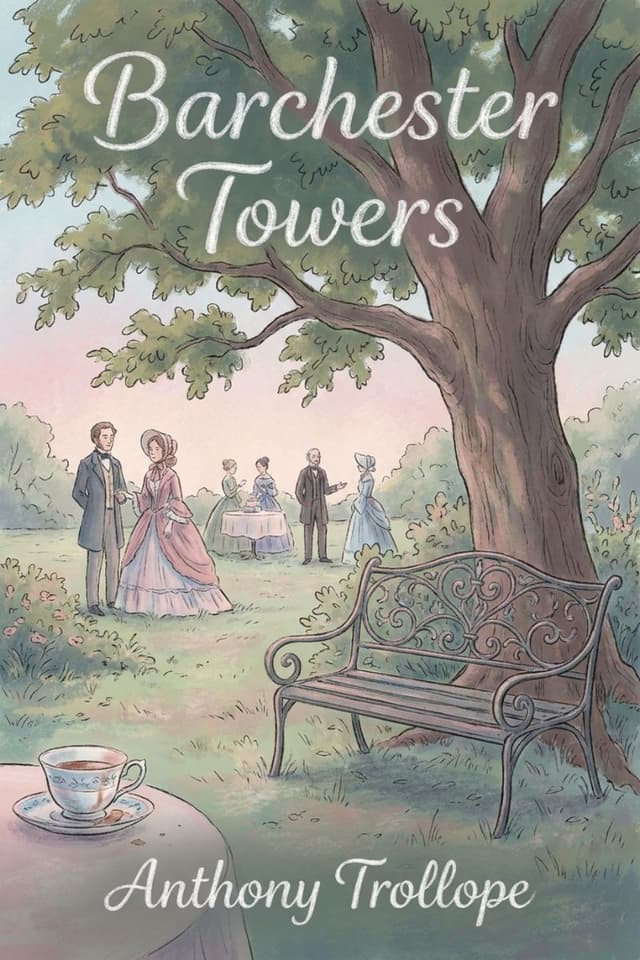
Barchester Towers
Read Barchester Towers by Anthony Trollope for free on Novelhalla, and try out our easy-to-read modern edition of this classic book. You can also download the EPUB and read it on any device if you prefer!
The Plot
A Bishop Lies Dying
In the sleepy cathedral city of Barchester, the old bishop is on his deathbed, and his son is having an awkward afternoon. Archdeacon Theophilus Grantly is a big, confident, worldly clergyman who has more or less been running the diocese for years. He loves his father. He also knows that if the old man dies while the current government is still in power, the Prime Minister will almost certainly make Grantly the next bishop. If the government falls first, the job goes to someone else.
The archdeacon sits by the bed, watching the clock and the political news at the same time, and hating himself a little for it. Then the timing goes badly wrong.
The New Regime
The new bishop is Dr. Proudie, a mild, ambitious man with modern ideas and no backbone whatsoever. The person actually in charge is his wife. Mrs. Proudie is a towering force of disapproval who wants to stamp out Sunday travel, launch Sabbath schools, and generally whip the lazy, comfortable clergy of Barchester into shape. She considers the cathedral close her personal kingdom.
Close behind them comes the bishop's chaplain, the Reverend Obadiah Slope. He's oily, ambitious, and has a damp handshake and a very high opinion of himself. Slope is supposed to be Mrs. Proudie's right-hand man, but he quickly realizes that whoever controls the bishop controls Barchester, and he'd much rather it was him.
Slope's very first sermon in the cathedral is a direct attack on everything the old clergy hold dear. Archdeacon Grantly is purple with rage. War has been declared.
Caught in the Middle
Gentle old Mr. Septimus Harding just wants his old job back. He used to be the warden of Hiram's Hospital, a charity home for elderly men, until a scandal pushed him out years before. Now the position is open again, and everyone assumes it's his. But Mr. Slope and Mrs. Proudie both have their own ideas about who should get it and what strings should be attached.
Then there's Mr. Harding's daughter Eleanor Bold, a young widow with a baby boy and, more importantly as far as certain gentlemen are concerned, a comfortable fortune of her own. Mr. Slope has noticed her. So has someone else. And the archdeacon, who is married to Eleanor's sister, is horrified by the idea that she might be giving the enemy any encouragement at all.
The Stanhopes Come Home
As if Barchester weren't chaotic enough, the bishop summons home one of his clergymen, Dr. Vesey Stanhope, who has spent the last dozen years living in Italy and catching butterflies instead of doing his job. The doctor arrives with his family, and they're something else entirely.
There's his son Bertie, a charming, penniless sculptor who's never finished anything in his life. There's his sharp, practical daughter Charlotte, who runs the whole household. And there's his younger daughter Madeline, the Signora Vesey Neroni, a dazzling beauty with a mysterious husband back in Italy and a mysterious injury that keeps her lying on a sofa wherever she goes. From that sofa she manages to bewitch nearly every man in Barchester, clergy included, for her own amusement.
Battle Lines
The archdeacon calls in reinforcements: Mr. Arabin, a brilliant Oxford scholar and debater who's exactly the man to take Slope down a peg. But Mr. Arabin turns out to have problems of his own he never expected to face in Barchester.
Meanwhile, a garden party at the old country estate of Ullathorne is about to bring everyone together in one place: the Proudies, the Grantlys, the Stanhopes, Slope, Arabin, Eleanor, and half the county. And then another important position in the cathedral suddenly opens up. Every ambitious man in Barchester starts scrambling, every alliance starts shifting, and nobody can quite tell who is plotting against whom.
About the Author: Anthony Trollope
A Miserable Boyhood
Anthony Trollope was born in London in 1815. His father was a brilliant but bad-tempered barrister whose career and finances collapsed, and the family slid steadily into debt. Anthony was sent to the expensive schools at Harrow and Winchester, where he was poor, shabby, and bullied mercilessly. He later described his school years as a time of total misery and loneliness.
The family was rescued by his mother, Frances Trollope, who started writing in her fifties to keep everyone fed. Her book Domestic Manners of the Americans was a bestseller, and she went on to write dozens more. When the debts finally caught up with them, the family fled to Belgium to escape creditors.
The Post Office
At nineteen, Trollope took a junior clerk's job at the General Post Office in London. He was terrible at it: late, sloppy, and constantly in trouble. His life turned around in 1841 when he was sent to Ireland as a postal surveyor's clerk. There, for the first time, he was good at his job. He took up fox hunting, which became a lifelong passion, and in 1844 he married Rose Heseltine.
Trollope stayed with the Post Office for more than thirty years, rising to a senior position. He's often credited with helping introduce the red pillar box to Britain, the freestanding mailbox you still see on British streets today.
The Writer
Trollope's first few novels were failures. By the end of 1857, he'd earned a grand total of £55 for ten years of writing. His fortunes changed with the Barchester novels, which grew into a six-book series, and then with his political Palliser novels.
He was famously disciplined. He woke before dawn, put his watch on the desk, and wrote a set number of words every fifteen minutes before heading off to his day job. He wrote on trains, on ships, and anywhere else he could find a spare moment. All told, he published forty-seven novels plus travel books, short stories, and biographies.
Final Years
Trollope left the Post Office in 1867 and tried his hand at politics, running unsuccessfully for Parliament. He traveled widely, writing about America, Australia, and South Africa. He died in London in December 1882 after a stroke.
His Autobiography, published the year after his death, revealed his clockwork writing routine and his frank interest in how much money his books earned. Some readers were scandalized that a novelist would treat his art like a business, and his reputation dipped for a while. By the twentieth century, though, he was firmly back in favor as one of the great Victorian novelists.
Fun Facts About the Book
A Sequel to a Short Book
This is the second novel in the Chronicles of Barsetshire. It picks up a few years after The Warden, a much shorter book about Mr. Harding and Hiram's Hospital. You don't need to read The Warden first, but the backstory of Mr. Harding's lost job comes from there.
It Grew Because the First Book Sold
Trollope began the novel in 1855 and set it aside. When sales of The Warden unexpectedly picked up, he went back to it with bigger plans, expanding it into a full three-volume novel and inventing new characters like the Stanhopes, Mr. Arabin, and the Thornes of Ullathorne along the way.
Written in Pencil on Trains
Trollope spent huge amounts of time traveling by rail for the Post Office, so he rigged up a portable writing desk and wrote in pencil as the train rolled along. His wife Rose then copied out the pages in ink. Most of this novel was written that way.
The Publisher's Reader Hated It
When Trollope submitted the manuscript, the publisher's reader wrote a scathing report complaining about the book's vulgarity and exaggeration and claiming it didn't even have a plot. At one point the publisher wanted it cut by a third. Trollope made a few small changes, but the book was largely published as he wrote it.
Trollope Loved Writing It
In his autobiography, Trollope said he took great delight in writing this book and that the bishop and Mrs. Proudie felt completely real to him. Mrs. Proudie became one of his most famous creations, and she pops up again throughout the later Barsetshire novels.
The Narrator Talks to You
Trollope's narrator constantly breaks in to chat with the reader, share opinions, poke fun at the characters, and even discuss how novels are supposed to work. Some critics found it annoying, but many readers love the feeling of having a witty, opinionated friend telling them the story.
A Real Church Feud
Behind the comedy is a real fight that was raging in the Church of England at the time. The traditional High Church clergy, who loved ritual, music, and old customs, were at war with the Evangelicals, who wanted plainer services and stricter morals. Trollope turns that national argument into a very personal brawl inside one small cathedral town.
The Most Famous Sofa in Literature
One of the book's best-loved scenes takes place at Mrs. Proudie's first grand reception, where a sofa, a long dress, and an overeager guest combine into one of the great slapstick moments in Victorian fiction.
Many Readers' Favorite
Of all Trollope's dozens of novels, this is the one that most people start with and the one most often named as a favorite. The Guardian included it on its list of a thousand novels everyone must read.
Historical Context
In Victorian England, the Church of England was a big part of public life and a big employer of educated gentlemen. Bishops were appointed by the Prime Minister, which meant that church jobs could hinge on which political party happened to be in power. That's why the timing of the old bishop's death matters so much in the opening chapters.
Church positions also came with houses, incomes, and social standing, and many were awarded through patronage and connections rather than merit. Understanding that a deanship or a wardenship could mean a comfortable life makes it easier to see why so many otherwise respectable clergymen in the novel are willing to scheme for them.
Themes
Ambition and Power
Almost everyone in Barchester wants something: a promotion, a wife, a better house, control of the bishop. Trollope has a wonderful time showing how ambition makes even religious men petty, scheming, and ridiculous, and how ordinary human vanity creeps into the holiest places.
Old Ways Versus New
The Proudies and Mr. Slope represent reform, efficiency, and change. The Grantlys and Mr. Harding represent tradition, comfort, and the way things have always been done. Trollope doesn't make either side perfect, and part of the fun is seeing how both sides get it wrong.
Hypocrisy
Many characters claim to act purely from principle while really looking out for themselves. Mr. Slope in particular preaches strict morality while pursuing his own interests with great energy. The book is full of the gap between what people say and what they really want.
Integrity and Gentleness
In the middle of all the scheming stands Mr. Harding, a kind, humble man who'd rather lose than fight dirty. The novel quietly asks whether goodness like his can survive in a world full of ambitious people, and whether it's worth more than winning.
Love and Money
Eleanor's fortune makes her very attractive to certain suitors, and the question of who loves her and who loves her money runs through the whole book. Trollope is honest about how money shapes romance, and funny about it too.
Misunderstanding
Many of the book's conflicts come from people assuming the worst, jumping to conclusions, and being too proud to ask a simple question. Some of the most frustrating and entertaining moments come from characters who could clear everything up with one honest conversation but just won't have it.
The Book's Legacy
This novel made Trollope's name and turned Barchester into one of the most beloved fictional places in English literature. The Barsetshire series eventually ran to six novels, and its gallery of clergy, gentry, and scheming wives became the model for the cozy, gossipy English village novel that writers have been borrowing ever since.
Mrs. Proudie and Mr. Slope in particular became famous character types. People still use "Mrs. Proudie" to describe a domineering wife who runs her husband's business, and "Slope" has become shorthand for a slippery, ingratiating schemer.
In 1982 the BBC adapted this novel and The Warden as The Barchester Chronicles, a much-loved miniseries starring Donald Pleasence as Mr. Harding, Nigel Hawthorne as Archdeacon Grantly, and a young Alan Rickman as Mr. Slope. It was Rickman's breakout role, and many fans think his slippery, oily chaplain is one of the best villains in television history.
Trollope has also had a long run as the favorite novelist of British politicians and prime ministers, who appreciate his sharp understanding of ambition, committees, and office politics. More than a hundred and fifty years later, anyone who has ever worked in an office full of power struggles will recognize Barchester instantly.