Novelhalla
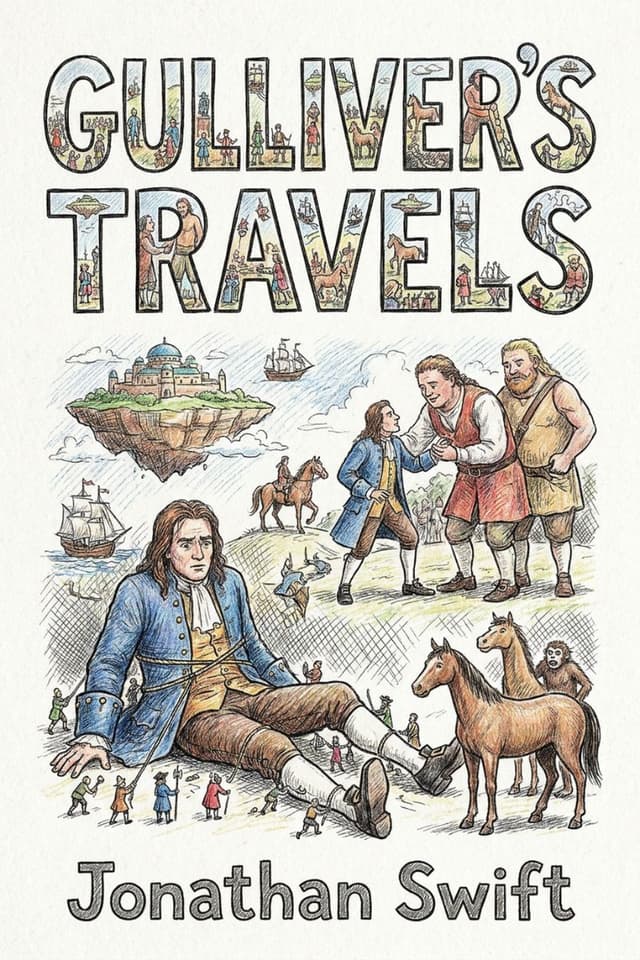
Gulliver's Travels
Read Gulliver's Travels by Jonathan Swift for free on Novelhalla, and try out our easy-to-read modern edition of this classic book. You can also download the EPUB and read it on any device if you prefer!
The Plot
Lemuel Gulliver is a practical man. Trained as a surgeon, educated at Cambridge and Leiden, he has a wife and children in London and a perfectly respectable career ahead of him. But respectable careers do not pay well enough, and Gulliver has a restless streak, so he keeps taking positions as a ship's surgeon on merchant vessels bound for distant seas. This habit will ruin his life in ways he cannot begin to imagine.
Part I: A Voyage to Lilliput
On a voyage to the East Indies, Gulliver's ship founders in a storm and he washes ashore on an unknown island. He wakes to find himself tied to the ground by hundreds of tiny threads, surrounded by people no taller than six inches. He has arrived in Lilliput.
The Lilliputians are initially terrified of this mountain of a man, but they are also organized, efficient, and remarkably brave. They feed him (it takes the output of several hundred kitchens to manage a single meal), house him in their largest building (an abandoned temple), and eventually bring him before their Emperor. Gulliver, flattered by royal attention and grateful for the hospitality, does his best to be useful. He is given his liberty on certain conditions, including that he not leave the country without permission and that he assist in the defense of the realm.
The defense in question concerns Blefuscu, a neighboring island nation with which Lilliput has been at war for generations. The cause of this war is a matter of the utmost seriousness: which end of a boiled egg should be cracked open first. The Big-Endians and the Little-Endians have fought six rebellions over this question. An emperor lost his life. Another lost his crown. Thousands have chosen death rather than submit to cracking their eggs on the wrong end. The religious establishment has weighed in with scriptural interpretations supporting both positions. It is, in short, a perfect portrait of how civilizations actually go to war.
Gulliver wades across the channel between the islands and captures the entire Blefuscudian fleet by tying the ships together and towing them back to Lilliput. The Emperor is delighted and awards Gulliver the highest honor in the land. But when Gulliver refuses to help the Emperor conquer and enslave Blefuscu entirely, royal favor begins to cool.
Things deteriorate further when a fire breaks out in the royal palace. Gulliver, in desperation, extinguishes it by the most expedient means available to a giant: he urinates on it. The palace is saved, but the Empress is not amused, and the court faction that already resents Gulliver's influence seizes on the offense. He learns that the government is drawing up articles of impeachment against him, proposing that he be blinded and then slowly starved to death. The prosecution considers this lenient.
Gulliver flees to Blefuscu, finds a human-sized boat washed ashore, repairs it, and sails home to England. He has been away less than two years. His family is glad to see him.
Part II: A Voyage to Brobdingnag
Two months later, Gulliver is at sea again. This time his ship is blown off course to an unknown land where everything is reversed: the inhabitants are giants, roughly sixty feet tall, and Gulliver is the tiny creature.
A farmer discovers him in a field and brings him home, where Gulliver becomes a novelty and then a source of income. The farmer's young daughter, Glumdalclitch, takes charge of him with genuine tenderness, building him a small bed and carrying him everywhere in a box. But the farmer, sensing profit, begins exhibiting Gulliver at markets and fairs like a performing animal, working him to near exhaustion. When Gulliver's health begins to fail, the farmer sells him to the Queen.
Life at court is more comfortable but no less humiliating. Gulliver is a living toy, a curiosity to be passed around and marveled at. The court dwarf, no longer the smallest person in the palace and jealous of the attention Gulliver receives, torments him at every opportunity, once dropping him into a bowl of cream. Wasps the size of partridges menace him. A monkey kidnaps him and carries him across the rooftops. Hailstones that are merely annoying to the Brobdingnagians nearly kill him.
But the most devastating encounters are intellectual. The King of Brobdingnag, a thoughtful and well-read ruler, takes an interest in Gulliver and invites him to describe the institutions of England. Gulliver obliges with patriotic enthusiasm, explaining the workings of Parliament, the legal system, the military, and the economy. The King listens carefully, asks pointed questions, and delivers a verdict that Gulliver will never forget: from everything Gulliver has described, the King concludes that the English must be the most vile race of vermin ever to crawl upon the surface of the Earth.
Gulliver is baffled. He tries to recover by offering to share the secret of gunpowder, describing in enthusiastic detail how the King might use cannons and bombs to demolish entire cities and maintain absolute power. The King is horrified and forbids the subject from ever being raised again. Gulliver privately concludes that the Brobdingnagians, for all their size and good nature, are hopelessly unsophisticated.
His departure from Brobdingnag is accidental: an eagle snatches his traveling box from the beach and drops it into the sea, where a passing ship rescues him. Back in England, Gulliver finds himself astonished by how tiny everyone looks.
Part III: A Voyage to Laputa, Balnibarbi, Glubbdubdrib, Luggnagg, and Japan
Gulliver's third voyage is the most episodic. After pirates set him adrift in a canoe, he is rescued by the inhabitants of Laputa, a floating island that hovers over the land below by means of a giant magnet. The Laputans are so absorbed in abstract mathematics and theoretical music that they require servants called "flappers" to swat them with bladders to remind them to speak or listen during conversation. They are brilliant in theory and catastrophically incompetent in practice. Their houses are badly built because they disdain applied geometry. Their clothes do not fit because they take measurements using astronomical instruments rather than tape measures.
Below Laputa lies Balnibarbi, where the Laputans' theories have been put into practice with ruinous results. Gulliver visits the Grand Academy, where researchers are attempting to extract sunlight from cucumbers, turn excrement back into food, build houses from the roof down, and breed naked sheep. None of these projects are working, but funding continues.
On the island of Glubbdubdrib, Gulliver encounters a sorcerer who can summon the spirits of the dead. Gulliver calls up historical figures and is dismayed to learn that most of history as written is a lie. Great heroes turn out to be cowards, celebrated statesmen turn out to be fools, and the noblest acts in the record books were actually motivated by greed or spite.
On Luggnagg, Gulliver learns of the Struldbrugs, beings who are born immortal. At first he is thrilled, imagining the wisdom and perspective that centuries of life would bring. Then he meets them. The Struldbrugs do not remain young; they simply cannot die. They grow old, senile, sick, and miserable, stripped of their property at eighty, unable to communicate with younger generations whose language has evolved past recognition, living on in perpetual wretchedness. Immortality without youth is not a blessing but a curse.
Part IV: A Voyage to the Country of the Houyhnhnms
The final voyage changes everything. Gulliver sets out as captain of his own ship, but his crew mutinies and abandons him on an unknown shore. He is immediately attacked by a tribe of filthy, savage, apelike creatures who throw their own excrement at him. These are the Yahoos.
Then he meets their masters: the Houyhnhnms, a race of horses who possess reason, language, and a harmonious civilization. The Houyhnhnms have no concept of lying, which they call "the thing which is not." They have no wars, no crime, no lawyers, no politicians, and no poverty. They govern themselves through gentle consensus. They are everything that Gulliver has been taught to admire in human civilization, except they are not human. They are horses. And the bestial Yahoos, it becomes increasingly and horribly clear, are human beings.
Gulliver's Houyhnhnm master takes an interest in him, recognizing that this particular Yahoo seems different from the others. He wears clothes, he can reason, he can speak. Gulliver, desperate to distinguish himself from the Yahoos, begins explaining human civilization. He describes warfare, law, medicine, money, and government. His master listens and concludes, with perfect equine logic, that humans are essentially Yahoos with just enough reason to make their natural vices more dangerous.
Gulliver, instead of defending humanity, finds himself agreeing. The longer he lives among the Houyhnhnms, the more he despises his own species. He begins to walk like a horse. He speaks in whinnies. He cannot bear the smell of other humans. When the Houyhnhnms' assembly decides that Gulliver must leave, because he is after all a Yahoo regardless of his clothes and conversation, he is devastated.
A kindly Portuguese sea captain rescues Gulliver and treats him with patience and compassion, but Gulliver can barely stand to be in the same room with him. He returns to England unable to tolerate the company of his own wife and children. He buys two horses and spends his time in the stable, talking to them. He can endure looking at his reflection in a mirror only with difficulty.
About the Author
Jonathan Swift was born on November 30, 1667, in Dublin, Ireland, seven months after the death of his father. This posthumous beginning set the tone for a life marked by displacement, frustrated ambition, and a talent for anger that he refined into the sharpest satirical prose in the English language.
Swift's childhood was unstable. His father, an Englishman who had settled in Dublin to practice law, left his widow and children dependent on relatives. An English nurse reportedly carried the infant Jonathan across the Irish Sea to Whitehaven without his mother's knowledge and kept him there for nearly three years. He was eventually returned and educated at Kilkenny Grammar School, then the best in Ireland, before attending Trinity College Dublin. He was not a distinguished student.
The Glorious Revolution of 1688 threw Ireland into upheaval and drove Swift to England, where he entered the household of Sir William Temple, a retired diplomat and man of letters, at Moor Park in Surrey. For the next decade, on and off, Swift served as Temple's secretary, read voraciously in his patron's library, and began to write. It was at Moor Park that he met Esther Johnson, the daughter of Temple's housekeeper. She was eight years old. Swift became her tutor and gave her the name "Stella." Their relationship, which lasted the rest of her life, remains one of the great mysteries of literary biography. Some believe they were secretly married in 1716. Others find the idea absurd. What is certain is that Swift persuaded Stella and her companion Rebecca Dingley to move to Ireland to be near him, and that they remained close until her death in 1728.
Swift was ordained as an Anglican priest in 1695 and spent years seeking advancement in the church, believing his literary talents and political services entitled him to a bishopric in England. He was disappointed. His early satirical masterpiece A Tale of a Tub (1704), which attacked corruption in religion and learning, offended Queen Anne, who found it blasphemous and blocked his promotion. When the Tories came to power in 1710, Swift threw himself into political journalism on their behalf, editing their newspaper The Examiner and producing devastating pamphlets against the Whigs. He became an insider, privy to the highest councils of government, recording his experiences in the Journal to Stella, a remarkable series of letters to Esther Johnson.
But the Tories fell in 1714, and Swift's political career crashed with them. The best his friends could manage was the Deanery of St. Patrick's Cathedral in Dublin, a position Swift regarded as exile. He returned to Ireland embittered, feeling like, as he put it, "a rat in a hole."
During his years in London, Swift had also become entangled with another Esther: Esther Vanhomrigh, a young woman who fell passionately in love with him. Swift gave her the name "Vanessa," a name he invented and which has been used ever since. He wrote a long poem, Cadenus and Vanessa, attempting to explain why he could not return her feelings. She followed him to Ireland and died there in 1723, apparently heartbroken. The full nature of Swift's relationships with Stella and Vanessa has never been satisfactorily explained.
In Ireland, Swift reinvented himself as a champion of Irish interests against English exploitation. His Drapier's Letters (1724-1725) rallied the public against a debased coinage being imposed on Ireland and made him a popular hero. In 1729, he published A Modest Proposal, suggesting with perfect deadpan gravity that the children of the Irish poor should be fattened and sold as food to wealthy English landlords. It remains the most famous work of satirical prose ever written in English.
Gulliver's Travels was composed between roughly 1720 and 1725, during what should have been a fallow period. Swift claimed he wrote it "to vex the world rather than divert it." He smuggled the manuscript to a London publisher in 1726, taking elaborate precautions to conceal his authorship, including having the manuscript copied so his handwriting could not be used as evidence. The publisher, Benjamin Motte, used five different printing houses to speed production and softened some of the most politically dangerous passages. The book was an immediate sensation, selling out its first edition within a week.
Swift's final years were grim. Stella's death in 1728 devastated him. He had long suffered from Meniere's disease, a disorder of the inner ear that caused chronic vertigo and nausea, and as he aged, his memory deteriorated. By 1742, he was unable to care for himself, and guardians were appointed to manage his affairs. He suffered a stroke that left him unable to speak. He died on October 19, 1745, at the age of seventy-seven.
He was buried beside Stella in St. Patrick's Cathedral, beneath an epitaph he composed himself in Latin. William Butler Yeats later offered this translation: "Swift has sailed into his rest; / Savage indignation there / Cannot lacerate his breast." He left most of his estate to found a hospital for the mentally ill, which still operates in Dublin today.
Fun Facts
-
The book was published as a hoax. The first edition appeared under the title Travels into Several Remote Nations of the World with the author listed as "Lemuel Gulliver, First a Surgeon, and then a Captain of Several Ships." A frontispiece portrait of the fictional Gulliver was included, and a preface by his equally fictional cousin "Richard Sympson" vouched for the manuscript's authenticity. Swift's name appeared nowhere.
-
It was an instant bestseller. The poet John Gay wrote to Swift that the book was "universally read, from the cabinet council to the nursery." The first edition sold out within a week. Readers debated whether Gulliver was real, and Swift received letters addressed to Captain Gulliver.
-
The publisher censored it. Benjamin Motte, fearing prosecution, cut or altered the most politically inflammatory passages before publication. Swift was furious. When a Dublin publisher brought out a new edition in 1735, Swift restored his original text, including passages that directly satirized the English court.
-
Swift invented the name "Vanessa." In his poem Cadenus and Vanessa, Swift created the name from his lover Esther Vanhomrigh's surname. The name had never existed before. It has since become one of the most popular women's names in the English-speaking world.
-
"Yahoo" entered the English language. Swift's word for the bestial humanoids has been in continuous use since 1726 as a term for a rude, uncouth, or brutish person. The Oxford English Dictionary traces it directly to Gulliver's Travels.
-
So did "Lilliputian." Meaning anything very small, the word has been used in English for three centuries. "Brobdingnagian," meaning very large, also entered the dictionary, though it gets far less use.
-
Computer scientists borrowed his egg joke. In 1980, Danny Cohen published a paper on computer architecture that borrowed Swift's "Big-Endian" and "Little-Endian" terminology to describe two methods of ordering bytes in memory. The terms are now standard in the field, and most programmers who use them have no idea they come from a satire about cracking eggs.
-
Swift may have predicted the moons of Mars. In Part III, Laputan astronomers are described as having discovered two moons orbiting Mars. When two Martian moons were actually discovered in 1877, over 150 years later, the coincidence stunned astronomers. Swift's description of their orbital periods was not accurate, but the fact that he guessed the number correctly remains remarkable.
-
The book has never been out of print. Continuously available since 1726, Gulliver's Travels is one of the longest-running bestsellers in the English language, nearly three centuries and counting.
-
Swift suffered from a misunderstood illness. His chronic vertigo and nausea, caused by Meniere's disease, led later biographers to claim he was insane. Victorian critics, particularly those hostile to his politics, used this myth to dismiss his work as the ravings of a madman. Modern medicine has entirely debunked this interpretation.
-
The Struldbrugs predicted a modern anxiety. Swift's immortal but endlessly aging beings, who grow senile and decrepit but can never die, anticipated debates about life extension and the quality of life in extreme old age that have only become more relevant with advances in medicine.
Themes
The Corruption of Power. Every society Gulliver visits demonstrates how power deforms those who hold it. The Emperor of Lilliput, who is six inches tall and rules over an island, behaves with exactly the same tyrannical impulses as any full-sized despot. The Laputans use their floating island to crush dissent below. Even the benevolent Houyhnhnms exercise a kind of gentle totalitarianism in their treatment of the Yahoos. Swift suggests that the appetite for domination does not depend on scale or species; it is woven into the fabric of organized society.
Perspective and Self-Knowledge. The book's great structural trick is that Gulliver's size changes from voyage to voyage, forcing him to see the world from radically different angles. Among the Lilliputians, he is a god. Among the Brobdingnagians, he is a bug. Yet Gulliver never really absorbs the lesson. He remains convinced of his own importance and the superiority of his civilization, even as every encounter exposes its absurdity. Swift is asking whether humans are capable of genuine self-awareness, or whether we are constitutionally incapable of seeing ourselves clearly.
Reason Versus Passion. The Houyhnhnms live entirely by reason and have created a harmonious society. The Yahoos live entirely by appetite and are degraded animals. Gulliver, like all humans, is caught between these poles. Swift leaves the reader with an uncomfortable question: is human reason actually a tool of civilization, or merely a more efficient way of pursuing the same brutish desires that drive the Yahoos?
The Failure of Institutions. Governments, academies, courts, churches: every institution Gulliver encounters is either corrupt, absurd, or both. Lilliputian politics are driven by factional hatred over trivial differences. The Laputan academy wastes resources on impossible projects. The legal system Gulliver describes to the King of Brobdingnag is a machine for rewarding the dishonest. Swift's target is not any particular institution but the human tendency to build systems that claim to serve justice and knowledge while actually serving vanity and greed.
The Danger of Misanthropy. By the end of his voyages, Gulliver has become a misanthrope who cannot bear the company of his own family. Swift does not present this as admirable. Gulliver's final state, talking to horses in a stable while his wife eats dinner alone, is pathetic rather than noble. The book warns that seeing through the illusions of civilization can be just as dangerous as believing them, that total disillusionment is its own form of madness.
The Book's Legacy
Gulliver's Travels was a phenomenon from the moment of its publication in October 1726. The first edition sold out within a week. Within months, unauthorized editions, translations, and sequels were appearing across Europe. Everyone read it, as John Gay noted, from government ministers to children, though children and ministers were taking quite different things from it.
The book's peculiar genius is that it works on two entirely separate levels. As a children's adventure, particularly the Lilliput section, it is one of the most beloved stories in English literature, endlessly adapted, illustrated, and retold. As an adult satire, it is one of the most savage, a systematic demolition of human vanity, institutional corruption, and the pretensions of civilization that loses none of its force three centuries later.
The influence on literature has been enormous. Gulliver's Travels helped establish satire as a legitimate mode of prose fiction and contributed to the emergence of the novel as a literary form. Voltaire's Candide (1759) owes a clear debt to Swift's method of using fantastical voyages to expose real-world absurdity. The tradition of dystopian fiction, from Samuel Butler's Erewhon (1872) through George Orwell's Animal Farm (1945) and Nineteen Eighty-Four (1949), traces a direct line back to Swift's imagined societies.
Swift's inventions have embedded themselves in the English language itself. "Lilliputian," "Brobdingnagian," and "Yahoo" are dictionary entries. The Big-Endian and Little-Endian dispute gave computer science its standard terminology for byte ordering. The very word "Swiftian" describes a particular kind of deadpan, merciless satire that the world had not quite seen before he demonstrated it.
The novel has been adapted relentlessly: silent films, animated cartoons, television specials, Hollywood productions, radio plays, stage musicals, and graphic novels. Most adaptations focus on the first two voyages and soften the satire considerably. The darker material of Parts III and IV, which is where Swift's vision is most disturbing and most original, is usually omitted or diluted. This has contributed to the widespread misconception of Gulliver's Travels as a children's book, which would have disgusted Swift and probably did not surprise him.
Modern readers who come to the full text for the first time are often startled by how dark, how funny, and how relevant it remains. The Lilliputian wars over eggs still describe how nations find reasons to destroy each other. The Laputan academy still describes how institutions waste resources on theoretical fantasies while practical problems go unsolved. The Struldbrugs still describe the horror of longevity without health. And Gulliver, talking to horses in his stable because he can no longer stand the smell of other people, still describes what happens when disillusionment goes all the way to the bottom.