Novelhalla
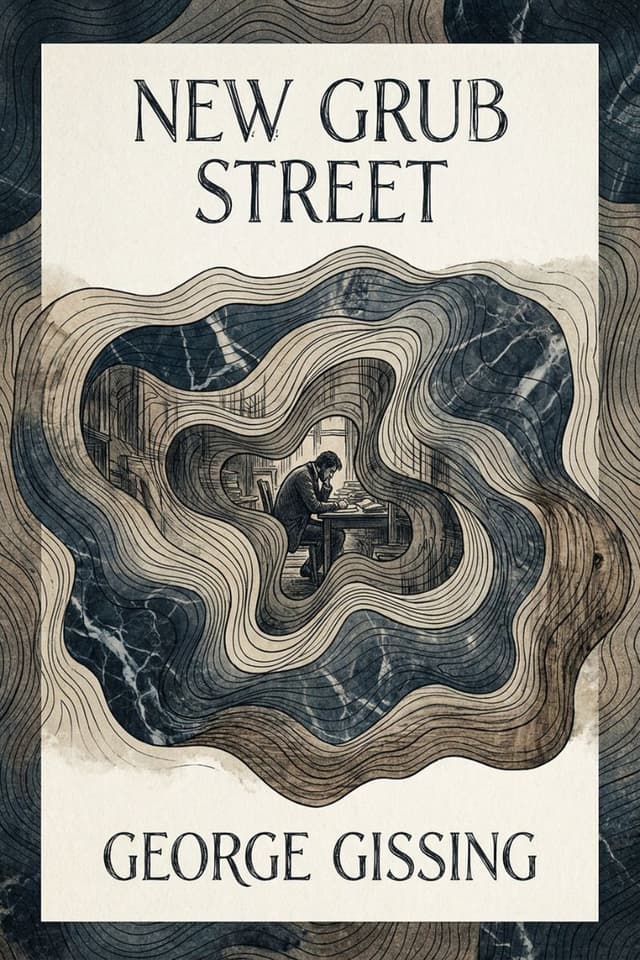
New Grub Street
Read New Grub Street by George Gissing for free on Novelhalla, and try out our easy-to-read modern edition of this classic book. You can also download the EPUB and read it on any device if you prefer!
The Plot
New Grub Street is a novel about writers struggling to survive in the literary marketplace of 1880s London, where commercial success and artistic integrity are locked in bitter conflict.
Two Kinds of Writers
The novel contrasts two young men making their way in the world of letters. Jasper Milvain is a journalist who understands exactly how the modern literary marketplace works. He is ambitious, pragmatic, and openly mercenary about his craft. "Literature nowadays is a trade," he declares in the novel's opening pages. "Your successful man of letters is your skilful tradesman. He thinks first and foremost of the markets."
Edwin Reardon is everything Milvain is not. A novelist of genuine talent, Reardon achieved modest critical success with his early books but finds himself increasingly unable to write the kind of fiction that sells. He is shy, cerebral, and constitutionally incapable of compromising his artistic standards for commercial gain. Where Milvain sees opportunity in the changing publishing industry, Reardon sees only degradation.
A Marriage Under Strain
Reardon's troubles are compounded by his marriage to Amy Yule, a woman who married him believing he would become a successful author. As Reardon's income dwindles and his creative powers fail, the marriage disintegrates. Amy cannot accept poverty and social decline. She watches her husband struggle to produce work he despises while refusing to take the practical steps that might rescue their finances.
The Reardons have a young son, Willie, but even the child cannot hold the marriage together. Amy eventually leaves, taking Willie to live with her mother. Reardon, broken in health and spirit, takes a clerk's position arranged by a friend, abandoning his literary ambitions entirely.
The Yule Family
Amy's relatives provide another window into the literary world. Her uncle Alfred Yule is an aging critic and scholar whose old-fashioned ideas about literature have left him bitter and unsuccessful. He is married to a working-class woman whose uneducated speech and manners embarrass him, preventing him from entertaining the publishers and critics who might advance his career.
Alfred's daughter Marian works as her father's research assistant, spending long hours in the British Museum reading room. She is intelligent, sensitive, and quietly devoted to her father's work. When Jasper Milvain meets Marian, he is attracted to her learning and spirit but troubled by her poverty. Milvain has already decided that he must marry a woman who can help his career.
When Marian unexpectedly inherits money from her uncle John Yule, Milvain sees his chance. He courts her, and they become engaged. But when the inheritance proves smaller than expected and Marian must use it to support her parents after her father begins to go blind, Milvain coldly breaks off the engagement.
Harold Biffen and the Realist Ideal
Reardon's closest friend is Harold Biffen, a writer even more unworldly than himself. Biffen lives in abject poverty, surviving by tutoring while working on his novel Mr. Bailey, Grocer, a rigorously realistic account of ordinary lower-class life. Biffen rejects all the conventions of popular fiction: romance, melodrama, exciting incident. He wants only to record life exactly as it is.
When his novel is finally published, it attracts little notice and earns almost nothing. Biffen has secretly fallen in love with Amy Reardon, but his love is hopeless. After Reardon's death and with no prospects of his own, Biffen takes his own life.
Milvain Triumphant
The novel ends with Milvain's complete success. After Reardon dies following a brief reconciliation with Amy, and after Amy inherits a substantial legacy from another uncle, Milvain courts and marries her. He secures an editorship and achieves the prosperity he always sought. The final scene shows Milvain and Amy, comfortable in their fashionable home, discussing poor Marian Yule's fate with something approaching pity.
About the Author: George Gissing
Early Promise
George Robert Gissing was born on November 22, 1857, in Wakefield, Yorkshire, the eldest of five children of Thomas Waller Gissing, who ran a chemist's shop. His father was an avid reader who encouraged George's studies, and by age ten the boy was reading Dickens. His father's death when George was thirteen marked the end of the family's comfortable life and sent the children to boarding school.
At fifteen, Gissing won a scholarship to Owens College in Manchester (later the University of Manchester), where his academic performance was brilliant. He won prizes in Greek, Latin, modern history, and mathematics. A career as a classical scholar seemed certain.
Scandal and Exile
Then disaster struck. Gissing fell in love with Marianne Helen Harrison, known as Nell, a young woman who had turned to prostitution. Desperate to help her, he began stealing money from the college cloakroom. He was caught, expelled, and briefly imprisoned with a sentence of hard labor.
With his academic career destroyed, Gissing sailed to America in 1876. He spent time in Boston and Chicago, where he earned a precarious living writing short stories for newspapers, including the Chicago Tribune. He lived in poverty until he found work demonstrating products for a traveling salesman. These experiences of literary struggle and financial desperation would later inform New Grub Street.
Two Unhappy Marriages
Gissing returned to England in 1877 and married Nell, hoping to reform her. The marriage was a disaster. Nell continued drinking heavily, and Gissing eventually placed her in an institution. She died of alcoholism in 1888.
His first novel, Workers in the Dawn, was rejected by publishers. Gissing published it himself in 1880, funding it with a small inheritance. It failed completely. Over the following decade, he wrote novel after novel while supporting himself by tutoring, earning pitifully small sums for his work: thirty pounds for one book, fifteen for another.
In 1891, the same year New Grub Street appeared, Gissing married again. His second wife, Edith Underwood, was another working-class woman, and this marriage also proved unhappy. They had two sons, but the relationship was marked by constant strife. They eventually separated in 1897, and Edith was later committed to an asylum.
Recognition and Decline
The 1890s brought Gissing greater recognition. By the end of the decade, critics ranked him alongside Thomas Hardy and George Meredith as one of the three leading novelists in England. He befriended other writers, including H.G. Wells, and his work began to earn better money.
But his health was failing. He had developed emphysema, and in 1898 he left England for the warmer climate of France. There he met Gabrielle Fleury, a cultured Frenchwoman who translated his work. They lived together as husband and wife, though Gissing could not legally marry while Edith lived.
His final years were the most comfortable he had known, spent writing in the south of France with a companion who understood and appreciated his work. His autobiographical fantasy The Private Papers of Henry Ryecroft, published in 1903, imagines a struggling writer who inherits money and retires to peaceful contemplation in the English countryside.
George Gissing died on December 28, 1903, at the age of forty-six. H.G. Wells traveled to be with him in his final days. He was buried in France but remained, in his imagination, always connected to the English literary world he had depicted so unflinchingly.
Fun Facts About the Book
Written at Breakneck Speed
Gissing wrote New Grub Street in just two months, from October to December 1890. He delivered the finished manuscript to his publishers before the end of the year, and it was in print by April 1891. This rapid composition is ironic given that the novel's protagonist, Edwin Reardon, is tormented by his inability to write quickly.
The Title's Historical Reference
Grub Street was a real London street in the Cripplegate area, known in the eighteenth century as the home of impoverished hack writers, cheap publishers, and literary drudges. Samuel Johnson defined it in his Dictionary as a street "much inhabited by writers of small histories, dictionaries, and temporary poems." By Gissing's time, the actual street had been renamed Milton Street, but "Grub Street" remained a byword for the desperate world of writing for money.
Gissing's Own Experience
The novel draws heavily on Gissing's personal knowledge of literary poverty. Like Reardon, he had struggled for years to earn a living from his writing. His payments for novels ranged from fifteen pounds to one hundred and fifty pounds, amounts that barely covered living expenses. For New Grub Street itself, he received two hundred and fifty pounds, his best payment yet.
George Orwell's Favorite
George Orwell, himself a struggling writer, championed Gissing throughout his life. In a 1943 essay, Orwell called Gissing "perhaps the best novelist England has produced" and described New Grub Street as "the most impressive" of his books, as well as "an upsetting and demoralising book." Orwell's own novel Keep the Aspidistra Flying, about a writer who renounces commercial success, shows clear influence from Gissing's work.
A Small First Printing
New Grub Street's first print run was between five hundred and seven hundred and fifty copies, most of which went to circulating libraries like Mudie's. The novel was published in the standard Victorian format of three volumes, priced at thirty-one shillings and sixpence, far too expensive for most readers to buy. Instead, they borrowed it from lending libraries, the system Gissing himself criticized in the novel.
The Three-Volume Problem
Much of the novel concerns the tyranny of the "triple-decker" format. Publishers demanded three-volume novels because circulating libraries paid more for them. This forced writers to pad their work and produced what Gissing saw as formulaic, repetitive fiction. The system collapsed just a few years after New Grub Street appeared, replaced by cheaper single-volume editions.
Adapted for Radio
New Grub Street has been adapted three times for BBC Radio 4, in 1972, 2002, and 2016. A long-running BBC Radio 4 comedy series, Ed Reardon's Week, takes its main character's name directly from Gissing's novel and depicts a modern struggling writer facing similar frustrations.
Influence on Later Writers
Edith Wharton's The House of Mirth (1905) was influenced by New Grub Street's treatment of economic precarity among the genteel classes. Wharton adopted Gissing's phrase "the relatively poor" to describe characters who have enough to seem respectable but not enough to be secure.
Themes
Art Versus Commerce
The central conflict of New Grub Street is between writing as art and writing as trade. Reardon believes that literature should express truth and beauty, that a writer should produce only work of which he can be proud. Milvain believes that writing is simply a commodity to be manufactured and sold. The novel does not simply take Reardon's side. It shows how his artistic ideals, however noble, doom him in a marketplace that rewards only commercial success.
The Economics of Writing
Gissing provides extraordinary detail about the financial realities of Victorian authorship: how much writers were paid, whether in lump sums or royalties; how the circulating library system worked; what it cost to maintain a middle-class life in London. Money, and the lack of it, drives every plot development. Characters marry for money, break engagements over money, and die for lack of money.
Class and Marriage
Nearly every character in the novel struggles with the relationship between marriage and class. Reardon marries a woman who expects him to maintain a middle-class standard of living. Alfred Yule is ashamed of his working-class wife. Milvain coldly calculates that he must marry money. Gissing shows marriage not as romance but as economic arrangement, with love a luxury few can afford.
The Rise of Mass Media
The novel depicts a publishing industry in transformation. Traditional three-volume novels are giving way to shorter works. Serious journals are being displaced by magazines aimed at readers with short attention spans. Whelpdale's new publication, Chit-Chat, promises articles no longer than two inches because "their attention can't sustain itself beyond two inches." Gissing sees this as cultural decline, the triumph of vulgarity over literature.
Poverty and the Writer's Life
Gissing depicts poverty not as picturesque bohemianism but as grinding misery. Harold Biffen lives in a room so cramped he can barely stand upright, eating bread bought with his last pennies. Reardon watches his marriage collapse because he cannot afford coal. The novel insists that poverty destroys creativity, that no one can write well while worrying about the rent.
The Woman Question
Although not its central focus, the novel addresses the limited options available to educated women. Marian Yule is intelligent and capable but can earn money only by assisting her father. When he goes blind, she must sacrifice her future to support him. Dora and Maud Milvain write for money because the alternative is becoming governesses. The novel anticipates Gissing's later The Odd Women, which deals explicitly with women's struggle for economic independence.
The Book's Legacy
New Grub Street was Gissing's greatest commercial and critical success, establishing his reputation as one of the leading novelists of his generation. Yet it also condemned him to be forever associated with literary poverty and failure, themes from which he could never entirely escape.
The novel's influence on later writers has been substantial. George Orwell's Keep the Aspidistra Flying and his essays on the economics of authorship owe clear debts to Gissing. The novel anticipated twentieth-century anxieties about the commodification of culture and the tension between artistic integrity and commercial survival.
Today, New Grub Street is recognized as one of the finest novels about the writing life ever written. Its portrait of a publishing industry driven by market forces rather than literary merit seems, if anything, more relevant than it was in 1891. The struggle between Reardon's idealism and Milvain's pragmatism continues to play out wherever writers try to earn a living from their work.
Gissing's achievement was to treat the writer's life with the same unflinching realism other Victorian novelists brought to factories and slums. He showed that the world of books and ideas could be as brutal as any coal mine, and that poverty of the mind could be as crushing as poverty of the body. In doing so, he created a novel that speaks to anyone who has ever tried to write for a living, or wondered whether art and commerce can ever be reconciled.