Novelhalla
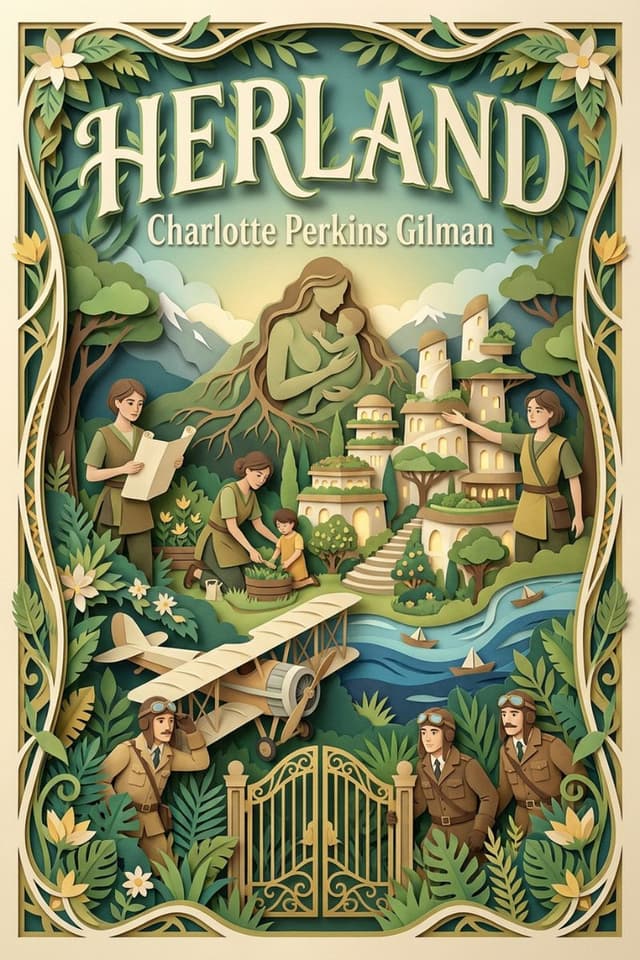
Herland
Read Herland by Charlotte Perkins Gilman for free on Novelhalla, and try out our easy-to-read modern edition of this classic book. You can also download the EPUB and read it on any device if you prefer!
The Plot
Somewhere in the unmapped wilderness, hidden behind impassable mountains, there is rumored to exist a land inhabited entirely by women. The native guides whisper about it, but no man who has gone looking has ever returned.
Three American friends hear these rumors while on a scientific expedition and cannot resist the challenge. Vandyck "Van" Jennings is a sociology student, curious about what kind of society women alone might create. Jeff Margrave is a doctor and a romantic, prone to placing women on pedestals of chivalric idealization. And Terry O. Nicholson is a wealthy adventurer and ladies' man, utterly confident in his own masculine superiority and certain that any society of women must be waiting for men to show up and take charge.
They return a year later, properly equipped, and fly their small plane over the mountains into an isolated plateau. What they find is nothing like they expected. The land is cultivated with extraordinary care, a patchwork of forests and gardens that suggest a civilization of remarkable sophistication. The towns are clean and orderly. The roads are excellent. And everywhere they look, they see only women and girls, no men or boys at all.
When the explorers attempt to make contact, they are quickly and efficiently captured by a group of middle-aged women they come to call "the Colonels." There is no violence, just calm, coordinated action that leaves the three men firmly in custody before they quite realize what has happened. Terry fires his gun in the scuffle and wounds one of their captors, a fact that will haunt them and shape their treatment.
The men find themselves held in comfortable quarters, given every necessity, and assigned tutors to teach them the local language. They are being studied as much as they are studying. The women are intensely curious about the outside world and its ways, and the men become windows into a civilization the Herlanders have never known.
As Van, Jeff, and Terry learn the language and customs, they piece together the astonishing history of this place. Two thousand years ago, a series of wars and natural disasters left a small population of women isolated atop this mountain plateau. Enslaved, their men killed in battle, the women revolted against their remaining captors and found themselves alone. They expected extinction. Instead, something miraculous happened: a young woman became pregnant without any man. Her daughters inherited this ability, and over generations, the entire population learned to reproduce through parthenogenesis, bearing only daughters.
With no men, the women organized their society along entirely different lines than anything the explorers have known. There is no war, no competition, no crime to speak of. Motherhood is the highest calling, but it is not private or possessive. Children are raised communally, educated by specialists, and considered the responsibility of all. Property is held in common. Work is chosen by aptitude and interest. The entire society functions as one enormous family pursuing the common good.
The men react to all this very differently. Van, the sociologist, finds himself genuinely impressed and increasingly ashamed of his own civilization by comparison. Jeff's romantic idealization of women seems almost validated, though the Herlanders are nothing like the fragile creatures he imagined. And Terry grows increasingly hostile, unable to accept a world where women do not need men, do not defer to them, and show no interest in being "mastered."
Three young women, Ellador, Celis, and Alima, are assigned to continue the men's education and serve as their companions. Courtship develops along very different lines than any of the men expected. The women approach relationships as equals, puzzled by the men's assumption that they should play passive or subordinate roles. The Herlanders are also deeply curious about the outside world and what these strange male creatures might offer their society.
As the men learn more about Herland and try to explain their own world in return, uncomfortable comparisons pile up. The women are shocked by descriptions of poverty, disease, exploitation, and violence. They cannot understand why any society would tolerate war, or why women would be economically dependent on men, or why motherhood would keep women from contributing to the wider world. The men find themselves editing their descriptions, leaving out the worst, ashamed of the civilization they once took for granted.
The question of whether the three men can truly belong in Herland, and what role they might play in its future, drives the story toward decisions that will determine whether this meeting of worlds ends in connection or catastrophe.
About the Author
Charlotte Perkins Gilman was born on July 3, 1860, in Hartford, Connecticut, into a family of famous intellectuals and reformers. Her great-aunts included Harriet Beecher Stowe, author of Uncle Tom's Cabin, and Catherine Beecher, a pioneer in women's education. But Charlotte's own childhood was marked by poverty and instability. Her father, a librarian and editor, abandoned the family when she was an infant, leaving her mother to raise two children with little support and constant moves between relatives' homes.
Despite her irregular education, Charlotte was intellectually voracious. Her absent father sent reading lists, and she devoured books on history, anthropology, and science. She attended the Rhode Island School of Design briefly and supported herself as an art teacher and painter of trade cards. In 1884, she married the artist Charles Walter Stetson, and a year later gave birth to a daughter, Katharine.
What followed was a nightmare that would shape her life and work. Charlotte plunged into a severe postpartum depression, a condition barely understood at the time and attributed to women's inherent nervous weakness. She was sent to the famous neurologist Dr. Silas Weir Mitchell, who prescribed his notorious "rest cure": complete bed rest, isolation, a fattening diet, and absolute prohibition on intellectual activity. She was to "live as domestic a life as possible," never touch pen, brush, or pencil again.
The treatment nearly destroyed her. Charlotte later described coming "so near the border line of utter mental ruin that I could see over." She saved herself by defying the doctor's orders, leaving her husband, and returning to work. The experience became the basis for her most famous short story, "The Yellow Wallpaper" (1892), a harrowing first-person account of a woman's descent into madness under the rest cure. She sent a copy to Dr. Mitchell himself.
After her divorce, Charlotte sent her daughter to live with her ex-husband and his new wife, a decision that scandalized society but which Charlotte defended as in her child's best interest. She threw herself into lecturing and writing on women's rights, labor reform, and social change. She lived for a time at Jane Addams's Hull House in Chicago and traveled internationally, meeting George Bernard Shaw, Beatrice and Sidney Webb, and other leading socialists.
In 1898, she published Women and Economics, a groundbreaking analysis of women's economic dependence on men that made her internationally famous. She argued that keeping women in domestic roles was not natural but a social arrangement that stunted both sexes. Her solution was radical: communal kitchens, professional childcare, and the reorganization of domestic work to free women for full participation in economic and intellectual life.
From 1909 to 1916, Charlotte single-handedly wrote, edited, and published The Forerunner, a monthly magazine devoted to her ideas. Nearly every word in its eighty-six issues came from her pen: fiction, poetry, essays, and serialized novels including Herland (1915). It was an astonishing feat of productivity, though the work sometimes suffered from the pace.
In 1900, Charlotte married her cousin George Houghton Gilman, with whom she found happiness until his sudden death from a brain hemorrhage in 1934. By then, she had been diagnosed with inoperable breast cancer. A longtime advocate of euthanasia, Charlotte took her own life on August 17, 1935, leaving a note that has become famous: "Human life consists in mutual service. When all usefulness is over, when one is assured of unavoidable and imminent death, it is the simplest of human rights to choose a quick and easy death in place of a slow and horrible one. I have preferred chloroform to cancer."
Fun Facts
-
Herland was lost for over sixty years. The novel was published as a serial in The Forerunner in 1915 but never appeared as a book during Gilman's lifetime. It was essentially forgotten until scholar Ann J. Lane rediscovered it and published it as a standalone novel in 1979 with the subtitle "A Lost Feminist Utopian Novel."
-
It's the middle of a trilogy. Gilman wrote three utopian novels that can be read as a loose trilogy: Moving the Mountain (1911), Herland (1915), and With Her in Ourland (1916). The sequel follows Ellador and Van as they travel the real world, with Ellador offering a Herlander's horrified commentary on war, poverty, and gender inequality.
-
The men represent three types of sexism. Gilman deliberately crafted her three male protagonists to embody different problematic attitudes toward women. Terry is the straightforward misogynist who believes women should be dominated. Jeff is the chivalrous romantic who idealizes women as delicate creatures. Van, the narrator, tries to be objective but still carries deep assumptions he must unlearn.
-
Gilman invented the women's pockets joke. In a detail that still resonates today, Van notes with surprise that the women of Herland have "pockets in surprising number and variety," brilliantly woven into their practical clothing. Over a century later, women are still fighting for functional pockets.
-
The parthenogenesis was symbolic. Gilman knew that human parthenogenesis was impossible. The miraculous reproduction was a literary device allowing her to imagine what women might create without any male influence at all, a thought experiment rather than a scientific proposal.
-
Gilman was related to abolitionists and suffragists. Her great-grandfather was Lyman Beecher, the famous Calvinist preacher. Her extended family included not only Harriet Beecher Stowe but also Isabella Beecher Hooker, a leader in the women's suffrage movement. Social reform was in her blood.
-
"The Yellow Wallpaper" changed medical practice. Gilman claimed that after Dr. Silas Weir Mitchell read her story, he altered his treatment of nervous disorders. Whether this is true is debated, but the story certainly influenced public perception of the rest cure and women's mental health treatment.
-
Gilman lived at Hull House. In 1895, she spent time at Jane Addams's famous settlement house in Chicago, where social reformers lived and worked among the urban poor. The experience reinforced her commitment to communal living and collective solutions to social problems.
-
The novel has troubling elements. Modern readers note that Herland's utopia includes eugenic practices, with the community controlling who reproduces and "breeding out" undesirable traits. This reflects the widespread acceptance of eugenics among Progressive Era reformers, including many feminists, before the horrors of Nazi Germany discredited the movement.
-
It pioneered feminist science fiction. Herland is now recognized as a foundational text in the genre of feminist speculative fiction, paving the way for writers like Ursula K. Le Guin, Joanna Russ, Marge Piercy, Octavia Butler, and Margaret Atwood.
Themes
The Social Construction of Gender. The heart of Herland is its challenge to the idea that gender roles are natural or inevitable. By creating a society that has functioned without men for two thousand years, Gilman forces her characters and readers to question which differences between the sexes are biological and which are simply the result of social arrangements. The Herlanders are strong, intelligent, practical, and capable because their society expects and enables these qualities, not because of any inherent feminine nature.
Motherhood Reimagined. Gilman transforms motherhood from a private, isolating burden into a communal, honored profession. In Herland, bearing children is the highest calling, but raising them is the work of trained specialists and the entire community. "We each have a million children to love and serve," one Herlander explains. This vision reflects Gilman's real-world arguments for professionalizing childcare and freeing individual mothers from the expectation that they alone are responsible for their children.
The Critique of Male-Dominated Society. The novel works as a mirror, using Herland's utopia to expose the absurdities and cruelties of the "civilized" world. When the men try to explain war, poverty, prostitution, and the subordination of women, they find themselves unable to justify these practices to people who have simply never known them. The Herlanders' puzzled questions force both the characters and readers to see familiar institutions with fresh, critical eyes.
Cooperation vs. Competition. Herland has no competition because it has no scarcity, no private property, and no status hierarchies based on domination. Everyone works for the common good because the common good is understood as everyone's interest. Gilman contrasts this with the competitive, acquisitive world the men come from, where success for one often means failure for another.
The Possibility of Change. For all its satirical edge, Herland is fundamentally optimistic. It imagines that human beings are capable of organizing society along radically different and better lines. The men's gradual transformation, especially Van's, suggests that even those raised in unjust systems can learn to see their limitations and embrace new possibilities. The novel is an invitation to imagine, and then to build, a better world.
The Book's Legacy
Herland had almost no impact when it was first published. Serialized in Charlotte Perkins Gilman's small-circulation magazine and never issued as a book during her lifetime, it simply disappeared from public consciousness after The Forerunner ceased publication in 1916. Gilman herself faded from prominence in the decades after her death, remembered only vaguely as a minor figure from the suffrage era.
The rediscovery began in the early 1970s, when second-wave feminists started excavating the lost history of women's writing. "The Yellow Wallpaper," which had been out of print for decades, was republished in 1973 and quickly became a canonical text in women's studies courses. As scholars investigated Gilman's other work, Ann J. Lane found Herland in the dusty archives of The Forerunner and published it as a standalone novel in 1979. The timing was perfect: feminists were actively imagining alternative social arrangements, and here was a book from 1915 that had already done the same.
The novel found an enthusiastic audience among both scholars and general readers. Writers like Marge Piercy, Joanna Russ, and Ursula K. Le Guin praised it for pioneering feminist science fiction. Courses on utopian literature, women's studies, and the history of feminism adopted it as essential reading. What had been completely forgotten became a classic.
Modern readers approach Herland with more complicated feelings than the first generation of rediscoverers. The novel's embrace of eugenics, its assumption that the proper response to "unfit" individuals is to prevent them from reproducing, sits uneasily with contemporary values. Gilman's racial attitudes, more visible in the sequel With Her in Ourland, were typical of Progressive Era white feminism and troubling by modern standards. These elements do not invalidate the novel's achievements, but they do complicate any simple celebration of it.
What endures is the audacity of Gilman's imagination and the sharpness of her social critique. The questions she poses, about what is natural and what is merely customary, about how societies might be organized differently, about what men and women might become if freed from constraining assumptions, remain as provocative today as when she first asked them. Herland is not a blueprint for utopia; it is an invitation to think beyond the limits of the present.
The novel's influence can be traced through decades of feminist speculative fiction, from Le Guin's The Left Hand of Darkness to Atwood's The Handmaid's Tale to Becky Chambers's The Long Way to a Small, Angry Planet. Every story that imagines gender differently, every utopia that asks what society might look like if women were truly equal, owes something to Charlotte Perkins Gilman and her lost land of mothers.