Novelhalla
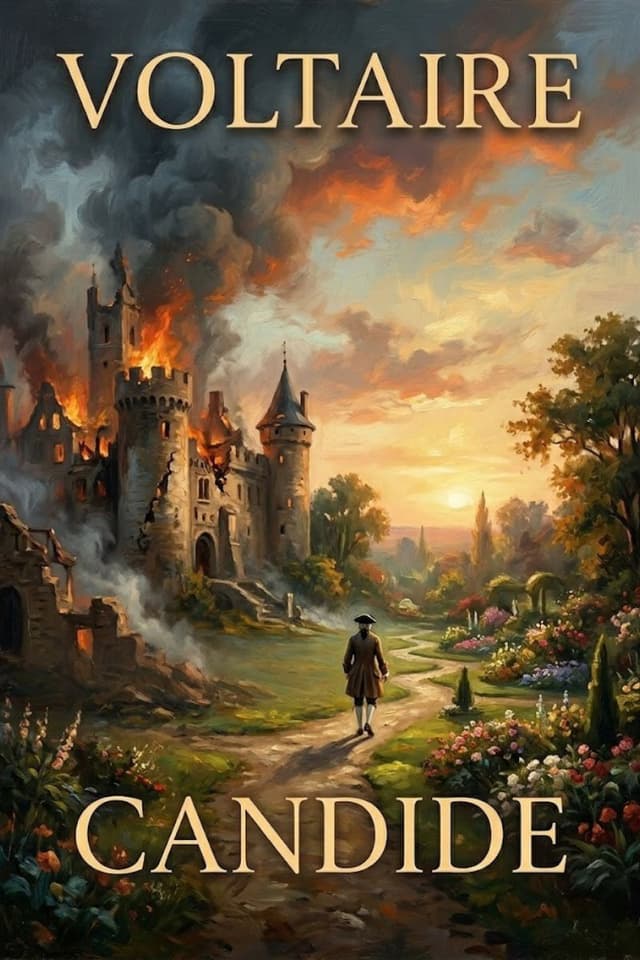
Candide
Read Candide by Voltaire for free on Novelhalla, and try out our easy-to-read modern edition of this classic book. You can also download the EPUB and read it on any device if you prefer!
The Plot
Candide is a whirlwind satire that careens through disasters, atrocities, and absurdities at breakneck speed. It follows a naive young man as his rosy worldview is systematically demolished by the cruelties of the actual world.
The Best of All Possible Worlds
Candide is a young man living in the castle of the Baron Thunder-ten-tronckh in Westphalia, Germany. He is the baron's illegitimate nephew, tolerated but not quite accepted. His tutor is Doctor Pangloss, a philosopher who teaches him that we live in "the best of all possible worlds," and that everything happens for a reason, and that reason is always for the best.
Candide believes this completely. He also loves the baron's beautiful daughter, Cunégonde. One day, inspired by seeing Pangloss in a compromising position with a chambermaid, Cunégonde approaches Candide. They are caught kissing. The baron kicks Candide out of the castle.
Thus begins his education.
A Catalogue of Disasters
What follows is a picaresque journey through every conceivable catastrophe. Candide is conscripted into an army, flogged, nearly executed, and witnesses the horrors of war. He survives the devastating Lisbon earthquake of 1755. He is whipped by the Inquisition. He flees across continents, from Portugal to South America to France to Venice to Turkey.
Along the way, he is reunited with people he thought were dead, separated from them again, cheated, robbed, and swindled. He kills men in self-defense. He loses fortunes. He discovers that Cunégonde has survived her own series of horrors, and he spends the novel trying to find her and marry her.
El Dorado
In the midst of his wanderings, Candide stumbles upon El Dorado, a hidden utopian kingdom where the streets are paved with gold and precious stones. The inhabitants are kind, there is no crime or conflict, and everyone is happy. It is, perhaps, actually the best of all possible worlds.
But Candide cannot stay. He is still searching for Cunégonde. He leaves paradise, loading sheep with treasure that will make him the richest man in Europe. Most of it is lost or stolen on the journey out.
Companions in Misery
Candide accumulates a cast of fellow sufferers. There is the old woman, a pope's daughter who has endured rape, enslavement, and cannibalism, and yet stubbornly clings to life. There is Cacambo, his resourceful valet. There is Martin, a pessimist who believes the world is fundamentally evil. And there is Pangloss, who somehow survives everything and never stops insisting that all is for the best.
Each character has a story of suffering. The novel suggests that everyone, if you ask them, believes they have suffered more than anyone else.
The Garden
The novel ends not with triumph but with exhaustion. The surviving characters find themselves together on a small farm. They are no longer young or beautiful or rich. They sit around discussing philosophy and complaining.
Then Candide meets an old Turkish farmer who knows nothing of philosophy or politics. He simply works his land with his children. Work, he says, keeps away boredom, vice, and need.
Candide takes this lesson to heart. When Pangloss tries once more to argue that everything has worked out for the best, Candide cuts him off with the novel's famous final line.
About the Author: Voltaire
François-Marie Arouet
Voltaire was born François-Marie Arouet on November 21, 1694, in Paris. His father was a notary, a respectable member of the bourgeoisie. His mother died when he was seven. From childhood, Voltaire was clever, witty, and inclined to make trouble.
He was educated by Jesuits at the prestigious Collège Louis-le-Grand, where he excelled at Latin and rhetoric. His father wanted him to become a lawyer. Voltaire wanted to write.
He began moving in literary and aristocratic circles, where his sharp tongue earned him admirers and enemies in equal measure. In 1717, he was imprisoned in the Bastille for eleven months for writing satirical verses mocking the regent. It was during this imprisonment that he adopted the pen name "Voltaire," an anagram of the Latinized spelling of his surname.
Exile and Success
Released from the Bastille, Voltaire established himself as a playwright and poet. His tragedy Oedipe (1718) was a hit. His epic poem La Henriade, celebrating the tolerant King Henry IV, gained him fame across Europe.
But his wit kept getting him into trouble. In 1726, after a quarrel with a nobleman who had him beaten by servants, Voltaire was given a choice: imprisonment or exile. He chose exile and went to England.
The three years Voltaire spent in England transformed him. He learned English, studied Newton and Locke, and was impressed by the relative freedom of English society compared to France. His Letters on England (1734), which favorably compared English liberalism to French absolutism, was burned by the French authorities and forced him to flee Paris again.
Émilie du Châtelet
From 1734 to 1749, Voltaire lived at Cirey, a château in eastern France, with the Marquise du Châtelet, a brilliant mathematician and physicist. Émilie du Châtelet was one of the most remarkable women of the century. She translated Newton's Principia into French and was Voltaire's intellectual partner and lover.
These were productive years. Voltaire wrote plays, histories, and philosophical works. He helped popularize Newton's physics in France. He corresponded with intellectuals across Europe.
Émilie died in 1749 during childbirth. Voltaire was devastated.
Frederick the Great
Voltaire accepted an invitation from Frederick the Great of Prussia to join his court in Berlin. For a time, he was the philosopher in residence to an "enlightened despot." But the relationship soured. Frederick was vain and authoritarian; Voltaire was incapable of holding his tongue. After three years, they parted bitterly.
The experience disillusioned Voltaire about enlightened monarchy. His faith that wise rulers could reform society from above was shaken.
Ferney
In 1755, the Lisbon earthquake killed tens of thousands of people and destroyed one of Europe's great cities. The catastrophe shocked Voltaire and deepened his skepticism about optimistic philosophy. How could this be the best of all possible worlds?
In 1759, now sixty-five years old, living near Geneva in a house he called Les Délices, Voltaire published Candide. It was an instant sensation and an instant scandal.
He spent his final two decades at his estate in Ferney, on the French-Swiss border, where he could escape to either country if authorities came after him. He became the most famous writer in Europe, receiving visitors from across the continent. He campaigned against religious persecution, defended victims of injustice, and continued to write.
In 1778, at the age of eighty-three, Voltaire returned to Paris for the first time in decades. He was greeted as a hero. A performance of his play was turned into a celebration of his life. He died on May 30, 1778, a few weeks later.
He had asked for a religious burial, but the church refused. His body was secretly interred at an abbey in Champagne. During the French Revolution, his remains were moved to the Panthéon in Paris, where they rest today.
Fun Facts About the Book
Published in Five Countries at Once
Voltaire knew Candide would be banned and pirated, so he turned these obstacles into advantages. He secretly sent manuscripts to publishers in Geneva, Paris, Amsterdam, London, and Brussels. The book appeared almost simultaneously in all five cities in January 1759. Within weeks, pirated editions were flooding Europe. By the end of the year, there were at least seventeen different editions in print.
Immediately Banned
The Great Council of Geneva and the administrators of Paris banned Candide within weeks of its publication. The Catholic Church placed it on the Index of Forbidden Books, where it remained for nearly two centuries. The bans only increased its popularity. An estimated 20,000 to 30,000 copies sold in the first year alone, making it a bestseller by eighteenth-century standards.
Published Anonymously
Voltaire did not put his name on Candide. The title page attributed the work to "Dr. Ralph," supposedly translated from the German. No one was fooled. The style was unmistakably Voltaire's, and his refusal to sign it only confirmed his authorship.
"Let Us Eat the Jesuit"
The phrase "Let us eat the Jesuit" became a popular catchphrase after the book's publication, referring to a darkly comic passage in the novel.
Seized by U.S. Customs in 1929
Even in the twentieth century, Candide was considered too dangerous for American readers. In 1929, U.S. Customs seized copies of the book that were being shipped to Harvard University, claiming it was obscene. Professors protested. The ban was lifted. In 1944, the U.S. Post Office demanded that the retailer Concord Books remove Candide from its catalog or black out the title.
Voltaire Won the Lottery
In 1729, decades before writing Candide, Voltaire and a mathematician friend discovered that the French lottery was poorly designed. The total cost of buying every ticket was less than the prize money. They organized a syndicate, bought up all the tickets, and won the equivalent of about $40 million in today's money. The windfall gave Voltaire financial independence for life.
The Leonard Bernstein Musical
In 1956, Leonard Bernstein adapted Candide as a comic operetta for Broadway, with a libretto by Lillian Hellman and lyrics by Richard Wilbur. The original production flopped, running only 73 performances, but the brilliant score gained a cult following. The show has been revised repeatedly over the decades and is now considered a classic. The aria "Glitter and Be Gay," sung by the character of Cunégonde, became a showpiece for sopranos, and the overture is a staple of the orchestral repertoire.
Inspired by McCarthyism
Bernstein and Hellman were drawn to Candide partly because its themes of persecution and false optimism resonated with their own experiences during the McCarthy era. Both had suffered professionally for their political views. The original production's "Auto-da-fé" scene was a direct satire of the House Un-American Activities Committee.
Voltaire's Influence on the Revolutions
Voltaire's ideas, including those expressed in Candide, helped inspire both the French and American Revolutions. King Louis XVI, imprisoned during the Revolution, reportedly blamed Voltaire and Rousseau for "destroying France."
The Most Famous Final Line
The novel's conclusion has become one of the most quoted phrases in Western literature. Scholars have debated its meaning for centuries. Is it a call to practical work over abstract philosophy? A retreat from politics into private life? An affirmation of building something good in a world that cannot be fixed? Voltaire never explained.
Themes
The Absurdity of Optimism
Candide is a sustained attack on philosophical optimism, particularly the ideas of the German philosopher Gottfried Wilhelm Leibniz, who argued that God, being perfect, must have created the best of all possible worlds, and that apparent evils are actually part of a greater good we cannot perceive. Voltaire found this idea both logically absurd and morally offensive, especially after the Lisbon earthquake. Pangloss's relentless insistence that "all is for the best" becomes increasingly grotesque as disasters multiply.
The Problem of Evil
If God is all-powerful, all-knowing, and all-good, why does evil exist? This ancient theological puzzle runs through the novel. Voltaire does not offer an answer, but he makes clear that glib philosophical answers are inadequate. The suffering in Candide is too vast and arbitrary to be explained away.
Satire of Institutions
Voltaire attacks virtually every institution of his era: the church (especially the Inquisition and the Jesuits), the military, the aristocracy, and the state. No one escapes his mockery. Kings are shown as corrupt or incompetent. Priests are hypocrites. Nobles are cruel. The powerful exploit the weak at every turn.
The Resilience of Ordinary Life
Despite everything, the characters in Candide keep going. The old woman, who has suffered more than anyone, does not kill herself. "I have wanted to kill myself a hundred times," she says, "but somehow I am still in love with life." This stubborn attachment to existence, irrational as it may be, is one of the novel's most human insights.
Work as Salvation
The novel's conclusion suggests that practical work, not philosophy, offers the best response to a chaotic world. The Turkish farmer who tends his garden is happier than all the philosophers and kings. Candide decides to follow his example. Whether this represents wisdom or resignation is left to the reader.
The Corruption of Wealth
El Dorado is a paradise precisely because its inhabitants do not value gold and jewels. Once Candide leaves with his treasure, he is cheated, robbed, and corrupted at every turn. Wealth brings misery, not happiness.
The Book's Legacy
Candide is one of the most influential works of the Enlightenment and one of the most widely read French books in the world. It has never gone out of print.
The novel established the satirical conte philosophique (philosophical tale) as a literary form. Its influence can be traced through later works of dark comedy and absurdist fiction, from the works of Jonathan Swift to Joseph Heller's Catch-22, Kurt Vonnegut's Slaughterhouse-Five, and the absurdist dramas of Samuel Beckett.
Candide's critique of blind optimism remains startlingly relevant. Every generation finds new reasons to question whether this is the best of all possible worlds. The novel's famous final phrase has entered the language as a call to practical engagement over passive philosophizing.
The novel has been adapted for stage, opera, and film. Leonard Bernstein's operetta, though initially a commercial failure, eventually became a beloved classic.
Voltaire's masterpiece endures because it is both very funny and very serious. It makes us laugh at catastrophe, which is perhaps the only sane response to a world that seems determined to destroy us. And it suggests, in its quiet final pages, that the best we can do is tend our own garden, love the people near us, and leave the unanswerable questions alone.