Novelhalla
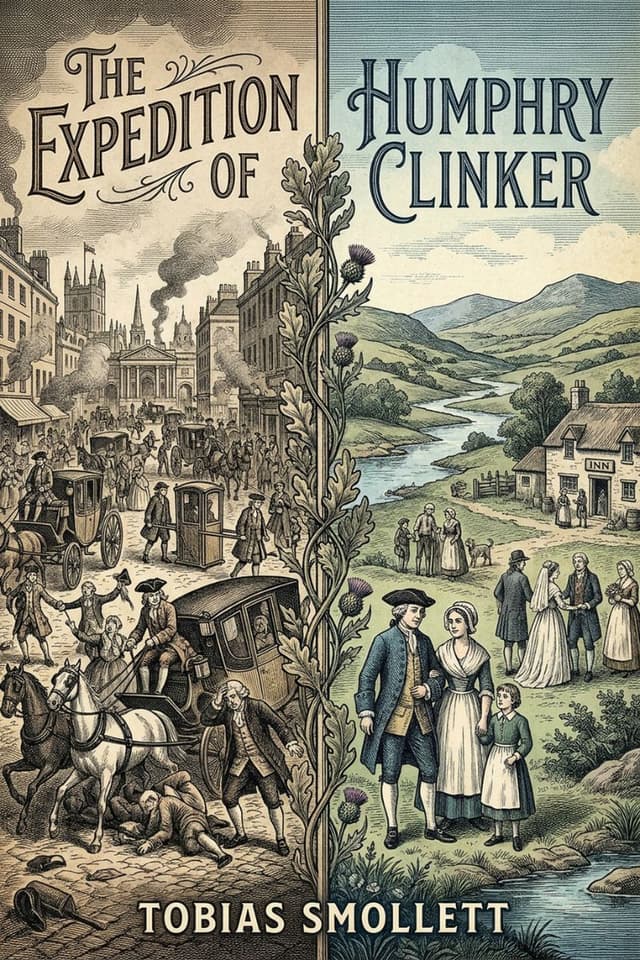
The Expedition of Humphry Clinker
Read The Expedition of Humphry Clinker by Tobias Smollett for free on Novelhalla, and try out our easy-to-read modern edition of this classic book. You can also download the EPUB and read it on any device if you prefer!
A quick note on formatting: This is one of those rare cases where the original book might actually be easier to navigate than our remaster. The entire novel is written as a series of letters with no chapter breaks, no sections, no clear table of contents, nothing. We did our best: we added a page break for each letter and called it a day. We obviously did our rewriting process as well, but didn't land on an appealing way to format it.
The Plot
The Grumpy Uncle Hits the Road
Matthew Bramble is a wealthy Welsh landowner with gout, a bad temper, and opinions about everything. His doctor has told him to take the waters at Bath for his health, and so begins a journey that will drag him, his family, and eventually a ragged stranger across the length of England and Scotland and back again.
But here's the thing about Matthew Bramble: he's not the curmudgeon he pretends to be. Underneath the constant complaining, the obsessive health worries, and the rants about the filth and stupidity of modern life, he's one of the most secretly generous men in English fiction. He just doesn't want anyone to know it.
Traveling with him are his sister Tabitha, a penny-pinching, husband-hunting terror who makes everyone's life miserable while insisting on bringing her awful lapdog everywhere; his niece Lydia, who is young, sweet, and nursing a secret romantic attachment to a mysterious young man her family would never approve of; and his nephew Jery, a sharp-tongued Oxford student who finds the whole expedition endlessly entertaining.
Oh, and there's Win Jenkins, Tabitha's maid, who can barely spell her own name but sees more clearly than almost anyone else in the party.
Bath, London, and Everything Wrong with England
The family hits Bath first, and Matthew hates it. The crowds, the social climbing, the disgusting state of the communal baths where sick and healthy people soak together in the same water. He writes furious letters to his doctor back home, cataloguing every offense against his senses and sensibilities.
London is worse. The noise, the stench, the food that isn't really food, the wine that isn't really wine. Matthew is appalled by all of it. Meanwhile Lydia is dazzled by the city, Jery is having the time of his life, and Tabitha is sizing up every eligible man she meets with the focus of a military strategist.
The genius of the book is that you're reading the same events through completely different eyes. Matthew sees a dinner party as a nightmare of bad food and worse company. Jery sees it as hilarious. Lydia sees romance everywhere. Win Jenkins sees things the educated characters miss entirely, and describes them in letters so mangled and misspelled they become their own kind of poetry.
Enter Humphry Clinker
About a quarter of the way into the journey, the family's carriage breaks down. They need a new driver. Enter Humphry Clinker: a ragged, penniless young man so poor he doesn't even have trousers. Tabitha is horrified by the sight of him. Matthew, characteristically, grumbles about his appearance and then quietly buys him a full set of clothes.
Humphry turns out to be earnest, loyal, strong, and deeply religious. He also has a talent for preaching that attracts devoted followers whenever he opens his mouth, which drives Matthew absolutely crazy. Humphry becomes a Methodist minister in his spare time. He gets falsely arrested as a highway robber. He accidentally humiliates Matthew by "rescuing" him from the sea when Matthew was just taking a cold dip. Every attempt at doing the right thing lands Humphry in absurd trouble.
But there's something about Humphry that Matthew can't quite put his finger on. Something familiar.
The Road North
The party continues through Yorkshire, with stops at Harrogate and Scarborough, collecting characters as they go. There's Lieutenant Lismahago, a gaunt, argumentative Scottish soldier who has survived captivity, torture, and a marriage to a Native American chief's daughter, and who now latches onto the group with a suspicious interest in Tabitha. There's the mysterious Wilson, who keeps appearing wherever Lydia happens to be, sending the girl into fits of anxiety and longing.
Scotland changes everything. Matthew, who has spent the entire trip complaining about England, falls in love with Edinburgh. The Highland landscapes move him. For the first time in the novel, his letters sound almost happy.
But the secrets that have been building beneath the surface of the story are getting harder to contain. Who is Wilson, really? What is Lismahago actually after? And why does Matthew Bramble keep looking at Humphry Clinker with that strange expression?
The Unraveling
The journey home is where everything comes together. Identities are revealed. Connections that seemed impossible turn out to have been hiding in plain sight. Love stories that looked doomed find unexpected paths forward. And Matthew Bramble, the man who started this trip convinced the world was going to hell, discovers that his family is bigger, stranger, and more wonderful than he ever imagined.
The answers to every question the novel has been quietly asking arrive in a rush that is funny, moving, and deeply satisfying. But only if you've been paying attention to the letters. Because the clues were always there. You just had to know which correspondent to trust.
About the Author: Tobias Smollett
A Scottish Surgeon's Son
Tobias George Smollett was born in 1721 in Dalquhurn, Scotland, into a family of lawyers and landowners. His grandfather had been knighted by King William. But the family's fortunes declined after his father died when Tobias was only five, and money was always tight.
He studied medicine at the University of Glasgow and apprenticed as a surgeon. But what he really wanted was to be a writer. At eighteen he went to London carrying a play called The Regicide, convinced it would make his name. No one would produce it. The rejection stung him for the rest of his life.
The Naval Surgeon
Unable to make it as a playwright, Smollett took a commission as a surgeon's mate in the Royal Navy. He served aboard HMS Chichester and participated in the disastrous British assault on Cartagena in 1741, a catastrophic military operation that killed thousands. The horrors he witnessed, the incompetence he saw, and the brutal realities of shipboard life would fuel his fiction for decades.
He ended up in Jamaica, where he married Anne Lascelles, the daughter of a wealthy planter. He returned to London and set up a medical practice on Downing Street, but his heart was never really in medicine.
The Novelist
In 1748 Smollett published The Adventures of Roderick Random, a wild, semi-autobiographical picaresque novel that became an immediate hit. It was funny, rude, violent, and packed with unforgettable characters. He followed it with The Adventures of Peregrine Pickle in 1751, another sprawling comic adventure.
Smollett became a literary celebrity. He translated Cervantes' Don Quixote. He edited The Critical Review. He hosted raucous Sunday gatherings at his home in Chelsea where he entertained Samuel Johnson, Oliver Goldsmith, and the actor David Garrick. He was described as brilliant, hot-tempered, generous, and exhausting.
Decline and Final Work
The 1760s hit Smollett hard. He was jailed briefly for libel. His only daughter, Elizabeth, died at fifteen. His own health deteriorated, possibly from tuberculosis. He and his wife left England for the continent, producing Travels Through France and Italy, a book so cantankerous that the novelist Laurence Sterne nicknamed him "Smelfungus."
A final visit to Scotland reinvigorated him enough to write Humphry Clinker, which he completed in 1770. It was published on June 17, 1771. He died three months later, on September 17, near Livorno, Italy. He was fifty years old. He is buried in the English cemetery at Livorno.
Fun Facts About the Book
His Last and Best
Humphry Clinker is universally considered Smollett's finest novel. He wrote it while sick, possibly dying, in Italy and during a final trip to Scotland. There's a warmth and generosity in the book that his earlier, more savage novels lack. The irascible Matthew Bramble is widely read as Smollett's most autobiographical character: a man who rages at the world but secretly loves it.
The Character Who Barely Appears
Despite lending his name to the title, Humphry Clinker doesn't show up until a quarter of the way through the book. And he never writes a single letter. Everything we know about him comes through the eyes of others. It's a remarkable structural choice: the novel is named for a character who exists only as other people see him.
The Misspelling Is the Point
Winifred Jenkins' letters are deliberately riddled with malapropisms, phonetic spellings, and mangled words. Smollett uses her fractured English to create comedy, but also something deeper. Win's misunderstandings often accidentally reveal truths the educated characters miss. Her garbled prose is one of the novel's great pleasures and has been compared to the language play in Joyce's work two centuries later.
The Rashomon of the Eighteenth Century
The same event, described by different letter writers, can sound like completely different experiences. A dinner party that horrifies Matthew delights Jery. A man who impresses Lydia disgusts Tabitha. Smollett was one of the earliest novelists to exploit the unreliable narrator, and he did it with six of them at once.
Dickens' Debt
Charles Dickens was a passionate admirer of Smollett's novels, and his influence on Dickens is enormous. The eccentric comic characters, the social satire, the picaresque road trip structure, the mix of sentimentality and sharpness: the DNA of Pickwick Papers and nearly everything Dickens wrote afterward runs straight back through Humphry Clinker.
A Real Scottish Tour
Smollett visited Scotland while planning the novel, and the Scottish sections draw directly on his travels. The descriptions of Edinburgh, the Highlands, and Loch Lomond are based on real places, including his own family's estate. The warmth of the Scottish passages stands in pointed contrast to the disgust Matthew feels in English cities, and some scholars read the entire novel as Smollett's love letter to a homeland he left as a teenager and never returned to permanently.
Published Three Months Before He Died
Smollett was already gravely ill when the novel appeared. He died in Italy on September 17, 1771, just three months after publication. He never knew the full extent of the book's success. George Orwell later called him "Scotland's best novelist."
Side Characters
Lieutenant Lismahago
A scarecrow of a man with a gaunt face, a missing eye, and an inexhaustible supply of opinions. Lismahago is a Scottish soldier who has survived captivity, torture, and years among Indigenous peoples in North America. He argues about everything, offends nearly everyone, and somehow manages to charm Tabitha Bramble, a feat no other man in the novel accomplishes. He is absurd, magnificent, and impossible to ignore.
Wilson
The young man who keeps appearing in Lydia's orbit like a persistent ghost. His identity and intentions are one of the novel's running mysteries. Is he a fortune hunter? A genuine lover? Something else entirely? Every time the family tries to shake him, he turns up again in a new disguise or a new town, and Lydia's heart rate spikes accordingly.
Themes
The Unreliable Self
The novel's greatest trick is showing how completely people can disagree about the same reality. Every character is convinced they're seeing the world clearly. None of them are. Smollett suggests that our perceptions say more about us than about what we're looking at, and that self-knowledge might be the hardest kind to come by.
City vs. Country
Matthew Bramble finds cities revolting and the countryside restorative. London is noise, pollution, and fraud. The Scottish Highlands are beauty, honesty, and health. The novel builds a sustained argument that urban life corrupts and that simplicity and nature are better for both body and soul.
Class and Pretension
The social climbers at Bath, the frauds in London, the servants who see through their masters: Smollett skewers class pretension from every angle. But he's not simply mocking the upper classes. He shows how class shapes language, perception, and opportunity, and how the people at the bottom of the hierarchy often understand the most.
The Hidden Heart
Matthew Bramble performs crankiness while secretly performing charity. The novel is fascinated by the gap between how people present themselves and who they actually are. Nearly every major revelation in the plot involves discovering that someone is not what they seemed, and usually the truth is kinder than the disguise.
Family, Found and Made
The Bramble party starts as a fractious group of relatives thrown together by circumstance. By the end, they've become something more: a real family, expanded and transformed by the people they picked up along the way. The novel suggests that family isn't just blood. It's whoever sticks with you through the journey.
The Book's Legacy
Humphry Clinker is one of the great comic novels of the eighteenth century, and one of the most influential books in the history of English fiction. Its structure, an epistolary novel where multiple narrators describe the same events from wildly different perspectives, was innovative in its time and has been imitated endlessly since.
Dickens learned from Smollett how to build a novel around eccentric characters on a journey, how to mix broad comedy with genuine emotion, and how to use social observation as entertainment. The line from Humphry Clinker to The Pickwick Papers is direct and unmistakable.
The novel is also a remarkable time capsule. Smollett's descriptions of Bath, London, Edinburgh, and the Scottish Highlands in the 1760s are vivid enough to serve as social history. You can smell the streets, taste the questionable food, and feel the jolting discomfort of eighteenth-century coach travel.
But what makes the book last is its heart. Underneath all the satire and the slapstick and the terrible spelling, it's a story about a grumpy old man who goes looking for a cure and finds a family instead. Smollett wrote it while dying, far from home, and you can feel the tenderness in every page. It's the work of someone who has seen the worst of the world and decided, in the end, that people are mostly worth loving anyway.