Novelhalla
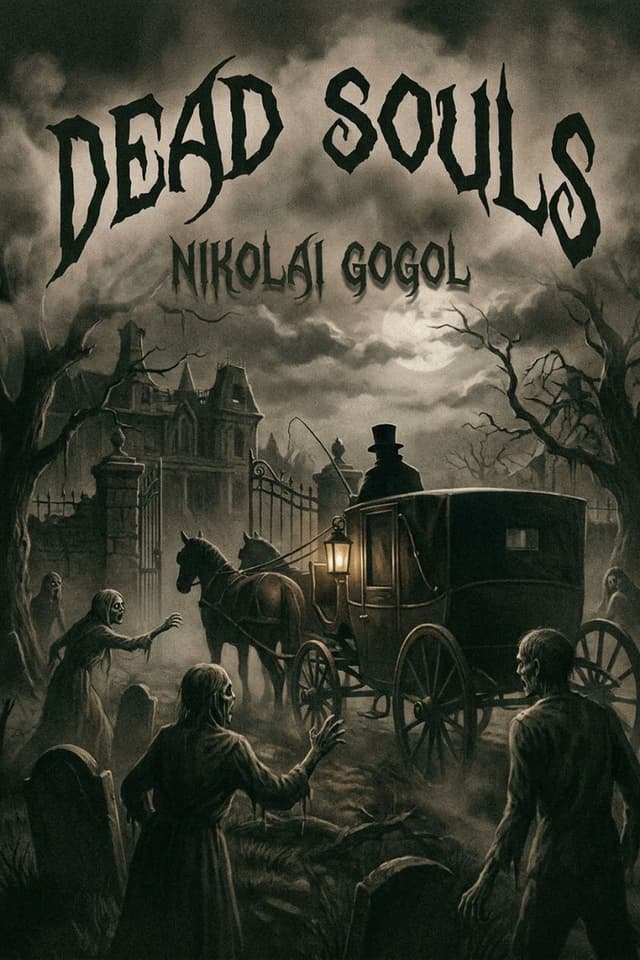
Dead Souls
Read Dead Souls by Nikolai Gogol for free on Novelhalla, and try out our easy-to-read modern edition of this classic book. You can also download the EPUB and read it on any device if you prefer!
The Plot
The story follows Pavel Ivanovich Chichikov, a mysterious middle-aged gentleman of pleasant appearance and impeccable manners, as he arrives in an unnamed provincial Russian town. He quickly ingratiates himself with the local officials and landowners, attending their dinners and card parties, flattering everyone with precisely calibrated charm.
Once he has established himself socially, Chichikov begins visiting the estates of local landowners with a peculiar business proposition. He offers to buy their "dead souls," meaning serfs who have died since the last census but remain on the tax rolls until the next one. Since landowners must pay taxes on these deceased serfs as if they were still alive, Chichikov presents his offer as doing them a favor. What he intends to do with these dead souls, and why he wants them, gradually becomes clear as the scheme unfolds.
Each landowner Chichikov visits represents a different type of Russian provincial character. Some are foolish, some shrewd, some generous to a fault, some pathologically stingy. Gogol uses these encounters to paint a panoramic portrait of Russian rural society, with all its absurdity, corruption, and occasional humanity.
The visits go smoothly at first, but rumors begin to circulate in town about Chichikov's strange purchases. Speculation runs wild about who he really is and what he is planning. The situation spirals into increasingly ridiculous territory as the townspeople concoct ever more outlandish theories.
About the Author: Nikolai Gogol
Ukrainian Origins
Nikolai Vasilievich Gogol was born in 1809 in Sorochyntsi, a village in the Poltava region of Ukraine, then part of the Russian Empire. His father was a minor landowner who wrote plays for a local theater. The Ukrainian countryside, with its folklore and colorful characters, provided material for Gogol's early stories.
Petersburg Dreams
Gogol moved to St. Petersburg in 1828 with literary ambitions that initially met with failure. His first published poem was so poorly received that he bought up all the copies and burned them. He worked briefly as a civil servant and a teacher, experiences that fed his satirical portrait of Russian bureaucracy.
Literary Success
His collection "Evenings on a Farm Near Dikanka" (1831-1832), drawing on Ukrainian folklore, brought him fame. He followed this with "Mirgorod" and the "Petersburg Tales," which included "The Nose" and "The Overcoat," stories that blended realism with the grotesque in ways that influenced all Russian literature to follow.
Writing Dead Souls
Gogol began "Dead Souls" in 1835, partly at Pushkin's suggestion. He worked on it obsessively for years, mostly while living abroad in Rome. The first part was published in 1842 after struggles with censorship. Gogol intended it as the first part of a trilogy modeled on Dante's Divine Comedy, with subsequent volumes showing Chichikov's purgation and redemption.
Spiritual Crisis
After publishing the first part, Gogol fell increasingly under the influence of a fanatical priest, Father Matthew Konstantinovsky. He became consumed with religious anxiety, convinced that his satirical writing was sinful. In 1852, during a period of fasting and prayer, he burned the manuscript of the second part of "Dead Souls." He died nine days later at age 42, likely from self-starvation.
The Lost Second Part
Fragments of the second part survived, showing that Gogol intended to introduce more virtuous characters and move Chichikov toward moral transformation. What remains suggests a work at war with itself, Gogol's satirical genius struggling against his desire for spiritual uplift.
Fun Facts About the Book
The Title
The Russian title "Myortvye Dushi" means both "dead souls" (the deceased serfs on paper) and "spiritually dead souls" (the living characters). Gogol exploits this double meaning throughout, suggesting that the landowners and officials are as dead in spirit as the serfs are in body.
Poem or Novel
Gogol called "Dead Souls" a "poem" rather than a novel, a deliberate provocation that confused readers and critics. He saw it as an epic in prose, comparable to Homer, with the episodic structure of Chichikov's visits mirroring Odysseus's wanderings.
Censorship Troubles
The censors initially rejected the manuscript, objecting to the title (souls belong to God, not to anyone who can buy or sell them) and to the tale within the novel about a corrupt official. Gogol had to fight for months to get it published, making revisions and mobilizing influential friends.
The Carriage
Much of the novel takes place in or around Chichikov's carriage as he travels between estates. The carriage becomes a symbol of Russia itself. The novel ends with a famous passage comparing Russia to a speeding troika, rushing toward an unknown destination while other nations step aside.
Real Scheme
The dead souls scam Chichikov attempts was actually possible under Russian law at the time. Owning serfs, even on paper, allowed one to mortgage them to the government. Someone who accumulated enough dead souls could theoretically borrow substantial sums against these nonexistent assets.
Pushkin's Contribution
Alexander Pushkin not only suggested the basic plot to Gogol but reportedly said that only Gogol could have written it because "Russia is so sad that if someone else wrote such a book, they would die of grief." Pushkin died before the novel was completed.
Illustrations
The first edition included illustrations that Gogol personally supervised. He was deeply involved in the visual presentation of his work and complained bitterly when publishers used illustrations he had not approved.
Themes
Russian Identity
Gogol wrestled throughout the novel with what Russia was and what it could become. His satire exposes the pettiness and corruption of provincial life, yet the famous troika passage suggests a belief in Russia's special destiny. The tension between criticism and patriotism runs through every chapter.
Appearance vs. Reality
Chichikov succeeds because he presents a pleasant surface that everyone accepts without question. The entire social world of the novel operates on appearances, from the officials who maintain respectability while taking bribes to the landowners who perform hospitality while exploiting their serfs.
Greed and Accumulation
Each landowner embodies a different relationship to possessions. Manilov is indifferent to practical matters, Plyushkin hoards compulsively, Sobakevich values everything in monetary terms. Chichikov's scheme to accumulate dead souls parodies the acquisitive drive that Gogol saw corrupting Russian society.
Bureaucracy and Absurdity
The government officials in the novel form a closed system of mutual accommodation. Nobody questions anything as long as proper forms are observed. Gogol portrays bureaucracy as a machine that processes paper while ignoring human reality.
Mortality and Meaning
The dead serfs whose names fill Chichikov's lists were once living people with skills, personalities, and stories. Gogol gives several of them brief biographies, reminding readers that behind every statistic was a human life. The comedy of the scheme cannot entirely obscure this darker undertone.
Spiritual Emptiness
Gogol increasingly saw his satire as diagnosis of a spiritual disease. The characters pursue money, status, and comfort while their inner lives remain barren. Whether Gogol could have dramatized spiritual renewal, as he intended in the later volumes, remains one of literary history's unanswerable questions.
The Book's Legacy
"Dead Souls" is considered one of the foundational works of Russian literature, essential to understanding both 19th century Russia and the development of the Russian novel. Dostoevsky, Turgenev, and later Russian writers all worked in its shadow.
The novel's blend of realism and grotesque exaggeration created a template that writers continue to follow. Its portrait of provincial mediocrity, bureaucratic absurdity, and schemes that spiral out of control feels remarkably contemporary.
Gogol's influence extends beyond Russia. Kafka admired him, and echoes of his work appear throughout 20th century literature wherever writers have sought to capture the absurdity of social systems and the gap between official reality and lived experience.