Novelhalla
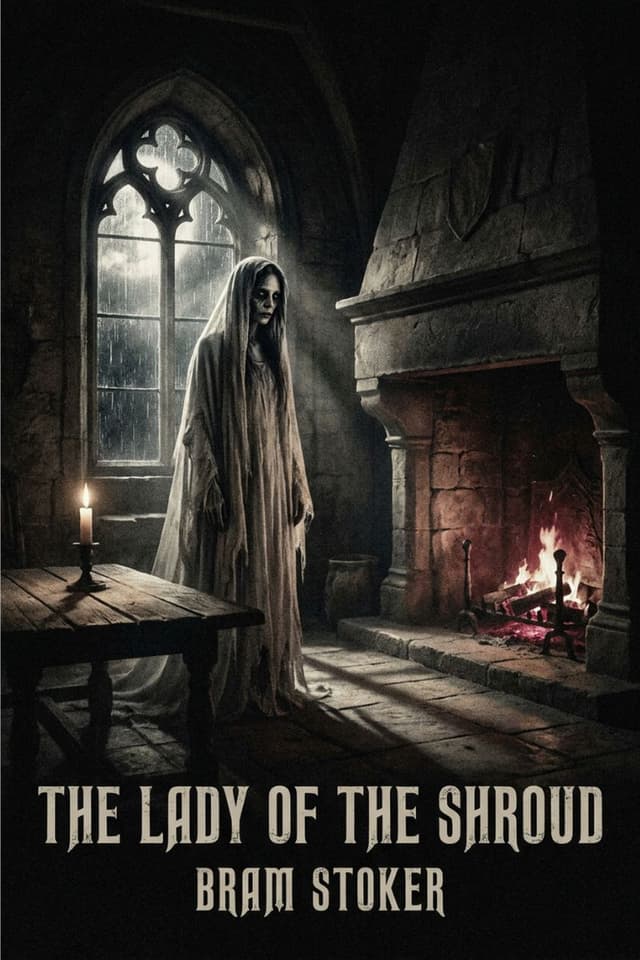
The Lady of the Shroud
Read The Lady of the Shroud by Bram Stoker for free on Novelhalla, and try out our easy-to-read modern edition of this classic book. You can also download the EPUB and read it on any device if you prefer!
The Plot
The Inheritance
Old Roger Melton is dead, and his fortune is one of the largest in Europe. His arrogant nephew Ernest Melton expects to inherit everything. He is wrong.
The money goes instead to Rupert Sent Leger, a young adventurer and distant relation whom the family considers a black sheep. Rupert is seven feet tall, fearless, and has spent his life in dangerous places doing dangerous things. But there's a catch. To claim the inheritance, Rupert must live for one full year in his uncle's castle, Vissarion, in a tiny, fiercely independent nation called the Land of the Blue Mountains, perched on the Dalmatian coast.
It's a test. Rupert doesn't know what his uncle was testing for. But he accepts.
The Castle
Rupert travels to the Blue Mountains with his Aunt Janet, a Scottish woman who possesses the unsettling gift of Second Sight. The castle sits in a wild, superstitious land of mountain warriors who carry daggers at their belts and distrust outsiders. The building itself is ancient, riddled with secret passages, and it overlooks a dark creek that connects to the sea.
Rupert sets about winning the trust of the local people. He uses his fortune to arm them against the Turkish forces that threaten their borders, buying modern weapons from a South American country that has unexpectedly found itself at peace. The mountaineers begin to accept him. He begins to feel at home.
And then, one wet night, she comes.
The Lady
A woman appears at the castle in the darkness. She is pale, soaked through, and wrapped in a burial shroud. She does not speak. She seeks warmth by his fire, and she flees before dawn.
She comes back. Again and again, always at night, always in the shroud, always vanishing before morning. Rupert barely exchanges a word with her, but he is falling in love with something he cannot explain. She is beautiful and strange and radiates a cold that seems to come from somewhere beyond the living world.
He visits the old church across the creek. In the crypt, he finds her lying in a glass-topped stone coffin.
Rupert is a rational man. He has traveled the world, faced death in a dozen countries. But he knows the stories. He knows what walks at night and sleeps in tombs. And he knows what he feels. He stands over the coffin and declares his love, to whatever she is, living or undead.
The Secret
She arranges a marriage. It happens at night, by candlelight, in an Orthodox ceremony in the old church. He still does not know her name. She tells him she must continue living in the crypt for now, that there are reasons she cannot explain. He accepts this, because he has already accepted everything else.
Then she is taken.
A forward party of Turkish troops storms into the mountains. Rupert's mysterious wife is kidnapped. And in the desperate race to save her, the truth begins to surface. She is not what he feared. She is not what he hoped. She is something far more complicated, and the danger surrounding her is not supernatural at all. It is political, military, and very, very real.
Her name is Teuta. She is the daughter of the Voivode, the leader of the Blue Mountains. And the game being played around her is bigger than Rupert imagined.
The War
What began as a gothic romance shifts into something else entirely. The Turkish threat is escalating. The Voivode himself has been captured. Rupert has at his disposal a fortune, a private warship equipped with the latest weapons, and, arriving just in time on the munitions vessel, an aeroplane with a near-silent engine and sets of bulletproof clothing.
The mountains are about to go to war. And Rupert Sent Leger, the seven-foot adventurer who came here to claim a castle, is about to discover what his uncle was really preparing him for.
About the Author: Bram Stoker
Early Life
Abraham "Bram" Stoker was born in Dublin in 1847, the third of seven children in a middle-class Protestant family. He was bedridden with an unidentified illness until the age of seven. No one expected much from him physically, which makes what followed remarkable: at Trinity College, Dublin, he became a champion athlete, excelled in mathematics, and was known as one of the university's finest debaters.
The Theatre Years
Stoker's life changed when he met the actor Henry Irving. As a young theatre critic for the Dublin Evening Mail, Stoker wrote a glowing review of Irving's Hamlet, and the two became fast friends. In 1878, Stoker moved to London to serve as Irving's business manager at the Lyceum Theatre, a post he held for twenty-seven years. The job consumed his life. He was out from morning to late at night, six days a week, managing everything from finances to international tours. Irving was the most famous actor in England, and through him Stoker entered London's high society, befriending Arthur Conan Doyle, Walt Whitman, and his old acquaintance Oscar Wilde.
That same year, Stoker married Florence Balcombe, a celebrated Dublin beauty whose former suitor had been Wilde himself. They had one son, whom they named Irving Noel, after the actor who had become the center of Stoker's professional life.
The Writer
Stoker wrote novels in his scarce free time, beginning with The Snake's Pass in 1890. But it was Dracula, published in 1897, that made him a literary celebrity. The novel drew on years of research, visits to Whitby and Cruden Bay, and possibly on Irving himself, whose commanding, magnetic personality some scholars see reflected in the Count. Irving rejected the role when the novel was dramatized, to Stoker's disappointment.
Final Years
Irving died in 1905, leaving Stoker nothing in his will despite their decades-long partnership. Stoker suffered a stroke shortly after and spent his remaining years in declining health and financial difficulty. He continued writing, producing The Lady of the Shroud in 1909 and The Lair of the White Worm in 1911. He died in London on April 20, 1912. His death certificate listed "locomotor ataxia," widely presumed to indicate syphilis, though some biographers attribute his death to exhaustion and stroke.
His ashes were placed in a display urn at Golders Green Crematorium. His son's ashes were later added to the same urn.
Fun Facts About the Book
Not the Vampire Novel You're Expecting
Stoker's most famous novel is about vampires. This one seems to be about vampires. It has a pale woman in a shroud, a coffin in a crypt, nighttime visits, and a Balkan castle. But Stoker is playing a different game here. The novel deliberately sets up every gothic expectation and then pivots into something completely unexpected. Whether that pivot delights or frustrates you depends on what you came for.
Early Science Fiction
The Lady of the Shroud is sometimes cited as an early example of science fiction. The novel features aeroplanes with near-silent engines, bulletproof clothing, and modern warships. Writing in 1909, only six years after the Wright brothers' first flight, Stoker was imagining military aviation as a decisive tool of warfare. He essentially predicted air superiority as a concept before World War I made it reality.
Montenegro in Disguise
The fictional Land of the Blue Mountains is widely understood to be based on Montenegro, the small Balkan nation whose fierce independence Stoker admired. The mountaineers' warrior culture, their resistance to Ottoman control, and the Orthodox religious traditions all mirror Montenegrin history. Stoker was drawing on travel writing and political journalism about the real country to build his fictional one.
An Epistolary Novel
Like Dracula, the story is told entirely through documents: diary entries, letters, legal papers, newspaper clippings, and official memoranda. Stoker loved this format. He borrowed it from Wilkie Collins's The Woman in White, and he used it throughout his career. The multiple voices give the novel a layered, documentary quality, as if you're piecing together what happened from the evidence left behind.
Written After Irving's Death
Stoker wrote The Lady of the Shroud after losing both Henry Irving and his position at the Lyceum Theatre. He was in poor health, struggling financially, and working under the shadow of a stroke. Some readers detect a wistful, almost escapist quality in the novel's adventure fantasy: a man of action who inherits a fortune, wins the love of a mysterious woman, defeats an empire, and is embraced by a grateful nation. It's not hard to see why Stoker might have needed that story.
Aunt Janet and Second Sight
Aunt Janet MacKelpie, Rupert's Scottish relative who accompanies him to the Balkans, possesses "Second Sight," a traditional Celtic belief in psychic visions. Stoker had a genuine interest in the occult and the supernatural, though he personally valued the scientific method over superstition. Janet's visions add an uncanny layer to the story, hinting at forces that the novel's rational plot can't entirely explain away.
Themes
The Rational and the Supernatural
The novel's central tension is between what seems to be happening and what is actually happening. Rupert believes he's encountered a vampire. The reader suspects the same. Stoker keeps both possibilities alive for as long as he can, asking how far rational men will go when confronted with something that defies explanation. The answer, in Rupert's case, is all the way: he declares his love regardless.
Love Beyond Understanding
Rupert falls in love with a woman he believes might be undead. He marries her without knowing her name. This isn't reckless stupidity in Stoker's framing. It's a kind of faith, a willingness to commit to another person even when you cannot fully comprehend them. The novel treats Rupert's devotion as heroic precisely because it requires him to accept mystery.
Modernity vs. Tradition
The Blue Mountains are a land of ancient customs, daggers, and superstition. Rupert brings modern weapons, technology, and organizational skill. But Stoker doesn't treat this as simple progress. The mountaineers' traditions are noble. Their warrior culture is admirable. The novel suggests that the best future combines old honor with new capability.
Self-Made Heroism
Rupert inherits his fortune, but he earns his place. His uncle's will is a test of character, not just a bequest. The novel is fundamentally about proving yourself: to a skeptical community, to a mysterious woman, and to a world that has underestimated you. Rupert is the black sheep who turns out to be the only one worthy of the legacy.
The Book's Legacy
The Lady of the Shroud has always lived in Dracula's enormous shadow, and that's not entirely fair. It's a genuinely strange and ambitious novel that tries to do something few books attempt: start as one genre and become another. The opening chapters are atmospheric gothic horror. The middle is a love story steeped in mystery. The final act is a military adventure with cutting-edge technology. Not all of these pieces fit together perfectly, but the ambition is remarkable.
The novel is now recognized as an early example of what modern readers might call steampunk or science fiction romance, blending Victorian gothic atmosphere with forward-looking technology. Stoker's vision of aerial warfare, written years before World War I, shows a writer thinking seriously about the future even while telling a story rooted in the oldest fears of the past.
For readers who know Stoker only through Dracula, The Lady of the Shroud is a revelation of how wide his imagination ranged. It's the work of a man who believed in ghosts but also in progress, who loved old castles but also new machines, and who understood that the most terrifying thing in the world might not be a monster at all, but the question of whether the woman you love is alive or dead.