Novelhalla
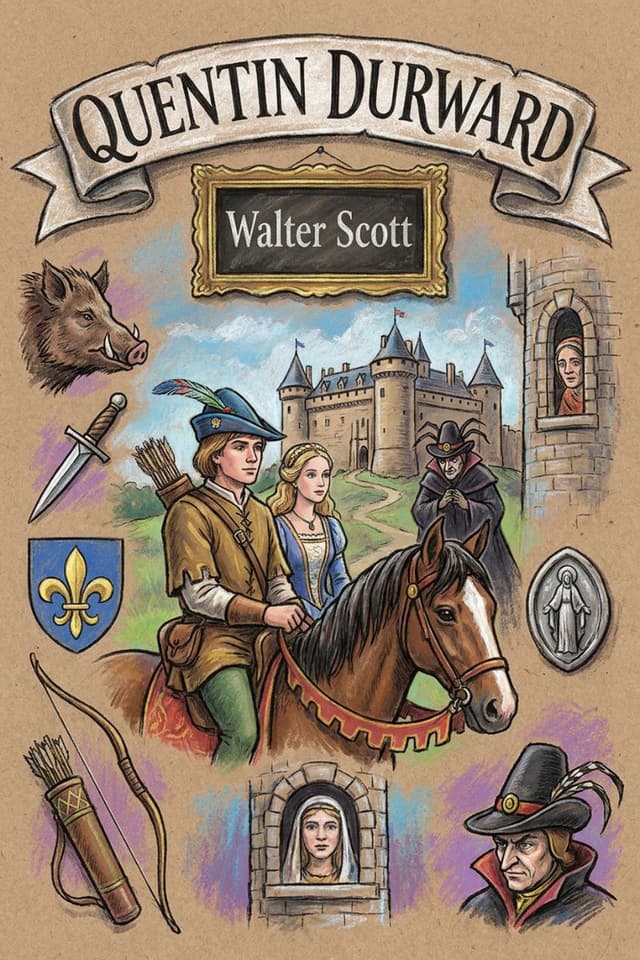
Quentin Durward
Read Quentin Durward by Walter Scott for free on Novelhalla, and try out our easy-to-read modern edition of this classic book. You can also download the EPUB and read it on any device if you prefer!
The Plot
A Scot in France
The year is 1468. The old feudal order of Europe is crumbling, and the two most powerful men on the continent are locked in a struggle that will shape the future of France. On one side is King Louis XI, who rules from behind a veil of disguises, spies, and carefully placed bribes. On the other is Charles the Bold, Duke of Burgundy, who rules by fury, pride, and the strength of his sword arm. Between them lies a map full of contested cities, restless vassals, and people who can be used.
Into this world walks Quentin Durward, a young Scotsman with nothing to his name but good looks, a hot temper, and fifteen generations of noble blood. His family has been ruined, and he has crossed the sea to find his uncle Ludovic Lesley, known as Le Balafre (the Scarred), who serves in the Garde Ecossaise, the elite company of Scottish archers who form the personal bodyguard of the King of France. Quentin intends to join them. He is young, brave, an excellent shot, and completely ignorant of the world he is walking into.
The Spider King
On the road to the royal castle of Plessis-les-Tours, Quentin meets an unremarkable older man in plain merchant's clothing who buys him breakfast at an inn and asks him shrewd questions about his plans. The man is generous, observant, and oddly well-informed. He is, of course, King Louis himself, who likes to move among his subjects in disguise, sizing up everyone he encounters.
Louis XI is one of the great characters in Scott's fiction. He is cunning where Charles is blunt, patient where Charles is explosive, devout and superstitious and ruthless all at once. He trusts no one except his barber, his astrologer, and the Virgin Mary, and even these he plays off against one another. He surrounds himself with the Scottish Guard precisely because foreigners with no stake in French politics are the only soldiers he can rely on not to betray him. His castle at Plessis is a fortress wrapped in suspicion: iron cages hang from the walls, and his provost-marshal, the terrifying Tristan l'Hermite, keeps the nearby trees decorated with the bodies of the hanged.
Quentin's first hours in France nearly kill him. He cuts down a man he finds hanging from a tree, not realizing the execution was carried out on royal orders. For this act of mercy, Tristan's men seize him and prepare to string him up in the dead man's place. Only the timely arrival of his uncle and the Scottish Guard saves his life.
The Countess
At court, Quentin catches a glimpse of a young woman whose beauty and bearing are unlike anything he has encountered. She is Isabelle, Countess de Croye, a Burgundian heiress who has fled to Louis's court with her aunt Lady Hameline to escape a marriage that Charles the Bold is trying to force upon her. She is intelligent, proud, and trapped between two kings, neither of whom has her interests at heart.
Louis sees in Isabelle a weapon. Charles sees in her an alliance to be secured. Isabelle herself wants only to be left alone, but in fifteenth-century Europe, a wealthy young noblewoman without a husband is a piece on the board whether she likes it or not.
The Mission
Louis assigns Quentin a task that seems straightforward: escort the Countess de Croye and her aunt to the city of Liege, where they will be placed under the protection of the Bishop. It is a mark of royal favor. Quentin is honored. He is also falling in love with Isabelle, which makes him the most motivated bodyguard in France.
What Quentin does not know is that Louis has no intention of delivering the Countess safely anywhere. The king has his own plans for Isabelle, plans that involve a dangerous outlaw known as the Wild Boar of the Ardennes, and a rebellion that Louis is secretly fomenting against his Burgundian rival. Quentin's guide on the journey is a Romani man named Hayraddin Maugrabin, whose loyalties are opaque and whose brother was the very man Quentin cut down from the tree.
The road through the Ardennes is long, the dangers are real, and nearly everyone Quentin meets is working for someone other than who they claim to serve.
About the Author: Walter Scott
Early Life
Walter Scott was born in Edinburgh on August 15, 1771, the ninth child of a solicitor and a physician's daughter. Six of his siblings died in infancy. At the age of two, he contracted polio, which left him with a permanent limp. He was sent to his grandparents' farm at Sandyknowe in the Scottish Borders to recover, and it was there, listening to his grandmother's stories of ancestors and border raids and his aunt's recitations of poetry, that he fell in love with the history and folklore that would shape his entire career.
He attended the Royal High School in Edinburgh and then the University of Edinburgh, where he studied law. He was called to the bar in 1792 and practiced as a lawyer for years, eventually becoming Sheriff-Depute of Selkirkshire and Clerk of Session in Edinburgh. He held both positions for most of his life, writing his enormous body of literature around the edges of a full legal career.
The Poet Turned Novelist
Scott first made his name as a poet. His long narrative poems, especially The Lay of the Last Minstrel (1805) and The Lady of the Lake (1810), were sensations that made him the most popular poet in Britain. But when Lord Byron arrived on the scene and began eclipsing him in verse, Scott quietly shifted to prose.
His first novel, Waverley, appeared anonymously in 1814 and was an immediate triumph. It is now widely regarded as the first true historical novel in Western literature. Scott followed it with a torrent of novels published under the byline "By the Author of Waverley," though his identity was an open secret for years. He did not publicly acknowledge authorship until 1827.
He married Charlotte Charpentier, a woman of French descent, on Christmas Eve 1797 in Carlisle. They had five children, four of whom survived to adulthood. In 1811, he purchased a farm on the River Tweed and transformed it into Abbotsford, a grand estate designed to look like a medieval manor, which he filled with antiquarian treasures, old weapons, and historical curiosities.
Ruin and Legacy
In 1820, Scott was made a baronet. By the mid-1820s he was the most famous and best-selling author in Europe. Then disaster struck. The financial collapse of 1825 brought down his publisher, Archibald Constable, and with it the Ballantyne printing firm in which Scott was a partner. He was left with debts of roughly 130,000 pounds, a staggering sum.
Scott refused to declare bankruptcy. He placed his home and income in trust for his creditors and resolved to write his way out of debt. For the next seven years he produced novels, biographies, histories, and essays at a punishing pace. His wife Charlotte died in 1826, adding private grief to financial pressure.
The effort broke his health. He suffered a series of strokes beginning in 1830, attempted a recuperative tour of the Mediterranean, and was brought home to Abbotsford to die. He passed away on September 21, 1832, at the age of sixty-one, in the study surrounded by the books that had been both his livelihood and his joy. His debts were finally cleared by continued sales of his novels shortly after his death.
Scott was buried at Dryburgh Abbey beside his wife. The Scott Monument on Princes Street in Edinburgh, a soaring Gothic spire completed in 1844, remains one of the largest monuments to a writer anywhere in the world. Edinburgh's Waverley Station is named for his first novel, the only major railway station in the world named after a book.
Fun Facts About the Book
Written at Breakneck Speed
Scott wrote Quentin Durward in roughly four months, from January to early May 1823, fitting the work around his legal duties and a steady stream of social obligations. The first edition of 10,000 copies was published on May 17, 1823. It was the third novel he issued that year alone, following Peveril of the Peak.
Scott's First Trip Abroad (On Paper)
Quentin Durward was Scott's first novel set entirely outside Britain. After building his reputation on Scottish and English settings, he ventured into fifteenth-century France, a landscape he had never visited in person. He relied heavily on the memoirs of Philippe de Commines, maps, gazetteers, and a travel journal kept by his friend James Skene of Rubislaw, whose sketches of French scenery helped Scott visualize places he had only read about.
A Sensation in Paris
The novel's reception in Britain was initially lukewarm, partly because it followed too closely on the heels of the less successful Peveril of the Peak. But in France, the reaction was extraordinary. The sensation Quentin Durward created in Paris was compared to the impact of Waverley in Edinburgh and Ivanhoe in London. French readers were thrilled to find their own history rendered with such energy and color by a foreign novelist. The book was rapidly translated and spawned a wave of imitations. Victor Hugo praised it extravagantly, and the young Dostoevsky counted it among his childhood favorites.
The Real Scottish Guard
The Garde Ecossaise that Quentin joins was a real military unit with a remarkable history. Founded in 1418 by Charles VII of France, it was composed of elite Scottish warriors who served as the personal bodyguard of the French king. The Guard accompanied Joan of Arc into Orleans, saved Louis XI's life at the Battle of Montlhery in 1465, and survived as a unit for over four hundred years, finally disbanded in 1830. By the later centuries, the company had become largely French in composition, but it retained its Scottish name and certain Scots words of command to the very end. An elite detachment of twenty-four men, the Gardes de la Manche, stood so close to the king during ceremonies that they could be brushed by his sleeve.
The Historical Louis XI
The real Louis XI, who reigned from 1461 to 1483, was very much the calculating, superstitious, endlessly scheming monarch that Scott portrays. His contemporaries called him the Universal Spider for his habit of spinning webs of intrigue across Europe. He genuinely preferred plain clothing and the company of tradesmen to the pomp of the court, and he really did rely on his barber Oliver le Dain and the fearsome Tristan l'Hermite. Scott drew his portrait almost entirely from the memoirs of Philippe de Commines, who served both Charles and Louis and wrote about them with rare balance and insight.
Published Anonymously
Like all of Scott's Waverley novels before 1827, Quentin Durward was published without the author's name. The title pages attributed it simply to "the Author of Waverley." Scott's identity was widely suspected but not officially confirmed until he acknowledged it at a public dinner in Edinburgh in 1827. By that time he had published over a dozen novels, all anonymous, and was the worst-kept secret in British literature.
It Helped Invent the Swashbuckler
Quentin Durward's influence on later adventure fiction was immense. Alexandre Dumas, who grew up reading Scott, borrowed freely from the novel's blend of historical intrigue, romantic adventure, and colorful rogues when writing The Three Musketeers two decades later. The 1955 MGM film adaptation, starring Robert Taylor, was the third in an unofficial trilogy of Scott adaptations directed by Richard Thorpe, following Ivanhoe and Knights of the Round Table. Its climactic sword fight on bell-ropes in a burning tower remains one of the most inventive action sequences of the era.
Themes
The Old World vs. the New
The novel's great historical argument is the collision between feudalism and the modern state. Charles the Bold represents the old order: personal courage, hereditary loyalty, the code of chivalry. Louis XI represents what is replacing it: centralized power, professional bureaucracy, manipulation, and money. Scott does not pretend this is a simple contest between good and evil. Louis is morally repellent in many ways, but he is building something that will last. Charles is magnificent, but his world is dying. Quentin, a young man raised on tales of chivalry, must find his way between the two.
Honor Among Schemers
Quentin's defining quality is that he means what he says and does what he promises. In a world where everyone is playing an angle, his straightforwardness is both a vulnerability and a weapon. The novel asks whether old-fashioned honor has any place in a world run by men like Louis, and the answer is more complicated than a simple adventure story would suggest.
The Uses of the Outsider
Scott repeatedly places young, naive protagonists in worlds they do not understand, and Quentin Durward is the purest version of this pattern. Quentin's ignorance of French politics is precisely what makes him useful to Louis, who needs servants with no local loyalties. But his outsider's perspective also allows him to see clearly what insiders have learned to overlook: the human cost of all this statecraft.
Power and Its Masks
Everyone in this novel is pretending to be something they are not. Louis disguises himself as a merchant. Isabelle first appears as a servant. Hayraddin's loyalties are a moving target. The entire diplomatic exchange between France and Burgundy is conducted through layers of deception, false friendship, and strategic rage. The novel suggests that in politics, the surface and the substance never match, and survival depends on reading the difference.
Women as Currency
Isabelle de Croye is intelligent, brave, and articulate, but her fate is determined almost entirely by men who see her as a means to an end. Louis wants to use her marriage to destabilize Burgundy. Charles wants to use it to secure an alliance. The Wild Boar of the Ardennes wants her lands. Quentin is the only man in the novel who cares about what Isabelle herself wants, and even his devotion is tangled up in the romance conventions of his age.
Loyalty and Self-Interest
The novel is populated by people whose allegiances are for sale. Hayraddin serves whoever pays. Oliver trims the king's beard and his conscience with equal dexterity. Even the noble Count de Crevecour, the Burgundian ambassador, must balance personal honor against political duty. Quentin's loyalty to his word, his family, and the woman he loves stands out not because it is common but because it is rare.
The Book's Legacy
Quentin Durward holds a distinctive place in Scott's enormous body of work. It was his first novel set on the European continent, and while British readers were initially uncertain about the unfamiliar setting, the book became a phenomenon in France, Germany, and Italy, cementing Scott's reputation as the most celebrated novelist in Europe. The contrast between Louis and Charles, the crafty spider and the roaring bull, gave European literature one of its most vivid portraits of political rivalry, and the depiction of Louis XI became the standard against which all later fictional treatments of the king were measured.
The novel also marked a shift in the adventure genre. By placing a romance at the center of real historical events and weaving fictional characters through documented political crises, Scott created a template that would influence generations of writers. Dumas acknowledged the debt openly. Robert Louis Stevenson admired Scott's pacing. The swashbuckling tradition that runs from The Three Musketeers through to modern historical adventure fiction traces a clear line back through Quentin Durward and Ivanhoe.
For modern readers, the novel offers both pleasures and challenges. Scott's prose is denser than contemporary taste prefers, and his habit of embedding long passages of historical context can slow the pace. But the storytelling, once it catches fire, is propulsive and genuinely exciting. The characters are vivid, the set pieces are spectacular, and the political gamesmanship between Louis and Charles crackles with intelligence and dark humor. Quentin himself, brave and honest and slightly out of his depth, remains an appealing hero: not because he is the cleverest person in the room, but because he is the only one in the room you would trust.