Novelhalla
Dracula
Read Dracula by Bram Stoker for free on Novelhalla, and try out our easy-to-read modern edition of this classic book. You can also download the EPUB and read it on any device if you prefer!
The Plot
A Business Trip to the Carpathians
Jonathan Harker is a young English solicitor with a simple assignment. A wealthy nobleman in the far corner of Transylvania wants to buy property in England, and somebody has to travel out there with the paperwork. Jonathan takes the job, kisses his fiancée Mina goodbye, and heads east by train and coach into mountains that get wilder and stranger with every mile.
The locals don't make him feel any better. When they hear where he's going, they cross themselves. An innkeeper's wife begs him not to go and presses a crucifix into his hand. His coach is met at a lonely mountain pass by a silent driver whose horses seem to know something Jonathan doesn't, and wolves follow them through the dark.
The Count
His host turns out to be a tall, pale, impeccably polite old man who speaks careful English and seems hungry to learn everything about London. The castle is enormous, ancient, and strangely empty. There are no servants that Jonathan ever sees. The Count never seems to eat. He's never around during the day. And Jonathan starts to notice details that he can't explain away, like the fact that the Count casts no reflection in his shaving mirror.
Then Jonathan tries a door and finds it locked. Then another. Slowly it dawns on him that he isn't a guest at all, and the long letters the Count has "suggested" he write home, dated weeks into the future, start to look a lot like a countdown.
Meanwhile, in Whitby
Back in England, Mina is visiting her best friend Lucy Westenra in the seaside town of Whitby. Lucy is sweet, lively, and has just received three marriage proposals in a single day: from Dr. John Seward, who runs a lunatic asylum; from the American adventurer Quincey Morris; and from Arthur Holmwood, the man she actually loves. Life should be wonderful. Mina's only real worry is that Jonathan's letters have stopped making sense, and then stopped coming at all.
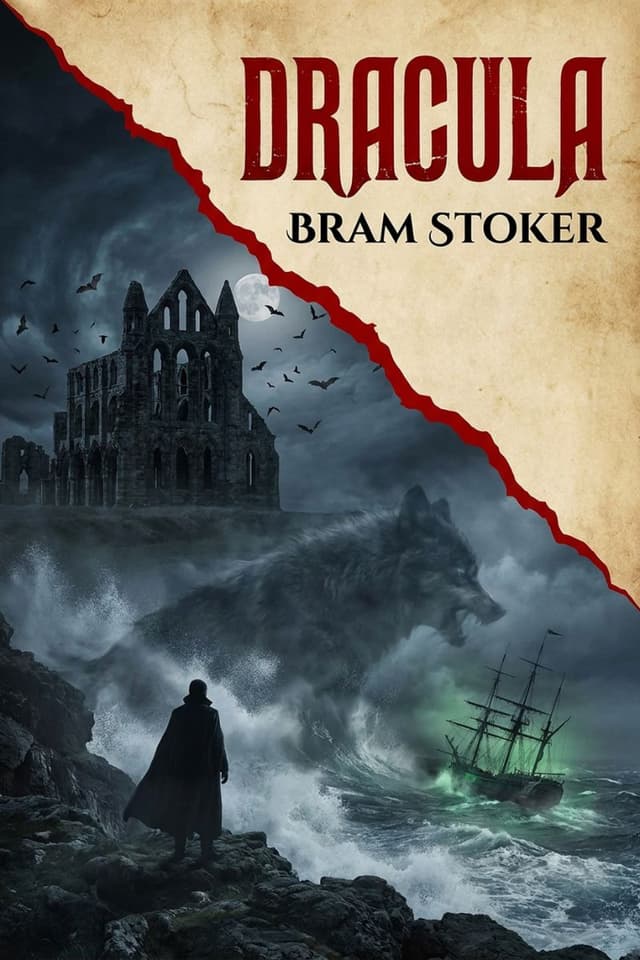
One stormy night, a Russian ship comes flying into Whitby harbor under full sail and runs aground. Its captain is dead, lashed to the wheel. The rest of the crew is gone. The only living thing aboard is an enormous dog that leaps ashore and disappears into the town. The ship's cargo is a collection of large wooden boxes filled with earth.
Something in the Night
Soon after, Lucy starts sleepwalking. She grows pale and tired for no reason anyone can find. Two tiny marks appear on her throat. Over at Dr. Seward's asylum, one of his patients, a man named Renfield who eats flies and spiders and keeps careful accounts of the lives he's consumed, becomes wildly excited, babbling about a "Master" who is coming.
Baffled, Seward sends for his old teacher from Amsterdam, Professor Abraham Van Helsing, a brilliant, eccentric doctor who takes one look at Lucy and goes very quiet. He starts filling her room with garlic flowers. He won't say why. Whatever he suspects, he's afraid that if he says it out loud, nobody will believe him, and by the time they do, it may be far too late.
About the Author: Bram Stoker
A Sickly Childhood
Abraham "Bram" Stoker was born in 1847 in Clontarf, just outside Dublin, the third of seven children. For the first seven years of his life he was so ill with a mysterious, undiagnosed condition that he could barely stand. He spent those years in bed, listening to his mother tell stories, including grim firsthand tales of the cholera epidemic she'd lived through as a girl in Sligo. Then, around the time he started school, he recovered completely, and nobody ever figured out what had been wrong with him.
Athlete, Clerk, and Critic
The boy who couldn't walk grew into a big, powerful young man. At Trinity College Dublin he became a celebrated athlete, winning prizes in weightlifting and long-distance walking, while also studying and getting involved in the university's debating societies. After graduating, he followed his father into a steady but dull job as a civil servant at Dublin Castle. He even wrote a book about it, a dry manual on the duties of court clerks.
On the side, Stoker reviewed plays for a Dublin newspaper without pay. In 1876 he wrote a glowing review of the famous English actor Henry Irving's Hamlet, and Irving asked to meet him. The two hit it off immediately, and that meeting changed Stoker's life.
Life at the Lyceum
In 1878 Stoker married Florence Balcombe, a celebrated Dublin beauty who had previously been courted by Oscar Wilde. That same year he moved to London to become business manager of Irving's Lyceum Theatre, a job he held for twenty-seven years. He handled the money, the correspondence, the tours, and Irving's enormous ego. Their son Noel was born at the end of 1879.
The Lyceum years put Stoker in the middle of London's glittering social world. He toured America with Irving's company and finally met his literary hero Walt Whitman, whom he'd written fan letters to years earlier. Somehow, in whatever spare time this exhausting job left him, he also wrote novels.
Final Years
Stoker published a dozen or so books, including The Jewel of Seven Stars and The Lair of the White Worm, but none came close to the success of his vampire novel. When Irving died in 1905, Stoker lost both his job and his closest friend. His health declined after a series of strokes, and money got tight. He died in London in April 1912, at sixty-four, with no idea of how famous his Count would become.
Fun Facts About the Book
It Was Almost Called The Un-Dead
Stoker's working title was The Un-Dead, and the typed manuscript still has it on the title page. The title was changed very late in the process. His early notes show other ideas too, including a villain named Count Wampyr.
The Name Came from a Library in Whitby
On a holiday in Whitby in 1890, Stoker was browsing the town's public library and found a history book about the regions of Wallachia and Moldavia. In it was a mention of a fifteenth-century prince called "Dracula," which Stoker noted meant "devil." He had his villain's name.
The Vlad the Impaler Debate
It's often said that the Count was based on Vlad the Impaler, the Wallachian prince who executed his enemies on stakes. Scholars are still arguing about it. Stoker borrowed the name and a few scraps of history, but his surviving working notes say nothing about Vlad's famous atrocities. The popular connection really took off in the 1970s.
Stoker Never Went to Transylvania
For all its vivid mountain scenery, the novel was researched entirely from books. Stoker spent hours at the British Museum and the London Library reading travel guides, folklore collections, and maps, and he built his Transylvania from the page.
A Real Shipwreck Gave Him the Ship
While Stoker was in Whitby, locals were still talking about the Dmitry, a Russian ship from Narva that had run aground below the East Cliff a few years earlier. He also wandered the graveyard of St Mary's Church, copying down names from the headstones to use in the book.
Over a Hundred Pages of Notes
Stoker worked on the novel for roughly seven years and filled more than a hundred pages with notes, outlines, calendars, and research. Those notes survive today at the Rosenbach Museum and Library in Philadelphia. The original typed manuscript, meanwhile, vanished for decades before turning up in Pennsylvania.
The Worst-Attended Premiere Ever
To protect his stage rights, Stoker staged a reading of the novel at the Lyceum just before publication in 1897. It ran for hours, and the audience was tiny. Henry Irving reportedly summed up the whole thing in a single word: "dreadful."
Told Entirely Through Documents
There's no narrator. The whole story is pieced together from diaries, letters, newspaper clippings, a ship's log, and recordings made on a phonograph. Readers have to assemble the truth the same way the characters do, piece by piece.
It Didn't Even Win Its Own Year
Dracula sold respectably when it came out, but another supernatural thriller published the same year, Richard Marsh's The Beetle, outsold it. Reviews were mixed too. One critic grumbled that it was a mistake to fill an entire book with horrors.
Cutting-Edge Technology
For a story about an ancient monster, the book is packed with brand-new 1890s technology: typewriters, phonograph recordings, telegrams, shorthand, and blood transfusions. Part of the fun is watching the modern world go up against something it doesn't have a name for.
Themes
The Old World Against the New
The story pits something ancient, patient, and rooted in superstition against a group of people armed with science, railway timetables, and filing systems. The book keeps asking whether modern knowledge is any match for evil that's been around for centuries, and whether the modern world has been too quick to dismiss the old warnings.
Knowledge as a Weapon
The characters can only fight what they understand, and understanding comes from sharing every scrap of information. Diaries are typed up, letters are compared, and timelines are built. The very structure of the book becomes part of the struggle.
Friendship and Loyalty
At its heart, this is a story about a group of friends who refuse to abandon each other. Doctors, lawyers, an aristocrat, a cowboy, and a schoolmistress all bring different skills, and their bond is the only real defense they have.
Faith and the Supernatural
Crucifixes, communion wafers, and old rituals carry real power in this world. The book raises big questions about whether faith and reason can work together, and Van Helsing is a man who believes in both.
Sanity and Madness
Much of the story takes place in and around an asylum, and the line between madness and truth gets very blurry. Renfield seems insane, but he may know more than anyone. Jonathan wonders if he's lost his mind. When the truth sounds crazy, how do you get anyone to believe you?
Temptation and Corruption
The Count's power is seductive as much as it's terrifying. His victims are drawn to him even as they're harmed, and the book is full of the push and pull between desire and self-control.
The Book's Legacy
It's hard to overstate how much this one novel shaped popular culture. Vampires existed in folklore and earlier fiction, but the image most people carry in their heads, the aristocratic stranger in the crumbling castle who can't cross running water and recoils from the cross, comes straight from Stoker. Count Dracula is one of the most frequently portrayed characters in film history, and the book has never gone out of print.
Its adaptation history is a story in itself. In 1922, the German film Nosferatu borrowed the plot without permission, changing the names to Count Orlok and Thomas Hutter. Stoker's widow Florence sued and won, and a court ordered every copy destroyed. A few prints survived anyway, and the film is now considered a masterpiece of silent cinema. It got another remake as recently as 2024.
The officially licensed adaptations followed, beginning with the 1931 Universal film starring Bela Lugosi, whose accent and cape defined the Count for generations. Christopher Lee took over the role in Hammer Films' run starting in 1958, and Francis Ford Coppola's lavish 1992 version brought the story back to the big screen. Stage, TV, comics, cartoons, and cereal boxes have all had their turn.
The book's influence stretches well past vampires. The Horror Writers Association's highest honors are called the Bram Stoker Awards. Whitby has built an entire tourism industry around its role in the story and hosts a twice-yearly goth festival. And because the novel is told through dated letters and diary entries, a free newsletter called Dracula Daily began sending readers each entry on the day it happens in the book, turning a 125-year-old novel into a shared, real-time reading event for hundreds of thousands of people.