Novelhalla
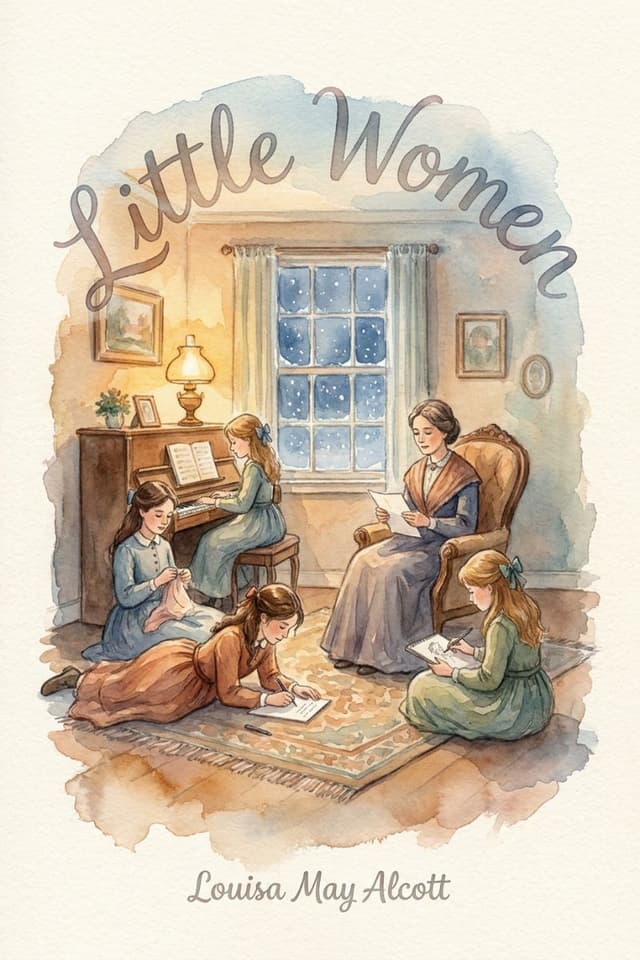
Little Women
Read Little Women by Louisa May Alcott for free on Novelhalla, and try out our easy-to-read modern edition of this classic book. You can also download the EPUB and read it on any device if you prefer!
The Plot
The story follows the four March sisters during and after the Civil War while their father is away serving as a chaplain with the Union army. The family has fallen on hard times financially, and the girls must learn to navigate adolescence with limited means but abundant love.
Meg, the eldest at sixteen, is responsible and pretty, longing for the nice things the family used to have. Jo, fifteen, is the tomboyish aspiring writer who chafes against the limitations placed on girls and women. Beth, thirteen, is gentle, shy, and devoted to her music and her family. Amy, twelve, is the youngest, artistic and vain, concerned with appearances and propriety.
Their mother, Marmee, guides the girls with wisdom and patience while managing the household in her husband's absence. She encourages them to work on their flaws, to be generous despite their poverty, and to find contentment in what they have rather than envy in what they lack.
The girls befriend their wealthy neighbor, Theodore Laurence, a lonely boy their age whom they nickname Laurie. His grandfather, old Mr. Laurence, becomes a benefactor and friend to the family, particularly to Beth, who reminds him of a granddaughter he lost. Laurie brings fun and mischief into the March household, and the sisters bring warmth into his.
Over the course of years, each sister faces her own trials and grows in her own way. Meg navigates society and romance, Jo pursues her literary ambitions while struggling with her temper and her resistance to change, Beth confronts serious illness, and Amy matures from a silly child into a thoughtful young woman. The novel traces their journey from girlhood toward adulthood.
About the Author: Louisa May Alcott
Early Life
Louisa May Alcott was born in 1832 in Germantown, Pennsylvania, the second of four daughters. Her father, Bronson Alcott, was a transcendentalist philosopher and educational reformer whose idealistic ventures repeatedly failed to support his family. The Alcotts lived in genteel poverty, moving frequently, and Louisa worked from a young age as a teacher, seamstress, and domestic servant to help with finances.
Transcendentalist Circles
The Alcott family lived at the center of American intellectual life. Ralph Waldo Emerson was a neighbor and patron, Henry David Thoreau taught the Alcott girls and took them on nature walks, and Nathaniel Hawthorne lived nearby. This environment shaped Louisa's thinking even as financial hardship shaped her determination to earn money through her pen.
Pseudonymous Thrillers
Before achieving fame with respectable fiction, Alcott wrote sensational stories and gothic thrillers under pseudonyms, producing tales of revenge, madness, and passion for the story papers. This work paid better than serious literature and allowed her to support her family. She kept this writing secret for years.
Civil War Service
Alcott served as a nurse in a Union hospital in Washington, D.C., in 1862-1863. The experience was formative but damaging. She contracted typhoid fever and was treated with mercury compounds that caused lasting health problems. Her letters home became "Hospital Sketches," which brought her first significant literary recognition.
Writing Little Women
In 1868, a publisher asked Alcott to write a book for girls. She was not enthusiastic about the project, writing in her journal that she did not enjoy that sort of story and did not know many girls besides her sisters. She drew heavily on her own family, transforming her sisters Anna, Elizabeth, and May into Meg, Beth, and Amy, and herself into Jo.
Success and Its Costs
"Little Women" was an immediate sensation. Alcott achieved financial security for the first time and became a celebrity, but success brought demands she found exhausting. Readers wanted more and more sequels, more novels for children. She obliged, producing "Good Wives," "Little Men," "Jo's Boys," and other books, but sometimes resented being trapped in a genre she had not chosen.
Later Years and Death
Alcott never married, supporting her parents and extended family with her earnings. She was active in abolition and women's suffrage movements. Her health, never fully recovered from her wartime illness, declined steadily. She died in Boston in 1888, two days after her father, at age 55.
Fun Facts About the Book
Two Parts
"Little Women" was originally published in two parts. The first part appeared in 1868 and ended with Mr. March returning home. The second part, sometimes titled "Good Wives," appeared in 1869 and followed the sisters into adulthood. Modern editions usually combine both parts into a single volume.
Autobiographical Origins
The March family closely mirrors the Alcott family. Jo is Louisa, Meg is her older sister Anna, Beth is Elizabeth (who died young just as Beth does), and Amy is May. Marmee is based on Abigail Alcott, and the absent father reflects Bronson's frequent absences pursuing his philosophical projects.
Reader Pressure
Readers who loved the first part wrote demanding to know whom the sisters would marry. Alcott was particularly pressured to have Jo marry Laurie. She refused, famously declaring that Jo would never marry Laurie even if she had to kill him off. She invented Professor Bhaer partly to frustrate readers who wanted the obvious romance.
The Title
The title was suggested by a family friend. Alcott initially wanted to call the book "The Pathetic Family," a joking reference to her own family's tendency toward drama and emotion.
Immediate Success
The first printing sold out within weeks, and Alcott was immediately commissioned to write the sequel. The book has never been out of print since its original publication.
No Copyright Protection
During Alcott's lifetime, international copyright protections were weak. "Little Women" was pirated extensively in England and elsewhere, meaning Alcott earned nothing from many foreign sales despite the book's worldwide popularity.
Real Pickwick Club
The Pickwick Club that the sisters form in the novel was based on a real club the Alcott sisters created, complete with a newspaper and dramatic productions. The family kept these childhood papers, which Alcott drew upon directly.
Jo's Writing
Jo's literary career mirrors Alcott's own, including the early production of sensational stories for money. When Jo writes blood-and-thunder tales for the newspapers, she is doing exactly what her creator did for years.
Themes
Women's Roles and Ambitions
The novel explores what paths are available to women and at what cost. Jo wants a career and independence, Meg wants domestic happiness, Amy wants artistic achievement and social position, Beth wants only to stay home. Each sister must negotiate between her desires and what society expects of women.
Poverty and Wealth
The Marches are poor but genteel, surrounded by wealthier families. The novel examines how poverty shapes choices and character, sometimes for the better. Marmee teaches the girls to be generous despite having little and to find richness in love rather than money.
Family and Sisterhood
The bond between the four sisters forms the novel's emotional core. They quarrel, compete, and sometimes wound each other, but their loyalty and love never waver. The family provides a foundation that allows each girl to venture out and grow.
Self-Improvement
Each sister has flaws she must work to overcome. Jo battles her temper, Amy her vanity, Meg her envy of wealth, Beth her excessive timidity. The novel treats character development as ongoing work rather than sudden transformation.
Domesticity and Its Value
The novel takes domestic life seriously as meaningful work. Managing a household, raising children, and creating a happy home are presented as valuable contributions, not lesser achievements than public success. This does not preclude other ambitions but exists alongside them.
Growing Up
The March sisters grow from girls into women over the course of the novel. The book captures both the excitement and the loss involved in this transition, the doors that open and the ones that close, the freedoms of adulthood and the innocence left behind.
The Book's Legacy
"Little Women" has never been out of print and has been translated into dozens of languages. It defined the American girls' novel and influenced generations of writers. Its portrait of Jo March inspired countless readers who saw themselves in her restlessness, her ambition, and her refusal to fit neatly into expected roles.
The novel has been adapted into plays, musicals, films, television series, and other media repeatedly. Major film versions appeared in 1933, 1949, 1994, and 2019, each finding new audiences and new ways to interpret Alcott's story for contemporary viewers.
Scholars have reassessed the novel over time, noting its tensions between Jo's rebellion and the conventional endings Alcott provided, between feminist impulses and domestic ideology. These tensions make the book richer rather than diminishing it, reflecting real conflicts in women's lives that persist today.