Novelhalla
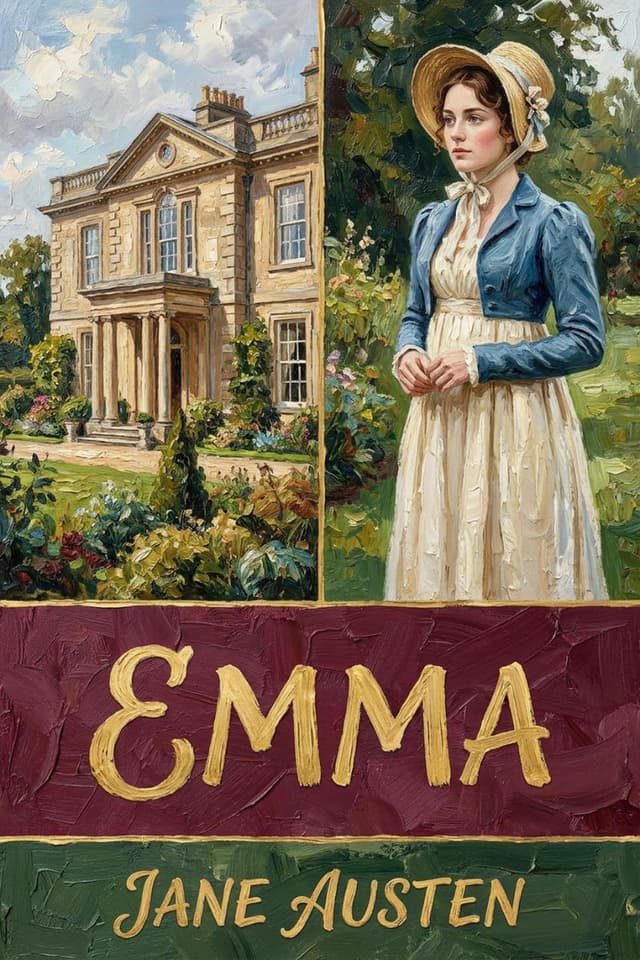
Emma
Read Emma by Jane Austen for free on Novelhalla, and try out our easy-to-read modern edition of this classic book. You can also download the EPUB and read it on any device if you prefer!
The Plot
Emma Woodhouse is twenty-one years old, beautiful, wealthy, and convinced she has a talent for matchmaking. She lives with her elderly, anxious father at Hartfield, the grandest estate in the village of Highbury. Her former governess and closest companion, Miss Taylor, has just married a local gentleman named Mr. Weston, leaving Emma without her best friend and daily confidante.
A New Project
Emma quickly finds a new project in Harriet Smith, a sweet but naive seventeen-year-old of unknown parentage who boards at the local school. Emma decides to take Harriet under her wing and improve her prospects by finding her a suitable husband.
Mr. Knightley, Emma's brother-in-law and one of the few people willing to criticize her, warns that she's meddling where she shouldn't. Emma dismisses his concerns. She knows best, after all. Didn't Miss Taylor's marriage prove her matchmaking skills?
A Village Full of Characters
Highbury is a small world, but Austen fills it with memorable people. There's the endlessly chattering Miss Bates, who can turn a story about apples into a twenty-minute monologue. Her elegant niece Jane Fairfax, whose reserved perfection irritates Emma for reasons she can't quite explain. The charming Frank Churchill, Mr. Weston's son from his first marriage, long expected to visit but always delayed. And eventually Mrs. Elton, a new arrival whose pushy social climbing and constant references to her brother-in-law's estate ("Maple Grove") make her one of Austen's most delightfully awful creations.
As these characters interact at dinners, dances, picnics, and afternoon visits, Emma keeps scheming and misreading situations. She's certain she understands everyone's secret feelings and motivations. The reader slowly realizes that Emma, for all her intelligence, is blind to what's happening right in front of her, including within her own heart.
A Comedy of Errors
The novel follows Emma through a year of social mishaps, embarrassing misunderstandings, and well-intentioned meddling that backfires. Austen balances sharp social comedy with genuine emotional stakes. Emma's mistakes aren't just funny; they have real consequences for people she cares about.
The story builds toward a series of revelations that force Emma to see how wrong she has been about nearly everything. Whether she can grow from her mistakes is the question at the novel's heart.
About the Author: Jane Austen
Early Life
Jane Austen was born in 1775 in Steventon, Hampshire, where her father was the rector. She was the seventh of eight children in a close-knit, literary family. The Austens read aloud to each other, performed plays, and encouraged Jane's early writing. She began composing stories as a teenager, producing witty parodies and short novels that she shared with her family.
A Quiet Life
Austen never married, though she accepted a proposal one evening and withdrew it the next morning. She lived with her family her entire life, first in Steventon, then in Bath after her father retired, and finally in the village of Chawton, where her brother Edward provided a cottage. It was at Chawton that she revised her early work and wrote her later novels.
She published anonymously during her lifetime, with her books credited only to "A Lady" or "the author of Pride and Prejudice." She earned modest sums from her writing but never achieved fame while alive.
Death and Legacy
Austen fell ill in 1816 and died in July 1817 at age forty-one, probably from Addison's disease. She was buried in Winchester Cathedral. Her brother Henry revealed her authorship for the first time in a biographical note published shortly after her death.
Her reputation grew steadily through the nineteenth century and exploded in the twentieth. She is now considered one of the greatest novelists in the English language, and her books have never gone out of print.
Fun Facts About the Book
Austen's Favorite
Austen famously described Emma as "a heroine whom no one but myself will much like." She was being playful but also perceptive. Emma is spoiled, snobbish, and often wrong. She's also witty, warm, and genuinely trying to do good even when she fails. Austen trusts readers to see past the flaws to the person underneath.
A Dedicated Novel
Emma was dedicated to the Prince Regent (later George IV), who was a fan of Austen's work. His librarian had hinted rather strongly that such a dedication would be welcome. Austen complied, though she privately despised the Prince for his treatment of his wife.
Box Hill Is Real
The famous picnic at Box Hill takes place at a real location in Surrey, a steep chalk hill with views across the countryside. It was a popular destination for day trips in Austen's time and remains so today. Visitors still walk the same paths Emma and her party would have taken.
The Knightley Age Gap
Mr. Knightley is thirty-seven to Emma's twenty-one, a sixteen-year age gap that he himself acknowledges. He has known her since she was a baby. Modern readers sometimes find this uncomfortable, though it was unremarkable by the standards of Austen's era.
No Physical Descriptions
Austen tells us almost nothing about what her characters look like beyond basic details. We know Emma is "handsome" and Harriet is pretty with blue eyes, but that's about it. Austen was far more interested in how people talked and thought than how they appeared.
Written Quickly
Austen began Emma in January 1814 and finished it in March 1815, writing steadily at Chawton. This was fast work for a novel of its complexity. She revised carefully, and the plotting is remarkably tight given how many characters and subplots she juggles.
Clueless
The 1995 film Clueless, directed by Amy Heckerling and starring Alicia Silverstone, is a loose adaptation of Emma set in a Beverly Hills high school. Cher Horowitz is Emma, and the story beats match up surprisingly well. It's now considered a classic in its own right.
Themes
Self-Knowledge
Emma thinks she understands herself and everyone around her. She doesn't. The novel tracks her slow, painful awakening to her own blindness. Austen suggests that intelligence without self-awareness is dangerous, and that true wisdom requires humility.
Class and Social Mobility
Highbury is rigidly stratified by wealth and birth. Emma's attempts to raise Harriet above her station and her horror at certain matches reveal how deeply class consciousness runs, even in a kind person. Austen observes these snobberies without quite condemning them.
The Limits of a Small World
Almost everything happens within walking distance. The confinement mirrors Emma's limited perspective. She thinks she sees everything in Highbury, but her narrow world has also made her narrow. Characters who have traveled, like Jane Fairfax, see things Emma cannot.
Marriage as Economics
Every marriage in the novel involves practical calculations about money and status. Love matters, but so do income and social position. Austen treats this matter-of-factly. This was simply the reality for women who couldn't earn their own living.
The Danger of Imagination
Emma's imagination runs away with her constantly. She invents romances, suspects secrets, and builds elaborate theories, almost all of them wrong. Austen shows how imagination without evidence leads to trouble.
The Book's Legacy
Emma is often considered Austen's most technically perfect novel. The plotting is intricate, the comedy is sharp, and the emotional payoff is earned. Austen limits the perspective almost entirely to Emma's point of view, making the reader complicit in her misreadings.
The novel pioneered a kind of intimate irony that influenced countless later writers. We see Emma's thoughts, but Austen lets us glimpse what Emma herself cannot see. This gap between Emma's understanding and the reader's creates much of the novel's comedy and suspense.
Emma remains endlessly adaptable. Beyond Clueless, there have been multiple film versions, television adaptations, and modern retellings. The story of a smart, privileged young woman who needs to learn she's not as smart as she thinks turns out to be timeless.