Novelhalla
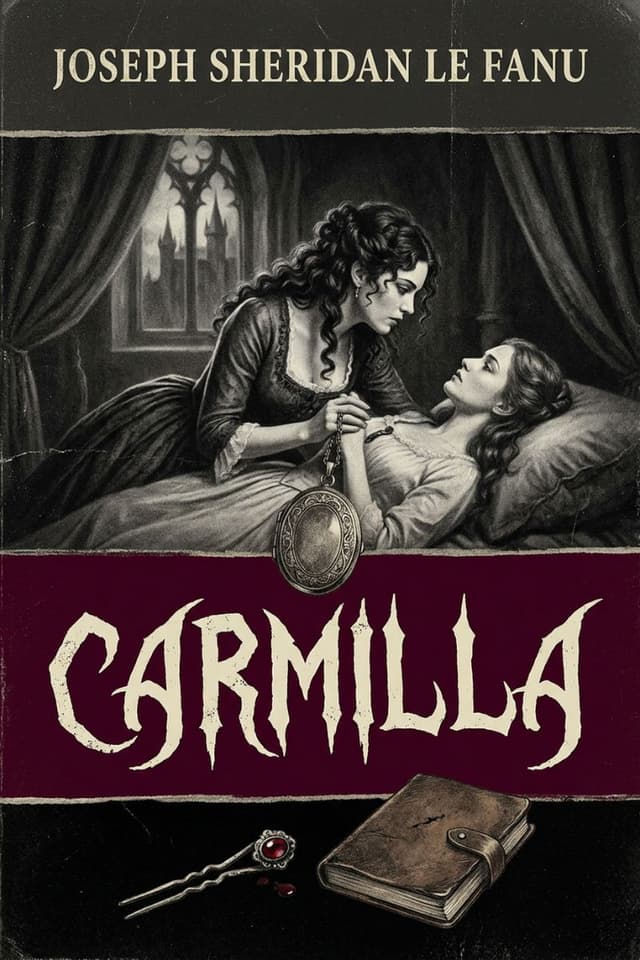
Carmilla
Read Carmilla by Joseph Sheridan Le Fanu for free on Novelhalla, and try out our easy-to-read modern edition of this classic book. You can also download the EPUB and read it on any device if you prefer!
The Plot
Laura is a lonely young woman living in a remote castle in the Austrian countryside with her father, a wealthy English widower. She has few companions her own age and spends her days in quiet isolation, surrounded by servants and the vast, empty forests of Styria.
A Childhood Memory
Laura recalls a strange experience from when she was six years old. She woke in the night to find a beautiful young woman in her bed, soothing her. She felt a sensation like two needles piercing her breast, cried out, and the figure vanished. The servants found no one, and the incident was dismissed as a dream. But Laura never forgot the face.
The Carriage Accident
Years later, when Laura is nineteen, a carriage accident occurs just outside the castle. A mysterious noblewoman is traveling with her daughter, and the crash injures the horses and throws the carriage. The mother claims she is on an urgent journey that cannot be delayed but asks if her daughter might stay at the castle to recover. Laura's father agrees, and the daughter is carried inside.
Her name is Carmilla. She is beautiful, languid, and strangely familiar. When Laura sees her face, she realizes with a shock that this is the same woman from her childhood dream. Carmilla recognizes Laura too, claiming to have had the same vision. They are drawn to each other immediately, with an intensity that puzzles Laura.
An Unusual Friendship
Carmilla becomes Laura's constant companion, but she is odd in ways Laura cannot explain. She sleeps late into the day, sometimes past one in the afternoon. She never joins the household for prayers. She refuses to share anything about her family or background, deflecting every question with playful evasions. She is given to strange moods, sometimes distant and melancholy, other times overwhelmingly affectionate, speaking to Laura with the passion of a lover.
Laura finds herself both drawn to and disturbed by Carmilla. The intensity of her friend's devotion is flattering but also suffocating. And there is something else: Laura begins to have troubling dreams. She feels a presence in her room at night. She grows pale and weak, though no doctor can explain why.
The Spreading Illness
Meanwhile, a mysterious plague is spreading through the nearby villages. Young women are dying, one after another, wasting away from an illness no one can diagnose. Funerals become common. The peasants whisper of an old evil returning to the land.
Laura's father grows concerned about his daughter's declining health. Doctors are summoned but remain baffled. Laura experiences strange nocturnal visitations, a sensation of something at her throat, and dreams of a large cat-like creature in her room. She tells no one the full extent of what she experiences.
Revelations
A family friend, General Spielsdorf, arrives with a terrible story. His own niece recently died of the same wasting illness, and he has discovered the horrifying truth of what killed her. He has come seeking vengeance against a creature he tracked to this very region.
The General's story begins to illuminate what Carmilla truly is and what she wants from Laura. Old documents are consulted. A mysterious portrait is examined. A ruined chapel in the forest holds secrets that have waited for over a century.
The novella builds to a confrontation with an evil that has preyed on young women for generations, hiding in plain sight, exploiting loneliness and desire.
About the Author: Joseph Sheridan Le Fanu
Anglo-Irish Origins
Joseph Thomas Sheridan Le Fanu was born in Dublin in 1814 into a literary and ecclesiastical Anglo-Irish family. His grandmother was the sister of the playwright Richard Brinsley Sheridan. His father was a Church of Ireland clergyman. Le Fanu grew up in comfortable circumstances, educated at Trinity College Dublin, where he studied law.
Journalism and Early Writing
Le Fanu was called to the bar but never practiced law, turning instead to journalism. He bought several Dublin newspapers and wrote prolifically, producing stories and serialized novels while managing his publications. His early ghost stories appeared in Dublin magazines in the 1830s and 1840s, establishing him as a master of the form.
Personal Tragedy
Le Fanu married Susanna Bennett in 1844, and they had four children. The marriage was happy, but Susanna suffered from anxiety and depression. She died in 1858 after what may have been a breakdown, leaving Le Fanu devastated. He became increasingly reclusive, rarely leaving his house on Merrion Square, writing through the night and sleeping during the day.
The Invisible Prince
After his wife's death, Le Fanu was nicknamed "The Invisible Prince" for his hermit-like existence. He wrote his best work during this period of seclusion, including the novels Uncle Silas and The House by the Churchyard, and the story collection In a Glass Darkly, which contains Carmilla.
Death
Le Fanu died in 1873 at fifty-eight. He had been troubled by recurring nightmares of a crumbling old house that was about to fall on him. His doctor reportedly said after his death, "I feared this. That house has fallen at last."
Fun Facts About the Book
Predates Dracula
Carmilla was published in 1872, twenty-five years before Bram Stoker's Dracula appeared in 1897. Stoker knew Le Fanu's work and was influenced by it. Many elements that became standard vampire lore, like the connection between vampire and victim, the wasting illness, and the staking and decapitation, appear in Carmilla first.
Part of a Collection
Carmilla was originally published as part of In a Glass Darkly, a collection of five stories framed as cases from the papers of Dr. Martin Hesselius, a German physician who investigates supernatural phenomena. Hesselius is sometimes considered an early example of the occult detective, predating similar characters by decades.
The Lesbian Subtext
Carmilla's attraction to Laura is barely subtext at all. The vampire's declarations of love, her physical affection, her jealousy, and her predatory desire are explicitly romantic and erotic. Victorian readers would have recognized this, even if it went officially unspoken. The story has become an important text in queer literary history.
Real Geography, Unreal Events
Le Fanu sets the story in Styria, a real region of Austria, and references actual locations like Graz. The specificity of the setting grounds the supernatural events in a recognizable world, a technique that Gothic writers used to heighten the horror of the impossible.
Influence on Film
Carmilla has been adapted for film many times, often loosely. The Hammer horror film The Vampire Lovers (1970) is a fairly faithful adaptation. The story has also influenced countless other vampire films, particularly those exploring female vampires and queer themes.
The Name
The name Carmilla is an anagram of sorts. Within the story, we learn that the vampire has used variations of the same name across centuries: Mircalla, Millarca, Carmilla. All are rearrangements of the same letters, suggesting an identity that shifts but cannot fully disguise itself.
A Frame Narrative
The story is presented as a manuscript written by Laura herself, years after the events, sent to Dr. Hesselius. This frame creates an interesting effect: Laura survived, so there's no suspense about her fate, but the horror lies in the telling, in watching her slowly realize what is happening to her.
Themes
Desire and Danger
Carmilla blurs the line between love and predation. The vampire's affection for Laura seems genuine, even as it kills her. The story suggests that desire itself can be dangerous, that intimacy can be a kind of consumption. Laura is drawn to Carmilla even as she senses something wrong.
Female Sexuality
Victorian literature rarely depicted female desire so openly. Carmilla's passionate declarations to Laura, her physical caresses, her jealousy of others, all read as erotic. The story can be read as an exploration of forbidden desire, with vampirism as a metaphor for sexuality that society cannot acknowledge.
Isolation and Vulnerability
Laura's loneliness makes her prey. She has no friends her own age, no mother, and limited contact with the outside world. When Carmilla arrives, Laura's hunger for companionship overwhelms her instinct for caution. The story suggests that isolation is dangerous, that we need connection but can be destroyed by the wrong kind.
The Returning Past
Carmilla is ancient, tied to a ruined chapel and a family tomb that have waited for generations. The past in Gothic fiction is never safely buried. Old sins, old evils, old secrets always return. Laura's modern, rational world proves thin protection against something that has haunted these forests for centuries.
The Unreliable Body
Laura's illness manifests as weakness, pallor, strange dreams, and marks on her skin. Her body knows something is wrong before her mind can accept it. The story taps into anxieties about illness, about bodies that betray us, about diseases that waste us from within while doctors stand helpless.
The Book's Legacy
Carmilla is foundational to vampire fiction. It established conventions that Stoker and countless later writers would adopt: the aristocratic vampire, the blood-drinking as intimacy, the connection between vampire and victim, the old documents that reveal the monster's history, the staking and destruction of the undead.
The story's queer dimensions have made it increasingly important to modern readers. Carmilla offers a rare Victorian depiction of desire between women, even if that desire is coded as monstrous. Contemporary adaptations often foreground this element, reclaiming Carmilla as a queer icon rather than a villain.
Le Fanu's influence extends beyond vampires. His technique of suggesting horror rather than showing it directly, of creating dread through atmosphere and implication, shaped the ghost story tradition that M.R. James and others would develop. He understood that what we imagine is often more frightening than what we see.
For a novella of fewer than a hundred pages, Carmilla casts a remarkably long shadow. It remains genuinely creepy, surprisingly modern in its psychology, and endlessly adaptable. The lonely girl in the castle and the beautiful stranger who comes to prey on her have become archetypes that horror fiction returns to again and again.