Novelhalla
A Tale of Two Cities
Read A Tale of Two Cities by Charles Dickens for free on Novelhalla, and try out our easy-to-read modern edition of this classic book. You can also download the EPUB and read it on any device if you prefer!
The Plot
Recalled to Life
It's 1775, and a mail coach is crawling through the mud and fog toward Dover. On board is Jarvis Lorry, a buttoned-up employee of Tellson's Bank who insists he's nothing more than a man of business. A rider gallops out of the dark with a message for him, and Lorry sends back a reply so strange that the messenger thinks he's lost his mind: "Recalled to life."
In Dover, Lorry meets Lucie Manette, a young woman raised in England as an orphan. He has to tell her something she's spent her whole life not knowing. Her father, a respected French doctor, didn't die when she was a baby. He vanished into the Bastille without trial or explanation and has been locked away for eighteen years. Now he's been released, and Lucie is going to Paris to bring him home.
The Wine Shop in Saint Antoine
They find Dr. Manette in a dark garret above a wine shop in one of the poorest neighborhoods in Paris. He doesn't know his own daughter. He sits at a bench making shoes, a skill he learned in prison, and when asked his name, he answers with his old cell number: One Hundred and Five, North Tower.
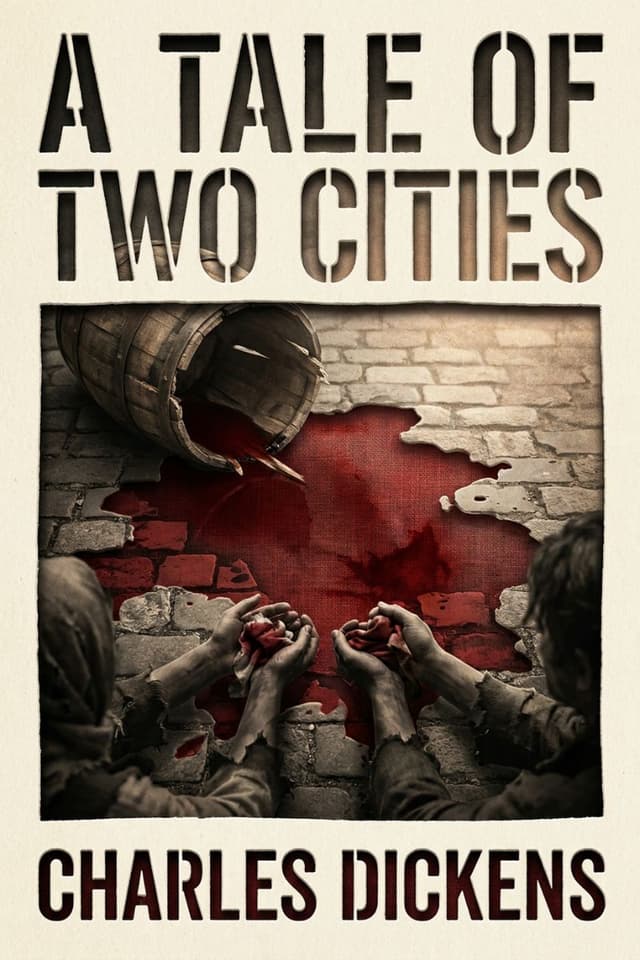
The wine shop belongs to Monsieur Defarge, who once served the doctor and seems to have reasons of his own for keeping him hidden. His wife, Madame Defarge, sits behind the counter, quiet and watchful, knitting constantly. Outside, a cask of wine has burst in the street, and the starving neighbors scramble to drink it from the cobblestones. One of them dips his finger in the red puddle and scrawls a single word on the wall: BLOOD.
A Trial in London
Five years later, a young Frenchman named Charles Darnay stands in the dock at the Old Bailey, accused of spying for France. The penalty is a gruesome execution, and the crowd has come hoping to see one. Lucie and her father are among the reluctant witnesses.
The defense has a secret weapon it barely knows it has: Sydney Carton, a brilliant, lazy, perpetually half-drunk lawyer who does all the real work for his flashy colleague and gets none of the credit. Carton spends most of the trial staring at the ceiling. But he's noticed something the rest of the courtroom hasn't. He and the prisoner look almost exactly alike.
The Golden Thread
Lucie becomes the center of a small, warm circle in a quiet corner of London. Her father slowly comes back to himself, though some memories still send him back to his shoemaker's bench. Darnay comes to visit. So does Carton, who is everything Darnay isn't: bitter, wasted, and convinced he's thrown his life away. Both men love Lucie, and neither is sure what that love is worth.
And Darnay is carrying a secret. He's walked away from a name, a family, and a fortune in France, and he won't say why. Dr. Manette seems to sense something about it, and it frightens him.
The Storm Gathers
Across the Channel, the aristocracy is still riding roughshod over the poor. A haughty Marquis runs down a child with his carriage and tosses a coin to the grieving father. The Defarges and their friends, who all go by the name Jacques, are keeping lists. Madame Defarge is knitting names into her work in a code only she can read, and every name is someone the revolution will remember.
Then the Bastille falls, and France explodes. Years later, a desperate letter arrives at Tellson's Bank in London, begging for help from someone trapped in Paris. Answering it means crossing into a country where a single accusation can send a man to the guillotine. Someone in Lucie's circle is about to be pulled back into France, and once the knitting needles start clicking, nobody is safe.
About the Author: Charles Dickens
A Childhood Cut Short
Charles Dickens was born in 1812 in Portsmouth, the second of eight children. His father was a navy clerk who was charming, generous, and hopeless with money. When Charles was twelve, his father was thrown into the Marshalsea debtors' prison, and the rest of the family joined him there, as was the custom.
Charles was sent to work in a rat-infested blacking warehouse, gluing labels onto pots of boot polish for long hours and little pay. It only lasted a few months, but it marked him for life. He kept it a secret from almost everyone, including his own children, and the injustice he felt as a boy shows up again and again in his books.
From Reporter to Phenomenon
After a bit more schooling, Dickens worked as a clerk in a law office, taught himself shorthand, and became a fast and sharp-eyed reporter covering Parliament. He started publishing humorous sketches of London life under the pen name "Boz," and in 1836, at twenty-four, he began The Pickwick Papers. It became a national craze. That same year he married Catherine Hogarth, with whom he eventually had ten children.
What followed was one of the most astonishing runs in literary history: Oliver Twist, Nicholas Nickleby, The Old Curiosity Shop, A Christmas Carol, David Copperfield, Bleak House, and more. Most were published in monthly or weekly installments, so readers followed his stories the way people follow a TV series today.
The Restless Middle Years
Dickens was a whirlwind. He edited magazines, ran charities, toured America, and staged amateur plays with friends. In 1857, while acting in The Frozen Deep, a play by his friend Wilkie Collins, he met a young actress named Ellen Ternan. His marriage, already unhappy, fell apart the following year, and Dickens and Catherine separated. Around the same time, a quarrel with his publishers led him to launch his own magazine, All the Year Round, and this novel was the first thing he ran in it.
Final Years
In his later years Dickens threw himself into public readings of his work, performing with such intensity that audiences fainted and his health suffered. In 1865 he survived a serious railway crash at Staplehurst, and he never fully got over it. He died in June 1870, at fifty-eight, at his home at Gad's Hill in Kent, leaving his final novel, The Mystery of Edwin Drood, unfinished. He was buried in Westminster Abbey's Poets' Corner, and the public filed past his grave for days.
Fun Facts About the Book
Born on the Stage
Dickens said the main idea for the novel came to him while he was acting in The Frozen Deep in 1857. He was so absorbed in his role that audiences and fellow actors were moved to tears night after night, and he wanted to capture that same intensity in a story.
A Name Borrowed from the Play
Ellen Ternan's small role in The Frozen Deep was a character named Lucy. Readers have long noticed the echo in the novel's heroine, Lucie Manette.
He Lived Inside Carlyle
Dickens leaned heavily on his friend Thomas Carlyle's history The French Revolution, and he reportedly claimed to have read it five hundred times. The story goes that when Dickens asked Carlyle for research material, Carlyle had a load of books sent over from the London Library. While writing, Dickens said he read nothing but books that had the air of the period in them.
One of His Only Historical Novels
Dickens almost always wrote about his own time. This novel and Barnaby Rudge are his only two historical novels. Scholars often call it the "least Dickensian" of his books because it has fewer comic characters and side plots than usual and moves at a much faster clip.
Weekly Deadlines
The novel ran in thirty-one weekly installments from April to November 1859. Dickens had to write short, punchy chapters that ended on hooks, which is part of why the story moves like a thriller. He found it hard to get started, then wrote that he hoped it was the best story he'd ever written.
The Mirror-Image Initials
Charles Darnay and Sydney Carton look alike, and their names are built to match. Darnay shares Dickens's own initials, C.D., and Carton's name was reportedly first planned as Dick Carton, giving D.C. The two men are reflections of each other in more ways than one.
That First Line
The opening sentence, which begins "It was the best of times, it was the worst of times," is one of the most quoted lines in English literature. Most people don't realize it keeps going for a long, winding paragraph of contradictions.
A Bestseller for the Ages
The novel is often listed among the best-selling novels of all time, with claims running as high as 200 million copies. Nobody can verify a number like that for a book this old, but it has never stopped selling.
Historical Context
The novel stretches from 1775 to the bloodiest years of the French Revolution in the early 1790s. In the decades before the revolution, French peasants were crushed by taxes, hunger, and the privileges of a nobility that answered to almost no one. People could be locked away indefinitely without trial through royal orders called lettres de cachet, which is exactly the kind of fate that swallows Dr. Manette.
The storming of the Bastille in July 1789 kicked off a revolution that began with hopes of liberty and slid into the Reign of Terror, when revolutionary tribunals sent thousands to the guillotine on flimsy evidence. Knowing that the mood in Paris swung from celebration to paranoia makes the stakes for anyone with the wrong name or the wrong family feel very real.
Themes
Resurrection
The phrase "recalled to life" echoes throughout the novel. Dr. Manette is brought back from a living death in prison, but he isn't the only one. Nearly every major character faces the question of whether a wasted or broken life can be made new again.
Sacrifice and Love
The novel is full of people giving things up for someone else: comfort, safety, reputation, fortune. It asks what love demands of us and how far a person might go for someone they care about.
The Cycle of Oppression and Revenge
Dickens shows the cruelty of the French aristocracy in brutal detail, and he clearly sympathizes with the starving poor. But he also shows what happens when the oppressed get power and revenge takes over. The novel suggests that injustice breeds more injustice, and that a mob can be just as merciless as a tyrant.
Doubles and Duality
The title itself sets up pairs: London and Paris, peace and chaos, two men who look alike but live opposite lives. The book keeps holding up mirrors and asking how different people's choices really make them.
Imprisonment
Prisons are everywhere in the story, from the Bastille to the Old Bailey to the prison of the mind that Dr. Manette can't escape. Carton is trapped by his own despair. The novel asks what it takes for anyone to truly get free.
Fate and History
Personal stories get caught up in forces much bigger than any one person. Madame Defarge's knitting feels like fate itself being woven, and the characters spend the novel wondering whether they can escape what history has in store for them.
The Book's Legacy
The novel is one of the most widely read books Dickens ever wrote, and for generations it was a standard in schools across the English-speaking world. Its opening line is so famous it's been parodied, borrowed, and quoted in everything from newspaper headlines to cartoons. Madame Defarge, quietly knitting a list of the condemned, became one of literature's great villains and a shorthand for cold, patient vengeance.
The story has been adapted many times. The 1935 film starring Ronald Colman is still considered a classic, and the 1958 British version starred Dirk Bogarde. There have been TV miniseries, radio dramas, stage plays, a 2008 Broadway musical, and even an opera. Sydney Carton became one of the defining roles for actors drawn to brilliant, self-destructive heroes.
The novel also shaped how English-speaking readers pictured the French Revolution for more than a century: the tumbrils rattling through the streets, the knitting women by the guillotine, the crowds roaring for blood. Historians argue about how fair that picture is, but it's hard to deny its power.
Above all, the book has lasted because of its characters, especially Sydney Carton, the man everyone has written off, including himself. Readers keep coming back to him because his story asks a question almost everyone has wondered about at some point: is it ever too late to make your life mean something?